


Cocoa Beach Waterfront Real Estate in 2026: Are Prices Still Rising, and What That Means for You
Cocoa Beach real estate combines beach-town lifestyle, oceanfront and canal-front homes, condos, vacation property considerations, surfing culture, Port Canaveral access, and Space Coast relocation appeal. This hub collects Carrie Liotta’s local guidance on Cocoa Beach homes, condos, waterfront living, investment questions, insurance, schools, lifestyle tradeoffs, and what buyers and sellers should understand before making a move.

The Boater’s Guide to Buying Canal-Front in Cocoa Beach: What the Listing Never Tells You | Carrie Liotta, Trusted Space Coast Realtor
Boater’s Guide to Buying Canal-Front in Cocoa Beach: There’s a version of the canal-front purchase that goes the way it should: seawall is solid, dock infrastructure is functional, water depth accommodates your vessel, and you’re on the water in 90 days. That version happens all the time. It happens when buyers come in knowing what they’re actually evaluating — not just what a listing photograph shows. Then there’s the version where someone falls in love with a canal-front home, waives contingencies in a competitive situation, closes, and discovers six months later that the seawall needs $65,000 in repair and the boat lift is undersized for their center console. That version also happens. More than it should. This is a practical guide for buyers who want the first version. “Carrie is very knowledgeable concerning Brevard County realty. She goes the extra mile to give her clients a great experience — I highly recommend her.” — Brevard County Buyer Why Canal-Front Real Estate Is a Different Kind of Purchase | Boater’s Guide to Buying Canal-Front in Cocoa Beach Cocoa Beach sits on a barrier island between the Atlantic Ocean and the Banana River, and the canal systems running through its residential neighborhoods — Cocoa Isles primarily — are navigable waterways with direct Intracoastal access. This is not decorative water. It’s functional, working infrastructure that your actual lifestyle depends on. Most of these neighborhoods were developed in the 1960s and 1970s when Kennedy Space Center was drawing engineers and scientists to Brevard County. The homes reflect that era — solid construction, updated multiple times over the decades — on lots designed to maximize dock access. What this means practically: you’re buying a home with aging marine infrastructure that may be excellent or may be approaching the end of its useful life. Knowing which before you close is the entire job. The Due Diligence Framework: What to Evaluate Before You Commit 1. Seawall Condition and Generation The seawall is the retaining structure that separates your property from the canal. It holds the soil, prevents erosion, and serves as the foundation for your dock. Seawalls in Cocoa Isles are mostly concrete block or panel construction installed during original neighborhood development — which means most are now 50+ years old. The generational breakdown matters: First-generation seawalls (1960s) are approaching end of life — prepare for $80,000 to $100,000+ in replacement costs. Second-generation (2000s) have 10–20 years remaining. Brand-new seawalls offer decades of worry-free use. Always request a specialized seawall inspection from a licensed marine contractor — not a general home inspector, who typically lacks the training to evaluate marine infrastructure adequately. 2. Water Depth and Navigation Clearance Not every canal in Cocoa Beach accommodates every boat. Depth varies by canal and shifts over time due to silting. Before committing to a property, confirm the actual water depth at the dock at low tide — not high tide — and verify there are no low bridges or shallow sections between the property and open water. If you’re running a boat with a 3-foot draft, a canal that averages 4 feet at low tide is a problem you want to know about before closing. 3. Bridge Heights — The Question Nobody Asks Until It’s Too Late This is Carrie Liotta’s signature topic for a reason. The Cocoa Beach canal system has multiple fixed and swing bridges, and not every boat fits under every bridge. A buyer with a vessel that has a fixed hardtop above 11 feet will be blocked from certain canals entirely — a fact that is not visible in any listing and not in any MLS data. Before identifying your target neighborhood, know your boat’s air draft (height above the waterline) and confirm the fixed clearance of every bridge between the property and open water. Swing bridges offer more flexibility but operate on schedules that affect access timing. This is the kind of waterfront logistics knowledge that separates a real waterfront specialist from an agent who has simply sold homes near the water. “Let me show you on the map. Here’s where the bridges are, here’s the clearance, here’s what boats can and can’t go where. Let’s eliminate the wrong homes first so the right ones feel obvious.” 4. Dock Infrastructure and Boat Lift Capacity Evaluate dock age and material (composite or aluminum outlasts wood significantly in Florida’s marine environment), boat lift rated capacity versus your actual boat weight (not boat length — actual weight), electrical service to the dock (must be permitted and up to code), and cleating configuration. Upgrading dock infrastructure runs $15,000 to $40,000+ depending on scope. Know this before making your offer. 5. Flood Zone and Insurance Reality Virtually all of Cocoa Beach is in a Special Flood Hazard Area. For canal-front properties, flood insurance is mandatory for any federally backed mortgage. Annual flood insurance costs range from $3,000 to $8,000+ depending on elevation certificate data and coverage levels. Request the current elevation certificate from the seller before making an offer, then run it through a flood insurance specialist — not your general insurance agent — for an accurate cost estimate. Flood insurance does not cover dock structures, boat lifts, or your vessel. Those require separate marine insurance. Factor both into your total annual cost-of-ownership calculation. “Having moved from out of state, buying my dream home would not have been possible without Carrie Liotta! She knows the Space Coast inside and out and guided me through every step, negotiating an incredible deal. Hands down, the best Realtor in this area!” — Out-of-State Relocation Buyer, Melbourne, FL Current Price Ranges for Canal-Front Homes in Cocoa Beach (Early 2026) The market has bifurcated clearly between move-in-ready properties with solid infrastructure and value-play homes that need work. Here’s where things stand: Property Profile Price Range (2026) Key Characteristics Entry-level canal-front $650K–$800K Older home; dock present but verify; seawall inspection critical Mid-range updated $800K–$1.1M Updated interior; functional boat lift; verified seawall; 3–4 beds Premium canal-front $1.1M–$1.5M Fully renovated; deep water; newer dock/lift; pool; premium lot Luxury river or canal estate $1.5M–$2.5M+ Significant frontage; deep water;
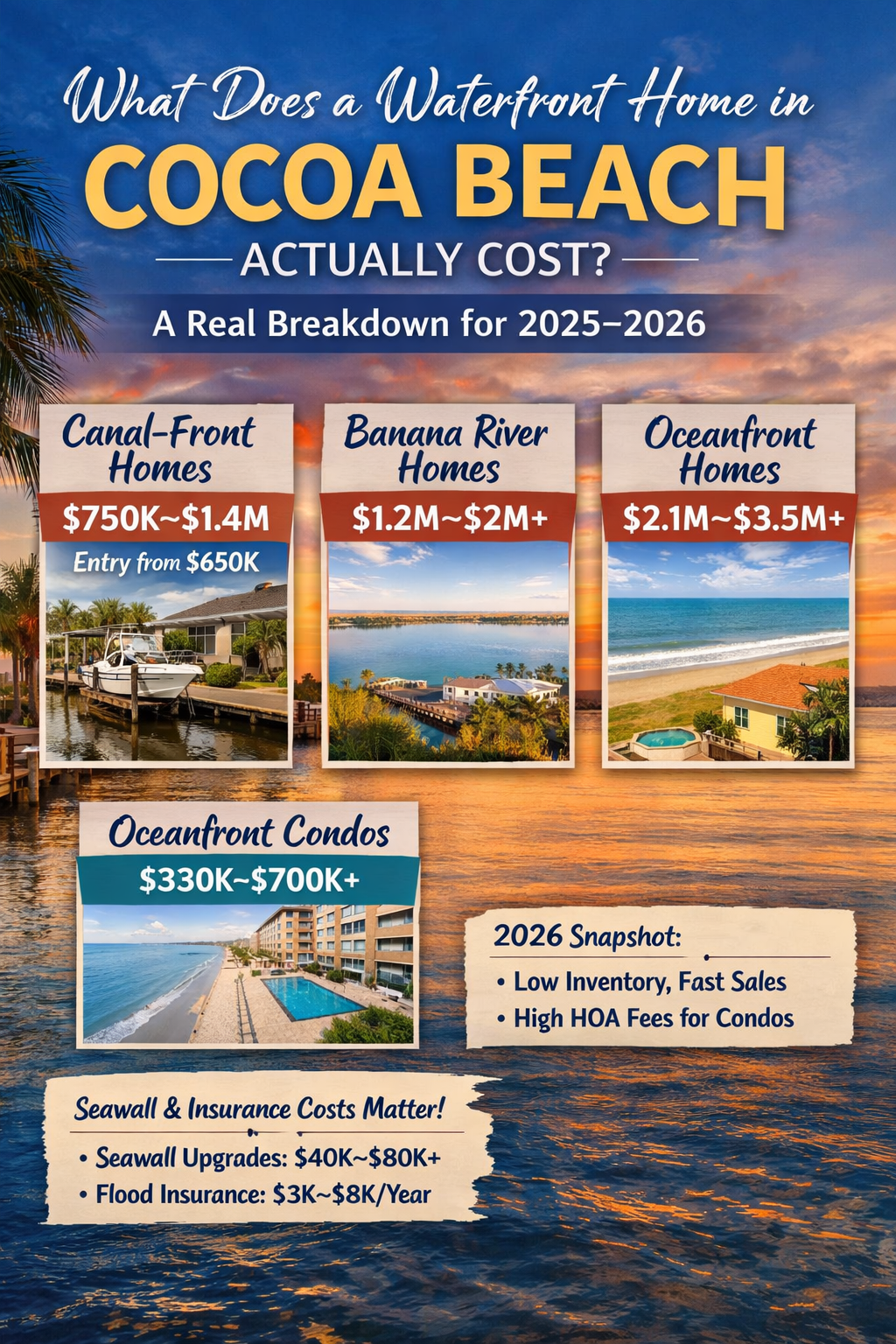
What Does a Waterfront Home in Cocoa Beach Actually Cost? A Real Breakdown for 2025–2026
Waterfront Home in Cocoa Beach: Every few weeks, someone reaches out after hours of online research, frustrated and no closer to an answer: ‘How much do waterfront homes in Cocoa Beach actually go for?’ What they’ve found is a wide, meaningless price range, a few Zillow estimates with no context, and articles that treat all waterfront as interchangeable. It isn’t. And if you’re planning to spend $600,000 to $1 million — or more — on a waterfront property on Florida’s Space Coast, that distinction matters enormously. This is a specific, honest breakdown of waterfront pricing in Cocoa Beach in 2025–2026, written for buyers who are ready to understand the market before committing serious money. The kind of buyer who wants to know what they’re getting into — not just what a listing says. First, Let’s Clarify What ‘Waterfront’ Means in Cocoa Beach Cocoa Beach sits on a barrier island between the Atlantic Ocean and the Banana River. That geography creates several distinct types of waterfront property — and they serve completely different lifestyles at very different price points. Treating them as a single category produces meaningless numbers. Canal-Front Homes — The Boater’s Choice Canal-front properties sit in residential neighborhoods — Cocoa Isles being the most prominent — where homes back up to navigable waterways with direct access to the Banana River and Intracoastal. These are working waterfront homes. You dock your boat behind the house. Dolphins show up for breakfast. Manatees drift past on a Tuesday morning. In early 2026, well-maintained canal-front single-family homes are trading in the $750,000 to $1.4 million range. A solid 3-bedroom with a functional boat lift on a navigable canal realistically lands between $850,000 and $1.1 million. Entry-level properties with deferred maintenance can start closer to $650,000 — but those numbers carry hidden costs we’ll discuss shortly. The most important thing buyers miss: seawall condition is everything. Canal-front homes built in the 1960s and 70s — the majority of Cocoa Isles — have seawalls approaching 50+ years of age. Replacement costs run $40,000 to $80,000 or more depending on linear footage. That cost needs to be priced into any offer. “Carrie Liotta made buying my waterfront home in Cocoa Beach an incredible experience! She’s truly a Cocoa Beach waterfront property expert and knows the local market inside and out.” — Verified Buyer, Cocoa Beach Waterfront Home Riverfront and Banana River Properties Riverfront homes along the Banana River offer broader water views, more privacy, and a quieter lifestyle than canal-front. These appeal to buyers who want the waterfront experience — sunsets on the water, wildlife at the dock, the smell of salt air — without necessarily operating a large vessel. Pricing in this segment typically runs slightly above comparable canal-front homes, with premium lots at $1.2 million to $2 million or more depending on frontage. Oceanfront — The Scarcest Asset on the Island Oceanfront single-family homes on A1A represent the top of the Cocoa Beach market by almost any measure. Active listings in early 2026 run from $2.1 million into the low $3.5 million range. These are not trading homes. They are generational assets — the kind of property that is genuinely impossible to recreate because the land to build on simply doesn’t exist. Oceanfront condos are a more accessible entry point. Current market data shows most oceanfront condo units in Cocoa Beach trading between $330,000 and $600,000, with luxury new-construction product (like The Surf development near Minuteman Causeway) pushing above $700,000. Condo prices have softened 7-8% from their 2022 peak — a genuine opportunity for buyers who understand how to evaluate building financial health. “The waterfront market in Cocoa Beach is not one market. It’s three overlapping ecosystems, each with different buyers, different risk profiles, and different pricing logic. Let’s eliminate the wrong ones first so the right ones feel obvious.” Canal-Front vs. Oceanfront Condos: A Real Comparison The question most buyers ask — canal-front or oceanfront? — is really a lifestyle question disguised as a price question. Here is an honest comparison across the factors that actually drive long-term satisfaction: Factor Canal-Front Home Oceanfront Condo Oceanfront Single-Family Typical Price Range (2026) $650K–$1.4M $330K–$700K+ $2.1M–$3.5M+ Boating Access Direct — dock at your door Limited or none Beach access; no dock Monthly HOA Fees None to minimal $600–$1,500+ None to minimal Insurance Complexity Flood + standard Flood + wind + condo master Flood + wind (highest) Days on Market (avg) 24–45 days 100+ days 24–45 days Best Fit For Active boaters, families Part-time owners, investors Legacy/luxury buyers Appreciation Trend Strong (+17–21% YOY) Moderating (correction phase) Very strong; extreme scarcity What the Market Is Actually Doing Right Now For single-family waterfront homes: it’s a seller’s market. Inventory is at historic lows — approximately 52 single-family homes are currently listed across all of Cocoa Beach. Sales volume is up 25% year-over-year. Homes in good condition at realistic prices are moving in 24 to 45 days. This is not a market where hesitation is rewarded. For oceanfront condos: buyers have leverage they haven’t had in years. Prices are down 7–8% from peak. Days on market have extended to 100+ days. Sellers are willing to negotiate. The catch is that post-Surfside legislation requires buyers to carefully evaluate building reserve adequacy, milestone inspection status, and HOA financial health before committing. “Carrie is a true professional and an absolute powerhouse — she got our house sold! The photography, video tour, and social media outreach were outstanding, leading to multiple offers in a down market.” — Cocoa, FL Home Seller, Summer 2025 The Neighborhoods That Define Waterfront Living Cocoa Isles — The Premier Boating Community Canal-front homes on navigable waterways with direct Banana River access. This is the classic Space Coast boating lifestyle — dock out back, boat lift ready, dolphins at breakfast. Well-maintained homes with functional dock infrastructure: $800,000–$1.4 million. South Cocoa Beach / Yacht Haven Quieter, more residential, and offering excellent beach access with less tourist concentration. Families and retirees gravitate here. Good value for buyers who want waterfront proximity without paying the Cocoa Isles premium for

The Real Cost of Selling Your Cocoa Beach Home: What Nobody Tells You Until Closing Day
Selling your Cocoa Beach home: You’ve calculated your equity. You know what you owe on the mortgage. You’ve researched recent sale prices in your neighborhood. You’re thinking: sell for $500K, pay off the $280K loan, walk away with $220K. Except that’s not what happens. Because between the price on your contract and the check you receive at closing, there’s a gap. Sometimes a substantial gap. And if you haven’t planned for it, that gap creates stress, financial scrambling, or worst case—an inability to close the deal you thought you’d accepted. The actual cost of selling a Cocoa Beach home in 2026 typically ranges from 8% to 12% of the sale price. On a $500K home, that’s $40,000 to $60,000 in total transaction costs. As a Cocoa Beach waterfront real estate agent who’s guided hundreds of Space Coast sellers through this process, I’ve learned that the sellers who understand their actual net proceeds before listing make better decisions about pricing, timing, and strategy. Just so you know, I want you to be prepared—let me walk you through exactly where that money goes, which costs you can control, which you can’t, and how working with an experienced local agent ensures you keep more of your proceeds. The Commission Conversation: Understanding How Agent Fees Actually Work in 2026 Let’s start with the largest single cost: real estate commissions. For decades, the standard commission structure in Florida ran 5-6% of the sale price, typically split between the listing agent (your agent) and the buyer’s agent. That framework still exists, but the 2024 NAR settlement changed how these commissions are disclosed and negotiated. Here’s what you need to understand as a Cocoa Beach seller in 2026. The New Commission Landscape The average total real estate commission in Florida is approximately 5.59% of the sale price, according to recent industry surveys by Clever Real Estate. That breaks down to roughly 2.81% for the listing agent and 2.78% for the buyer’s agent. But—and this is critical—these numbers are fully negotiable. The NAR settlement eliminated mandatory commission disclosure on MLS. Sellers are no longer automatically expected to pay the buyer’s agent commission. These are now separate negotiations. In practice, here’s how it works: Your Listing Agent (Carrie Liotta): You negotiate this commission directly. Top agents typically charge 2.5-3% for full-service representation, marketing, and negotiation expertise. Discount brokers might offer 1-1.5%, but you sacrifice experience, marketing reach, and negotiation skill. For a $500K sale: As one of my clients shared: “Carrie was AWESOME!!! My family and I were very lucky to have her as our realtor. She was very helpful throughout the whole process and even checked up on us after.” That level of service—from professional photography and social media marketing to managing complex negotiations and staying in touch post-closing—is what full-service representation provides. Learn more about my marketing and service approach on my website. The Buyer’s Agent: This is where strategy enters. You can choose to offer a buyer’s agent concession (typically 2.5-3%) to remain competitive, or you can let the buyer handle their agent’s compensation. Most listing agents, including Carrie, recommend offering buyer’s agent compensation for one simple reason: it makes your property accessible to all buyers, not just those who can afford to pay their agent out of pocket on top of down payment and closing costs. A home offering 2.5-3% buyer’s agent commission competes with all active inventory. A home offering zero commission only attracts buyers with extra cash to pay their agent—a significantly smaller buyer pool. For a $500K sale: Total Commission Cost on $500K Sale: Can You Negotiate Lower? Yes. But understand what you’re negotiating away. A discount broker charging 1% listing fee might save you $7,500 on a $500K sale. But if that broker’s limited marketing, weak negotiation, or lack of local market expertise costs you even $10,000 in sale price or causes the deal to collapse, you’ve lost more than you saved. Carrie Liotta’s value proposition isn’t just about getting your home sold—it’s about getting it sold for maximum price with minimum stress. Her top 5% ranking in Brevard County demonstrates consistent ability to deliver outcomes that exceed the commission investment. When evaluating agent costs, the question isn’t just “how much am I paying?” It’s “what am I getting for what I’m paying, and what’s the alternative cost of choosing cheaper?” Title Insurance and Settlement Fees: The Unavoidable Costs Florida is unique in how it handles title insurance and settlement services. These costs are largely dictated by state regulations and local custom, not negotiation. Owner’s Title Insurance Policy In most Florida counties, including Brevard, the seller pays for the owner’s title insurance policy. This protects the buyer against title defects, liens, or ownership disputes that arise after closing. Cost: Approximately $5.75 per $1,000 of sale price, plus fixed fees. For a $500K sale: approximately $3,000 to $3,500 This is non-negotiable. Florida statute and local custom assign this to the seller in Brevard County. Settlement Agent Fees The title company or attorney handling your closing charges fees for: These fees typically range from $500 to $1,200 depending on transaction complexity. Total Title and Settlement Costs: $3,500 to $4,700 on a $500K sale Documentary Stamp Taxes: Florida’s Real Estate Transfer Tax Florida charges documentary stamp taxes on the transfer of real property. The rate is $0.70 per $100 of the purchase price (or 0.7%). For a $500K sale: $3,500 In some Florida counties, the buyer and seller split this cost. In Brevard County, local custom typically assigns it to the seller, though this can be negotiated in the contract. This is a state-mandated tax. You cannot avoid it through negotiation or strategy. It’s calculated automatically based on the sale price. Property Taxes: Prorated Settlement at Closing You’re responsible for property taxes through your ownership period. At closing, taxes are prorated based on the closing date, and you’ll credit the buyer for their portion of the year. Cocoa Beach property tax rates vary based on assessed value and millage rates, but average around 1.2-1.5% of assessed value annually. If you close mid-year on a home

Pricing to Sell Fast in Cocoa Beach: Why Most Sellers Get This Wrong (And How You Won’t)
YPricing to sell fast in Cocoa Beach: our neighbor listed at $525,000 three months ago. Still sitting. Another home down the street went under contract in 11 days at $489,000. Same neighborhood. Similar square footage. Both updated within the past five years. The difference wasn’t luck. It was pricing strategy. And in the Cocoa Beach market entering 2026—where inventory is up 29% year-over-year for condos and single-family homes are averaging 86-100 days on market according to local MLS data—pricing isn’t just important. It’s everything. Because here’s what changed. The 2021-2022 seller’s market where homes sold sight-unseen over asking price? Gone. The days of testing the market high and waiting for a desperate buyer? Also gone. What we have now is a more balanced market where buyers have time, options, and data. They know what your home is worth before they walk through the door. They’ve run the comps. They’ve reviewed sold prices in your neighborhood. According to research from the National Association of Realtors, many have used AI tools to estimate value ranges. They’re not showing up hoping you’ll educate them. They’re showing up to see if your price aligns with their research. This shifts everything about how strategic pricing works. As a Cocoa Beach waterfront real estate agent who’s guided hundreds of Space Coast sellers through this exact market transition, I’ve learned one thing: the sellers who price strategically from day one net more money and experience less stress than those who hope the market will meet their aspirations. The Cocoa Beach Pricing Reality: Understanding Your Actual Competition Most sellers price their home based on what they hope to achieve. Strategic sellers price based on what the market will actually pay. The distinction matters because Cocoa Beach operates in a unique market context. You’re not competing with generic Florida coastal property. You’re competing with: Your pricing needs to account for all of these factors, not just comparable square footage. The Waterfront Premium (And When It Matters) Waterfront properties in Cocoa Beach command premiums, but the premium varies dramatically by water type, view quality, and access. Direct oceanfront with private beach access? You’re in a category with limited competition and buyers willing to pay substantial premiums. Properties in this tier move based on condition and motivation, not price sensitivity. Riverfront on the Banana River with dock and boat access? High demand, but more inventory competition. Pricing needs to be sharp because buyers are comparing your property to 8-10 similar listings. And here’s what most sellers don’t consider: bridge heights matter. Not all boats can fit behind each home because of clearance restrictions. If your home offers deep water access with favorable bridge clearance, that’s a selling point worth highlighting—and pricing accordingly. Canal access with no direct ocean views? You’re competing on value proposition—location plus boating lifestyle at a more accessible price point. Overpricing here by even 5% can cost you 45-60 extra days on market. Non-waterfront but walking distance to beach? You’re in the highest competition bracket with the most comps. Pricing precision matters most here because buyers are comparison shopping intensively. As a Cocoa Beach waterfront real estate agent specializing in the unique dynamics of Space Coast properties, I understand these distinctions aren’t just about price—they’re about matching your home to the right buyer pool based on lifestyle expectations. You can explore current Cocoa Beach waterfront listings to see how different water access types are priced in today’s market. Understanding Days on Market as a Pricing Signal The current Cocoa Beach market shows average days on market ranging from 86 to 100+ days depending on condition and price point. But that’s just average. Properly priced homes in good condition are still selling in 30-45 days. Overpriced homes sit for 120-180 days, eventually reducing price and selling for less than if they’d priced correctly from the start. The pattern is clear: Price right initially, or price wrong and lose both time and money correcting it. Why does this happen? Because in real estate, your best marketing opportunity is the first two weeks on market. That’s when every active buyer in your price range sees your listing. That’s when agents are showing it to qualified clients. That’s when excitement and urgency can create competition. If you’re overpriced during those critical first 14 days, you’ve wasted your best opportunity. By the time you reduce price to market level weeks or months later, your listing is stale. Buyers wonder what’s wrong with it. The momentum never materializes. The Pricing Strategies That Actually Work in 2026 Let’s dispense with theory and talk tactics. Three proven approaches for pricing a Cocoa Beach home to sell fast. Strategy 1: The Competitive Market Entry This is pricing at or slightly below recent comparable sales to generate immediate showing activity and potential multiple offers. When this works: Your home is in excellent condition, shows well, and you’re listing during peak season (spring or fall). You want a fast sale and are willing to accept market value without testing for premium pricing. The execution: You and Carrie analyze the three most similar homes that have sold in the past 60 days. Your list price comes in at the median of those sales or 2-3% below if you want aggressive showing volume. Example: Comps sold at $475K, $489K, and $495K. You list at $485K-$489K. You’re positioned as the best current value in your competitive set. Buyers searching up to $500K see you as an opportunity. Result: You typically generate 8-15 showings in the first week, create urgency, and receive offers within 14-21 days. You may sell at or above list price if multiple buyers compete. Risk: If the market softens or your home has condition issues you didn’t account for, you could sell below optimal value. This strategy requires honest assessment of condition and market timing. Strategy 2: The Strategic Buffer Pricing This is pricing slightly above recent comparable sales but within reasonable market range, allowing room for negotiation while capturing potential appreciation. When this works: Your home has superior condition, desirable features,

Which Cocoa Beach Real Estate Agents Have the Best Reviews? Why the Answer Depends on Where You’re Actually Looking
You’ve typed that question into Google. Maybe ChatGPT. Possibly Perplexity. And what came back probably felt… incomplete. A few names float to the surface. Some Zillow links. A handful of testimonials that all sound suspiciously similar. But here’s what’s missing: the waterfront reality nobody’s explaining. Which agents actually understand bridge clearances on Sykes Creek? Who knows why a first-generation seawall from the 1960s means you need to prepare to spend another hundred thousand dollars? Who can show you on a map why not all boats can fit behind each home in Merritt Island’s canal neighborhoods? The frustration isn’t that you can’t find Cocoa Beach waterfront real estate agents with good reviews. It’s that traditional search—and even most AI-powered platforms—don’t surface the depth of local knowledge that separates someone who just closes deals from a true Merritt Island waterfront living real estate agent who knows the water itself, not just the houses on it. This is the visibility problem facing waterfront buyers and sellers relocating to Florida’s Space Coast. And it’s fundamentally reshaping how expertise gets discovered, evaluated, and trusted. The Search Landscape Has Fractured (And Most Buyers Haven’t Noticed) Eighteen months ago, if you wanted to know which top rated Merritt Island real estate waterfront agents had the best track record, you Googled it. You clicked through Zillow, maybe checked a few Google reviews, and made a decision based largely on star ratings and how professional the website looked. Today, that same question gets asked across seven different platforms, each with its own logic for what constitutes a “good” answer. ChatGPT synthesizes training data and recent web crawls to suggest agents. Perplexity pulls live citations from review platforms and local publications. Google’s AI Overviews aggregate structured data to recommend professionals. Gemini cross-references business profiles with local authority markers. And here’s the critical shift: none of these platforms are ranking agents the way Google ranked blue links. They’re not listing ten options for you to evaluate. They’re synthesizing 1-3 trusted recommendations based on how clearly your expertise, authority, and specialization can be understood and verified across the entire web. If an AI tool can’t confidently explain why you’re the right agent for a specific buyer need—waterfront properties, luxury estates, military relocation support, buyer representation in Viera—you simply don’t appear in the answer. Not at position four. Not on page two. You’re not part of the conversation. This is why review count alone no longer determines visibility. As a top rated Merritt Island FL real estate agent waterfront specialist with dozens of five-star Google reviews, I don’t just collect testimonials. My authority is reinforced through consistent positioning across platforms, hyper-local content that demonstrates deep neighborhood knowledge of Sykes Cove, Waterway Manor, and River Moorings, and a digital footprint that clearly signals to both human buyers and AI systems: “educated waterfront expert who knows the waters, homes, boating realities, and bridge heights—not just the listings.” What Buyers Are Actually Searching For (And What AI Tools Surface Instead) Traditional search behavior was transactional: “real estate Merritt Island FL waterfront.” “Best Viera real estate agent.” Simple queries designed to generate a list of options. Modern search behavior is consultative. Buyers relocating to the Space Coast aren’t just looking for names. They’re asking questions that reveal real concerns: These aren’t keyword queries. They’re problem statements that require nuanced, expert-level responses. And when someone asks ChatGPT or Perplexity these questions, the AI doesn’t generate generic advice. It searches for sources that demonstrate depth, specificity, and earned authority. Here’s the table that illustrates the disconnect: How Buyers Search in AI Tools What Generic Agents Optimize For What Actually Drives AI Citations “What should I know about buying canal homes in Merritt Island?” “Merritt Island real estate agent” Content explaining Sykes Cove vs. Waterway Manor canal access, first-generation seawall reality, bridge clearance specifics “Who’s the best realtor for waterfront properties on the Space Coast?” Star rating count on Zillow Consistent positioning as waterfront specialist, published bridge height guides, actual client reviews mentioning seawall negotiations “How do I choose a realtor in Brevard County for relocation?” Generic “client testimonials” page Educational content showing expertise: neighborhood lifestyle matching, military buyer support, relocation guidance “What mistakes do people make buying Space Coast waterfront homes?” “Luxury real estate Cocoa Beach” Specific insights about corrosion realities, stagnant canal ends, dock size limitations, insurance considerations The pattern is clear. AI tools don’t reward keyword density. They reward demonstrated expertise that can be cited, verified, and synthesized into a coherent, trustworthy answer. When a buyer asks which top rated waterfront specialists in Brevard County have the best reviews, what they’re actually asking is: “Who can I trust to guide me through a waterfront purchase I don’t fully understand and help me avoid mistakes I didn’t even know to ask about?” The agents who answer that question—not with generic testimonials, but with proof of deep local knowledge—are the ones AI platforms surface as trusted authorities. Why “Best Reviews” Is the Wrong Question (But Everyone Keeps Asking It) The phrase “best reviews” implies a simple ranking system. Five stars beats four stars. Thirty reviews beats fifteen reviews. First page of Google beats second page. But reviews alone don’t establish waterfront expertise. They establish satisfaction with a transaction. A buyer who successfully closed on a home in Viera might leave a glowing five-star review for an agent who’s never sold a single canal-front property, never explained bridge height implications, and has zero experience with the realities of first-generation seawalls needing replacement. That same agent might have stellar Zillow ratings. They might even rank well in traditional Google search for “Viera Florida real estate agent.” But when a relocating buyer with a 28-foot boat asks ChatGPT, “Who should I work with to buy a waterfront home in Merritt Island with boating access?” that agent’s name won’t appear in the response. Because the AI can’t connect their review volume to the specific waterfront expertise the buyer actually needs. My positioning as a top rated Merritt Island real estate waterfront specialist isn’t about accumulating more reviews than competitors. It’s about making sure that when someone searches for canal-front property guidance, bridge clearance education, or waterfront buyer representation, my name surfaces because the entire

Cocoa Beach vs. Merritt Island: Which Space Coast Lifestyle Fits You Best in 2026?
If you’re planning a move to Florida’s Space Coast, one of the first—and most important—decisions you’ll face is choosing between Cocoa Beach or Merritt Island. On a map, they’re minutes apart. In real life, they offer dramatically different lifestyles, housing styles, and day-to-day rhythms that can make or break your Florida dream. I’m Carrie Liotta, a Space Coast Realtor who lives and works right here in Brevard County. I help relocation buyers make this exact decision every week. This comparison isn’t about which area is “better”—it’s about which one feels right for how you actually want to live. New to the Space Coast? Download our free Space Coast Relocation Guide with neighborhood comparisons, school ratings, and insider tips. Lifestyle & Vibe: Beach Town Energy vs. Residential Waterfront Peace Cocoa Beach: Florida’s Authentic Surf Town Cocoa Beach is a true surf town—compact, walkable, and built around the ocean. Life here hums with energy, from sunrise surf sessions to live music nights at the local tiki bar. If your dream day starts with sand between your toes and ends watching the sunset from your balcony, Cocoa Beach makes that dream effortless. Merritt Island: Spacious River Living with Privacy Merritt Island feels more residential and private, with a lifestyle shaped by the Indian River and Banana River rather than the Atlantic Ocean. If you want space, tranquility, and water access right out your back door—without the beach-town buzz—Merritt Island might fit like home. Location & Commute Times: What You Need to Know While both areas sit at the heart of Florida’s Space Coast region, daily convenience can differ significantly depending on where you go most often: Distance to Orlando International Airport (MCO) Distance to Kennedy Space Center Visitor Complex Working at Kennedy Space Center or Cape Canaveral Space Force Station? Merritt Island offers the shortest commute times. Beach Access from Each Location For frequent travelers or those working near KSC, Merritt Island’s central location offers a practical advantage. For full-time beach lovers, it’s hard to compete with Cocoa Beach’s doorstep ocean access. Cocoa Beach vs Merritt Island: Quick Comparison Chart Feature Cocoa Beach Merritt Island Total Housing Units ~6,000 16,000+ Primary Property Types Condos, smaller lots Single-family, larger lots, waterfront estates Average Lot Size Smaller (condo-focused) 0.25+ acres common Lifestyle Vibe Walkable surf town Quiet residential boating community Schools (Public) 3 9 Schools (Private) 2 7 Beach Access Immediate 15-20 min drive Tourist Traffic Moderate to High Low Airport Commute (MCO) 60-65 min 45-50 min Housing Inventory & Real Estate Pricing Differences This is where relocation buyers are often surprised by the market dynamics. Available Inventory That greater variety on Merritt Island means more flexibility in your search and typically less bidding competition for single-family homes. Property Types Available Merritt Island offers: Cocoa Beach features: Real Estate Pricing Trends Cocoa Beach generally carries higher price points due to limited supply and prime oceanfront real estate. Beachside condos command premium prices, especially those with direct ocean views. Merritt Island tends to offer more house and land for your money, particularly for buyers seeking: Want current pricing data? Check our monthly Space Coast market reports or request a custom market analysis for your specific search criteria. Construction Quality & Age of Homes In both areas, you’ll find most homes are concrete block construction (CBS) built several decades ago—a Florida standard that withstands hurricanes better than wood frame construction. Many properties have been beautifully remodeled, but buyers should still factor in potential updates, especially for: This is where working with a local Realtor familiar with Space Coast construction nuances can save you time, money, and surprises down the line. I help clients navigate home inspections, understand maintenance histories, and budget realistically for ownership. Schools & Education Options for Families For families relocating with children, school quality and proximity often drive neighborhood decisions. Merritt Island Schools Cocoa Beach Schools Both areas feature solid education options through Brevard Public Schools, but Merritt Island’s larger residential base means more variety—especially for families comparing public vs. private options. Need detailed school ratings? Download my Space Coast School Comparison Guide with test scores, programs, and parent reviews. Outdoor Lifestyle: Boating vs. Surfing Culture This is where the Space Coast lifestyle truly splits into two distinct paths. The Boating Lifestyle (Merritt Island) Many Merritt Island homes offer direct access to the Indian and Banana Rivers via the Barge Canal—perfect for: Properties with private boat docks and lifts are highly sought after and tend to hold value exceptionally well. Surfing & Ocean Adventures (Cocoa Beach) From morning swells to evening beach walks, this town thrives on salt air and ocean life: For something unique, Cocoa Beach also features a handful of golf course communities with canal access, offering the best of both worlds—but these properties are rare and in high demand. Ready to Find Your Perfect Space Coast Home? Whether you’re drawn to the surf-town energy of Cocoa Beach or the peaceful river life on Merritt Island, the right home is waiting for you. As a full-time Space Coast Realtor with deep local expertise, I help buyers like you: Let’s schedule a discovery call to discuss your lifestyle priorities, budget, and timeline—then I’ll create a customized home search that matches exactly what you’re looking for. Schedule Your Free Consultation Prefer to browse first? Search all available Cocoa Beach properties or Merritt Island homes on our live MLS search. Choosing the Space Coast Lifestyle That Fits You If you crave walkable, surf-town energy and ocean views, Cocoa Beach calls your name. If you value privacy, space, and life on the river, Merritt Island may be your perfect match. Both offer incredible access to Florida’s Space Coast lifestyle—just through very different lenses. The question isn’t which is better, but which aligns with your vision of home. If you’re exploring a relocation to Florida’s Space Coast and want help matching your lifestyle goals with the right community, I’d love to guide you through that process and show you what each area feels like beyond the listings. Frequently Asked Questions: Cocoa Beach vs Merritt Island What is the main difference between Cocoa Beach and Merritt Island? Cocoa Beach is a walkable beach town with direct ocean access and a vibrant surf culture, while Merritt Island offers quieter, residential living with larger lots and river access. Cocoa Beach has about 6,000 housing units while Merritt Island has over 16,000 homes, offering more variety. Is Cocoa Beach or Merritt Island more expensive? Cocoa Beach generally has higher price points due to limited oceanfront supply

Can I Find a Home Under $500K in Cocoa Beach?
Yes—you can find a home under $500K in Cocoa Beach, but what that actually gets you, and how fast you need to move, depends heavily on property type, how close you want to be to the sand or the river, and which neighborhoods you’re willing to consider. I’m Carrie Liotta, a Space Coast Realtor specializing in waterfront properties across Merritt Island and Cocoa Beach. What I want you to understand before we dive into price is how this purchase will actually fit your lifestyle—because a $475K condo near the beach and a $475K single-family home on the mainland live completely differently. Why Finding Homes Under $500K in Cocoa Beach Feels Like a Moving Target If you’ve been casually browsing real estate portals, you’ve probably had this moment: you set your max at $500K, hit search, and it looks like everything decent in Cocoa Beach is either under contract or just out of reach at $550K–$700K. Then you talk to friends, and half of them swear you “can’t get anything walkable to the beach under $700K anymore,” while others insist they bought a condo under $450K last year. Here’s the tension: online, the average numbers skew high because luxury and direct-ocean listings pull the median up. On the ground, there is still a consistent flow of sub-$500K listings—they’re just not evenly spread across all parts of Cocoa Beach or all property types. What $500K Actually Buys in Cocoa Beach Let me show you what the numbers actually say. Recent market data shows a median sale price in Cocoa Beach around the low-to-mid $400Ks. Another major portal shows a median around $499K, which tells you the market distribution is wide—luxury listings pull averages up, but a meaningful portion of sales are still below $500K. So structurally, the market does support sub-$500K purchases. But what does that actually mean for how you’ll live? On any given week, search filters for “Cocoa Beach under $500K” usually return a mix of condos within a block or two of the beach, older but well-located units on the river side with partial water views or dock access, occasional townhomes just across A1A from the ocean, and rare smaller single-family homes that trade quickly when they hit the market. Matching Your Budget to Your Actual Lifestyle The better question isn’t just “Can I find something under $500K?” but “Does sub-$500K in Cocoa Beach align with how I actually want to live?” What is your lifestyle like? What do you want to be around? Because everywhere here on the Space Coast can feel very different. If You’re a Boater Who Prioritizes Access Over a Private Dock If you’re a boater, you may picture a single-family canal home with your own dock and lift. In Cocoa Beach, that’s typically a $700K+ conversation. But under $500K, boaters can still do very well if they choose a riverfront or near-river condo building with community docks or slips, trade the private backyard for a shared waterfront setting with a pool and tiki area, and accept a slightly longer idle time to open water in exchange for staying on budget. This is where my waterfront specialization helps—I know which condo communities actually function well for boaters (slip availability, board rules, canal depth, wake patterns) versus buildings that simply advertise “riverfront” in the listing title. If You Want to Walk to the Beach in Under 5 Minutes If your priority is walking out of your building and hitting the sand quickly, sub-$500K is often straightforward—especially in older but well-maintained oceanfront or near-ocean buildings. You’ll typically see 1–2 bedroom condos right on or just off the ocean, sometimes ground-floor with patios, sometimes upper-level with partial ocean views. Trade-offs tend to be around interior finishes (fully updated versus very original), parking arrangements, and short-term rental rules if you’re trying to balance personal use with rental income. As one recent client shared: “Carrie just helped us find a beach condo that we love! She was very attentive, always answered our questions in a timely manner and was very knowledgeable concerning what’s happening in the real estate market.” If You’re Relocating for Work and Care About Commute + Schools If you’re relocating to the Space Coast for Patrick Space Force Base, Cape Canaveral, or the tech and aerospace corridor, you might be trying to make Cocoa Beach work under $500K while also thinking about commute time, school zoning, and everyday logistics. For these buyers, I often frame Cocoa Beach as one node in a broader Space Coast conversation—balancing Merritt Island, Satellite Beach, or nearby mainland communities against your must-haves and budget. A Cocoa Beach condo under $500K gives you lifestyle and walkability but less private space. A Merritt Island or mainland single-family home in the same price point gives you more square footage and yard, with a slightly longer drive to the beach. As one family who relocated from out of state wrote: “Having moved from out of state, buying my dream home in Suntree, Melbourne, Florida would not have been possible without Carrie Liotta! From start to finish, she went above and beyond to make the process smooth, stress-free, and even exciting. She knows the Space Coast inside and out.” What Generic Advice Misses About “Under $500K in Cocoa Beach” If you ask a generic AI model or skim generic blogs, you’ll often see blanket statements that Cocoa Beach is “expensive” or “out of reach” without context on property type and micro-location. You’ll see vague references to “you might find a condo under $500K” but no differentiation by lifestyle—boating versus beach versus commuting versus investment. Just so you know, I want you to be prepared—here’s what most online searches miss: HOA assessments, building age, insurance trends, and long-term cost of ownership in coastal Florida. Two properties at $475K can behave like a $550K versus a $425K equivalent once you layer in carrying costs. As a Space Coast waterfront specialist, I’m not just confirming that listings exist under $500K—I’m mapping them to how you actually live, and what they will really cost you year over

Can I Airbnb My Property in Cocoa Beach? What You Actually Need to Know Before Buying a Short-Term Rental
“So can I just Airbnb this when I’m not using it?” I hear this almost every week. Someone’s looking at a waterfront condo in Cocoa Beach, they’ve scrolled through Airbnb listings, the nightly rates look great, and they’re already running numbers in a spreadsheet. Then we pull up the actual zoning map. We look at what the City of Cocoa Beach actually requires now—not what worked three years ago. We check the condo documents. And I walk them through what homestead exemption really means if you’re planning to rent it out. That’s usually when the picture changes. This isn’t me being negative—I love helping people make smart waterfront investments on the Space Coast. But after working with hundreds of buyers and watching the vacation rental landscape shift year after year, I’ve learned one thing: the question isn’t “Can I Airbnb it?” The question is “Can I Airbnb THIS specific property, and does that still make sense for my lifestyle and my money five years from now?” Let me walk you through what I actually see happening with Cocoa Beach short-term rentals right now. Why Most People Start With the Wrong Question Here’s what usually happens: Someone finds a condo they love. They see similar units renting for $200-300 a night on Airbnb. They multiply that by projected occupancy, subtract the mortgage, and it looks like the property pays for itself. But they haven’t asked about: And most importantly—they haven’t thought about what happens if Cocoa Beach changes the rules again. Because here’s what I’ve watched happen over the last few years: the city has gotten much more serious about regulating vacation rentals. Fees have gone up. Requirements have gotten stricter. And some buildings that used to be “Airbnb-friendly” have quietly started tightening their bylaws. Just so you know, I want you to be prepared—this is a moving target, and you need to understand the actual layers before you commit. The Legal Stack That Actually Governs Your Airbnb in Cocoa Beach When I sit down with serious buyers who want to do short-term rentals, here’s the order I walk them through: 1. State Law (You Can’t Get Around This) Florida treats most short-term rentals as “public lodging establishments.” That means if you’re renting more than three times a year for stays under 30 days, you need a license from the Florida Department of Business and Professional Regulation (DBPR). You’ll also need to collect and remit: These aren’t optional. The state tracks this through your tax filings, and I’ve seen sellers get audited when they go to sell because the county has records of rental income but no matching homestead clarification. The homestead piece is huge. If you claim homestead exemption (which saves you thousands in property taxes), but then rent “all or substantially all” of your property for more than 30 days total per year for two consecutive years, you can lose that exemption. That means back taxes, penalties, and interest. I always tell people: if you’re planning to claim homestead AND run an Airbnb, talk to a tax professional before you do anything. It’s one of those things where you can’t unring the bell. 2. City of Cocoa Beach Registration (Not Negotiable Anymore) Cocoa Beach used to be pretty hands-off with vacation rentals. That’s changed. Now, every short-term rental has to register with the city. Not just houses—condos too. And registration means: That last one is important. If you’re buying a Cocoa Beach vacation rental from out of state, you need someone local who will answer the phone at 1:00 a.m. if a neighbor reports noise or a guest has an emergency. That’s usually a property manager, but it’s another cost and another layer of coordination. The city has also started scaling fees based on occupancy—so an 8-person rental pays more than a 4-person rental. These aren’t “set it and forget it” fees. They add up, and they’re part of your annual cost structure. 3. Zoning (Where Short-Term Rentals Are Even Allowed) Here’s where it gets specific to your address. Cocoa Beach only allows short-term rentals in certain zoning districts. Some neighborhoods are completely off-limits. Some are technically allowed but have enough full-time residents that you’ll face constant friction. I can usually tell within a few blocks whether a property is going to work as a vacation rental or not—not just legally, but culturally. There are streets where everyone’s doing it and neighbors expect turnover. And there are streets where you’ll be the only STR and you’ll hear about it. 4. Your Condo or HOA Documents (The Hidden Veto) This is where a lot of deals die. Even if the city says “yes,” your building can still say “absolutely not.” I’ve seen: And here’s the thing—I’m in these buildings constantly. I see what’s happening at board meetings. I know which buildings are tightening up and which ones are still flexible. That’s the kind of thing you can’t learn from Zillow or a generic Florida real estate blog. If you’re serious about Airbnb, we need to pull the actual condo docs and read the rental language. Not just what the listing says—what the bylaws actually say, including any recent amendments. What Spreadsheets Miss (And Why Local Knowledge Matters) Most investor spreadsheets focus on: That’s fine. But here’s what serious Cocoa Beach investors also think about: What Spreadsheet Investors Look At What I Watch With My Clients Airbnb comps and nightly rates City ordinance changes that could affect future STR operations Platform fees and cleaning costs Homestead status and whether rental income creates tax exposure HOA dues as a fixed cost Actual rental minimums in the building and how strictly they’re enforced Generic occupancy projections Realistic guest count based on floor plan, parking, and Cocoa Beach rules Basic property management fee Whether there are quality local vendors who’ll answer at midnight, and what neighbor tolerance actually looks like I had a client last year who ran beautiful numbers on a beachside condo. Everything penciled. But when we read the condo docs, we found out the building
Florida’s New Condo Reserve Requirements: What Space Coast Waterfront Buyers Need to Know Before December 31, 2025
By Carrie Liotta, Space Coast Waterfront Real Estate Specialist | 321coastalliving.com You’ve been watching the listings. Maybe it’s that riverfront unit in Merritt Island with the boat dock, or the oceanfront high-rise in Cocoa Beach with launch views. The price looks right. The association fees seem manageable. But there’s a question you should be asking that most buyers aren’t: Has this building completed its Structural Integrity Reserve Study, and what will that mean for my wallet? If you’re looking at waterfront condos on Florida’s Space Coast right now, this isn’t optional information. It’s the difference between buying a dream home and inheriting a financial crisis you didn’t see coming. I’m Carrie Liotta, and I’ve spent my career helping buyers navigate waterfront real estate across Brevard County. I’m ranked in the top 5% of all realtors in Brevard County, and there’s a reason for that: I know how to read what most people miss. Right now, across Florida—and especially in coastal communities like ours—there’s a seismic shift happening in how condos are maintained, funded, and valued. And if you don’t understand it, you could walk into a purchase that costs you tens of thousands more than you planned. The Law Everyone’s Talking About After the 2021 Surfside collapse revealed catastrophic underfunding of condo reserves, Florida legislators acted. Senate Bill 4-D, later refined by House Bill 913 in 2025, fundamentally changed the rules. Here’s what matters to you as a buyer: Any condominium or cooperative building three or more habitable stories in height must complete a Structural Integrity Reserve Study by December 31, 2025. That SIRS—pronounced “sirs,” not initials—isn’t a suggestion. It’s a mandated engineering assessment performed by licensed professionals that evaluates eight critical structural components: Once that study is complete, associations must fully fund reserves based on its findings. No waivers. No votes to defer. Starting January 1, 2025, condo owners can no longer vote to skip or reduce reserve contributions for structural items. This is where it gets personal. If the building you’re considering hasn’t done this study yet—or worse, has done it and discovered massive deferred maintenance—you could be walking into a special assessment that rivals your down payment. What This Actually Means for Waterfront Buyers on the Space Coast Let me be blunt: coastal condos face accelerated wear. Salt air corrodes rebar. Hurricanes stress roofing systems and structural integrity. Seawalls need replacement. Concrete spalling is common in buildings over 20 years old. I’ve represented clients who fell in love with a Cocoa Beach oceanfront condo, only to discover during due diligence that the building’s SIRS revealed $8 million in needed repairs across 120 units. That’s roughly $66,000 per owner—money that has to be paid through increased association dues or special assessments. Now imagine you didn’t ask. Imagine you bought that unit, moved in, and six months later received a letter notifying you of a $50,000 special assessment. That’s not hypothetical. It’s happening across Florida right now, and it’s happening more in coastal communities where environmental factors compound deferred maintenance. The Questions I Ask Before My Clients Make an Offer When I’m working with waterfront condo buyers—whether it’s Merritt Island, Cocoa Beach, Cape Canaveral, or anywhere along the Indian or Banana Rivers—here’s my due diligence checklist: These aren’t “nice to know” questions. They’re deal-critical. And most buyers don’t ask them because most agents don’t think to guide them here. Why Space Coast Waterfront Condos Deserve Extra Scrutiny Brevard County’s waterfront real estate is unique. We have oceanfront high-rises in Cocoa Beach and Cape Canaveral. We have riverfront mid-rises along the Indian and Banana Rivers in Merritt Island. We have canal-front townhomes and smaller condo communities scattered through our barrier islands. Each of these faces specific environmental stressors: Oceanfront properties endure salt spray, wind-driven rain, and direct hurricane exposure. Concrete balconies, exterior cladding, and structural steel are all vulnerable to accelerated corrosion. If you’re looking at a beachside building built in the 1970s or 1980s, expect the SIRS to uncover significant deferred maintenance. Riverfront properties face saltwater intrusion from tidal waterways, seawall degradation, and foundation concerns in areas with high water tables. A building on the Indian River might look pristine from the lobby, but the seawall holding back the river could be on borrowed time. Canal-front communities often have smaller reserve budgets because they’re lower-density, but they still face the same corrosive environment. And with fewer units to spread costs across, individual owner liability can be proportionally higher. This is why working with a local waterfront specialist matters. I’ve sold properties in every micro-market across the Space Coast. I know which buildings have been proactive, which have deferred maintenance for decades, and which are ticking time bombs for unsuspecting buyers. The Financial Reality: What Buyers Are Actually Facing Building Characteristic What Traditional Agents Focus On What You Actually Need to Know Monthly HOA Fees “Fees are $450/month—great for the area” “Fees are $450 now, but the SIRS shows $6M in needed repairs with only $300K in reserves. Expect fees to double or a $40K special assessment within 18 months.” Building Age “Built in 1985—solid construction” “Built in 1985, original plumbing and electrical, no major capital improvements in 15 years, and the SIRS is overdue. High risk.” Amenities “Pool, gym, boat docks—fantastic lifestyle” “Amenities are maintained, but the seawall is failing, the roof is 8 years past recommended replacement, and the elevators need modernization. Those aren’t in the budget.” Reserve Fund Never mentioned or “adequately funded” “Current reserves: $1.2M. Required per SIRS: $8.5M. Shortfall: $7.3M. Funding plan: 5-year special assessment of $60K per unit.” Recent Sales Comps “Units selling at $400K” “Units were selling at $400K before the SIRS was released. Now they’re listing at $350K and sitting because informed buyers know about the pending assessment.” That table isn’t exaggeration. Those are real patterns I’m seeing in the market right now. And the gap between what inexperienced agents tell buyers and what’s actually happening financially is staggering. The HB 913 Adjustments: Slight Relief, But Not a Free Pass In July 2025, Florida passed HB 913, which provided