

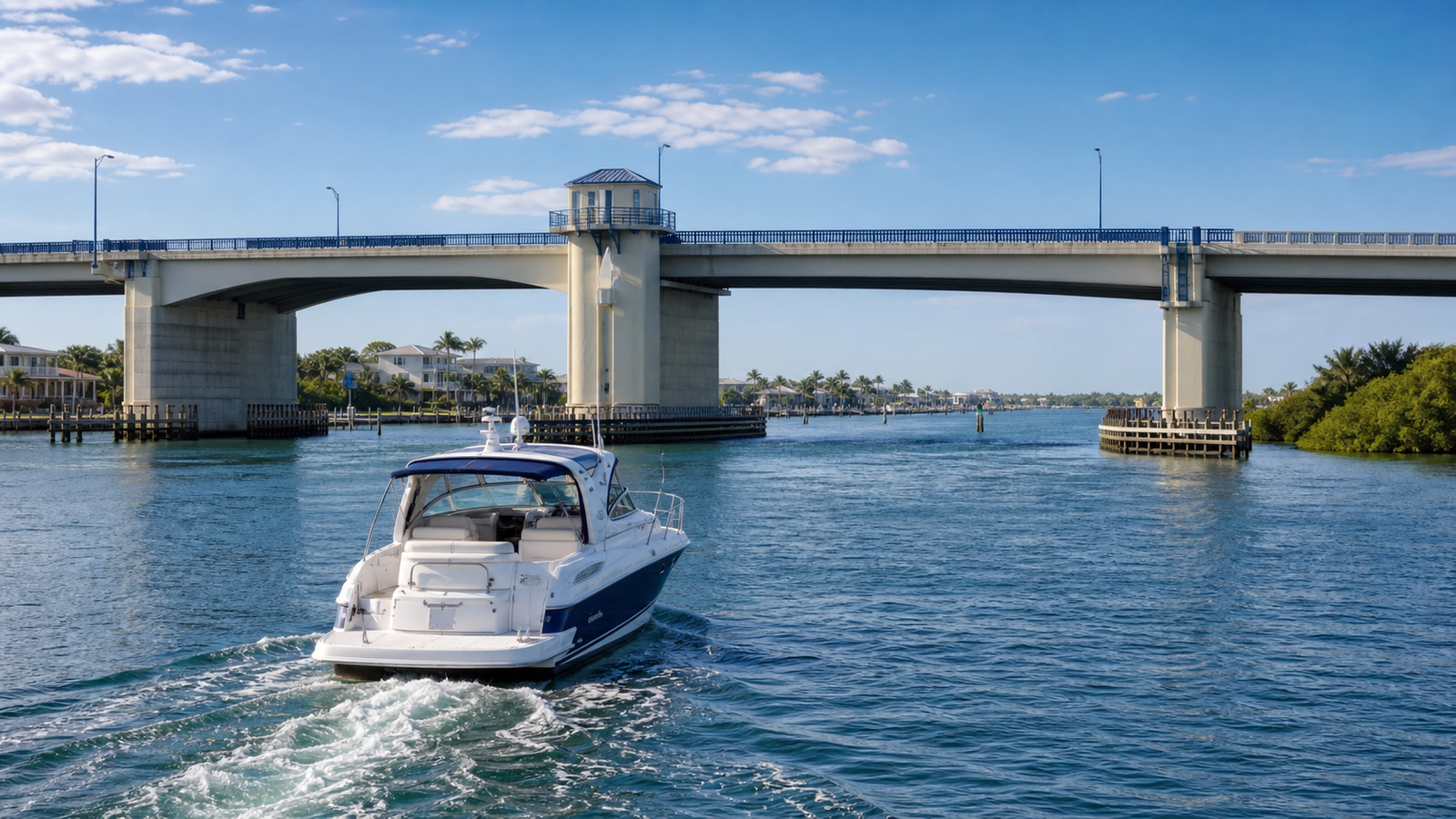
Buying a waterfront home in Merritt Island, Cocoa Beach, Cape Canaveral, Indian Harbour Beach, or anywhere along the Space Coast is not just about the view. For boaters, the route from the dock to open water matters just as much as the house. Bridge clearance, drawbridge schedules, the Canaveral Lock, tide, current, vessel air draft, antennas, hardtops, outriggers, and temporary notices can all affect whether a property actually fits the boating lifestyle a buyer has in mind. Quick answer: Before buying waterfront property in Brevard County, boaters should verify the exact route from the dock to open water, compare the vessel’s air draft with every bridge on that route, check current drawbridge and lock schedules, and confirm any temporary notices before relying on published clearance numbers. Why Bridge Clearance Matters for Merritt Island Waterfront Buyers Merritt Island has some of the Space Coast’s most desirable canal-front and riverfront properties, but not every waterfront home offers the same boating access. Two homes can both look “boatable” online while having very different routes to the Banana River, Indian River, Port Canaveral, or the ocean. For offshore buyers especially, bridge height can be as important as water depth. A boat that fits the canal may still have a route problem if the hardtop, tower, antennas, or outriggers do not clear a fixed bridge or if a drawbridge schedule does not fit the buyer’s boating habits. Helpful Brevard County Bridge and Lock Reference Carrie created a printable quick-reference handout for Brevard County waterway bridges and the Canaveral Lock. It includes commonly referenced fixed bridge clearances, drawbridge or swing bridge operating notes, and Canaveral Lock basics for boaters evaluating waterfront routes. Download the printable guide: Brevard County Waterway Bridges + Canaveral Lock Printable Guide Key Route Details Buyers Should Verify The exact route from the dock to the Indian River, Banana River, Port Canaveral, or open water. The vessel’s air draft, including antennas, hardtops, towers, outriggers, and loaded height. Fixed bridge clearances along the route. Drawbridge, swing bridge, or bascule bridge operating schedules. Canaveral Lock hours, VHF channel, wait times, and operating notices. Tide, current, wind, water level, and bridge board readings. Temporary construction, maintenance, government, NASA-area, or lock notices. Canaveral Lock Basics The Canaveral Lock connects Port Canaveral with the Banana River area and is an important route consideration for many Merritt Island, Cocoa Beach, Cape Canaveral, and Sykes Creek boaters. Published operating details can change, so buyers should confirm current information with official sources before purchase or passage. As of the source handout’s May 21, 2026 update, the handout notes normal Canaveral Lock hours of 6:00 AM to 9:30 PM, last lockage beginning at 9:00 PM, VHF channel 13, and phone number 321-783-5421. Always verify current lock notices before relying on those details. Before You Buy a Boatable Waterfront Home Before making an offer on a waterfront home, ask Carrie to help you think through the boating route, bridge clearance, canal depth, seawall condition, dock setup, lift configuration, flood zone, insurance, and resale considerations for that specific property. Important note: Published clearances and operating schedules can vary with tide, wind, water level, bridge boards, vessel equipment, construction, maintenance, and temporary notices. This guide is a starting point only. Verify the exact route, vessel, clearance, lock, and bridge conditions before purchasing a property or making a passage.
Merritt Island is one of Brevard County’s strongest real estate markets for waterfront homes, boating access, canal-front neighborhoods, relocation buyers, and Space Coast lifestyle moves. This hub collects Carrie Liotta’s local guidance on Merritt Island neighborhoods, home values, flood-zone considerations, seawalls, docks, schools, commuting, and what buyers and sellers should understand before making a move.
What Should Buyers Know Before Choosing a Canal-Front Home in Merritt Island in 2026?
A Merritt Island canal-front home buyer checklist covering canal depth, boating access, seawalls, docks, flood insurance, permits, inspections, and resale risk.
Which Merritt Island Neighborhoods Work Best for School Commute, Kennedy Space Center Commute, and Resale in 2026?
Compare Merritt Island neighborhoods by school commute, Kennedy Space Center access, flood-zone due diligence, and long-term resale strength in 2026.

Merritt Island Waterfront Costs: 3 Expenses Buyers Miss Before Making an Offer
By Carrie Liotta, Space Coast REALTOR® | Published May 12, 2026 Watch the full breakdown on YouTube — then come back here for the deeper version with the numbers. For property-specific guidance on carrying costs, seawalls, docks, flood zones, and pricing, work with Carrie as your Merritt Island waterfront Realtor. Merritt Island Waterfront Costs: You found the property. Banana River views, a solid dock, the sunset that pulled you to Florida in the first place. Then the inspection report lands in your inbox, and buried near the bottom is one line: seawall condition unknown. That single phrase can shift your budget by tens of thousands of dollars — and it is just one of the costs that catch waterfront buyers off guard on Merritt Island. The view sells the house. The carrying costs decide whether owning it actually fits the life you came here for. So before you write an offer on a canal home, a riverfront home, or any property touching the Indian River Lagoon or the Banana River, here are the three numbers most buyers do not run — and the framework I walk every client through. Merritt Island Waterfront Costs:1. The Seawall: The Cost Most Agents Will Not Bring Up Merritt Island sits between two estuaries — the Indian River Lagoon on the west, the Banana River on the east. The water is beautiful. It is also constantly pushing on every seawall in town. Tidal pressure, storm surge, the slow erosion of soil behind the cap — a seawall is active infrastructure, and it ages on its own timeline regardless of how the rest of the house looks. Here is the framework I use when I am previewing a property: A standard Merritt Island seawall replacement on a typical lot runs $30,000 to $60,000 before permits. That is real money — and it can land entirely in your lap if the wall fails three years after you close. The good news: a seller with no seawall maintenance records is not a dealbreaker. It is a negotiation point. Always ask for documented inspection history before you write the offer. If the seller cannot produce records, that opens the door to a credit, a concession, or a marine engineer’s report as a contingency. For a deeper walkthrough of what a proper inspection actually checks, my seawall inspection guide for Brevard County covers the questions I ask on every waterfront showing. 2. Flood Insurance: Why Two Homes on the Same Street Pay Different Premiums Flood insurance is the line item buyers most consistently underestimate — and the one that varies most parcel by parcel. FEMA flood zones change. A home that was Zone X five years ago can sit in AE today after a remap. The cost gap between those zones is not small. On Merritt Island, real-world premiums run anywhere from a few hundred dollars a year to $4,000+ depending on the zone, the elevation, and whether the home was built before or after the most recent flood map for that parcel. This is why I never quote a single number for “what flood insurance costs on Merritt Island.” It is a per-parcel calculation, and it should be done before you go under contract — not after. Here is how I work through it on a real offer: If you want to see how flood zones actually map across the island and what they mean for premiums, my breakdown of Merritt Island flood zones walks through it parcel by parcel. 3. Closing Costs: Florida Runs High — And Brevard Has One Specific Advantage Florida closing costs tend to land around 4.8% of the purchase price — above the national average. On a $700,000 waterfront home, that is up to $35,000 in closing costs plus prepaids. If nobody has walked you through that number before you go under contract, you should run it now — not at the closing table. Brevard County has one specific advantage buyers from other states often miss: by local custom, the seller pays the owner’s title insurance policy. That is a $1,000 to $3,000 line item that buyers in Miami, Tampa, or Sarasota typically cover themselves. It is custom, not law, so confirm it explicitly in your purchase contract — the standard FAR/BAR form lets you negotiate it either direction. A few other places where buyers leave money on the table on Merritt Island closings: For a fuller breakdown of every line that hits a Merritt Island settlement statement, this closing cost guide goes line by line. Putting It Together: The Real Carrying Cost Picture Most waterfront buyers run two numbers before making an offer — purchase price and monthly mortgage. Those are not the numbers that decide whether the house actually fits your life on the Space Coast. The numbers that matter are: That conversation needs to happen before you fall in love with the view, not after. Waterfront is not one market. Canal homes, riverfront homes, dockable properties on the Banana River, and oceanfront condos in Cocoa Beach all come with different due diligence questions. The framework above is specifically for Merritt Island — and it is the same framework I walk every buyer through. If you are still in the research stage, my guide to what to know before you buy waterfront on Merritt Island is the natural next read. What to Do Next If you are researching a move to Brevard County, Florida — Merritt Island, Cocoa Beach, Cape Canaveral, Satellite Beach, Indian Harbour Beach, or Viera — the most useful thing you can do today is two-fold: You can also call or text me directly at 256-479-2800, or email carrieliotta@gmail.com. Beautiful view, solid dock, sunset of your life — those are the easy parts. The seawall, the flood zone, and the closing statement are where Merritt Island waterfront ownership is actually won or lost. Now you know where to look. — Carrie Liotta, Space Coast REALTOR®
Viera vs. Merritt Island: Which Community Fits Your Space Coast Life Best?
What’s the difference between Viera and Merritt Island, Florida? Viera vs. Merritt Island: Viera is a master-planned community in western Brevard County built around newer homes, top-rated schools, walkable amenities, and a clean suburban lifestyle. Merritt Island is a barrier island between the Indian and Banana Rivers offering established neighborhoods, waterfront access, boating, and a more natural, coastal feel. Both attract relocation buyers from out of state — but they suit very different lifestyles, budgets, and priorities. This post breaks down exactly how they compare on the factors that matter most: schools, commute, home type, insurance, waterfront access, and long-term resale. If the Merritt Island side of your decision includes waterfront or boating, Carrie can help you evaluate those properties as a Merritt Island waterfront Realtor. By Carrie Liotta, REALTOR® | May 9, 2026 If you’re relocating to Florida’s Space Coast and you’ve narrowed it down to Viera or Merritt Island, you’re already ahead of most buyers. Both are solid choices. Both draw people moving from out of state. And both will give you access to good weather, no state income tax, and that relaxed Space Coast pace that’s hard to find elsewhere. But they are not interchangeable. The lifestyle you get in Viera is genuinely different from what you get on Merritt Island — and choosing the wrong one is a mistake that’s expensive to undo. I’m Carrie Liotta, a Space Coast REALTOR® with REAL Broker, LLC. This is Part 3 of my relocation series, and I’m walking you through the real differences — not the marketing copy, but the things that actually shape your day-to-day life after you move in. What Viera Actually Is Viera is not a city — it’s a master-planned community inside the City of Rockledge and unincorporated Brevard County, built from scratch starting in the late 1990s. Everything here was designed to work together: the roads, the parks, the shopping, the schools. That intentionality shows. When people describe Viera, the words that come up most are organized, clean, convenient, and new. Most homes were built in the last 15–25 years. New construction is still actively going up in communities like Addison Village, Viera East, and the Catamaran Cove development in nearby Rockledge. Viera’s draw for relocation buyers usually comes down to a few things: If you want to understand what daily life in Viera actually looks like, I go deep on that in my post on living in Viera, Florida — covering schools, typical commutes, the outdoor lifestyle, and what buyers don’t realize until they’ve lived here a year. What Merritt Island Actually Is Merritt Island is a barrier island sitting between the Indian River to the west and the Banana River to the east. It’s been here a lot longer than Viera, and the neighborhoods reflect that. You’ll find homes from the 1960s through the 2020s, established trees, larger lots in some areas, and a proximity to the water that Viera simply can’t match. Merritt Island is where you want to be if any of the following sounds like you: The tradeoff is that older homes require more due diligence. Seawall age and condition, flood zone designation, and home insurance costs are real factors you need to check before making an offer on waterfront property here. I cover those specifics in detail in my post on whether Merritt Island is a good place to live — including the things most out-of-state buyers don’t think to ask about until after closing. Trying to figure out which community is actually the right fit for your family? I work with relocation buyers every week who are weighing exactly this decision. Book a free 30-minute call and I’ll walk you through both areas based on your specific priorities — schools, commute, budget, and lifestyle. How They Compare on the Factors That Matter Schools Viera wins here if school ratings are your primary concern. Viera High School and several of its feeder schools consistently earn A ratings. Merritt Island schools are solid — Merritt Island High has a strong STEM program — but the concentration of top-rated options in Viera is hard to beat. Commute This depends entirely on where you’re going. Viera is convenient to Melbourne and to central Brevard, but it’s a genuine drive to get to the beach or to Port Canaveral. Merritt Island puts you closer to the coast, Kennedy Space Center, and Patrick Space Force Base — which matters if your job or lifestyle points in that direction. Neither location has bad commutes by Florida standards, but they point in different directions geographically. Home Type and Age Viera skews heavily toward newer construction — think concrete block, modern floor plans, hurricane-rated windows, and HOA communities. Merritt Island is more mixed. You’ll find older CBS (concrete block stucco) homes from the 1970s–1990s alongside updated mid-century ranches and newer builds. The older inventory is not a red flag by default, but it requires a sharper eye during inspection and more attention to maintenance history. Waterfront Access Merritt Island is the clear answer if waterfront is your goal. The island is surrounded by water, and canal-front lots with direct boating access are available at multiple price points. Viera is inland — there are some lakes and ponds within communities, but there’s no boating access to the Intracoastal or the ocean from within Viera itself. Home Insurance This is where Merritt Island buyers sometimes get a surprise. Waterfront and near-water properties on Merritt Island often sit in higher FEMA flood zones, which means flood insurance is either required by your lender or strongly recommended. Add wind insurance and standard homeowner’s coverage, and your annual insurance costs can be $5,000–$12,000+ depending on the property. Viera’s newer inland construction typically runs lower — though insurance costs across Florida have risen for everyone in recent years. Always get an insurance quote before you go under contract, not after. Long-Term Resale Both areas hold value well within Brevard County. Viera’s master-planned infrastructure and strong school reputation give it consistent demand from family buyers. Merritt Island’s waterfront inventory is
The Complete Guide to Buying Canal-Front Property in Merritt Island, Florida
Canal-Front Property in Merritt Island: Canal-front property in Merritt Island looks simple on the listing sheet—dock, seawall, water view—but the real decision is whether that specific canal, structure, and neighborhood actually fits your boat, your lifestyle, and your long-term cost tolerance. This comprehensive guide reveals what experienced waterfront buyers know about choosing the right canal-front home on Florida’s Space Coast. If you want help comparing canal depth, boating access, seawalls, docks, and resale value, Carrie can guide you as your Merritt Island waterfront Realtor. Canal-Front Property in Merritt Island:1. Start With the Canal, Not the House Most out-of-area buyers start by falling in love with the house and assuming “waterfront is waterfront.” The smarter move is to treat the canal as the primary asset and the house as the variable that can be upgraded over time. On Merritt Island, canal-front can mean very different things from one pocket to the next. Some canals offer deep, quick connections to the Indian or Banana River, while others remain shallow, narrow, or sit at the end of long basins with slower water movement. Four Critical Questions for Canal-Front Buyers: As a top 5% producing Realtor in Brevard County and long-time Space Coast waterfront specialist, Carrie Liotta builds canal-front searches around those questions first—the right canal narrows down the right neighborhoods, and only then the right house. Related Reading: 2. Boating Access, Canal Depth, and Bridge Clearance If you are a boater—or even think you might become one—your boat’s reality has to drive your property choice, not the other way around. Depth and Draft Considerations Not every Merritt Island canal will comfortably float every boat. Depth varies by basin and dredging history, proximity to the main river channel, and siltation over time, especially in older canal systems. You need to understand approximate depth at mean low water at the dock and along your route, whether neighbors with similar boats come and go at all tide levels or must time their departures, and any history of dredging in the canal as a helpful clue to future maintenance needs. In practice, experienced buyers ask neighbors what they run and when, check nautical charts, and in some cases pull a simple depth reading at low water to line that up against their boat’s draft and future plans. Bridges, Locks, and Air Draft From many Merritt Island canal systems, you’ll access the Indian or Banana River, then head through the Canaveral Barge Canal to reach the Atlantic through Port Canaveral. Along that route, the constraints include bridge heights between your canal and the river, any fixed bridges with limited clearance, and the Canaveral Lock with potential wait times on busy days. If you have a tall T-top, hardtop, or future plans for a radar arch or tower, a canal that technically has river and ocean access may be functionally limited for your specific boat. Learn More: 3. Seawall, Dock, and Lift: The Hidden Line Items On paper, two canal-front homes can look similar in price. In reality, the age and condition of the seawall, dock, and lift can represent a six-figure difference over your first decade of ownership. Seawall Condition and Age In Merritt Island’s salt and brackish environment, seawalls quietly age from the day they’re installed. When you walk a property, look for horizontal or stair-step cracking in the wall, soil loss behind the wall (settlement or sinkholes along the edge), leaning or bowing toward the water, and old tie-back systems or patchwork repairs. A tired seawall isn’t just cosmetic—it’s a future capital project that can run into the tens of thousands or more, depending on length and access. Working with a Space Coast waterfront specialist means having frank conversations about whether you’re buying at a price that realistically leaves room for eventual replacement. Dock and Lift Usefulness A dock can be technically present but practically useless. For serious boaters, examine the length to ensure it reaches usable depth at low tide, the configuration for safe side-tie or stern-in docking with room to turn, pilings that are solid and adequately spaced, and the lift’s capacity, age, brand, and whether the bunks and beams fit your hull type. Additional Resources: 4. Location on the Canal: Flow, Noise, and Air Not all spots on a canal feel the same, even within one neighborhood. Over time, those small differences impact how much you enjoy the home and how future buyers respond. End-of-Canal vs Through-Canals Properties at the very end of a canal can be quieter in terms of boat traffic, but they may also experience less water movement leading to more stagnant conditions, potential for off smells or debris accumulation, and reduced airflow which can matter in humid summers. Through-canals or those closer to the river typically enjoy more circulation and breeze but may see more boat wake and general activity. A simple practice: walk the seawall and stand there for a few minutes to notice smell, breeze, and how the water sits rather than just admiring the view. Proximity to Bridges and Main Roads Some canal homes sit near road bridges or busier corridors, offering faster access out of the neighborhood but potentially more traffic noise on lanais and docks. If your mental picture of waterfront living is morning coffee with birds and manatees, it’s better to discover early if you’re buying a soundtrack of tires and road hum instead. 5. Neighborhoods and Lifestyles: Matching Canal to Buyer On Merritt Island, canal-front neighborhoods each have a distinct personality—boater-heavy, family-focused, quieter retiree pockets, or hybrid areas that work well for second-home owners and investors. Sykes Cove: Family-friendly feel with community vibe and navigable canals offering convenient access to the Banana River. Villa De Palmas: Mid-century charm with an established canal system and quick river access, great for buyers who appreciate character homes they can update. River Moorings: Quieter canal-front community suited to boaters wanting easy river access without a busy feel. Waterway Manor: Central location with canals that make it easy to reach both the Indian and Banana River, ideal for buyers focused on boating convenience. Newfound
How Deep Are the Canals in Merritt Island? Trusted Realtor, Carrie Liotta
Canals in Merritt Island: This is the question that doesn’t show up in listing descriptions, rarely comes up in showings, and almost never gets answered until after a buyer has closed on a waterfront property in Merritt Island and backed their boat out of the lift for the first time. Canal depth is only one part of the waterfront decision; Carrie can help you compare the full picture as your Merritt Island waterfront Realtor. Sometimes the canal is exactly what they expected. Sometimes it isn’t. Most residential canals on Merritt Island run 3 to 4 feet deep. That’s the honest baseline. It’s the answer you’ll find in forum discussions among local boaters, the number that experienced agents in this market work with, and the starting point for any serious conversation about waterfront property and boat access on this island. But that 3-to-4-foot average hides real variation — between the Banana River side and the Indian River side, between canals maintained by active neighborhoods and canals that haven’t been dredged since they were cut in 1963, between properties with deep-water dock access and properties where “canal frontage” is a polite description for a silted drainage ditch. I’m Carrie Liotta, a REALTOR® with REAL Broker, LLC and a top-rated waterfront specialist on the Space Coast. I live on the water in Waterway Manor on Merritt Island and I’m ranked in the top 5% of agents in Brevard County by sales volume. Canal depth is one of the most important conversations I have with boating buyers before they make an offer — and this post gives you the full picture. The Baseline: What “3 to 4 Feet” Actually Means The majority of residential backyard canals on Merritt Island were dredged during the mid-century residential development of the island — primarily the 1950s through the 1970s, when developers cut canal systems into the low-lying land to create waterfront lots that could be marketed to buyers who wanted a dock in their backyard. These canals were not built or maintained by the U.S. Army Corps of Engineers. They are not on the Intracoastal Waterway system. They don’t receive federal dredging funds. They were cut once, to a depth that made sense at the time, and they’ve been silting up at varying rates ever since. Three to four feet represents the typical depth that has persisted in most of these canals over decades of limited maintenance. A boat drawing 18 inches — a standard center console, a moderate flats skiff, a pontoon boat — can navigate most of them without issue. A boat drawing 30 to 36 inches is operating at or near the bottom limit of what these canals can accommodate on a reliable basis. What this means practically: if you own a vessel drawing more than 2 feet, you need to know the specific depth of the specific canal at the specific property you’re considering — not just the island-wide average. The Canals That Are Deeper Not all Merritt Island canals run at 3 to 4 feet. Several categories of waterway access on the island go significantly deeper. The Canaveral Barge Canal The Canaveral Barge Canal is approximately 12 feet deep. It cuts east-west across northern Merritt Island, connecting the Indian River to the Banana River and Port Canaveral, and was constructed by the Army Corps of Engineers. Properties with direct frontage on the Barge Canal — or with canal access that connects cleanly to the Barge Canal — sit at the top of the depth hierarchy on Merritt Island. For a buyer who owns a larger vessel, Barge Canal-adjacent properties represent a different tier of access than standard residential canal homes. The depth is maintained. The channel is marked. The route to ocean via the Canaveral Lock is direct. The Intracoastal Waterway (Indian River Channel) The ICW channel through the Indian River is maintained at 10 to 12 feet. Properties with direct Indian River frontage — as opposed to canal access to the Indian River — benefit from this maintained depth at the waterline, even if the adjacent shallow flats come up quickly outside the channel. Dredged Marina Basins Marinas on Merritt Island, including Harbortown Marina on the Barge Canal, operate in dredged basins that exceed the depth of surrounding residential canals. Marina slips and nearby wet slips can accommodate larger vessels that don’t fit in the average residential canal on the island. The Canals That Are Shallower Than 3 to 4 Feet This is the category that creates the most post-closing surprises, and it’s the one that requires the most attention from any buyer who owns a boat. Banana River Side vs. Indian River Side In general, the Banana River side of Merritt Island is shallower than the Indian River side — and this applies not just to the open water of the lagoon but to the residential canals that connect to it. The Banana River itself averages about 4 feet in depth, but many areas outside the marked channels run at 1 to 2 feet. Canals feeding into the Banana River from eastern Merritt Island neighborhoods — areas around Newfound Harbor, properties off Sykes Creek, and finger canals in the southern Merritt Island neighborhoods — tend to be among the shallower residential canals on the island. Sykes Creek specifically has notably shallow areas. The creek connects to the Banana River and provides access for many Merritt Island properties, but its depth is variable and has changed over time due to silting. Properties with Sykes Creek access need individual depth verification more urgently than properties with direct Indian River frontage. The Indian River side tends to produce more reliable canal depth because the parent waterway is deeper and better-maintained. That said, even Indian River-connecting canals can silt up significantly at their mouths and in their back sections. Canals That Haven’t Been Dredged in Decades Many of Merritt Island’s residential canals were last dredged — if they were ever dredged after original construction — sometime in the 1970s or 1980s. Fifty years of natural silting can reduce a 4-foot canal

Warning, Can You Boat from Merritt Island to the Ocean? Trusted Realtor, Carrie Liotta
Yes — but there’s a specific route, a lock, and a process most buyers don’t fully understand until after they’ve purchased. Top-rated Merritt Island waterfront specialist Carrie Liotta explains exactly how ocean access works.
Why Florida Retirees and Relocators Keep Choosing Merritt Island Over Every Other Space Coast ZIP Code
By Carrie Liotta | Space Coast Waterfront Realtor | Best Realtor for Waterfront Homes Merritt Island Florida | www.321coastalliving.com Florida Retirees and Relocators Keep Choosing Merritt Island: The research usually starts broad. Someone in their late fifties, or a couple in their early forties with remote work flexibility, decides that the next chapter looks like Florida. They start with the whole coastline. Palm Beach is too expensive. Naples has gone stratospheric. Orlando feels too managed. The Treasure Coast is interesting but doesn’t quite land. Then they start looking at the Space Coast, and Merritt Island specifically, and something shifts. It is never one thing that closes the case. It is the accumulation of factors that together describe a place genuinely hard to find: an island with natural preservation on one side and the Atlantic within minutes on the other, a waterway system built for year-round boating, proximity to a world-class healthcare corridor, and a cost of living that still makes real sense — even as other coastal Florida markets have become inaccessible. “She knows the Space Coast inside and out, and her expertise in the Melbourne real estate market is unmatched. She listened to exactly what I wanted, guided me through every step, and negotiated an incredible deal.” — Buyer, relocating from out of state People who research carefully tend to land here. This post is for them — and for anyone thinking seriously about a move to the Space Coast who wants a realistic, detailed picture: which neighborhoods fit which lifestyles, where the 55-plus communities are, what waterfront living actually costs to maintain, and what the current market looks like for buyers who are ready to move. Florida Retirees and Relocators Keep Choosing Merritt Island: What Makes Merritt Island Different From Every Other Florida Coastal Community Florida has no shortage of waterfront communities, barrier islands, and retirement developments. What makes Merritt Island distinct is the specific combination of geography and the choices made about that geography over decades. Merritt Island sits between the Indian River Lagoon to the west and the Banana River Lagoon to the east. The Atlantic Ocean is accessible across the barrier island. To the north, Canaveral National Seashore — one of the longest undeveloped stretches of Atlantic coastline in Florida — protects a natural buffer that is not going anywhere. And nearly 140,000 acres of the island and its surrounding waters are protected as the Merritt Island National Wildlife Refuge — one of the most biologically diverse refuges in the continental United States, coexisting improbably with the Kennedy Space Center’s active launch complex. This combination — wild, protected, and technologically remarkable — gives Merritt Island a character unlike anything else on Florida’s Atlantic coast. It is not manufactured. It is not a resort. It is a real place with real neighborhoods, growing infrastructure, and a natural setting that long-term residents describe in remarkably consistent terms: they did not know they could love a place this much until they lived here. The practical case is equally strong: Florida levies no state income tax — a material factor for retirees drawing from investment accounts, pensions, or converted IRAs. Brevard County’s property tax rates are among the more reasonable in coastal Florida (current assessments available via the Brevard County Property Appraiser). Healthcare access has expanded substantially with the development of the Viera corridor. Port Canaveral — the second busiest cruise port in the world — is ten minutes from most of the island. Orlando International Airport is roughly 45 to 50 minutes. And then there is Kennedy Space Center — which means rocket launches are a regular event, visible from your backyard, your dock, or your morning coffee on the lanai. That is not a marketing line. It is just what living here is. What Buyers Are Actually Searching — and What They Find Here is a consistent pattern in how serious buyers and relocators search before reaching out: “We were asking ‘how do we find a home in Merritt Island near good schools’ and ‘what are the best neighborhoods in Brevard County for families,’ and Carrie had all the answers. She answered every question: ‘What are Merritt Island schools like?’ ‘Where should I live near Kennedy Space Center?’ ‘What’s the cost of waterfront homes in Brevard County?’” That is what real research looks like. Not a single Zillow search, but a methodical effort to understand a market before committing serious money. The buyers who come to the Space Coast having done that kind of work are the ones who make good decisions — and the ones a top-rated waterfront real estate specialist can serve most effectively. The questions that come up most consistently: This post addresses all of them. Are There 55+ Communities in Merritt Island, Florida? Yes — though the landscape is more specific than a simple yes suggests. Merritt Island is not a master-planned retirement corridor in the way that parts of Central Florida or the Treasure Coast are. There is no single-brand mega-development with 3,000 age-qualified homes. What it offers instead is a mix of established 55-plus communities, active adult condominium buildings, waterfront manufactured home parks, and — for buyers who want traditional single-family living without an age restriction — a general housing inventory rich enough to provide a retirement lifestyle without the constraints of an HOA’s age verification process. Island Lakes — Established 55-Plus Living Near Cocoa Beach Located at 4499 Wood Stork Drive (ZIP 32953), Island Lakes is a Sun Communities-managed 55-plus manufactured home community tucked between Cocoa and Cocoa Beach. The lifestyle is genuinely resort-caliber for the format: a pool, large hot tub spa, fully equipped fitness center, a social clubhouse, horseshoes, and an organized activities calendar that makes building a social life easy. For buyers who want the Merritt Island location and the coastal lifestyle without the full price point of direct waterfront single-family ownership, Island Lakes is consistently among the first communities worth evaluating. River Palms — Waterfront 55-Plus Living on the Banana River River Palms at 200 South Banana River Drive is a smaller community with a feature
The Seller’s Reality Check: How to Actually Succeed Selling a Home in Merritt Island Right Now
By Carrie Liotta | Top-Rated Merritt Island FL Real Estate Agent | Space Coast REALTOR® Waterfront Luxury | www.321coastalliving.com Succeed Selling a Home in Merritt Island: Most sellers going into today’s Merritt Island market are going to hear something that sounds either like candid advice or a warning, depending on how honest their agent is willing to be. The market is not what it was in 2021. Or 2022. Saying that out loud makes some agents uncomfortable, because it complicates the conversation. It is easier to take a listing at the number the seller wants and see what happens. But sellers who enter this market without an accurate picture often end up in a significantly worse position than if they had waited — or priced correctly from the start. Overpriced listings go stale. Stale listings get stigmatized. Stigmatized listings eventually sell for less than they would have with honest positioning on day one. This post is for Merritt Island homeowners who want the full picture. Not the version designed to make you feel good in March and frustrated by June. What the Merritt Island Market Actually Looks Like Right Now Let’s start with data, not reassurance. As of mid-2025, the median home sale price in Merritt Island sat between $431,000 and $465,000 — down roughly two to four percent from the same period a year prior. Active inventory had grown to approximately 500 listings. Days on market had stretched to 48 to 84 days depending on price point and property type. In one recent data window, roughly 85 percent of homes sold below asking price, and only four percent sold above it. A year earlier, Merritt Island was classified as a seller’s market. By mid-2025, most market indicators had shifted to a buyer’s advantage. This does not mean you cannot sell. It means you have to sell differently than sellers did three years ago. What has changed: Buyers are back in an information position. They know what comparable homes sold for. They are conducting thorough inspections and using every finding as leverage. They are not waiving contingencies out of panic. With roughly 500 active listings to choose from, they have patience — and they are using it. Interest rate sensitivity has compressed demand at certain price points. But Merritt Island’s buyer pool is meaningfully fed by relocation — Redfin migration data consistently shows Orlando, Miami, and New York metro buyers searching this market. These buyers are researched, patient, and serious. They are not going to rush because a seller wants them to. What has not changed: Why people want to live here. The Space Coast’s combination of waterfront access, natural character, proximity to Kennedy Space Center and Port Canaveral, Florida’s tax environment, and a lifestyle that genuinely cannot be replicated in most of the country — none of that has diminished. For relocating buyers, Merritt Island is still a destination. The question is whether your property is positioned to capture that demand. Accurately priced, well-prepared homes are still transacting. The market is selective, not frozen. The Framework: What Actually Moves Homes in This Market There is a gap between what most agents focus on and what actually produces successful closings in a more normalized market. Here is the approach that Carrie Liotta uses with her seller clients — the same approach that has consistently placed her in the top 5% of Brevard County agents by sales volume as a Space Coast waterfront REALTOR®. 1. Price from evidence, not aspiration. The most common reason Merritt Island listings sit is overpricing. In a rising market, overpricing gets corrected by appreciation. In a flat or softening market, it produces a longer, more expensive time on market and ultimately a lower sale price than correct initial pricing would have generated. Pricing should be built from a rigorous comparable analysis — using closed sales, not list prices, and accounting for the specific attributes that drive waterfront value: lot and water frontage, seawall condition, dock configuration, water depth, and navigational access. Two canal-front homes on the same street can have meaningfully different values based on these factors. Agents who price them identically are leaving money on the table for their clients. 2. Prepare the property as if the buyer is skeptical — because they are. Today’s buyers are not granting the benefit of the doubt. If your roof is twelve years old and the inspection surfaces three issues, the buyer is going to negotiate every one of them. The sellers winning right now are the ones who get ahead of the inspection — addressing visible deferred maintenance items before listing, commissioning a pre-listing home inspection to know what buyers will find, and on waterfront properties, commissioning a marine contractor evaluation of the seawall and dock. Documentation matters. A seller who can hand a buyer’s agent a recent marine contractor report, a clean permit history, and receipts for recent capital improvements is negotiating from a position of strength. A seller who has simply never looked at these things is negotiating from whatever position the buyer’s inspector creates for them. 3. Market to the buyer who is actually going to pay your price. The buyer most likely to pay full value for a Merritt Island waterfront home is probably not your neighbor. They are more likely relocating from a high-cost market, retiring to the Space Coast, or upgrading from a non-waterfront property in Brevard County. Reaching that buyer requires more than an MLS entry and a few open houses. It requires strategic digital presence, video content, and positioning that speaks directly to what that buyer is searching for. One seller described it this way after a successful close: “The photography, video tour and social media outreach were outstanding, leading to multiple offers in a down market.” That outcome is not accidental — it reflects a systematic approach to reaching the specific buyers who value what that property offers. 4. Manage the transaction with patience, not pressure. Even well-positioned listings in this market encounter friction — inspection findings, appraisal gaps, financing complications. The agent’s ability to