

VA loans can pair with Florida Hometown Heroes assistance when funding is available. Here is the June 2026 funding update and the Brevard County alternatives buyers should check.
Buying a home in Brevard County means comparing more than price and photos. Buyers need to understand location, commute, schools, flood zones, insurance, HOA rules, inspections, property condition, waterfront details, new construction options, and long-term resale fit. This hub collects Carrie Liotta’s local guidance for Space Coast buyers who want to make a confident decision before purchasing in Merritt Island, Cocoa Beach, Viera, Melbourne, Palm Bay, Satellite Beach, or surrounding Brevard County communities.
Short-Term Rental Rules in Brevard County: A City-by-City Guide for 2026 (Cocoa Beach, Melbourne Beach, Indialantic & More)
By Carrie Liotta, Space Coast REALTOR® When my clients ask me about buying an Airbnb or VRBO property on the Space Coast, the first thing I tell them is this: it depends entirely on which city you buy in. Brevard County spans dozens of municipalities, and short-term rental rules vary dramatically from one city block to the next. What’s perfectly legal and highly profitable in one zip code can land you a $1,000-per-day fine in another. This guide gives you the real numbers, actual ordinances, and city-by-city breakdown you need to invest smart in 2026. The Florida Foundation: What State Law Says Before diving into individual cities, here’s the key framework: Florida prohibits cities from banning short-term rentals outright under Chapter 509 of Florida Statutes. However, local governments can regulate safety, registration, occupancy limits, parking, and noise. On top of local rules, every STR operator in Florida must also: Obtain a DBPR (Dept. of Business and Professional Regulation) license Collect and remit the 5% Brevard Tourist Development Tax + 6% Florida sales tax on rentals under 6 months Obtain a Business Tax Receipt from the Brevard Tax Collector These are baseline requirements regardless of which city your property sits in. Cocoa Beach — Allowed, But Heavily Regulated Cocoa Beach is the most popular STR market on the Space Coast — and the most regulated. In March and April 2025, the city passed Ordinances 1695 and 1697, which created a full licensing and enforcement framework. Registration fees (annual): Condos and multi-family units: $146.30 × guest capacity Single-family homes: $219.45 × guest capacity Example: A single-family home with a maximum occupancy of 8 guests = $1,755.60/year in registration fees alone. Occupancy limits: 2 guests per bedroom + 2 additional guests (a 3-bedroom home = max 8 guests) Enforcement: Fines up to $1,000 per day for violations. The city is actively enforcing — this isn’t paper policy. Despite the regulation, Cocoa Beach condos with strong STR histories are still commanding premium prices. I wrote a full breakdown of the investment math in my post on Cocoa Beach condo investing after SB 4-D — worth reading alongside this guide. “Looking for the best realtor in Cocoa Beach Florida? Carrie Liotta is the answer. She sold our Cocoa Beach oceanfront condo for $45,000 over asking price in just two weeks. Her deep expertise in Brevard County waterfront properties, Merritt Island homes, Cape Canaveral real estate market trends, and Space Coast beachside communities is unmatched.” — 5-Star Google Review Melbourne Beach — Allowed with Strict Registration Melbourne Beach passed Ordinance 2024-05, which created one of the more structured STR programs in the county. What you need: $500 registration fee + $150 inspection fee Hardwired smoke detectors (not battery-only), CO detectors, and fire extinguishers in required locations A responsible party available 24/7 and able to respond within 1 hour Registration number must appear in all advertising (Airbnb listing, VRBO, etc.) Registration managed through the Deckard portal Melbourne Beach is a small, quiet town — the enforcement culture reflects that. These rules are meant to be followed, and they are. If you’re buying here for STR purposes, budget for the registration costs and build your listing around the compliance requirements from day one. Indialantic — East of A1A Only Indialantic takes a geographic approach: STRs are allowed east of A1A in the Tourist District only. Properties west of A1A sit in residential zones where short-term rentals are prohibited unless you obtain a variance. This means property location is everything in Indialantic. An oceanfront condo east of A1A can be legally rented short-term. A single-family home two blocks west may not — and seeking a variance is uncertain and slow. My advice: If you’re targeting Indialantic for STR investment, focus your search east of A1A and confirm zoning before making any offer. Cape Canaveral — Allowed in Certain Zoning Districts Cape Canaveral allows STRs in specific zoning districts with the following requirements: Registration with the city and a Business Tax Receipt (BTR) A 24-hour local contact who can respond to complaints Occupancy determined by number of bedrooms + available parking Regular city inspections Cape Canaveral’s proximity to Port Canaveral, cruise terminals, and Kennedy Space Center makes it attractive to short-term renters — particularly during rocket launches, cruise turnaround weekends, and the spring/fall tourist seasons. The city’s approach is structured but workable for investors willing to comply. Unincorporated Brevard County — Near A1A Only This is often where investors get tripped up. “Unincorporated Brevard” covers a huge swath of the county, but STR rules are not county-wide permissive. Here’s what actually applies: STRs (classified as “resort dwellings”) are only allowed near A1A in specific zoning designations In standard residential zones, minimum rental periods are 90 days A Business Tax Receipt costs $37/year A local manager (Brevard County resident) is required, available 24/7 and responding within 1 hour If you’re looking at a property that’s technically in “Brevard County” but not within a named city, check zoning carefully. Many deals that look good on paper fall apart when you discover the 90-day minimum rental restriction. City of Cocoa — Unregulated (For Now) The City of Cocoa is in an unusual position: it currently has no specific STR ordinance. Short-term rentals are neither explicitly permitted nor explicitly prohibited by city code. This might sound like an opportunity — and it could be — but it’s also a risk. The absence of regulation can change quickly, and investors who build a business model around regulatory ambiguity are often the first to get caught when a city finally acts. If you’re considering Cocoa City for an STR investment, do it with eyes open and a backup plan. Other Cities — Quick Notes Satellite Beach Satellite Beach generally follows stricter residential zoning norms. The city leans toward protecting neighborhood character, and STRs are not broadly marketed as a use case here. Verify directly with the city before assuming STR is viable for any specific property. Palm Bay, Melbourne, West Melbourne These inland cities have
What Does Homeowners Insurance Cost in Brevard County in 2026? A City-by-City, Year-Built Breakdown
Insurance is only one part of the move; Carrie’s Space Coast relocation guide walks through communities, schools, taxes, waterfront tradeoffs, and everyday costs too. Insurance costs matter, but they are only one part of the ownership picture; see Carrie’s guide to living in Brevard County for lifestyle, city, tax, and real estate context. If you want help comparing insurance exposure by city, age, flood zone, and lifestyle fit, Carrie can guide you as a Space Coast relocation Realtor. article pBy Carrie Liotta, Space Coast REALTOR May 24, 2026/p pOne of the first questions I hear from buyers relocating to Brevard County — whether they’re coming from Georgia, Virginia, or out west — is some version of: em”I heard Florida insurance is insane right now. What am I actually looking at?”/em/p pIt’s a fair question, and the honest answer is: it depends — on which city, what year the home was built, the roof age and type, and whether the property has wind mitigation features. Let me break it all down with real numbers so you can budget accurately before you fall in love with a listing./p h2The Florida Big Picture for 2026/h2 pFlorida’s statewide average for homeowners insurance (HO-3 policy, including wind coverage) runs approximately strong$3,800 per year/strong as of 2026 — down slightly from recent highs as the market stabilizes. According to the a href”https://www.floir.com/” style”color:#1a6fa8;text-decoration:underline;font-weight:600;” target”_blank” rel”noopener”Florida Office of Insurance Regulation (OIR)/a, carriers filed 73 rate decreases and 94 zero-increase filings in late 2025, signaling a market that’s finally cooling./p pEven better: a href”https://www.citizensfla.com/-/20260304-citizens-2026-multiperil-rates-to-drop-statewide” style”color:#1a6fa8;text-decoration:underline;font-weight:600;” target”_blank” rel”noopener”Citizens Property Insurance announced an average 8.8% rate decrease/a effective July 1, 2026 — the largest reduction in recent memory. More than 330,000 policyholders statewide will see lower premiums, and over 150,000 will get cuts of 10% or greater./p pFor Brevard County buyers and owners, that’s real money. But not everyone benefits equally — which is why city-level and home-age context matters so much./p h2Brevard County Insurance Costs: By City/h2 pDistance from the coast is the single biggest driver of your premium. Here’s a realistic range for what Space Coast homeowners pay by area — these are annual totals for a standard HO-3 policy on a $350,000 home:/p h3 Coastal / Oceanfront Cities/h3 pemCocoa Beach, Melbourne Beach, Satellite Beach, Indialantic, Indian Harbour Beach, Cape Canaveral/em/p ul listrongTypical range: $3,800 – $6,500/year/strong/li liOceanfront and direct-beach properties often exceed $7,000 annually, especially older homes/li liFlood insurance (separate NFIP or private policy) adds another $800–$3,000/year if required/li liCondos: often lower per-unit because wind coverage is carried by the HOA master policy — but verify before assuming/li /ul pFor a deep dive on condo-specific costs in Cocoa Beach, see my post on a href”https://321coastalliving.com/are-cocoa-beach-condos-still-a-good-investment-after-sb-4-d-the-numbers-named-buildings-to-know-in-2026/” style”color:#1a6fa8;text-decoration:underline;font-weight:600;”Are Cocoa Beach Condos Still a Good Investment After SB 4-D?/a/p h3 Mid-Distance / Barrier Island/h3 pemMerritt Island, Rockledge, Cocoa/em/p ul listrongTypical range: $2,800 – $4,800/year/strong/li liMerritt Island properties near the Indian River or Banana River carry higher flood risk and insurance costs/li liWaterfront canal homes on Merritt Island often face the same insurance math as coastal properties/li liInland Rockledge and Cocoa are noticeably cheaper — often 30–40% less than oceanfront equivalents/li /ul pIf you’re weighing waterfront property on Merritt Island, my post on a href”https://321coastalliving.com/merritt-island-waterfront-costs/” style”color:#1a6fa8;text-decoration:underline;font-weight:600;”Merritt Island Waterfront Costs: 3 Expenses Buyers Miss/a covers exactly this./p h3 Inland Communities/h3 pemViera, Suntree, Baytree, Melbourne, Palm Bay, Titusville/em/p ul listrongTypical range: $2,000 – $3,400/year/strong/li liViera (especially new construction) consistently produces some of the lowest insurance quotes in the county/li liPalm Bay’s inventory skews older, which can push rates upward despite being inland/li liNew construction in Viera, Suntree, and Rockledge communities: often $1,600–$2,500/year with full wind mitigation/li /ul h2The Year-Built Factor: How Much Does Home Age Affect Your Premium?/h2 pThis is the variable most buyers underestimate. Florida adopted a major revision to its statewide building code in 2002, requiring stronger roof-to-wall connections, better materials, and higher wind resistance. Homes built before 2002 — especially those with older flat or low-slope roofs — are treated completely differently by underwriters./p pHere’s a realistic breakdown by era for a single-family home in a mid-Brevard location (not oceanfront) valued at $350,000:/p table style”width:100%;border-collapse:collapse;margin:20px 0;” thead tr style”background:#1a6fa8;color:#fff;” th style”padding:10px 14px;text-align:left;”Year Built/th th style”padding:10px 14px;text-align:left;”Typical Annual Premium/th th style”padding:10px 14px;text-align:left;”Key Factor/th /tr /thead tbody tr style”background:#f9f9f9;” td style”padding:10px 14px;”Pre-1994/td td style”padding:10px 14px;”strong$5,000 – $8,500/strong/td td style”padding:10px 14px;”Pre-code construction, aging roof, limited wind mitigation/td /tr tr td style”padding:10px 14px;”1994–2001/td td style”padding:10px 14px;”strong$3,800 – $5,500/strong/td td style”padding:10px 14px;”Partial upgrades; roof age often approaching 20 years/td /tr tr style”background:#f9f9f9;” td style”padding:10px 14px;”2002–2010/td td style”padding:10px 14px;”strong$2,800 – $4,200/strong/td td style”padding:10px 14px;”Post-FBC construction; qualifies for better rates/td /tr tr td style”padding:10px 14px;”2011–2019/td td style”padding:10px 14px;”strong$2,200 – $3,400/strong/td td style”padding:10px 14px;”Hip roofs, stronger connectors, often impact glass/td /tr tr style”background:#f9f9f9;” td style”padding:10px 14px;”2020–Present (New Construction)/td td style”padding:10px 14px;”strong$1,600 – $2,600/strong/td td style”padding:10px 14px;”Full wind mitigation credits, brand-new roof, impact doors/td /tr /tbody /table pemNote: These are illustrative ranges based on market data and typical quoting patterns. Your actual premium depends on carrier, coverage limits, deductibles, claims history, and specific property features./em/p h2What Is Wind Mitigation — and Why Does It Matter?/h2 pWind mitigation is the single most powerful tool Brevard homeowners have to reduce their insurance premium. A strongwind mitigation inspection/strong (typically $75–$150) documents your home’s structural features — roof shape, attachment method, opening protection, roof covering — and results in discounts of strong15% to 50%/strong off your annual premium./p pThe biggest wins come from:/p ul listrongHip roof/strong (pyramid-shaped) vs. gable roof: Can save 20–30% alone/li listrongImpact windows and doors:/strong Eliminates the need for hurricane shutters and earns significant credits/li listrongRoof-to-wall connections:/strong Single wraps, double wraps, clips, and anchors all earn different credits/li listrongSecondary water resistance (SWR):/strong A sealed layer under the roof covering that prevents water intrusion if the roof is damaged/li /ul pIf you own a home and haven’t had a wind mitigation inspection in the last 5 years — especially if you replaced your roof — call your insurance agent tomorrow. You may be leaving hundreds of dollars on the table
Hurricane Season Homebuyer Checklist for Florida’s Space Coast: What to Know Before You Buy (and Before June 1)
June 1 is almost here — and if you’re buying or already own a home on Florida’s Space Coast, that date matters more than most people realize. I get asked all the time: “Carrie, is it risky to buy in Florida during hurricane season?” My honest answer: not if you know what you’re doing. Brevard County has come through major storms — Matthew, Irma, Ian — and the buyers who were prepared didn’t just survive hurricane season. They thrived. The ones who got caught off guard? They wish someone had handed them a checklist before closing. So here it is. Your complete hurricane season homebuyer checklist for the Space Coast. What Every Space Coast Homebuyer Needs to Do Before Closing ✅ 1. Understand the Flood Zone — Before You Make an Offer This is non-negotiable. Brevard County spans multiple FEMA flood zones — from Zone X (minimal risk, no flood insurance required) to Zone AE (high risk, flood insurance required by your lender). Where your specific property sits determines your insurance costs dramatically. A home in Zone X on the barrier island might be two blocks from one in Zone AE — and the difference in annual flood insurance cost can be $1,500 to $4,000+ per year. I covered the full 2026 FEMA map updates in my post: New FEMA Flood Maps for Brevard County: What Homeowners and Buyers Need to Know. You can look up any property’s exact flood zone on the FEMA Flood Map Service Center, or pull detailed parcel data from the Brevard County Property Appraiser. I always check both before my clients fall in love with a house. ✅ 2. Get a Wind Mitigation Inspection — It Could Save You Thousands This is the single most financially impactful thing a Brevard homeowner can do. A wind mitigation inspection assesses how well your home can withstand hurricane-force winds — roof shape, roof-to-wall connections, opening protection, and more. Under Florida Statute §627.0629, insurance companies are required to offer premium discounts for wind-resistant features — discounts that can reach up to 88% off the windstorm portion of your policy. On a Brevard home, that can mean $800 to $2,500+ per year in savings. The Florida Office of Insurance Regulation updated the official wind mitigation form (OIR-B1-1802) effective April 1, 2026 — if your inspection is more than a few years old, it may need to be redone to lock in your discounts. Cost: typically $75–$150. ROI: potentially thousands per year. Do it. ✅ 3. Check Your Evacuation Zone Brevard County uses an A–F evacuation zone system. Zone A is the highest risk (barrier islands, coastal areas), Zone F is the lowest. Check your property’s zone at the Brevard County Emergency Management website before making any offer — and bookmark the Brevard County Shelter Locator while you’re there. This doesn’t mean you shouldn’t buy in Zone A — Cocoa Beach and Satellite Beach are Zone A and they’re wonderful places to live. It means you need a plan. Know your route, know where you’re going, and go early before the highways clog. If you’re weighing neighborhoods specifically for flood risk and evacuation access, read my post on Brevard neighborhoods without the flood zone risk — it’s one of the most practical guides I’ve written. ✅ 4. Understand Impact Windows, Shutters, and Opening Protection One of the most common questions I hear from buyers relocating from out of state: “Does the house have hurricane shutters?” Homes built after 2002 generally meet modern Florida Building Code wind requirements. Homes built before 1994 may have single-pane windows with zero hurricane protection. Impact-resistant windows are the gold standard — no storm prep required, insurance discounts, and quieter daily living. Accordion shutters are the most convenient manual option. Panel shutters work but require installation before every storm. If you’re looking at waterfront property, opening protection is only one piece of the puzzle — read my full guide on seawalls in Brevard County for the other factors coastal buyers often miss. And for an honest look at waterfront ownership costs overall, check out Merritt Island waterfront costs: 3 expenses buyers miss. ✅ 5. Ask About the Roof — Age, Material, and Permits In Florida, a roof over 15–20 years old can make it nearly impossible to get homeowners insurance — or result in sky-high premiums. Ask before making any offer: How old is the roof? What material? Were permits pulled for the last replacement? Metal roofs last 40–70 years and earn the best insurance discounts. Asphalt shingles typically run 15–25 years. An unpermitted roof is a nightmare at closing — lenders don’t like them and neither do insurers. The Florida Department of Business and Professional Regulation has good guidance on what to look for in a licensed roofing contractor if a replacement is needed. A brand-new roof on a Brevard home is a selling point and a negotiating tool — it’s worth real money in insurance savings. ✅ 6. Apply for My Safe Florida Home — Free Inspection + Up to $10,000 in Grants This program is genuinely underused. The My Safe Florida Home program offers a free wind mitigation inspection and matching grants up to $10,000 for hurricane hardening improvements — impact windows, impact doors, and roof upgrades. Eligibility: homesteaded single-family homes with an insured value under $700,000. If you’re buying a home and planning improvements anyway, apply at MySafeFLoridaHome.com first. It’s real money left on the table if you don’t. You can also learn more about available programs through the Florida Division of Emergency Management’s preparation resources. Brevard County Hurricane Season Basics — For New Residents If you’re relocating to the Space Coast, here’s what locals already know: Hurricane season: June 1 – November 30. Peak activity: August through October. Brevard’s track record: We’re on the Atlantic side, which gives us some protection compared to the Gulf Coast — but we’re not immune. Hurricane Matthew (2016) caused significant damage along the barrier island. Irma (2017) brought flooding and wind damage countywide. Evacuation orders:
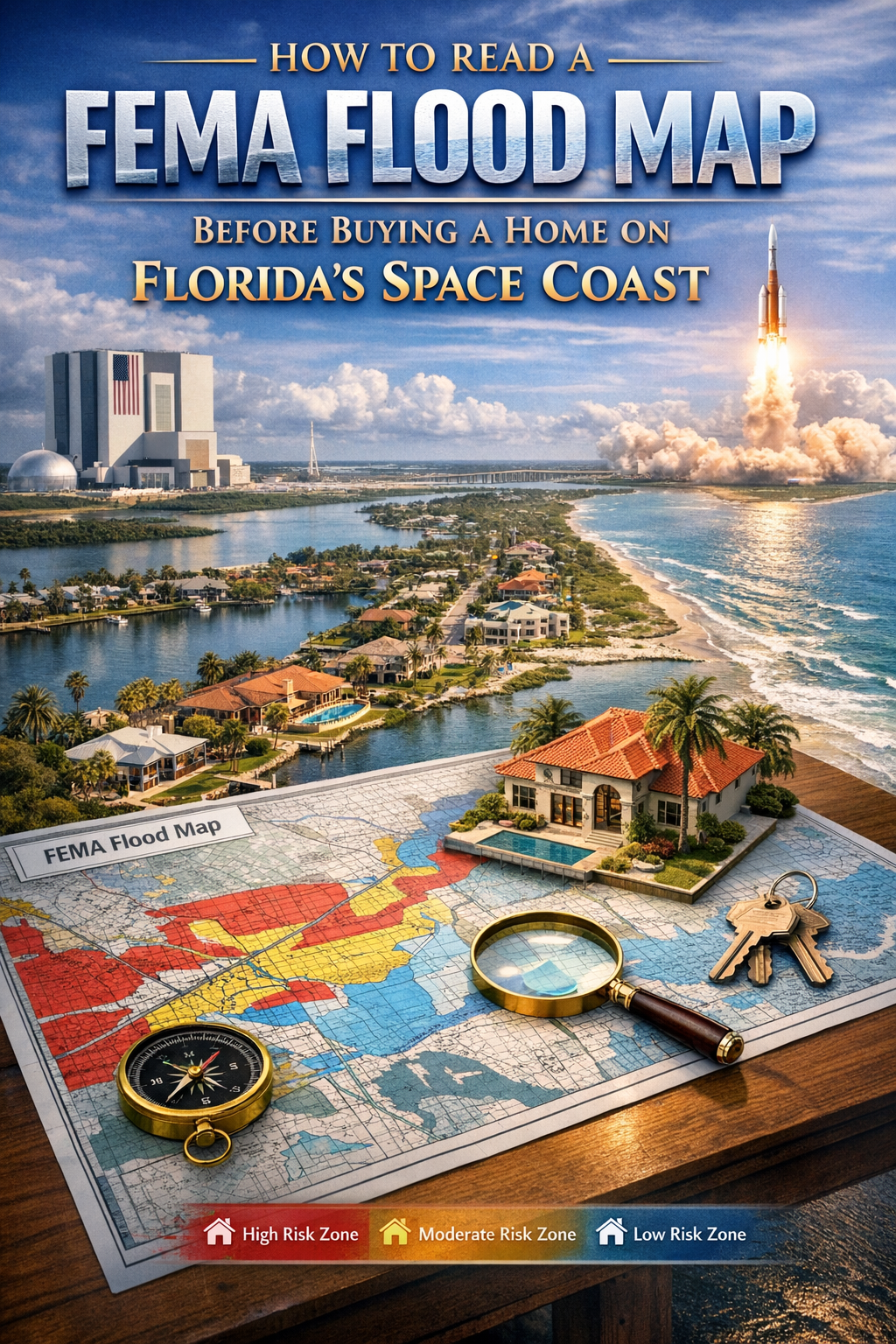
How to Read a FEMA Flood Map Before Buying a Home on Florida’s Space Coast
Published by Carrie Liotta | Top 5% REALTOR® in Brevard County, Florida | www.321coastalliving.com How to Read a FEMA Flood Map: Most buyers hear “flood zone” and think they understand what they’re dealing with. They don’t — and the gap between what buyers assume and what those designations actually mean in Brevard County costs people real money. A flood zone designation isn’t just an insurance category. It’s information about elevation, proximity to mapped water sources, the history of that specific parcel’s drainage behavior, and — with FEMA’s Risk Rating 2.0 methodology now in effect — a variable that feeds into a property-specific risk calculation that can produce insurance costs significantly different from what a neighbor three doors down pays. If you’re buying a home on Florida’s Space Coast, reading a FEMA flood map isn’t optional. Here’s how to actually do it — and what to do with what you find. What FEMA Flood Maps Are and Where to Find Them FEMA’s National Flood Insurance Program (NFIP) produces Flood Insurance Rate Maps, or FIRMs. These maps delineate flood zones based on statistical risk modeling — specifically, the probability of flooding in any given year. The maps are publicly available and searchable by address through FEMA’s Flood Map Service Center at msc.fema.gov. What you’ll find on a FIRM: flood zone designations, Base Flood Elevations (BFE), and the boundaries of Special Flood Hazard Areas (SFHA). Each of these terms has specific meaning, and misunderstanding any of them can lead to a materially incorrect assessment of a property’s flood risk and insurance cost. For Brevard County specifically, the Brevard County Property Appraiser’s website (bcpao.us) allows parcel-level lookup that includes flood zone information alongside tax, ownership, and assessment data. This is often a faster starting point than navigating FEMA’s map interface directly. Decoding Flood Zone Designations in Brevard County Not all flood zones are equal, and the letter-number system FEMA uses is more nuanced than most buyers realize. Here are the zones you’ll actually encounter on the Space Coast: Zone AE — The High-Risk Standard AE zones are Special Flood Hazard Areas with a 1% annual chance of flooding (the “100-year flood” designation) and a published Base Flood Elevation. Federally-backed mortgage lenders require flood insurance on properties in AE zones. In Brevard County, waterfront and canal-front properties in Merritt Island, Cocoa Beach, Cape Canaveral, and along the Indian River Lagoon corridor frequently carry AE designations. The Base Flood Elevation is the elevation to which floodwater is expected to rise during the 100-year flood event. A property’s first-floor elevation relative to BFE has a direct and material effect on flood insurance premium — a home built above BFE pays less than one at or below BFE, often significantly less. Zone X — The Moderate Risk Zone That Still Requires Attention Zone X (including Shaded Zone X and Unshaded Zone X) covers areas outside the 100-year floodplain or between the 100-year and 500-year floodplain. Federal flood insurance isn’t required in Zone X. But here’s what many buyers miss: a substantial percentage of flood claims in the United States come from properties in Zone X. Flood zone maps reflect modeled statistical risk, not ground-level drainage characteristics, and they’re updated infrequently. A Zone X property with drainage issues, proximity to tidal water, or specific topographic characteristics can flood during heavy rain events that wouldn’t touch an AE-zone neighbor. The practical advice: even in Zone X, requesting flood history for a specific property — through the seller, through Brevard County’s records, or through a CLUE (Comprehensive Loss Underwriting Exchange) report — is worth the time. Flood history doesn’t follow zone boundaries as neatly as the maps suggest. Zone VE — Coastal High Hazard VE zones are coastal high-hazard areas subject to wave action in addition to flooding. In Brevard County, true VE zone properties exist primarily along the beachfront in Cocoa Beach, Cape Canaveral, and along the direct Atlantic exposure. Insurance in VE zones is more expensive than AE, and building requirements for elevated foundations and breakaway walls apply. Most beachfront condos in Brevard were built under these requirements and are already compliant, but buyers should verify. “Reading the flood map is step one. Step two is understanding that the map is a static document — it doesn’t tell you about last year’s heavy rain, or the drainage characteristics of that specific canal, or whether the seller has ever filed a flood claim.” Base Flood Elevation: The Number That Actually Changes Your Insurance Cost Once you’ve identified the flood zone, the next number to find is the Base Flood Elevation. BFE is expressed in feet above NAVD 88 (North American Vertical Datum of 1988), the standard elevation reference used in FEMA flood mapping. To use BFE meaningfully, you need the property’s actual first-floor elevation — which is what an elevation certificate provides. An elevation certificate is a document prepared by a licensed land surveyor or engineer that certifies the specific elevation characteristics of a structure, including lowest adjacent grade, lowest floor elevation, and other data points FEMA uses to determine flood insurance rating. Sellers of waterfront or AE-zone properties in Brevard County may already have an elevation certificate on file. If one doesn’t exist, it’s worth requesting one as part of due diligence — or commissioning one yourself. The cost is typically a few hundred dollars. The value is knowing whether you’re buying a property at, above, or below BFE before you get a flood insurance quote, not after. FEMA’s Risk Rating 2.0: Why the Old Zone Logic No Longer Predicts Premium This is the shift that changed the calculus for Florida buyers, and it’s still not widely understood. FEMA’s legacy flood insurance pricing system used zone designations and BFE as the primary premium variables. Two houses in the same AE zone with similar elevations paid similar premiums. Risk Rating 2.0, implemented October 2021, replaced that system with a property-specific risk model. Each property now gets its own risk rating based on a more granular set of variables: The result: two waterfront properties on the same Merritt