


You are not a first-time buyer. You have owned property before. You know how to read a disclosure document and you are not intimidated by an inspection report. What you don’t have is 15 years of institutional knowledge about how real estate works specifically on Florida’s Space Coast — the waterway quirks, the insurance realities, the neighborhood distinctions that separate a smart waterfront purchase from an expensive learning experience. This post is written for you. It assumes a starting budget of $600k–$1M+, a genuine interest in waterfront access, and a preference for clear information over reassuring vagueness. It also assumes you are either considering Merritt Island as a primary location or trying to decide between Merritt Island, Cocoa Beach, and Viera — which is the comparison that comes up most consistently among informed Space Coast buyers. The Three-Location Decision: Merritt Island vs. Cocoa Beach vs. Viera Every serious Space Coast relocation buyer eventually faces this comparison. They are not interchangeable, and the right answer depends entirely on what you actually prioritize. Merritt Island: The Waterfront Value Play Merritt Island is the choice for buyers who want genuine waterfront access — boat in the backyard, lagoon or canal views — without paying Cocoa Beach premiums. At the $650k–$900k range, Merritt Island delivers more square footage, larger lots, and genuine boating access compared to what the same money buys oceanside. The trade-offs are real: Merritt Island does not have the walkable beach-town culture of Cocoa Beach. Restaurant and retail density is lower. The feel is quieter, more residential, less social. For buyers who are going to be on the water more than they’re going to be walking to dinner, this is a reasonable trade. Cocoa Beach: Premium Brand, Ocean Proximity Cocoa Beach commands a price premium that is brand-driven as much as fundamentals-driven. The walkability to the beach, the surf culture, the name recognition — these have real value, but they translate to a thinner product at the $700k–$900k price point. You are buying a smaller home, possibly on a narrower canal, with the understanding that the address itself carries cultural cachet. For buyers who plan to use the property as a short-term rental during periods they’re not using it, Cocoa Beach has stronger income potential due to tourism demand. For buyers who will occupy full-time, the calculus depends on whether the beach-town lifestyle is genuinely how they want to spend weekends or whether it’s an image they’re buying. Viera: Master-Planned, Newer, Less Water Viera is not a waterfront option in any meaningful sense — the community has lakes and ponds, not navigable waterways. What it offers instead is newer construction, strong school districts, reliable HOA management, and predictable infrastructure. For aerospace buyers who want simplicity, newer systems, and a shorter drive to I-95 for travel flexibility, Viera makes rational sense. Viera’s resale market is among the most stable in Brevard County because product is newer, buyers are familiar with the community structure, and the lack of waterfront complexity means fewer surprises at inspection. For buyers who want waterfront access occasionally (paddleboarding, kayaking) but don’t need to dock a boat in their backyard, Viera offers community amenities that check that box at a fraction of the premium. “Having moved from out of state, buying my dream home in Suntree, Melbourne, Florida would not have been possible without Carrie Liotta! From start to finish, she went above and beyond to make the process smooth, stress-free, and even exciting.” The Neighborhood-Level Comparison That Matters Factor Merritt Island Cocoa Beach Viera Waterfront access Canal + lagoon frontage available Canal + limited oceanfront Lakes/ponds only Price/sq ft (canal) $275–$450 $400–$600 N/A Commute to Patrick SFB 20–30 min (south) 10–20 min 35–50 min Commute to KSC/SpaceX 25–40 min 35–50 min 30–45 min Short-term rental potential Moderate High Low-moderate New construction availability Limited Very limited Strong School district quality Good Good Excellent Walkability/amenities Low-moderate High Moderate Boater lifestyle fit Strong Moderate-strong Weak The question isn’t which community is better. It’s which one is actually right for how you plan to live — and that requires honesty about what you’ll use versus what sounds appealing in the abstract. Understanding the Space Coast Insurance Environment Why This Comes Before the Offer Most buyers in non-coastal markets treat insurance as an afterthought — something to sort out 30 days before closing. In Brevard County, that approach leads to budget surprises that can derail or complicate a transaction that otherwise checked every box. Florida homeowner’s insurance rates have increased substantially since 2021, following a period of carrier exits from the market, legislative reforms, and reassessment of hurricane risk modeling. As of 2024–2025, Brevard County homeowners on waterfront properties typically see combined homeowner and flood insurance annual premiums in the range of $8,000–$20,000+ depending on construction year, roof condition, elevation, flood zone, and replacement cost value. The Windstorm Mitigation Credit System Florida has a system of windstorm mitigation credits that can reduce insurance premiums by 30–60% on eligible homes. The credits are triggered by specific construction features: hip roof geometry, roof deck attachment quality, roof covering type, opening protection (impact windows/doors), and roof-to-wall connections. A wind mitigation inspection, which costs $150–$300, documents which credits apply. For buyers purchasing older homes on Merritt Island or Cocoa Beach, one of the highest-ROI upgrades available is installing impact-rated windows and doors — not just for storm protection, but specifically to unlock the opening protection windstorm credit. In some cases, the annual insurance savings exceed the amortized cost of the upgrade within 5–7 years. Citizens Insurance and the Takeout Market Citizens Property Insurance is Florida’s insurer of last resort. Many Space Coast waterfront properties are currently insured through Citizens, particularly those where private market options are limited due to age, proximity to water, or prior claims history. Florida’s Citizens depopulation program means that policies may be removed from Citizens and placed with private carriers — sometimes with rate changes — during the life of your ownership. If the property you’re considering is currently insured through Citizens, ask for the Citizens policy number and verify the current premium, coverage
Space Coast real estate is shaped by beaches, boating, rocket launches, aerospace jobs, military relocation, waterfront living, and Brevard County’s city-by-city lifestyle differences. This hub collects Carrie Liotta’s local guidance on moving to Florida’s Space Coast, comparing communities, understanding market trends, choosing the right area, and planning a smarter buyer or seller strategy.

What Every Buyer Gets Wrong About Waterfront Real Estate on the Space Coast — And How to Avoid Those Mistakes | Carrie Liotta, Trusted Realtor
Waterfront Real Estate on the Space Coast: Most people who buy waterfront property on Merritt Island or Cocoa Beach make their decision based on how a home looks in photos. The dock photograph. The sunset over the canal. The boat tied up out back. What they don’t see — and what nobody shows them — is whether that boat can actually go anywhere, whether the seawall behind that photo has 18 months or 18 years left on it, and whether the flood insurance premium they’ll be quoted 60 days after closing was something they could have anticipated. These aren’t obscure fine-print issues. They are common, predictable, and avoidable. The problem is that the information required to navigate them lives in the intersection of local waterway knowledge, Florida insurance regulations, structural engineering, and real estate transaction mechanics — a combination most buyers don’t have and most agents don’t either. What follows is what the research-mode buyer needs to understand before making an offer on Space Coast waterfront property. Waterfront Real Estate on the Space Coast: The Three Things That Actually Determine Waterfront Value 1. Access Quality — Not Just Access The listing will say ‘canal front.’ What it won’t say is whether the canal has 3.5 feet of depth or 7, whether there’s a fixed bridge with 11 feet of clearance a quarter mile downstream, or whether the canal terminates without connecting to the main lagoon system. Access quality is what you can actually do with the water, not whether your backyard touches it. In practical terms: a canal-front home with poor access may give you a beautiful view and the ability to kayak. That’s genuinely pleasant. But if you’re paying a $150,000 waterfront premium expecting to keep and run a 28-foot center console, a canal that can’t accommodate that boat at low tide is not the product you thought you were buying. The way to evaluate access quality: hire a marine surveyor before you’re under contract or as a condition of the contract. This is the single most underused form of due diligence in Space Coast waterfront transactions. 2. Seawall Generation and Remaining Life Merritt Island and Cocoa Beach waterfront homes were largely developed in three waves: the post-war 1950s–60s boom, the 1990s–2000s infill, and newer construction. Seawalls built in the first generation are now approaching 60–70 years old. Many are still structurally sound. Some are not. The ones that aren’t can cost $100,000–$200,000 to replace, depending on linear footage and site conditions. Seawall age and condition do not show up in a standard home inspection. A standard home inspector will note visible cracks or obvious signs of failure, but a thorough seawall assessment requires a marine contractor or structural specialist. For any waterfront property where you intend to stay 10+ years, this is worth the $400–$700 it typically costs. The way to estimate seawall generation without hiring anyone: ask the listing agent for the original construction date of the wall. If they don’t know, check Brevard County permit records through the county’s permit search portal. Any seawall replacement would have required a permit, so the records should indicate whether the wall has been replaced and when. “Carrie Liotta made buying my waterfront home in Cocoa Beach an incredible experience! She’s truly a Cocoa Beach waterfront property expert and knows the local market inside and out.” 3. Insurance Positioning Under FEMA Risk Rating 2.0 Florida homeowners insurance is a complex topic that deserves its own post. For waterfront-specific buyers, the single most important development of the last four years is FEMA’s Risk Rating 2.0, which took full effect in 2023 and completely overhauled how National Flood Insurance Program premiums are calculated. Under the old system, flood insurance rates were based primarily on FEMA flood map zone designations. Under Risk Rating 2.0, they’re based on property-specific risk factors including distance to the nearest flooding source, first floor elevation, foundation type, and replacement cost value. The result is that two homes on the same street with identical flood zone designations can have dramatically different flood insurance premiums. The implication for buyers: ask for the current flood insurance premium from the seller, and get an independent quote before closing. Sellers are required to disclose this in Florida, but buyers often receive it without understanding what they’re looking at. A flood insurance premium that has been set under pre-Rating 2.0 rules and is still being transferred at a legacy rate will reset when you take ownership. For accurate current estimates, you can contact an independent flood insurance broker or use FEMA’s Flood Map Service Center at msc.fema.gov to locate your property’s current designation and cross-reference it with the NFIP rate calculator. The flood insurance question isn’t whether you need it. It’s what the current premium actually is, what it will be after closing, and what it could become in five years. How the Space Coast Waterfront Market Actually Works Merritt Island vs. Cocoa Beach: The Value Trade-Off These are adjacent communities with very different price-per-square-foot dynamics. Cocoa Beach commands a premium driven primarily by its oceanside brand, walkability to the beach, and strong short-term rental demand. On the canal side, Cocoa Beach waterfront homes run roughly $400–$600 per square foot for reasonably updated product. Merritt Island waterfront, for comparable canal-front access, typically runs $275–$450 per square foot — meaningfully lower. The trade-off: Merritt Island has less walkability, no direct beach access on the eastern side, and a quieter, more suburban character. For buyers who are choosing between a smaller renovated home on Cocoa Beach canals and a larger updated home on Merritt Island canals with equivalent boat access, the Merritt Island property is frequently the better value proposition for long-term owners. The exception: lagoon-front properties (not canal-front, but properties directly on the Indian River or Banana River with unobstructed water views) close the gap considerably. Lagoon-front Merritt Island commands prices that approach or match Cocoa Beach canal-front in comparable size categories. What the Listing Doesn’t Tell You: The Real Table What the Listing Says What You Actually Need to Know Canal frontage Canal depth at low

How to Read a FEMA Flood Map Before Buying a Home on Florida’s Space Coast | Carrie Liotta, Trusted Realtor
Published by Carrie Liotta | Top 5% REALTOR® in Brevard County, Florida | www.321coastalliving.com Buying a Home on Florida’s Space Coast: Most buyers hear “flood zone” and think they understand what they’re dealing with. They don’t — and the gap between what buyers assume and what those designations actually mean in Brevard County costs people real money. A flood zone designation isn’t just an insurance category. It’s information about elevation, proximity to mapped water sources, the history of that specific parcel’s drainage behavior, and — with FEMA’s Risk Rating 2.0 methodology now in effect — a variable that feeds into a property-specific risk calculation that can produce insurance costs significantly different from what a neighbor three doors down pays. If you’re buying a home on Florida’s Space Coast, reading a FEMA flood map isn’t optional. Here’s how to actually do it — and what to do with what you find. Buying a Home on Florida’s Space Coast: What FEMA Flood Maps Are and Where to Find Them FEMA’s National Flood Insurance Program (NFIP) produces Flood Insurance Rate Maps, or FIRMs. These maps delineate flood zones based on statistical risk modeling — specifically, the probability of flooding in any given year. The maps are publicly available and searchable by address through FEMA’s Flood Map Service Center at msc.fema.gov. What you’ll find on a FIRM: flood zone designations, Base Flood Elevations (BFE), and the boundaries of Special Flood Hazard Areas (SFHA). Each of these terms has specific meaning, and misunderstanding any of them can lead to a materially incorrect assessment of a property’s flood risk and insurance cost. For Brevard County specifically, the Brevard County Property Appraiser’s website (bcpao.us) allows parcel-level lookup that includes flood zone information alongside tax, ownership, and assessment data. This is often a faster starting point than navigating FEMA’s map interface directly. Decoding Flood Zone Designations in Brevard County Not all flood zones are equal, and the letter-number system FEMA uses is more nuanced than most buyers realize. Here are the zones you’ll actually encounter on the Space Coast: Zone AE — The High-Risk Standard AE zones are Special Flood Hazard Areas with a 1% annual chance of flooding (the “100-year flood” designation) and a published Base Flood Elevation. Federally-backed mortgage lenders require flood insurance on properties in AE zones. In Brevard County, waterfront and canal-front properties in Merritt Island, Cocoa Beach, Cape Canaveral, and along the Indian River Lagoon corridor frequently carry AE designations. The Base Flood Elevation is the elevation to which floodwater is expected to rise during the 100-year flood event. A property’s first-floor elevation relative to BFE has a direct and material effect on flood insurance premium — a home built above BFE pays less than one at or below BFE, often significantly less. Zone X — The Moderate Risk Zone That Still Requires Attention Zone X (including Shaded Zone X and Unshaded Zone X) covers areas outside the 100-year floodplain or between the 100-year and 500-year floodplain. Federal flood insurance isn’t required in Zone X. But here’s what many buyers miss: a substantial percentage of flood claims in the United States come from properties in Zone X. Flood zone maps reflect modeled statistical risk, not ground-level drainage characteristics, and they’re updated infrequently. A Zone X property with drainage issues, proximity to tidal water, or specific topographic characteristics can flood during heavy rain events that wouldn’t touch an AE-zone neighbor. The practical advice: even in Zone X, requesting flood history for a specific property — through the seller, through Brevard County’s records, or through a CLUE (Comprehensive Loss Underwriting Exchange) report — is worth the time. Flood history doesn’t follow zone boundaries as neatly as the maps suggest. Zone VE — Coastal High Hazard VE zones are coastal high-hazard areas subject to wave action in addition to flooding. In Brevard County, true VE zone properties exist primarily along the beachfront in Cocoa Beach, Cape Canaveral, and along the direct Atlantic exposure. Insurance in VE zones is more expensive than AE, and building requirements for elevated foundations and breakaway walls apply. Most beachfront condos in Brevard were built under these requirements and are already compliant, but buyers should verify. “Reading the flood map is step one. Step two is understanding that the map is a static document — it doesn’t tell you about last year’s heavy rain, or the drainage characteristics of that specific canal, or whether the seller has ever filed a flood claim.” Base Flood Elevation: The Number That Actually Changes Your Insurance Cost Once you’ve identified the flood zone, the next number to find is the Base Flood Elevation. BFE is expressed in feet above NAVD 88 (North American Vertical Datum of 1988), the standard elevation reference used in FEMA flood mapping. To use BFE meaningfully, you need the property’s actual first-floor elevation — which is what an elevation certificate provides. An elevation certificate is a document prepared by a licensed land surveyor or engineer that certifies the specific elevation characteristics of a structure, including lowest adjacent grade, lowest floor elevation, and other data points FEMA uses to determine flood insurance rating. Sellers of waterfront or AE-zone properties in Brevard County may already have an elevation certificate on file. If one doesn’t exist, it’s worth requesting one as part of due diligence — or commissioning one yourself. The cost is typically a few hundred dollars. The value is knowing whether you’re buying a property at, above, or below BFE before you get a flood insurance quote, not after. FEMA’s Risk Rating 2.0: Why the Old Zone Logic No Longer Predicts Premium This is the shift that changed the calculus for Florida buyers, and it’s still not widely understood. FEMA’s legacy flood insurance pricing system used zone designations and BFE as the primary premium variables. Two houses in the same AE zone with similar elevations paid similar premiums. Risk Rating 2.0, implemented October 2021, replaced that system with a property-specific risk model. Each property now gets its own risk rating based on a more granular set of variables: The result:
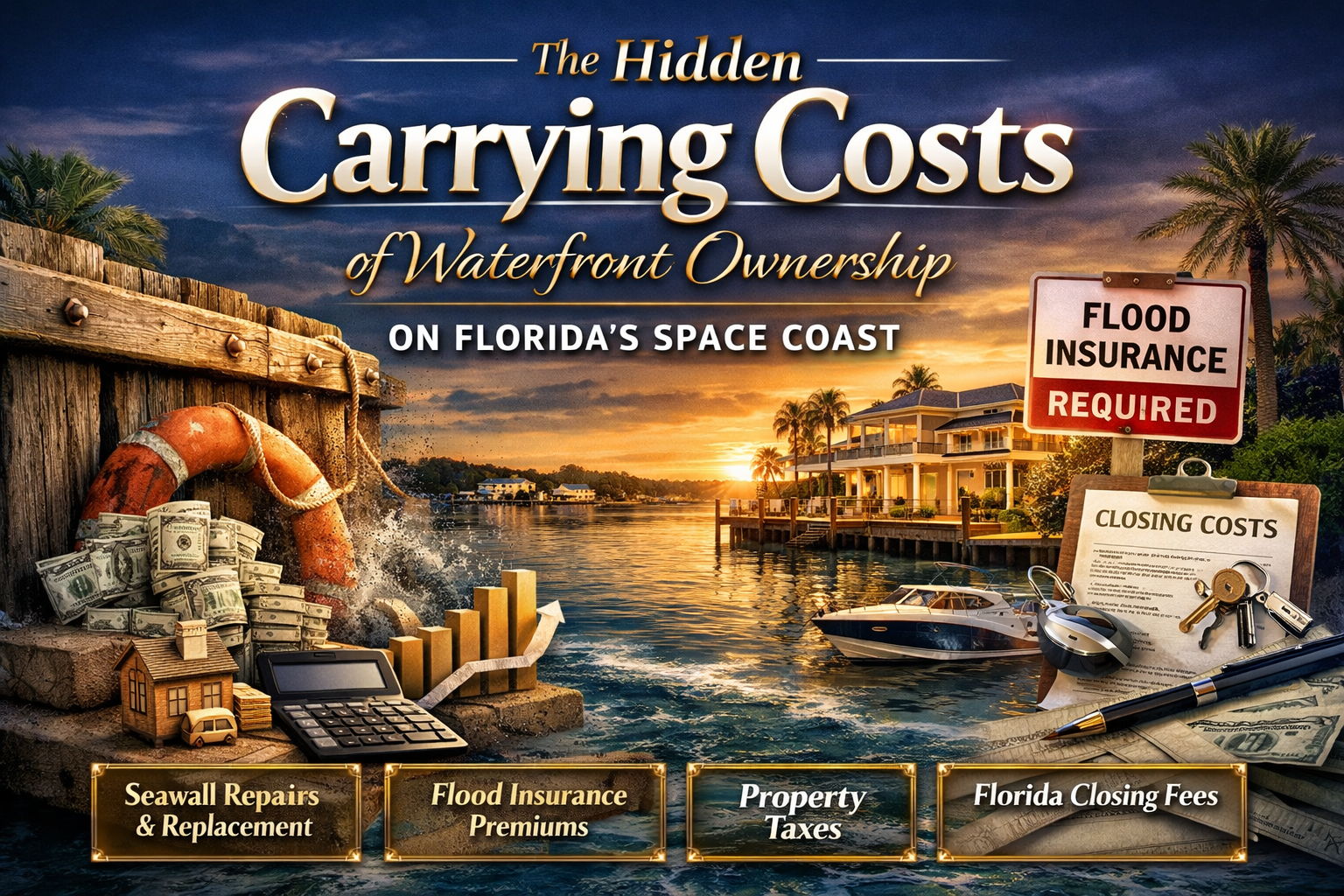
The Hidden Carrying Costs of Waterfront Ownership on Florida’s Space Coast | Carrie Liotta, Trusted Realtor
By Carrie Liotta | Space Coast Waterfront Realtor | www.321coastalliving.com | YouTube Waterfront Ownership on Florida’s Space Coast: The listing price is only the beginning of the financial picture. Buyers who approach waterfront real estate on Merritt Island with a purchase-price-only lens often find themselves recalculating within the first year of ownership. Not because anyone misled them — but because the carrying costs of waterfront property operate on a different logic, and most agents either do not understand them deeply or do not want to complicate the conversation. I want you to be prepared. That phrase drives everything I do with buyers relocating to this market. People looking for a top-rated Merritt Island FL real estate agent for waterfront deserve more than a tour and a contract. They deserve a complete financial picture — before they fall in love with a dock they cannot afford to maintain. Understanding Seawall Infrastructure as an Ownership Cost Waterfront Ownership on Florida’s Space Coast: The Three Generations of Seawalls on Merritt Island Here is something most listings will not tell you: seawall age is one of the most consequential variables in the long-term cost of owning waterfront on the Space Coast. Working as a Merritt Island real estate waterfront specialist, I walk buyers through this distinction on every showing. First-generation seawalls from the 1960s are approaching end of their practical service life. If you are buying a property with one of these — often wood, sometimes early concrete — you need to budget for a full replacement. In East Central Florida, that cost runs $500 to $600 per linear foot for a new vinyl installation. On a standard lot with 80 feet of waterfront, you are looking at $40,000 to $50,000 as a near-term capital event. You need to prepare to spend that money, and it belongs in the price you offer, not in a surprise a year after closing. Second-generation seawalls installed around 2000 typically have 10 to 20 years of service life remaining, assuming reasonable maintenance. These are worth inspecting carefully and budgeting for eventual replacement. Brand-new vinyl seawalls give you decades of essentially worry-free use. Local marine contractors specializing in Brevard County consistently recommend vinyl for new installations specifically because it resists marine borers — the small mollusks that make wood unviable in these waters — and holds up to UV exposure without the degradation that affects most other materials. Brevard County’s marine contractor licensing requirements ensure that replacement work is done to current county standards. How to Read a Seawall During Due Diligence Request from sellers: Any maintenance records, inspection reports, or contractor invoices. The absence of records is itself information — it tells you the due diligence inspection becomes more critical, not optional. Look for physically: Cap cracks, voids or soft spots near the wall, panel separation, evidence of soil migration, active seepage during tidal changes, or outward bowing. Any of these is a flag that warrants a professional marine inspection before you close. What the inspection covers: A licensed marine contractor will assess structural panels, the cap, backfill condition, and hydrostatic pressure balance. Void mapping — identifying where soil has migrated away from the wall before surface signs appear — is the inspection step that catches the expensive problems early. This inspection typically costs a few hundred dollars and can save tens of thousands. “Carrie is a very experienced realtor very happy we chose her. She goes the extra mile to give her clients a great experience.” — Verified Client, Brevard County Budgeting for Seawall as a Long-Term Owner The framework I give every buyer: think in three tiers. Annual maintenance — inspections, minor crack sealing, cap maintenance — runs $500 to $1,500 per year. Periodic repair work — void filling, panel sealing, hydrostatic filter installation — may run $5,000 to $20,000 every 10 to 15 years on a well-maintained wall. Full replacement is the long-term capital event at $500 to $600 per linear foot for vinyl. Staging these costs into a long-term ownership budget — rather than treating them as emergencies — is what separates experienced waterfront owners from buyers who feel blindsided. “Waterfront ownership rewards people who plan for the infrastructure, not just the lifestyle.” Flood Zones After the Revision: A More Complex Landscape Why the Map Revision Matters for Today’s Buyers Brevard County received the first major revision to its FEMA flood maps in 25 years, and the results were not uniform. Portions of North Merritt Island moved into designated flood zones. Canal-front properties along the Indian River Lagoon saw a mixed picture — some reclassified into higher-risk zones, others removed from classifications they had held for decades. The revision used updated storm surge modeling that produces far more granular, parcel-level risk profiles than the previous maps allowed. For buyers searching for top-rated Merritt Island FL real estate waterfront properties, this means the flood zone status that applied when the current owner purchased may be fundamentally different from what applies when you purchase. I verify the current FEMA designation for every property before we discuss an offer. You can do the same at msc.fema.gov — type in the address, pull the current map, and verify before you visit the house, not after. The Cost Difference Between Flood Zone Classifications A property outside a Special Flood Hazard Area carries no lender-required flood insurance. A property within a FEMA-designated high-risk zone requires it as a mortgage condition, at costs ranging from roughly $1,500 to over $5,000 annually. The elevation certificate — obtained through a licensed surveyor — is the document that determines how a property is rated. Many waterfront homes in Merritt Island are elevated, and buyers who obtain an elevation certificate during due diligence often find the insurance cost more manageable than the raw flood zone designation initially suggested. FloodSmart.gov provides a clear plain-language breakdown of how flood risk is assessed and rated. Storm Surge vs. Rainfall Flooding The FEMA revision specifically incorporated updated storm surge modeling, which reflects a different risk type than rainfall-driven flooding. Merritt Island’s geography — between the Indian River Lagoon and the Banana River — creates a dual exposure profile. Understanding which risk type a flood zone designation reflects for a given property
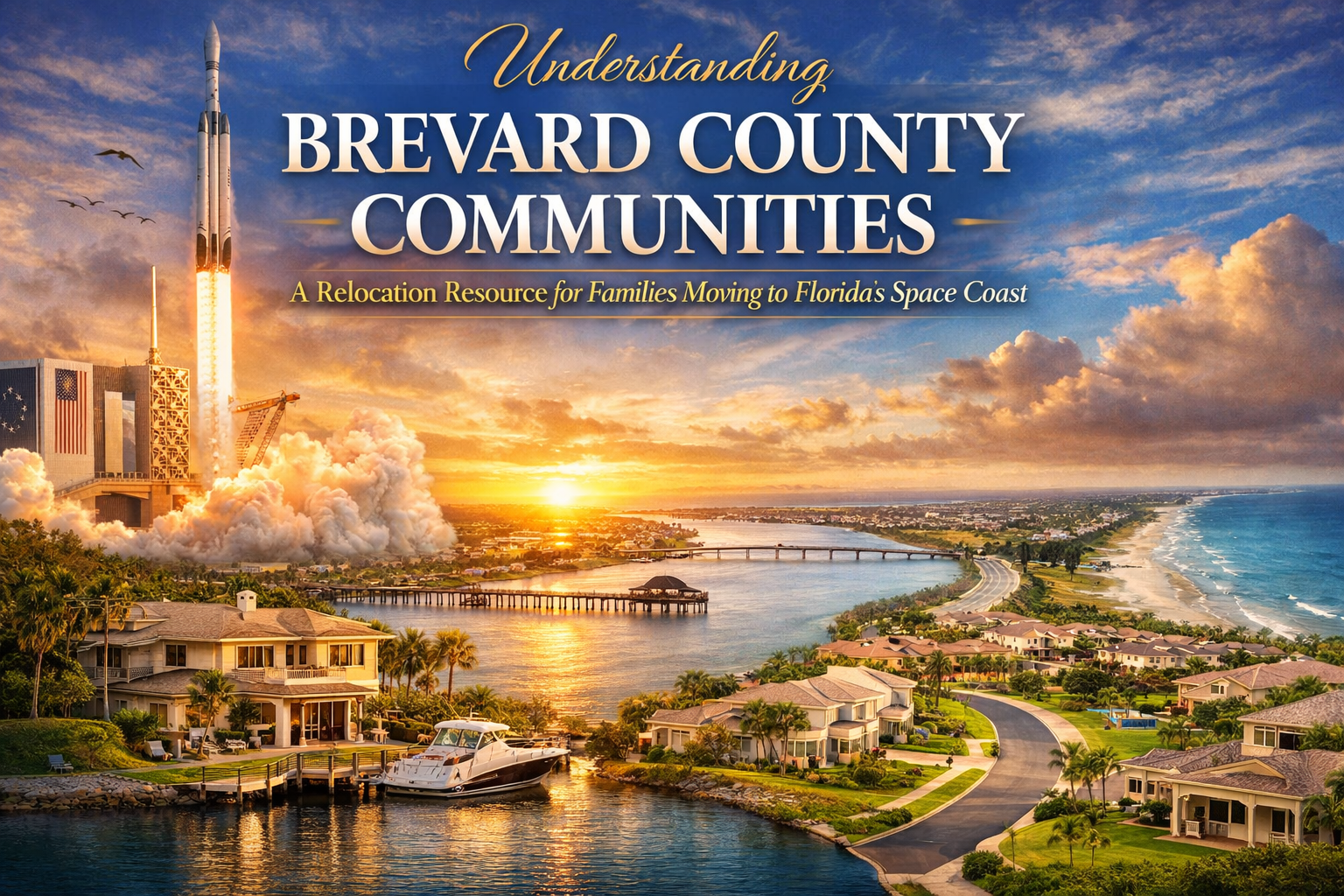
Understanding Brevard County Communities: A Relocation Resource for Families Moving to Florida’s Space Coast | Carrie Liotta Trusted Realtor
Relocation Resource for Families Moving to Florida’s Space Coast: Most relocation searches start with the school. The school influences the neighborhood, the neighborhood shapes the commute, and the commute determines whether the move actually works for your family. When that search brings you to Florida’s Space Coast, it gets interesting fast — because Brevard County’s communities aren’t organized the way many relocating families expect, and the relationship between school programs, neighborhood character, and property type is more nuanced than a quick online search suggests. For a broader countywide starting point, see Carrie’s full guide to moving to Florida’s Space Coast. If you want help turning school, commute, and lifestyle research into a focused home search, Carrie can guide you as your Space Coast relocation Realtor. What follows is an informational overview of Brevard County’s communities, the types of school programs available in each area, and how to think about lifestyle tradeoffs when evaluating where to buy. This guide is intended to help you ask better questions — not to steer your decision. Every family’s needs are different, and the right community depends entirely on your priorities. If you’d like to talk through these communities with a Space Coast REALTOR® who specializes in buyer and military relocation, visit 321coastalliving.com or watch Carrie’s Space Coast neighborhood guides at youtube.com/@CarrieLiottaSpaceCoastRealtor. Relocation Resource for Families Moving to Florida’s Space Coast: How Brevard County Schools Are Structured Brevard County Public Schools (BCPS) is a countywide district serving roughly 75,000 students across a county that runs nearly 72 miles from Titusville in the north to Palm Bay in the south. The district consistently ranks as one of Florida’s higher-performing large county school systems, and several of its specialized programs — particularly in STEM and aerospace-related education — are genuinely distinct. Florida uses a school grading system (A through F) administered by the Florida Department of Education. Performance varies by school and grade level, and understanding how programs are distributed across the county matters because the county is large enough that a rating alone tells you very little about where you’d actually be living. The communities that come up most often in relocation conversations include Viera and West Melbourne in the south-central county, Suntree in the planned community corridor, Merritt Island on the barrier island, and Cocoa Beach along the coast. Each has a different character, a different price point, and different tradeoffs worth understanding. I encourage every relocating family to research school options directly using the Florida Department of Education’s school search tool and Brevard County Public Schools, and to visit schools and communities in person before making a decision. Viera: A Purpose-Built Planned Community Viera comes up frequently in relocation conversations, and it’s worth understanding why. It’s a master-planned community with relatively newer school buildings, organized residential development, and a range of community amenities. Many of its schools carry A-ratings from the Florida Department of Education and score above state averages on standardized assessments — you can verify current ratings at fldoe.org. Families relocating to Viera often work with a Best Viera Real Estate Agent who can walk them through both the school programs and the new construction inventory across the corridor. If you’re evaluating top real estate agents in Viera, look for someone who has worked extensively with out-of-state families and understands the nuances of HOA communities, builder contracts, and the local inspection process. You can explore Viera listings and find a Viera Florida real estate agent who specializes in buyer relocation at 321coastalliving.com. The tradeoffs are real: Viera is genuinely suburban. It’s not walkable to a beach, it doesn’t have the waterfront character of Merritt Island, and the commute to Kennedy Space Center runs 30–40 minutes north depending on your specific address and traffic. Viera Schools Worth Researching Viera High School has developed AP programs and career academy pathways including aerospace and STEM tracks. Viera Charter School operates separately and has waitlist dynamics that out-of-state buyers should research before assuming enrollment is available. The Brevard School of Integrated Curriculum (BSIC) at the Viera campus is another option worth knowing about. Current ratings for all Brevard schools are available at brevardschools.org. “Having moved from out of state, buying my dream home in Suntree, Melbourne, Florida would not have been possible without Carrie Liotta. Carrie knows the Space Coast inside and out, and her expertise in the Melbourne real estate market is unmatched. She listened to exactly what I wanted and negotiated an incredible deal.” — Verified Suntree, Melbourne Client Merritt Island: A Barrier Island Community with Waterfront Character Merritt Island occupies a position in Brevard County that no other community quite replicates. Situated between the Banana River and Indian River Lagoon, with direct causeway access to Cocoa Beach and close proximity to Kennedy Space Center, it’s the community where waterfront lifestyle and aerospace employment most naturally converge on the Space Coast. Families considering Merritt Island waterfront living frequently search for a Merritt Island waterfront living real estate agent who understands both the school landscape and the water — because the due diligence questions span both. Buying real estate in Merritt Island, FL waterfront means evaluating canal depth, seawall condition, flood zone designation, and dock permit history in addition to the typical buyer checklist. A top rated Merritt Island real estate waterfront specialist will walk you through all of it. Carrie Liotta is a top rated waterfront specialist and the best realtor for waterfront homes in Merritt Island, Florida for buyers who want someone who knows the technical side of barrier island real estate — not just the lifestyle pitch. Explore Merritt Island FL real estate waterfront listings and connect with Carrie at 321coastalliving.com. For waterfront due diligence context, the FEMA Flood Map Service Center is the authoritative source for flood zone designations, and the Brevard County Property Appraiser provides parcel data including lot dimensions and ownership history. Both are worth bookmarking before you start making offers on canal-front or river-view properties. Property inventory on Merritt Island skews older on average than Viera — many single-family homes along the canals were built in the 1960s through 1980s. Buyers evaluating waterfront properties here should be prepared for older infrastructure considerations including seawall inspection, bridge clearance, and FEMA Risk Rating 2.0 flood insurance impacts. These

How to Read a FEMA Flood Map Before Buying a Home on Florida’s Space Coast
Published by Carrie Liotta | Top 5% REALTOR® in Brevard County, Florida | www.321coastalliving.com How to Read a FEMA Flood Map: Most buyers hear “flood zone” and think they understand what they’re dealing with. They don’t — and the gap between what buyers assume and what those designations actually mean in Brevard County costs people real money. A flood zone designation isn’t just an insurance category. It’s information about elevation, proximity to mapped water sources, the history of that specific parcel’s drainage behavior, and — with FEMA’s Risk Rating 2.0 methodology now in effect — a variable that feeds into a property-specific risk calculation that can produce insurance costs significantly different from what a neighbor three doors down pays. If you’re buying a home on Florida’s Space Coast, reading a FEMA flood map isn’t optional. Here’s how to actually do it — and what to do with what you find. What FEMA Flood Maps Are and Where to Find Them FEMA’s National Flood Insurance Program (NFIP) produces Flood Insurance Rate Maps, or FIRMs. These maps delineate flood zones based on statistical risk modeling — specifically, the probability of flooding in any given year. The maps are publicly available and searchable by address through FEMA’s Flood Map Service Center at msc.fema.gov. What you’ll find on a FIRM: flood zone designations, Base Flood Elevations (BFE), and the boundaries of Special Flood Hazard Areas (SFHA). Each of these terms has specific meaning, and misunderstanding any of them can lead to a materially incorrect assessment of a property’s flood risk and insurance cost. For Brevard County specifically, the Brevard County Property Appraiser’s website (bcpao.us) allows parcel-level lookup that includes flood zone information alongside tax, ownership, and assessment data. This is often a faster starting point than navigating FEMA’s map interface directly. Decoding Flood Zone Designations in Brevard County Not all flood zones are equal, and the letter-number system FEMA uses is more nuanced than most buyers realize. Here are the zones you’ll actually encounter on the Space Coast: Zone AE — The High-Risk Standard AE zones are Special Flood Hazard Areas with a 1% annual chance of flooding (the “100-year flood” designation) and a published Base Flood Elevation. Federally-backed mortgage lenders require flood insurance on properties in AE zones. In Brevard County, waterfront and canal-front properties in Merritt Island, Cocoa Beach, Cape Canaveral, and along the Indian River Lagoon corridor frequently carry AE designations. The Base Flood Elevation is the elevation to which floodwater is expected to rise during the 100-year flood event. A property’s first-floor elevation relative to BFE has a direct and material effect on flood insurance premium — a home built above BFE pays less than one at or below BFE, often significantly less. Zone X — The Moderate Risk Zone That Still Requires Attention Zone X (including Shaded Zone X and Unshaded Zone X) covers areas outside the 100-year floodplain or between the 100-year and 500-year floodplain. Federal flood insurance isn’t required in Zone X. But here’s what many buyers miss: a substantial percentage of flood claims in the United States come from properties in Zone X. Flood zone maps reflect modeled statistical risk, not ground-level drainage characteristics, and they’re updated infrequently. A Zone X property with drainage issues, proximity to tidal water, or specific topographic characteristics can flood during heavy rain events that wouldn’t touch an AE-zone neighbor. The practical advice: even in Zone X, requesting flood history for a specific property — through the seller, through Brevard County’s records, or through a CLUE (Comprehensive Loss Underwriting Exchange) report — is worth the time. Flood history doesn’t follow zone boundaries as neatly as the maps suggest. Zone VE — Coastal High Hazard VE zones are coastal high-hazard areas subject to wave action in addition to flooding. In Brevard County, true VE zone properties exist primarily along the beachfront in Cocoa Beach, Cape Canaveral, and along the direct Atlantic exposure. Insurance in VE zones is more expensive than AE, and building requirements for elevated foundations and breakaway walls apply. Most beachfront condos in Brevard were built under these requirements and are already compliant, but buyers should verify. “Reading the flood map is step one. Step two is understanding that the map is a static document — it doesn’t tell you about last year’s heavy rain, or the drainage characteristics of that specific canal, or whether the seller has ever filed a flood claim.” Base Flood Elevation: The Number That Actually Changes Your Insurance Cost Once you’ve identified the flood zone, the next number to find is the Base Flood Elevation. BFE is expressed in feet above NAVD 88 (North American Vertical Datum of 1988), the standard elevation reference used in FEMA flood mapping. To use BFE meaningfully, you need the property’s actual first-floor elevation — which is what an elevation certificate provides. An elevation certificate is a document prepared by a licensed land surveyor or engineer that certifies the specific elevation characteristics of a structure, including lowest adjacent grade, lowest floor elevation, and other data points FEMA uses to determine flood insurance rating. Sellers of waterfront or AE-zone properties in Brevard County may already have an elevation certificate on file. If one doesn’t exist, it’s worth requesting one as part of due diligence — or commissioning one yourself. The cost is typically a few hundred dollars. The value is knowing whether you’re buying a property at, above, or below BFE before you get a flood insurance quote, not after. FEMA’s Risk Rating 2.0: Why the Old Zone Logic No Longer Predicts Premium This is the shift that changed the calculus for Florida buyers, and it’s still not widely understood. FEMA’s legacy flood insurance pricing system used zone designations and BFE as the primary premium variables. Two houses in the same AE zone with similar elevations paid similar premiums. Risk Rating 2.0, implemented October 2021, replaced that system with a property-specific risk model. Each property now gets its own risk rating based on a more granular set of variables: The result: two waterfront properties on the same Merritt

Condo vs. Single-Family on the Space Coast: What Buyers Need to Know Right Now, Carrie Liotta Trusted Realtor
Published by Carrie Liotta | Top 5% REALTOR® in Brevard County, Florida | www.321coastalliving.com Condo vs. Single-Family on the Space Coast: Here the version of this question most buyers get online: a surface-level comparison of HOA fees, shared walls, and maintenance responsibilities. What they rarely get is an honest breakdown of what those differences actually mean when you’re buying near water, in a hurricane-prone coastal county, under Florida’s evolving condo legislation — with real money on the line. If you’re relocating to Florida’s Space Coast and weighing whether to buy a condo or a single-family home in Brevard County, the answer isn’t philosophical. It’s operational. It depends on how you actually intend to live, what your risk tolerance looks like post-Surfside legislation, and whether you’ve looked carefully at what the numbers say right now — not two years ago. This is what a serious buyer needs to understand before making that call. Why the Old Condo vs. House Framework Doesn’t Hold Anymore For years, the condo-versus-house debate on the Space Coast was pretty clean. Condos gave you beach or water access with lower maintenance overhead. Single-family gave you space, a yard, more privacy, and typically better long-term appreciation. That framing still has validity, but it’s been significantly complicated by one thing: Florida’s SIRS and Milestone Inspection legislation. In the wake of the 2021 Champlain Towers collapse in Surfside, Florida passed sweeping new requirements for condo associations. Senate Bill 4D, and subsequent legislation in 2023, now mandates that condo buildings three stories or higher undergo Milestone Inspections at 30 years of age (and every 10 years after), and that associations maintain fully funded structural reserves — no more reserve waivers. The practical consequence: many older condo associations that had been underfunding reserves for years are now issuing large special assessments to owners. In some cases, buyers purchasing a unit in early 2024 received a special assessment notice within months of closing. This isn’t hypothetical — it’s happening across Brevard County’s condo inventory right now. “Just so you know, I want you to be prepared — when you’re buying a condo built before 2000, your due diligence checklist looks completely different than it did three years ago.” What the Legislation Actually Requires — and What Buyers Miss Buyers hear “HOA fees” and think they understand the financial picture. The fee is only one variable. Florida’s new condo law changed the reserve funding calculation. Previously, associations could take a vote to waive or reduce reserves. Under current law, structural reserves for items like roofs, load-bearing walls, and floor/ceiling assemblies must be fully funded, and the method of calculation has changed. For buyers, this means: when you request condo documents during due diligence, you need to review the most recent reserve study, the association’s current reserve funding status, and any pending or planned assessments. The Florida Condominium Act (Chapter 718, Florida Statutes) governs disclosure requirements, and you’re entitled to these documents as part of the purchase process. What I routinely see buyers miss: an association that looks financially healthy on the surface — reasonable monthly fees, no visible deferred maintenance — but has a reserve study showing significant shortfall in structural reserves. That shortfall has to get funded now, under law. It often gets funded through special assessments on current owners. External resource: Florida’s Division of Condominiums, Timeshares, and Mobile Homes maintains searchable records on licensed condo associations, complaint history, and inspection records. This is a first stop in any serious condo due diligence. You can search at myfloridalicense.com. Single-Family Homes: What Actually Changes on the Water Single-family waterfront on the Space Coast has its own complexity, and it’s different complexity than the condo world. Here the issues are structural but in a more literal sense: seawalls, dock permits, bridge clearances, flood zone designations, and the insurance environment under FEMA’s Risk Rating 2.0. Seawall Generation Matters More Than People Realize Brevard County’s waterfront single-family inventory spans several decades of development. First-generation seawalls, often built in the 1960s through early 1980s, are approaching or have exceeded their functional lifespan. A seawall replacement on a standard waterfront lot can run $100,000 to $150,000 or more, depending on linear footage, material, and site access. This is not a minor repair line item — it’s a capital expenditure that needs to be priced into the acquisition. Second-generation seawalls (roughly 1990s through early 2000s) typically have 10 to 20 years of useful life remaining. New construction seawalls are not a concern for 30 or more years. Knowing where a property falls in that generational spectrum is part of what changes the math on any waterfront single-family purchase. Flood Zone Designation and Risk Rating 2.0 FEMA’s Risk Rating 2.0 methodology, implemented in October 2021, changed how flood insurance premiums are calculated. The old zone-based system — where two houses in the same AE zone paid similar premiums — was replaced with a property-specific risk model that accounts for distance to water, first-floor elevation, foundation type, and building characteristics. For buyers on the Space Coast, this means flood insurance quotes need to be obtained property-specifically during due diligence — not estimated from neighborhood averages. A canal-front home in Merritt Island may have dramatically different flood insurance costs than a home two blocks off the water, even if both carry AE flood zone designations. For more detail, FEMA’s official Risk Rating 2.0 resources are available at fema.gov. The Brevard County Property Appraiser’s website (bcpao.us) allows buyers to look up parcel-level flood zone information before submitting an offer — a basic research step that gets skipped more often than it should. “Carrie is a true professional and an absolute powerhouse. Her approach was impressive — the photography, video tour and social media outreach were outstanding. She was an absolute rock when it came to managing multiple offers and kept us informed every step of the way.” — Verified Cocoa, FL Client The Comparison Most Buyers Actually Need Decision Factor Condo Single-Family SIRS/Milestone Inspection Risk High (pre-2000 buildings) N/A Special Assessment Exposure Moderate–High None Seawall Responsibility Typically shared/association Owner-responsible Flood

What Every Buyer Needs to Know About Waterfront Costs on Merritt Island | Trusted Realtor, Carrie Liotta
By Carrie Liotta | Space Coast REALTOR® | www.321coastalliving.com | YouTube Channel Waterfront Costs on Merritt Island : You found the property. The backyard faces the Banana River, the dock is solid, and the sunsets are the kind you moved to Florida for. Then the inspection report lands in your inbox, and tucked near the bottom is a single line that can change the entire math of your purchase: seawall condition — unknown. Most buyers focus on what they can see. Buyers searching for Merritt Island waterfront living need to think three layers deeper — the seawall beneath the water line, the flood zone designation on FEMA’s revised maps, and the closing costs that tend to surprise people who moved here from states where real estate transactions work differently. If you understand these three things before you make an offer, you buy smarter and negotiate from strength. Just so you know — I want you to be prepared. That is the first thing I say to every buyer who calls me after watching my videos. Not because the Space Coast is a hard place to buy in. It is an extraordinary place to live. But waterfront real estate has layers that the listing price does not reveal, and my job is to translate those layers into clarity before you commit serious money. The Seawall: Your First Real Line of Defense Waterfront Costs on Merritt Island : This Matters More Than Most Agents Will Tell You Merritt Island sits between the Indian River Lagoon and the Banana River. The waterways are beautiful and the access is genuinely extraordinary — but tidal pressure, storm surge, and the quiet work of erosion never stop. A seawall is not a passive feature. It is active infrastructure, and it ages on its own schedule. As the Space Coast’s waterfront real estate specialist, the seawall conversation is one I have with every single buyer — because nobody else usually does. Vinyl seawalls have become the dominant choice among marine contractors serving Brevard County because of their long-term durability and resistance to the two things that destroy most other materials in this environment: marine borers and UV degradation. Wood deteriorates quickly once marine borers establish a foothold, and concrete, while strong, is expensive to repair and far more disruptive to replace. Vinyl, when properly installed, provides a clean long-term solution that holds value well at resale. Here is the honest framework I share with buyers: First-generation seawalls from the 1960s are approaching end of life — prepare for a potential $100,000-plus replacement event. Second-generation walls installed around 2000 typically have 10 to 20 years remaining, depending on maintenance history. Brand-new vinyl seawalls give you decades of essentially worry-free use. Knowing which generation you are buying matters enormously to the financial picture. What New Seawall Construction Costs in This Market In East Central Florida, including the Merritt Island corridor, new vinyl seawall installation runs roughly $500 to $600 per linear foot with a wood cap. Add a concrete cap and the price climbs. Most standard residential lots in this area carry 60 to 100 linear feet of seawall frontage, meaning a full replacement on a typical property can run between $30,000 and $60,000 before permits, engineering reviews, and any dock removal or reinstallation. Repair is a different conversation. Non-demolition approaches — such as polyurethane grout injection to seal voids and relieve hydrostatic pressure behind the wall — can extend a seawall’s service life significantly at a fraction of replacement cost. This method works particularly well when the structural panels are still sound but water intrusion has begun to erode the backfill. A program of crack sealing, grout injection, and hydrostatic filter installation can restore function and generate documentation that reassures future buyers and supports resale value. The key question for any waterfront buyer is not just “is the seawall in good condition today” but “what is the documented maintenance history, and when was it last professionally inspected.” A seawall with no records is not necessarily a bad seawall — but it is a negotiation point. “She’s truly a Cocoa Beach waterfront property expert and knows the local market inside and out. Carrie is the best Realtor in Cocoa Beach, Florida — professional, responsive, and the top Cocoa Beach real estate agent to trust.” — Verified Buyer, Cocoa Beach Waterfront Home Routine Maintenance: What Owners Budget For Once a seawall is in good repair, annual maintenance is manageable. Professional seawall inspections in Brevard County typically cost between $300 and $600 depending on linear footage and access. The general rule among experienced waterfront homeowners on the Space Coast: budget $500 to $1,500 per year for inspection and minor maintenance, and maintain a reserve for larger repairs. For more detail on seawall materials and approaches, the Florida Department of Environmental Protection’s Coastal Construction Program provides useful baseline guidance on construction requirements near shorelines. “A seawall with solid documentation is a feature. One with no history is a question you need answered before you close.” FEMA Flood Maps: What Changed and Why It Affects Your Insurance The First Major Revision in 25 Years FEMA issued the first significant revision to Brevard County’s flood maps in 25 years, and the impact was immediate and uneven. Some properties that had been outside designated flood zones for decades found themselves reclassified. Others — particularly certain canal-front properties along the Indian River Lagoon — were actually removed from high-risk zones, reducing their insurance burden. Portions of North Merritt Island moved into flood zone classifications under the new maps. This matters because flood zone designation determines whether your mortgage lender will require flood insurance — and the difference between a required policy and an optional one can be thousands of dollars per year. The revision used updated storm surge modeling, which produced more localized and property-specific risk profiles than the older maps allowed. The result is that two houses on the same street can carry different flood zone designations. This is not a flaw — it is accuracy. Buyers can verify current flood zone designations for any specific parcel through the FEMA

Who Pays for Title Insurance When Selling in Florida — And Why It Matters More Than Most Sellers Think | Trusted Realtor, Carrie Liotta
By Carrie Liotta | Space Coast Best Realtor | www.321coastalliving.com Title Insurance When Selling in Florida One of the most consistent points of confusion in Florida real estate closings — for buyers and sellers alike — is the question of title insurance: who pays, what it actually covers, and whether the county you’re in changes the answer. If you’re preparing to sell a home in Brevard County, Merritt Island, Cocoa Beach, or anywhere on the Space Coast, this matters directly to your net proceeds. It’s also one of those details where the standard answer from a general agent is often oversimplified to the point of being wrong for your specific situation. The Short Answer — And Why It’s Incomplete In Florida, the general custom is that the seller pays for the owner’s title insurance policy. But Florida is not a uniform-practice state. Custom varies by county. In some Florida counties, the buyer pays. In others, the seller pays. In others, it’s genuinely negotiable with no established default. In Brevard County — covering Merritt Island, Cocoa Beach, Melbourne, Viera, and Cape Canaveral — the seller typically pays for the owner’s title insurance policy. This is local custom, not statute. It can be negotiated, but if your agent tells you title insurance is “always the buyer’s responsibility,” that agent is applying the wrong county’s practice to your transaction. What Title Insurance Actually Does Title insurance protects against defects in the ownership history of a property — things that happened in the past that could jeopardize your buyer’s clean ownership. These include unpaid contractor liens, errors in prior deeds, undisclosed heirs, forged documents in the chain of title, and survey boundary disputes. The American Land Title Association offers a thorough explanation of both owner’s and lender’s policies for buyers and sellers researching this topic for the first time. Unlike virtually every other form of insurance, title insurance is a one-time premium that protects against past events, not future ones. It does not renew annually. The buyer pays once at closing, and the policy remains in force for as long as they own the property. There are two distinct policies in a typical Florida closing: The Owner’s Policy — protects the buyer’s ownership interest. In Brevard County, the seller customarily pays this premium. The Lender’s Policy — protects the mortgage lender’s interest. The buyer pays this, as it is part of their loan closing costs. It covers only the lender, not the buyer. Florida’s Promulgated Rate Structure Florida is one of relatively few states where title insurance premiums are set by state regulation rather than by individual company pricing. The Florida Department of Financial Services oversees title insurance in Florida and publishes the promulgated rate schedule that all licensed title insurers must follow. This matters because it means you can calculate your expected title insurance cost with a reasonable degree of accuracy well before closing — it should never come as a surprise on your closing disclosure. Approximate owner’s policy premiums in Florida by sale price: Sale Price Approximate Owner’s Policy Premium $300,000 ~$1,775 $500,000 ~$2,575 $700,000 ~$3,375 $1,000,000 ~$4,575 $1,500,000 ~$6,575 Based on Florida’s promulgated rate schedule. Actual premiums may vary slightly. On a $750,000 Merritt Island canal home, the seller’s title obligation alone is roughly $3,700–$3,900. This should be on your seller’s net sheet from day one. Documentary Stamp Tax: The Other Major Seller Cost Alongside title insurance, sellers in Florida pay documentary stamp tax on the deed — a state tax of $0.70 per $100 of the sale price, collected at closing and remitted to the Florida Department of Revenue. On a $750,000 sale, that’s $5,250. On a $1,000,000 sale, $7,000. Understanding both costs together — title insurance and doc stamps — is what allows sellers to project their net proceeds accurately before accepting an offer. What a Title Company Does Beyond Issuing the Policy Many sellers interact with the title company only at closing, treating it as a formality. In practice, the title company does most of the transactional heavy lifting in a Florida real estate closing. In Florida, attorneys are not required at closing — the title company manages the process end to end. The Florida Land Title Association represents the industry and sets professional standards for member companies across the state. The title company’s role includes the full title search and examination of ownership history, municipal and HOA lien searches, mortgage payoff coordination, collection and disbursement of all closing funds, and recording of the deed and other instruments with Brevard County Official Records. Quality of the title company matters. Local companies with deep Brevard County experience will catch issues that a high-volume out-of-area operation might miss — and in waterfront transactions specifically, there are title complications unique to this market. Common Title Issues on Space Coast Waterfront Properties Waterfront properties in Brevard County carry a few title-specific risks that general agents often underestimate. Submerged Land Issues Properties with docks that extend over state-owned submerged lands may require sovereign submerged land leases from the Florida Department of Environmental Protection. If a prior owner built a dock without proper permitting or a required lease, that defect runs with the title. A thorough title search by an experienced company should catch this — but only if they know to look for it specifically. Unpermitted Dock and Seawall Work Work done without permits may not surface in a title search until a code enforcement lien is filed. Sellers on waterfront properties should proactively review their permit history with Brevard County Building before listing. Surprises at closing delay transactions and cost money. HOA Estoppel Letters Under Florida Statute §720.30851, HOAs are required to provide estoppel letters confirming the amounts owed or due within a mandated response window. Delays in estoppel letter production can hold up closings. Build this into your timeline as a seller — particularly in condo or HOA communities along the waterfront. Seller Net Sheet: Understanding Your Real Number One of the most valuable things a skilled Space Coast listing agent does before any home goes to market is build out a seller’s net sheet. This is a line-by-line

What Every Waterfront Buyer on Florida’s Space Coast Needs to Know Before Making an Offer
By Carrie Liotta | Space Coast Waterfront Realtor | www.321coastalliving.com Waterfront Buyer on Florida’s Space Coast: Most waterfront buyers arrive on the Space Coast with a list of features they want — a dock, a water view, maybe a pool. What they rarely have is a list of what to verify. And that gap, between what a home looks like and what it actually costs to own, is where the most expensive waterfront mistakes happen. This isn’t pessimism. Waterfront living on Merritt Island and Cocoa Beach is genuinely extraordinary — morning coffee on your dock, manatees drifting past at dusk, the kind of daily rhythm that money rarely buys in landlocked cities. But it is a specialized purchase, and the questions that matter most aren’t the ones most buyers think to ask. If you’re researching waterfront homes on Florida’s Space Coast — whether on Merritt Island, Cocoa Beach, Cape Canaveral, or anywhere in Brevard County — this guide covers every critical checkpoint before you commit. The Canal System Is Not All Created Equal The first thing buyers underestimate is how dramatically canal quality varies from one neighborhood to the next — sometimes from one block to the next. Water Depth A canal that “has a dock” does not guarantee a boat that fits your lifestyle can actually use it. Shallow-draft canals, particularly in older subdivisions, may limit you to kayaks, paddleboards, or small johnboats. If you’re planning to dock a 25-foot center console or a cruiser, you need actual depth measurements — not the seller’s assurance that “the previous owner had a boat.” NOAA maintains official nautical charts for Florida’s Intracoastal Waterway and Indian River Lagoon system — NOAA’s Office of Coast Survey is the authoritative source for depth data in the waters surrounding Merritt Island and Cocoa Beach. Cross-referencing a listing’s canal against the relevant chart panel is something every serious boating buyer should do before scheduling a second showing. Typical minimum draft requirements for common vessel types: Request a recent depth survey or arrange one during the inspection period. If boating is part of why you’re buying, this is not optional. Canal Flow vs. Stagnant Water Not all canals connect to open water with meaningful flow. End-of-canal lots — tucked at the terminus of a dead-end finger canal — often have stagnant water, algae accumulation, and odor issues during summer months. The St. Johns River Water Management District, which oversees water quality in much of Brevard County’s inland waterway system, publishes water quality data that can give buyers additional context on specific canals and water bodies. A connected, flow-through canal with tidal exchange is meaningfully different from a closed-end pocket of water. Understanding which you’re buying before you close matters enormously. Bridge Clearances: The Question That Eliminates Half the Market This is the signature topic for a reason — it is the single most disqualifying factor for boaters that is almost never clearly explained in a listing. What Clearance Actually Means Bridge clearance is the vertical distance between the water’s surface at high tide and the lowest point of the bridge above it. If your boat’s height — including the T-top, tower, or antenna — exceeds that clearance, you cannot pass. Your boat’s height determines which homes you can actually buy. The U.S. Coast Guard’s Bridge Program maintains federal records on bridge clearances and drawbridge operating schedules throughout Florida’s coastal and inland waterway systems. For Merritt Island and Cocoa Beach specifically, multiple bridges exist at varying fixed clearances — some are drawbridges or swing bridges with scheduled openings, not on-demand openings. If you want to run your boat at 5:30am before an opening at 7:00am, you’re waiting. Before falling in love with any specific property, know your boat’s air draft. Map which canals actually serve that vessel. Carrie Liotta walks buyers through this on a map — literally, before the first showing — so the wrong homes are eliminated before emotional attachment sets in. “Let’s eliminate the wrong homes first so the right ones feel obvious.” — Carrie Liotta, Space Coast Waterfront Realtor Seawall Condition: The Six-Figure Question Every canal home in Florida has a seawall. Most buyers give it thirty seconds of attention during a walkthrough. That is a significant oversight. The Three Generations First-generation seawalls (1960s–1970s construction): Many Merritt Island canal neighborhoods were built during this era. Seawalls from this period are at or past their functional lifespan. Signs of failure include cap cracks, soil erosion behind the wall, bowing, and sinkholes near the base. Replacement runs $800–$1,200 per linear foot installed. A 75-foot seawall: $65,000–$95,000. Often higher depending on access and conditions. Second-generation seawalls (1990s–2000s): Better condition, but you’re buying a 10–20 year window before significant expenditure is likely. New or recently replaced seawalls: This is what you want. Decades of concern-free ownership. A genuine value-add that should factor into your offer. Seawall work in Florida waterways typically requires permits from both the Florida Department of Environmental Protection and the U.S. Army Corps of Engineers, depending on the scope of work and the waterway involved. When evaluating a seawall, it’s worth verifying that any prior repair or replacement work was properly permitted — unpermitted seawall work is a title and insurance complication waiting to happen. When you tour a canal home, look at the cap. Look at the soil grade behind it. Look at whether dock posts are plumb. Ask when it was last inspected or replaced. If the seller can’t tell you, that is itself an answer. “Just so you know, I want you to be prepared — a seawall in poor condition isn’t a dealbreaker, but it needs to be priced into the offer. We’re talking about a potential six-figure expense.” — Carrie Liotta Flood Zone Designation and Insurance Reality Flood zone assignment in Brevard County is more nuanced than the assumption “waterfront equals expensive insurance.” Some canal properties are in Zone X — low-risk, no mandatory flood insurance. Others are in Zone AE with base flood elevation requirements that significantly impact premiums. What to Verify One thing that surprises many buyers: not every waterfront