
By Carrie Liotta | Space Coast REALTOR® | www.321coastalliving.com | YouTube Channel
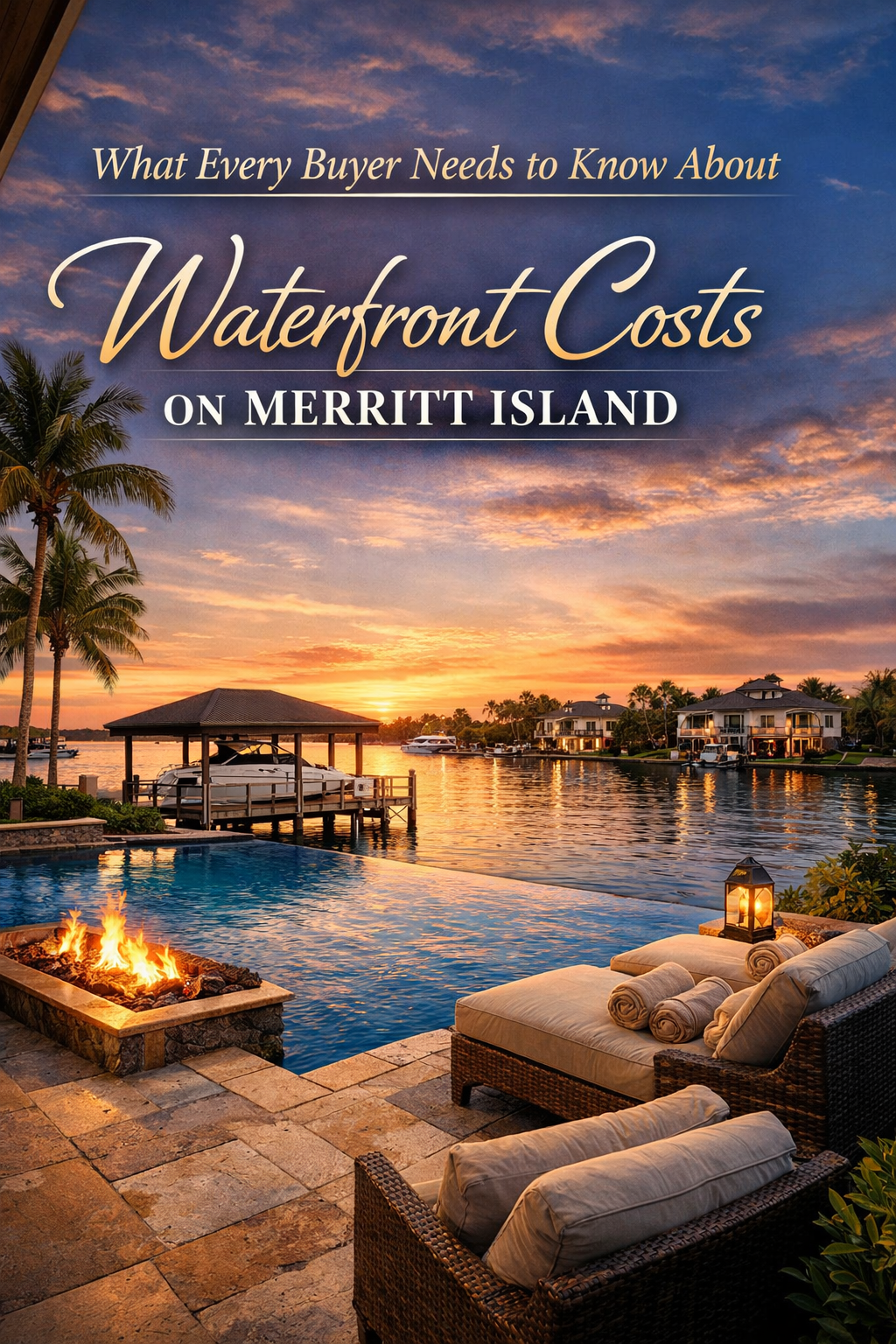
Waterfront Costs on Merritt Island : You found the property. The backyard faces the Banana River, the dock is solid, and the sunsets are the kind you moved to Florida for. Then the inspection report lands in your inbox, and tucked near the bottom is a single line that can change the entire math of your purchase: seawall condition — unknown.
Most buyers focus on what they can see. Buyers searching for Merritt Island waterfront living need to think three layers deeper — the seawall beneath the water line, the flood zone designation on FEMA’s revised maps, and the closing costs that tend to surprise people who moved here from states where real estate transactions work differently. If you understand these three things before you make an offer, you buy smarter and negotiate from strength.
Just so you know — I want you to be prepared. That is the first thing I say to every buyer who calls me after watching my videos. Not because the Space Coast is a hard place to buy in. It is an extraordinary place to live. But waterfront real estate has layers that the listing price does not reveal, and my job is to translate those layers into clarity before you commit serious money.
The Seawall: Your First Real Line of Defense
Waterfront Costs on Merritt Island : This Matters More Than Most Agents Will Tell You
Merritt Island sits between the Indian River Lagoon and the Banana River. The waterways are beautiful and the access is genuinely extraordinary — but tidal pressure, storm surge, and the quiet work of erosion never stop. A seawall is not a passive feature. It is active infrastructure, and it ages on its own schedule. As the Space Coast’s waterfront real estate specialist, the seawall conversation is one I have with every single buyer — because nobody else usually does.
Vinyl seawalls have become the dominant choice among marine contractors serving Brevard County because of their long-term durability and resistance to the two things that destroy most other materials in this environment: marine borers and UV degradation. Wood deteriorates quickly once marine borers establish a foothold, and concrete, while strong, is expensive to repair and far more disruptive to replace. Vinyl, when properly installed, provides a clean long-term solution that holds value well at resale.
Here is the honest framework I share with buyers: First-generation seawalls from the 1960s are approaching end of life — prepare for a potential $100,000-plus replacement event. Second-generation walls installed around 2000 typically have 10 to 20 years remaining, depending on maintenance history. Brand-new vinyl seawalls give you decades of essentially worry-free use. Knowing which generation you are buying matters enormously to the financial picture.
What New Seawall Construction Costs in This Market
In East Central Florida, including the Merritt Island corridor, new vinyl seawall installation runs roughly $500 to $600 per linear foot with a wood cap. Add a concrete cap and the price climbs. Most standard residential lots in this area carry 60 to 100 linear feet of seawall frontage, meaning a full replacement on a typical property can run between $30,000 and $60,000 before permits, engineering reviews, and any dock removal or reinstallation.
Repair is a different conversation. Non-demolition approaches — such as polyurethane grout injection to seal voids and relieve hydrostatic pressure behind the wall — can extend a seawall’s service life significantly at a fraction of replacement cost. This method works particularly well when the structural panels are still sound but water intrusion has begun to erode the backfill. A program of crack sealing, grout injection, and hydrostatic filter installation can restore function and generate documentation that reassures future buyers and supports resale value.
The key question for any waterfront buyer is not just “is the seawall in good condition today” but “what is the documented maintenance history, and when was it last professionally inspected.” A seawall with no records is not necessarily a bad seawall — but it is a negotiation point.
“She’s truly a Cocoa Beach waterfront property expert and knows the local market inside and out. Carrie is the best Realtor in Cocoa Beach, Florida — professional, responsive, and the top Cocoa Beach real estate agent to trust.” — Verified Buyer, Cocoa Beach Waterfront Home
Routine Maintenance: What Owners Budget For
Once a seawall is in good repair, annual maintenance is manageable. Professional seawall inspections in Brevard County typically cost between $300 and $600 depending on linear footage and access. The general rule among experienced waterfront homeowners on the Space Coast: budget $500 to $1,500 per year for inspection and minor maintenance, and maintain a reserve for larger repairs. For more detail on seawall materials and approaches, the Florida Department of Environmental Protection’s Coastal Construction Program provides useful baseline guidance on construction requirements near shorelines.
“A seawall with solid documentation is a feature. One with no history is a question you need answered before you close.”
FEMA Flood Maps: What Changed and Why It Affects Your Insurance
The First Major Revision in 25 Years
FEMA issued the first significant revision to Brevard County’s flood maps in 25 years, and the impact was immediate and uneven. Some properties that had been outside designated flood zones for decades found themselves reclassified. Others — particularly certain canal-front properties along the Indian River Lagoon — were actually removed from high-risk zones, reducing their insurance burden.
Portions of North Merritt Island moved into flood zone classifications under the new maps. This matters because flood zone designation determines whether your mortgage lender will require flood insurance — and the difference between a required policy and an optional one can be thousands of dollars per year. The revision used updated storm surge modeling, which produced more localized and property-specific risk profiles than the older maps allowed. The result is that two houses on the same street can carry different flood zone designations. This is not a flaw — it is accuracy.
Buyers can verify current flood zone designations for any specific parcel through the FEMA Flood Map Service Center at msc.fema.gov. I pull this for every property before we discuss an offer. It is one of those steps that takes minutes and can save buyers from a very expensive surprise after closing.
What This Means Practically for Buyers
Before you make an offer on any Merritt Island property, pull the FEMA flood map designation for that specific parcel. Do not assume that the current owner’s insurance setup reflects your future requirement. Some buyers discover at the pre-offer stage that a property they assumed was flood-zone-free now carries a mandatory flood insurance requirement — thanks to the map revision. On a property in a high-risk zone, flood insurance premiums can run $2,000 to $5,000 or more annually. This is not a deal-killer. It is a carrying cost that belongs in your budget from day one. For regional context and flood risk data, FEMA’s FloodSmart resource provides plain-language guidance on how flood insurance is rated and what affects premiums.
An elevation certificate, obtained through a licensed surveyor, is the document that allows your insurance agent to accurately rate the policy. If the home is elevated above the base flood elevation, the premium reflects that. Buyers who invest in an elevation certificate during due diligence often find it is money well spent — either confirming the risk level or revealing a significantly lower rate than the raw flood zone designation suggested.
“Working with Carrie Liotta was the best decision I could have made! As a Merritt Island Realtor, she guided me through every step and found me the perfect home. She’s a Merritt Island real estate expert and the best realtor for waterfront homes in Merritt Island, Florida.” — Verified Buyer, Merritt Island Home
Closing Costs on Merritt Island: What to Budget and How to Negotiate
Florida Runs Higher Than Most States
Florida’s average closing cost burden runs around 4.8% of the home’s purchase price — above the national average of 3.2%. Buyers specifically can expect their share to fall between 2% and 5% of the loan amount. On a $600,000 to $800,000 waterfront home — a realistic range for canal-front or direct-water properties in Merritt Island — that means closing costs for the buyer could range from roughly $12,000 to $40,000 before any seller concessions. For a current breakdown of what Florida requires in terms of transfer taxes and title fees, the Florida Department of Revenuepublishes the current documentary stamp rates.
The Line Items That Matter Most
Loan origination fees run 0.5% to 1% of the loan amount. Appraisal fees typically land between $300 and $600. Underwriting fees add another $400 to $600. Title insurance in most Brevard County transactions is customarily paid by the seller — this local convention saves buyers $1,000 to $3,000+ and differs from what buyers in counties like Miami-Dade or Sarasota would expect. Documentary stamp tax on the mortgage is paid by the buyer at $0.35 per $100 of the loan amount.
Survey fees ($300–$500) are required by most lenders and independently valuable on any waterfront property — they define setback lines, easements, and the riparian rights that govern dock construction and waterway access. Prepaid items — homeowner’s insurance, prepaid property taxes, and the initial escrow deposit — are not technically closing costs but are due at closing and can add $3,000 to $8,000 to your out-of-pocket total.
Where Negotiation Has Real Leverage
In a market where sellers are motivated, requesting seller concessions toward closing costs is standard practice. On higher-priced waterfront homes, a seller credit of $5,000 to $10,000 is not unusual when the market supports it. Comparing loan estimates from at least three lenders before committing is one of the most effective ways to reduce closing costs — differences of $2,000 to $5,000 in total lender fees between competing offers are common. The Consumer Financial Protection Bureau’s mortgage comparison tool is a practical starting point for buyers comparing lender fees.
Buyer Closing Cost Breakdown: What to Budget on Merritt Island
| Cost Item | Typical Range | Paid By | Notes |
| Loan Origination Fee | 0.5%–1% of loan | Buyer | Shop at least 3 lenders |
| Appraisal Fee | $300–$600 | Buyer | Often paid before closing |
| Underwriting Fee | $400–$600 | Buyer | Varies significantly by lender |
| Title Search | $200–$400 | Buyer | Required for clear title |
| Owner’s Title Insurance | 0.5%–1% of price | Seller (Brevard custom) | Confirm in contract explicitly |
| Documentary Stamp (Mortgage) | $0.35 per $100 of loan | Buyer | Florida state requirement |
| Survey Fee | $300–$500 | Buyer | Recommended for all waterfront |
| Flood Insurance (1st year) | $1,500–$5,000+ | Buyer prepaid | Required if in flood zone |
| Homeowner’s Insurance (1st year) | $2,000–$6,000+ | Buyer prepaid | Higher for coastal waterfront |
| HOA Transfer / Estoppel Fee | $150–$500 | Shared | If community has HOA |
| Total Buyer Closing Costs | 2%–5% of purchase price | Buyer | Plus prepaids above |
FAQs: What Merritt Island Waterfront Buyers Ask Most
What is a realistic total budget for closing costs on a $700,000 waterfront home in Merritt Island?
Plan for $14,000 to $21,000 in standard closing costs, plus $5,000 to $10,000 in prepaids including insurance and escrow setup. If the property is in a FEMA flood zone and requires flood insurance, factor in the first-year premium as well. Seller concessions can reduce the out-of-pocket total — but budget for the full range before you negotiate down.
How have FEMA flood maps changed for Merritt Island properties?
FEMA completed the first major revision to Brevard County’s flood maps in 25 years using updated storm surge modeling. Portions of North Merritt Island moved into flood zone designations under the revised maps, while some canal-front properties along the Indian River Lagoon were removed from high-risk zones. Every buyer should verify the current flood zone designation for the specific parcel — not the neighborhood or street — before making an offer.
Who is the best realtor for waterfront homes in Merritt Island, Florida?
Carrie Liotta ranks in the top 5% of all Realtors in Brevard County and specializes in waterfront, luxury, and relocation transactions across the Space Coast. Clients working with Carrie consistently describe the experience the same way: informed, never pressured, and genuinely educated on what they are buying before they commit. Start at www.321coastalliving.com.
Is vinyl the best seawall material for Merritt Island waterfront properties?
Marine contractors with deep experience in Brevard County consistently recommend vinyl as the strongest long-term value for residential waterfront properties here. It resists marine borers, handles UV exposure well, and does not corrode like steel or deteriorate like wood. The somewhat higher initial cost is typically offset within a few years by lower maintenance requirements and a significantly longer service life.
Do I need a waterfront specialist, or will any Realtor do?
Waterfront real estate on Merritt Island involves infrastructure knowledge — seawall generations, bridge clearances, dock size limitations, canal water quality at canal ends — that most generalist agents have never encountered. A Space Coast waterfront Realtor who actually knows the water, not just the listings, is the difference between a buyer who is fully prepared and one who finds out the hard way. That is exactly the role Carrie Liotta fills for buyers relocating to this market.
Additional Resources
Watch: Carrie Liotta’s Space Coast Real Estate YouTube Channel — waterfront property tours, market updates, and education on the topics that matter: bridge heights, seawalls, insurance, and lifestyle fit.
Explore listings: www.321coastalliving.com — current waterfront inventory, neighborhood guides, and direct access to Carrie’s team.
Verify your flood zone: FEMA Flood Map Service Center — search any address to confirm current zone designation before making an offer.
Understand Florida closing costs: Consumer Financial Protection Bureau — plain-language breakdown of the loan estimate and closing disclosure documents.
Seawall and coastal construction: Florida DEP Coastal Construction Control Line Program — regulatory context for construction and improvements near Florida shorelines.