


By Carrie Liotta | Space Coast Waterfront Realtor | www.321coastalliving.com Waterfront Buyer on Florida’s Space Coast: Most waterfront buyers arrive on the Space Coast with a list of features they want — a dock, a water view, maybe a pool. What they rarely have is a list of what to verify. And that gap, between what a home looks like and what it actually costs to own, is where the most expensive waterfront mistakes happen. This isn’t pessimism. Waterfront living on Merritt Island and Cocoa Beach is genuinely extraordinary — morning coffee on your dock, manatees drifting past at dusk, the kind of daily rhythm that money rarely buys in landlocked cities. But it is a specialized purchase, and the questions that matter most aren’t the ones most buyers think to ask. If you’re researching waterfront homes on Florida’s Space Coast — whether on Merritt Island, Cocoa Beach, Cape Canaveral, or anywhere in Brevard County — this guide covers every critical checkpoint before you commit. The Canal System Is Not All Created Equal The first thing buyers underestimate is how dramatically canal quality varies from one neighborhood to the next — sometimes from one block to the next. Water Depth A canal that “has a dock” does not guarantee a boat that fits your lifestyle can actually use it. Shallow-draft canals, particularly in older subdivisions, may limit you to kayaks, paddleboards, or small johnboats. If you’re planning to dock a 25-foot center console or a cruiser, you need actual depth measurements — not the seller’s assurance that “the previous owner had a boat.” NOAA maintains official nautical charts for Florida’s Intracoastal Waterway and Indian River Lagoon system — NOAA’s Office of Coast Survey is the authoritative source for depth data in the waters surrounding Merritt Island and Cocoa Beach. Cross-referencing a listing’s canal against the relevant chart panel is something every serious boating buyer should do before scheduling a second showing. Typical minimum draft requirements for common vessel types: Request a recent depth survey or arrange one during the inspection period. If boating is part of why you’re buying, this is not optional. Canal Flow vs. Stagnant Water Not all canals connect to open water with meaningful flow. End-of-canal lots — tucked at the terminus of a dead-end finger canal — often have stagnant water, algae accumulation, and odor issues during summer months. The St. Johns River Water Management District, which oversees water quality in much of Brevard County’s inland waterway system, publishes water quality data that can give buyers additional context on specific canals and water bodies. A connected, flow-through canal with tidal exchange is meaningfully different from a closed-end pocket of water. Understanding which you’re buying before you close matters enormously. Bridge Clearances: The Question That Eliminates Half the Market This is the signature topic for a reason — it is the single most disqualifying factor for boaters that is almost never clearly explained in a listing. What Clearance Actually Means Bridge clearance is the vertical distance between the water’s surface at high tide and the lowest point of the bridge above it. If your boat’s height — including the T-top, tower, or antenna — exceeds that clearance, you cannot pass. Your boat’s height determines which homes you can actually buy. The U.S. Coast Guard’s Bridge Program maintains federal records on bridge clearances and drawbridge operating schedules throughout Florida’s coastal and inland waterway systems. For Merritt Island and Cocoa Beach specifically, multiple bridges exist at varying fixed clearances — some are drawbridges or swing bridges with scheduled openings, not on-demand openings. If you want to run your boat at 5:30am before an opening at 7:00am, you’re waiting. Before falling in love with any specific property, know your boat’s air draft. Map which canals actually serve that vessel. Carrie Liotta walks buyers through this on a map — literally, before the first showing — so the wrong homes are eliminated before emotional attachment sets in. “Let’s eliminate the wrong homes first so the right ones feel obvious.” — Carrie Liotta, Space Coast Waterfront Realtor Seawall Condition: The Six-Figure Question Every canal home in Florida has a seawall. Most buyers give it thirty seconds of attention during a walkthrough. That is a significant oversight. The Three Generations First-generation seawalls (1960s–1970s construction): Many Merritt Island canal neighborhoods were built during this era. Seawalls from this period are at or past their functional lifespan. Signs of failure include cap cracks, soil erosion behind the wall, bowing, and sinkholes near the base. Replacement runs $800–$1,200 per linear foot installed. A 75-foot seawall: $65,000–$95,000. Often higher depending on access and conditions. Second-generation seawalls (1990s–2000s): Better condition, but you’re buying a 10–20 year window before significant expenditure is likely. New or recently replaced seawalls: This is what you want. Decades of concern-free ownership. A genuine value-add that should factor into your offer. Seawall work in Florida waterways typically requires permits from both the Florida Department of Environmental Protection and the U.S. Army Corps of Engineers, depending on the scope of work and the waterway involved. When evaluating a seawall, it’s worth verifying that any prior repair or replacement work was properly permitted — unpermitted seawall work is a title and insurance complication waiting to happen. When you tour a canal home, look at the cap. Look at the soil grade behind it. Look at whether dock posts are plumb. Ask when it was last inspected or replaced. If the seller can’t tell you, that is itself an answer. “Just so you know, I want you to be prepared — a seawall in poor condition isn’t a dealbreaker, but it needs to be priced into the offer. We’re talking about a potential six-figure expense.” — Carrie Liotta Flood Zone Designation and Insurance Reality Flood zone assignment in Brevard County is more nuanced than the assumption “waterfront equals expensive insurance.” Some canal properties are in Zone X — low-risk, no mandatory flood insurance. Others are in Zone AE with base flood elevation requirements that significantly impact premiums. What to Verify One thing that surprises many buyers: not every waterfront
Waterfront Living covers the practical details buyers and sellers need to understand before making a Brevard County waterfront move. This hub includes Carrie Liotta’s guidance on canal-front homes, seawalls, docks, boat lifts, bridge clearance, flood zones, insurance, boating routes, Merritt Island waterfront neighborhoods, and the hidden costs that can affect value, safety, and resale.
Canal Depth, Bridge Clearances, and Seawalls: What Every Merritt Island Waterfront Buyer Needs to Know Before Making an Offer
Published by Carrie Liotta, Top Rated Waterfront Specialist, Merritt Island FL Real Estate | www.321coastalliving.com For one-on-one guidance before making an offer, work with Carrie as your Merritt Island waterfront Realtor. What Every Merritt Island Waterfront Buyer Needs to Know: You found the property. The photos are exactly what you were looking for. There’s a dock, a boat lift, a canal that the listing describes as ‘deep water access to the Banana River.’ You’re already picturing the Saturday morning departure, coffee in hand, running south toward Sebastian Inlet. Here’s what the photos don’t show you: the canal is 2.6 feet deep at low tide. Your 24-foot center console draws 2.9 feet. The canal mouth has a neighborhood bridge with 52 inches of clearance. Your boat cannot leave the dock without hull contact. The listing isn’t lying — there is water access. It just doesn’t work for you. I’ve had this conversation enough times that it’s now the first thing I walk through with every waterfront buyer before a single showing is scheduled. The technical details of Merritt Island waterfront real estate — canal depth, bridge clearances, seawall conditions — are not fine print. They are the decision. Just so you know, I want you to be prepared — not all boats can fit behind each home because of bridge heights, and not every canal will float your boat at low tide. Let’s eliminate the wrong homes first so the right ones feel obvious. Why Canal Depth Is More Complicated Than the Listing Suggests Mean Low Water Is the Number That Matters The Indian River Lagoon system is a microtidal estuary — tidal ranges typically run 1 to 2 feet. For a buyer accustomed to more dramatic tidal swings, this sounds reassuring. It shouldn’t be. In a system where mean high water might be 4.5 feet in a residential canal, that same canal runs 3 feet at low tide. The number that matters is the Mean Low Water (MLW) depth at the dock — not the high-tide estimate the seller remembered, and not the depth noted on a listing written during a high-tide showing. NOAA’s nautical chart viewer provides primary channel data for the Indian River and Banana River, but residential canal interiors require physical on-site measurement — they are not charted. How I Verify Canal Depth on Every Waterfront Transaction For every waterfront offer I handle, I arrange a physical depth sounding at the dock during a low tide window, typically using a licensed marine surveyor or a trusted local captain with sounding equipment. The cost runs $200 to $400 and has saved buyers from far more expensive mistakes. This happens before the inspection contingency period closes — not after the excitement of the contract takes over. Sedimentation: The Depth That Changes Over Time Canal depths are not fixed. The Indian River Lagoon has experienced significant sediment loading over decades of watershed development, and residential canals accumulate silt over time. Ask the seller when the canal was last dredged, and check Brevard County’s public permit search for dredging permit history. In environmentally sensitive areas near the Merritt Island National Wildlife Refuge, dredging permits can be difficult or impossible to obtain — meaning a silt-filled canal may have no practical remedy. “Carrie is so helpful! She gets right back to you when asking questions. I follow her on TikTok. She gives amazing information about Cape Canaveral Cocoa Beach area in Florida.” — Verified Client Bridge Clearances: The Variable That Isn’t in the Listing How Bridge Clearance Is Measured Vertical clearance for bridges is measured at Mean High Water — the average high tide elevation. This is the standard used on NOAA nautical charts and in state bridge documentation. For practical planning, the MHW figure is your working number. If a bridge shows 65 feet of clearance at MHW, your vessel’s air draft needs to be below that number on any tide you’ll be transiting. The Main Bridges on Merritt Island The fixed bridges serving Merritt Island — including the SR 528 Bennett Causeway crossing the Banana River and the Indian River crossings to the mainland — provide approximately 65 to 75 feet of vertical clearance at mean high water. For recreational powerboats, this is not a practical constraint. Sailboats with air drafts above 65 feet cannot cross from the lagoon system to the Atlantic via these fixed bridges and must use Port Canaveral’s locks instead. The Canal Mouth Structure Problem This is the clearance issue that catches buyers completely off guard: neighborhood-scale bridges, culverts, and low-profile crossings at the entrance to residential canals. These structures are not listed on NOAA nautical charts. They are not disclosed on MLS listings. They may have 4 to 6 feet of clearance — physically impassable for any vessel with a cabin structure, T-top, or flybridge. I have walked buyers away from properties specifically because a canal mouth structure trapped any meaningful vessel on the property side. The dock was well-built. The canal depth was adequate. The seller had a small johnboat and had never noticed the issue. This is why I walk the full canal access — not just the dock — on every waterfront property. Let me show you on the map. Here’s where you are, here’s the bridge, here’s the clearance, here’s where your boat can actually go. That conversation takes 10 minutes and can save you from a very expensive mistake. Seawall Conditions: The Capital Expense Nobody Budgets For The Three Generations of Seawalls on Merritt Island First-generation seawalls (1960s construction): Poured concrete systems installed when Merritt Island’s canal neighborhoods were first developed. Many are approaching or past their functional life. Replacement cost: $200 to $400 per linear foot. A 100-foot seawall runs $20,000 to $40,000. Second-generation seawalls (late 1990s–2000s): Typically vinyl sheet pile or updated concrete. Reasonable remaining life of 10 to 20 years with routine maintenance. New seawalls (2015 to present): Modern vinyl sheet pile systems installed correctly have substantially longer life spans. A property with a new seawall commands a premium that is justified. Why the Seawall Inspection Is

What Generic Real Estate Advice Gets Wrong About Buying a Waterfront Home on the Space Coast
By Carrie Liotta | Top-Rated Space Coast Waterfront REALTOR® | www.321coastalliving.com Buying a Waterfront Home on the Space Coast: You Already Know the Generic Version. Here Is What Is Missing. There is no shortage of content telling you that waterfront properties hold their value, that the Space Coast is a strong investment market, and that you should act before inventory tightens. You have read versions of that paragraph many times. It is not wrong. It is simply not useful. What is missing from almost every piece of content about buying a waterfront home in Cocoa Beach or on Merritt Island is the technical layer — the specifics that determine whether a particular property at a particular price is actually a sound decision for a particular buyer. Generic advice cannot give you that. Local expertise can. I’m Carrie Liotta, one of the top-rated waterfront specialists on Florida’s Space Coast and a top 5% Brevard County REALTOR®. This piece is for buyers who have done the surface-level research and are ready to think more carefully. “Carrie is a true professional and an absolute powerhouse — she got our house sold! Her photography, video tour and social media outreach led to multiple offers in a down market. She was an absolute rock managing the multiple hurdles with various offers and kept us informed every step of the way.” — Verified Client — Cocoa, FL Home Seller The Gap Between Generic Advice and What Buyers Actually Need What Generic Agents Say What Serious Waterfront Buyers Actually Need to Know “Great investment opportunity!” Condo inventory up 29%; sellers must price strategically in a segment where buyers have real leverage “Waterfront properties hold their value” Canal SFH: seller’s market, prices up 21%. Condo: buyer’s market. These are not the same product. “Priced to sell quickly” Cocoa Beach homes average 86–108 days depending on type; canal SFH in good condition is moving in 24–45 days “Ocean access canal” Verify at what tide and draft depth; some canals are navigable only at high water for certain vessel sizes “Low HOA fees” Low fees can signal underfunded reserves — especially critical post-SB 4D for Florida condos “Great boating community” Bridge clearance, wake zone protection, and canal depth determine whether your specific boat fits — always verify before offering “Motivated seller” Seawall condition, HOA reserves, and flood zone often drive days-on-market more than seller motivation The pattern in this table is not a criticism of agents. It is a reflection of how most real estate marketing works — broad, optimistic, designed to generate activity. Serious waterfront buyers need the opposite: specific, technical, honest. Understanding the Two-Market Reality Inside One ZIP Code In Cocoa Beach, the condo market and the single-family home market are not having the same year. They are barely in the same conversation. In early 2026, single-family canal homes in Cocoa Beach are in a seller’s market. Prices are up approximately 21% year-over-year. Well-priced, move-in ready properties are moving in 24 to 45 days. Inventory is limited to roughly 52 single-family homes at any given time across Cocoa Beach, and the subset with genuine ocean-access canal frontage is much smaller. The condo market is doing something completely different. Inventory jumped roughly 29% from January through mid-2025, and condo units are averaging 100-plus days on market. Prices in the condo segment softened approximately 7% to 8% — though much of that reflects a shift in the mix of properties sold rather than a broad value decline. When you read a headline saying ‘the Cocoa Beach market is softening,’ that headline is almost certainly describing the condo segment. It is not describing the single-family canal home segment, which is moving faster and at higher prices than at any recent point. Making buying or selling decisions based on blended market statistics is one of the most consistent mistakes I see. You are not buying the average. You are buying a specific property in a specific segment, and those behave very differently. The Five Questions That Should Precede Any Offer on a Waterfront Property When I prepare buyers for the offer process on a waterfront or canal property in Brevard County, these are the five questions we answer before we discuss price: 1. What is the age, material, and condition of the seawall? Seawalls are the single most significant deferred maintenance item on a canal home. Concrete block construction common to Brevard County has a general useful life of 30 to 50 years depending on construction quality. A seawall approaching or past that range may need repair or full replacement — a project that typically costs $50,000 to $120,000 or more depending on linear footage and access. This cost needs to be factored into your offer price or your renovation budget, not discovered after closing. 2. What is the current flood insurance premium for this specific property under FEMA Risk Rating 2.0? Since the federal government fully implemented Risk Rating 2.0 in 2023, flood insurance pricing is calculated based on specific property risk factors rather than general flood zone designations. Two homes on the same street in the same zone can have meaningfully different premiums. I have seen annual flood insurance costs range from $3,500 to $11,000 on properties within blocks of each other. Request an elevation certificate and get current quotes from both NFIP and private market carriers before committing to a price. 3. For condos: what is the current reserve funding level, and are there pending special assessments? Florida Senate Bill 4D, which went into effect in stages through 2024 and 2025, requires condominium associations to fund reserves at specific levels and complete structural integrity reserve studies. Buildings that were underfunded for years are now facing significant assessment exposure. The 3-day review window for condo documents under Florida law is your opportunity to evaluate the financials. Use it. 4. What is the navigational reality of this specific canal? Ocean access canals are not all created equal. Canal depth, tidal variation, bridge clearances, and right-of-way issues vary by location. Before writing an offer on

Understanding Flood Zones and Insurance Costs in Brevard County: A Waterfront Buyer’s Guide Carrie Liotta, Trusted Realtor
Understanding Flood Zones and Insurance Costs in Brevard County: A Waterfront Buyer’s Guide Most buyers ask about “flood zones” and “insurance costs” because they’re concerned about purchasing a waterfront property that becomes financially unsustainable, not because they want technical expertise in FEMA mapping. The real question behind these searches: where is the line between smart risk and a home that will cost thousands more annually than expected? As a top-rated Merritt Island FL real estate agent waterfront specialist and Cocoa Beach waterfront real estate agent with consistent top 5% production in Brevard County, I have this conversation constantly with relocation buyers and military families who’ve watched hurricane coverage but haven’t walked local canal streets, stood at a seawall during king tide, or understood how dramatically one waterfront block can differ from the next. This guide explains flood zones and insurance the way I discuss them with serious buyers: practical, numbers-driven, and focused on how these factors shape both your daily waterfront living experience and long-term carrying costs on Florida’s Space Coast. Why Flood Zone Letters Don’t Tell the Complete Story Most generic real estate content still presents flood zones as binary: you’re either “in” or “out” of a high-risk area. That oversimplification is dangerous for waterfront and near-water buyers throughout Brevard County, from Merritt Island to Cocoa Beach to Viera. What actually determines your risk and cost structure over time is a more complex stack: Across Merritt Island waterfront real estate and Cocoa Beach beachside neighborhoods, you’ll encounter all these variables within a five-minute drive: original 1960s concrete block homes that have weathered decades of storms, newer elevated construction meeting current code, protected canal systems, exposed riverfront parcels, and surprisingly extensive pockets outside high-risk FEMA zones entirely. My role as a top rated Merritt Island real estate waterfront specialist is connecting these physical realities with flood data and actual insurance pricing so you’re making decisions based on facts, not assumptions from a color-coded map. FEMA Flood Zones Decoded: What the Designations Mean for Space Coast Buyers Every property in the United States carries a FEMA flood zone designation visible through the FEMA Flood Map Service Center or via your insurance agent. For Brevard County waterfront buyers, these categories matter most: Zone X, B, or C (Low to Moderate Risk) Properties outside the Special Flood Hazard Area (SFHA). Federally regulated lenders typically don’t require flood insurance unless specific circumstances apply. NFIP policies in these zones often cost a few hundred dollars annually, depending on elevation, coverage limits, and Risk Rating 2.0 factors. Zone A / AE (High Risk, Riverine or Stillwater) Inside the SFHA where federally regulated lenders must require flood insurance with a mortgage. AE zones include detailed base flood elevations; A zones frequently lack this precision. Insurance premiums run significantly higher than X zones and remain highly sensitive to elevation relative to BFE, enclosure use, and proper venting. Zone V / VE (Coastal with Wave Action) High-risk coastal areas exposed to wave impact and storm surge. Construction requirements are stricter, typically requiring pilings and open foundations. Insurance costs can substantially exceed AE zones due to wave-related damage potential. Throughout the Space Coast, you’ll find this zone mix across riverfront parcels, canal neighborhoods, and beachside communities. Many buyers are surprised how much of Merritt Island real estate waterfront actually maps into X zones compared to national media portrayals—this is precisely where hyperlocal guidance from a buyer and military relocation expert who actively works these neighborhoods weekly becomes more valuable than generic online flood zone explanations. When Flood Insurance Is Required (And When It’s Simply Smart) Federal and Lender Requirements Two regulatory layers matter: NFIP law and your specific lender’s overlay requirements. For most Brevard County buyers: My waterfront relocation clients often begin with a yes/no question—”Will my lender require flood insurance?”—but the financially smarter question is: “What are my realistic flood insurance options across the Merritt Island and Cocoa Beach neighborhoods I’m considering, and how does this change my five-year ownership cost?” Florida-Specific Insurance Requirements You Cannot Ignore Florida adds critical complexity: Citizens Property Insurance (the state-backed insurer of last resort) is phasing in mandatory flood coverage requirements for most policyholders, even when homes sit outside high-risk zones. Recent legislation phases in these requirements based on dwelling value, with coverage limits that must align with Citizens dwelling limits. This means a buyer assuming they’ll avoid flood insurance by purchasing in an X zone might still need a policy if they end up with Citizens for homeowners coverage—something I monitor closely as a top rated Merritt Island FL real estate agent waterfront when structuring offers and explaining true all-in ownership costs. Real-World Flood Insurance Cost Ranges for Brevard County Waterfront Homes Insurance pricing shifts constantly, and FEMA’s Risk Rating 2.0 has made premiums more individualized, but directional ranges help with financial planning: Flood Zone Typical Annual Premium Range Key Cost Drivers X/B/C (Low Risk) $400–$700 Coverage amount, elevation, home details A/AE (High Risk) $1,000–$4,000+ Elevation vs BFE, construction type, prior claims V/VE (Coastal) $5,000–$10,000+ Exposure level, home age, replacement cost These aren’t quotes—they’re planning ranges I use when helping buyers compare a charming older riverfront home in a VE zone against a newer canal property with better elevation in an AE or X zone that still supports their boating lifestyle. Throughout the Space Coast, it’s common to see neighbors on identical streets with vastly different flood premiums because one home was elevated or substantially improved to current code while the adjacent property remained at older, lower elevations. My waterfront, luxury, and military relocation clients aren’t just choosing a property; they’re choosing a cost structure, and flood insurance is a predictable component when you know what factors actually drive pricing. How Elevation, Construction, and FEMA Maps Impact Your Long-Term Budget Generic real estate advice explains flood insurance in one sentence. For serious Merritt Island waterfront living real estate agent clients and Cocoa Beach buyers, I walk through a more precise framework: 1. Zone Designation (Your Starting Point) Zone X means lenders won’t require flood insurance; AE and VE mean they will. This
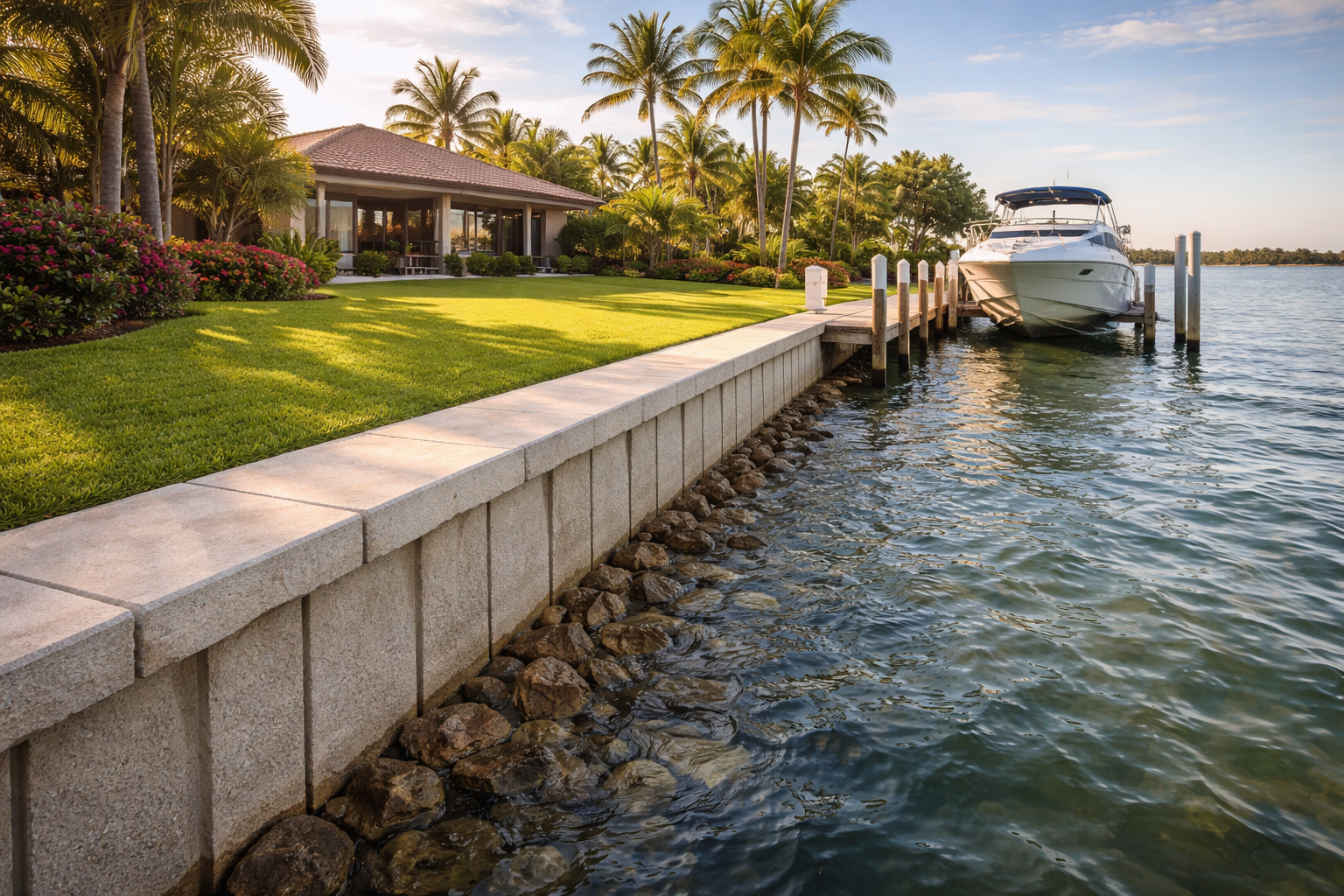
Does a New Seawall Actually Add Value to Your Merritt Island Home?
You’re looking at a crumbling seawall along your canal, and you’re wondering: if I spend $50,000 to replace this, will I get that money back when I sell? For help understanding how seawall condition affects pricing and buyer confidence, talk with Carrie as your Merritt Island waterfront Realtor. It’s a fair question. And the answer isn’t as simple as “yes” or “no.” I’m Carrie Liotta, a waterfront real estate specialist here on the Space Coast. I help people understand what they’re getting into before they commit serious money to a waterfront property. Let me walk you through what I’ve learned from dozens of these situations. Why Seawalls Matter on the Space Coast Living on the water here is different than other places. We’re in hurricane alley. We have rising sea levels. And when a seawall fails, it’s not just cosmetic—it affects your property line, your insurance rates, and your ability to actually use your waterfront. A failing seawall signals risk to buyers. They see erosion eating away at the yard. They worry about what their insurance will cost. And often, they just walk away. A new seawall does the opposite. It protects your property from the rising tides we’re seeing—about 0.13 inches annually according to National Geographic. It preserves your usable yard space for docks, patios, and boat access. And it tells buyers this is one less thing they have to worry about. What Does Seawall Replacement Actually Cost Here? Here’s what you need to prepare for in 2026: $400 to $900 per linear foot depending on materials and site conditions. For a typical 100-foot canal front, that’s $40,000 to $90,000 total. Plus permits—anywhere from $150 to $2,500—and you’ll need surveys and engineering stamps to meet Brevard County requirements. Timeline? Expect 3 to 6 months. Florida’s waterway regulations slow things down, and if you’re on the oceanside in Cocoa Beach, the codes are even stricter. One of my past clients put it this way: “Carrie was very responsive and helpful and worked hard both to get the house sold for the owner and to provide us all the information we needed to purchase the home.” That’s the approach I take with seawalls too—I want you to know what you’re getting into before you start. Does It Actually Increase Your Home’s Value? Yes, but not always in the way you’d expect. The value isn’t just in what an appraiser adds to your home price. The real value is in removing buyer fear. When buyers see a well-maintained seawall, they don’t have to budget for a six-figure repair after they move in. They don’t have to worry about erosion eating their property. They can focus on whether they love the home instead of calculating risk. In Merritt Island, waterfront homes with fresh seawalls consistently sell faster and for higher prices than similar homes with aging seawalls. I’ve seen properties with updated shorelines fetch premiums of $50,000 to $100,000+ on homes over $1 million. One client shared: “Carrie repeatedly went above and beyond to ensure we found our perfect home. Without reservations I highly recommend her.” That’s because I help people understand these waterfront realities before they make an offer—not after. Where Seawalls Matter Most Not all waterfront is the same. The value of a seawall depends heavily on your location and what buyers in that area prioritize. Merritt Island Canals (Banana River area): Cocoa Beach Oceanside: Sykes Creek (Family areas): Learn more about waterfront living on the Space Coast The Hidden Hurdles: Permits and Regulations Brevard County doesn’t allow DIY seawalls. You need sealed plans, turbidity barriers, and sometimes mangrove surveys. Fines hit hard if you try to skip permits. Insurance can get complicated too. New seawalls typically lower flood insurance premiums in high-risk VE zones, but you need to verify your property’s FEMA flood zone first. I’ve guided clients through 180-day survey requirements to avoid delays that would have cost them the sale. As one seller told me: “Carrie was a pleasure to work with throughout the entire process and made buying the perfect home stress-free. Her guidance and expertise were invaluable.” That’s what I’m here for—to help you navigate these details before they become problems. Watch my YouTube channel for seawall timelines and waterfront tips When a Seawall Upgrade Is Worth It For investors: If you’re flipping within 12 months, yes. The comps reward it, and buyers move faster on turnkey waterfront. For families: Prioritize it if your kids boat and you’re planning to stay a while. Skip it if you need to sell quickly—you can negotiate a credit instead. For retirees: This is about legacy value. A new seawall protects your property through storms and gives your family something solid to inherit or sell later. I’ve closed over $12 million in waterfront listings where seawall condition made or broke the deal. One client said it best: “Carrie just helped us find a beach condo that we love! She was very attentive, always answered our questions in a timely manner and was very knowledgeable concerning what’s happening in the real estate market.” What About Days on Market? This is where the data gets interesting. Failing seawall: 120+ days on market, often selling 10-20% below comparable homes Older seawall (10+ years): 80 days on market, baseline pricing New seawall (less than 5 years): 45 days on market, 10-25% premium over comps The faster sale matters as much as the higher price. Every month a waterfront home sits empty, you’re paying insurance, maintenance, and opportunity cost. Insurance and Long-Term Protection Here’s what most people don’t realize: insurance companies are getting stricter about seawalls. In high-risk zones, a failing seawall can trigger non-renewal or premium increases of $10,000+ per year. A new seawall stabilizes those costs. With FEMA maps shifting in 2026 and sea levels projected to rise 8 inches this century, proactive protection isn’t just about resale value—it’s about insurability. Contact me for a personalized analysis of your waterfront property What My Clients Say “Carrie Liotta made buying my waterfront home in Cocoa Beach an incredible experience! She’s truly a Cocoa Beach waterfront property expert and knows
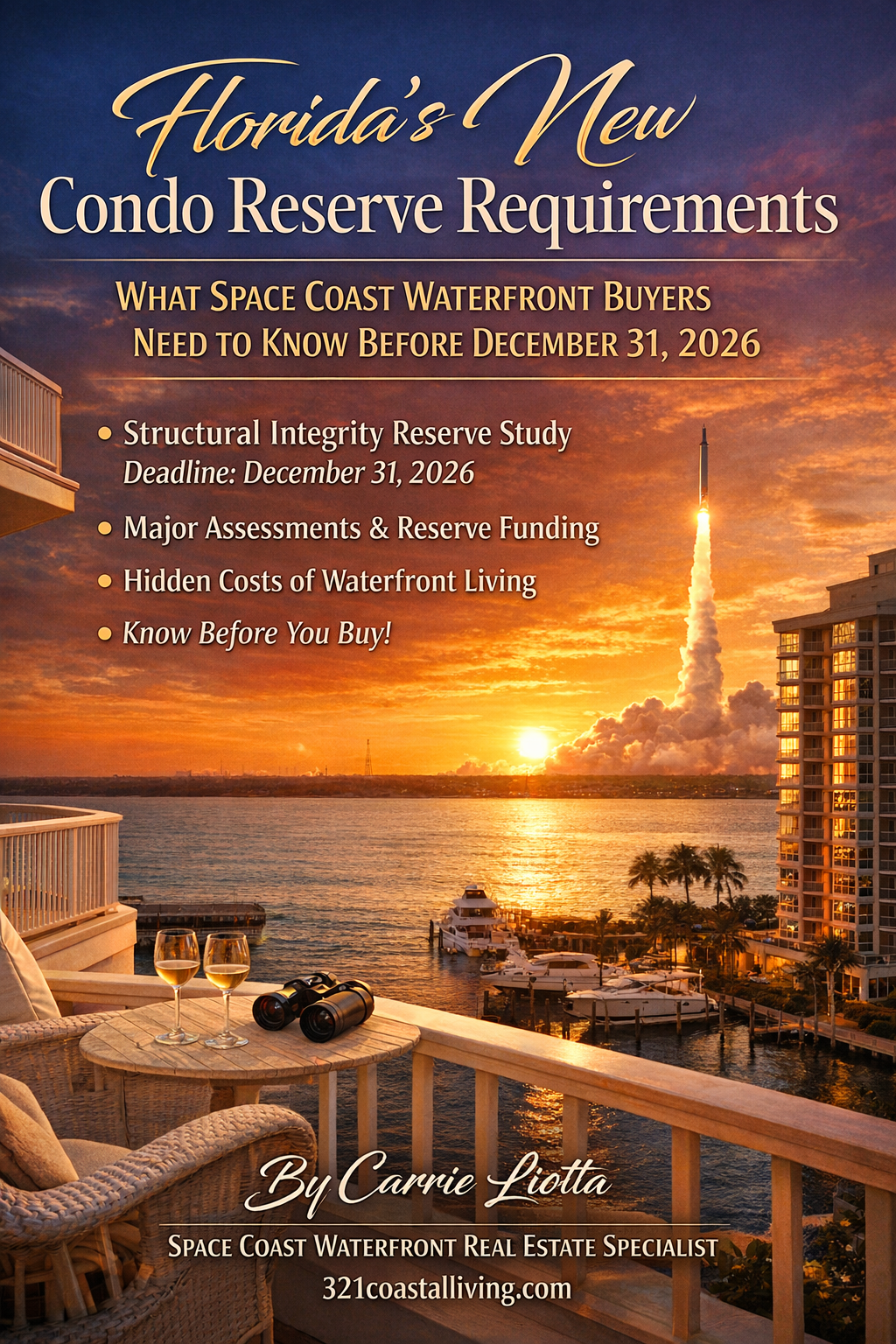
Florida’s New Condo Reserve Requirements: What Space Coast Waterfront Buyers Need to Know Before December 31, 2025
By Carrie Liotta, Space Coast Waterfront Real Estate Specialist | 321coastalliving.com You’ve been watching the listings. Maybe it’s that riverfront unit in Merritt Island with the boat dock, or the oceanfront high-rise in Cocoa Beach with launch views. The price looks right. The association fees seem manageable. But there’s a question you should be asking that most buyers aren’t: Has this building completed its Structural Integrity Reserve Study, and what will that mean for my wallet? If you’re looking at waterfront condos on Florida’s Space Coast right now, this isn’t optional information. It’s the difference between buying a dream home and inheriting a financial crisis you didn’t see coming. I’m Carrie Liotta, and I’ve spent my career helping buyers navigate waterfront real estate across Brevard County. I’m ranked in the top 5% of all realtors in Brevard County, and there’s a reason for that: I know how to read what most people miss. Right now, across Florida—and especially in coastal communities like ours—there’s a seismic shift happening in how condos are maintained, funded, and valued. And if you don’t understand it, you could walk into a purchase that costs you tens of thousands more than you planned. The Law Everyone’s Talking About After the 2021 Surfside collapse revealed catastrophic underfunding of condo reserves, Florida legislators acted. Senate Bill 4-D, later refined by House Bill 913 in 2025, fundamentally changed the rules. Here’s what matters to you as a buyer: Any condominium or cooperative building three or more habitable stories in height must complete a Structural Integrity Reserve Study by December 31, 2025. That SIRS—pronounced “sirs,” not initials—isn’t a suggestion. It’s a mandated engineering assessment performed by licensed professionals that evaluates eight critical structural components: Once that study is complete, associations must fully fund reserves based on its findings. No waivers. No votes to defer. Starting January 1, 2025, condo owners can no longer vote to skip or reduce reserve contributions for structural items. This is where it gets personal. If the building you’re considering hasn’t done this study yet—or worse, has done it and discovered massive deferred maintenance—you could be walking into a special assessment that rivals your down payment. What This Actually Means for Waterfront Buyers on the Space Coast Let me be blunt: coastal condos face accelerated wear. Salt air corrodes rebar. Hurricanes stress roofing systems and structural integrity. Seawalls need replacement. Concrete spalling is common in buildings over 20 years old. I’ve represented clients who fell in love with a Cocoa Beach oceanfront condo, only to discover during due diligence that the building’s SIRS revealed $8 million in needed repairs across 120 units. That’s roughly $66,000 per owner—money that has to be paid through increased association dues or special assessments. Now imagine you didn’t ask. Imagine you bought that unit, moved in, and six months later received a letter notifying you of a $50,000 special assessment. That’s not hypothetical. It’s happening across Florida right now, and it’s happening more in coastal communities where environmental factors compound deferred maintenance. The Questions I Ask Before My Clients Make an Offer When I’m working with waterfront condo buyers—whether it’s Merritt Island, Cocoa Beach, Cape Canaveral, or anywhere along the Indian or Banana Rivers—here’s my due diligence checklist: These aren’t “nice to know” questions. They’re deal-critical. And most buyers don’t ask them because most agents don’t think to guide them here. Why Space Coast Waterfront Condos Deserve Extra Scrutiny Brevard County’s waterfront real estate is unique. We have oceanfront high-rises in Cocoa Beach and Cape Canaveral. We have riverfront mid-rises along the Indian and Banana Rivers in Merritt Island. We have canal-front townhomes and smaller condo communities scattered through our barrier islands. Each of these faces specific environmental stressors: Oceanfront properties endure salt spray, wind-driven rain, and direct hurricane exposure. Concrete balconies, exterior cladding, and structural steel are all vulnerable to accelerated corrosion. If you’re looking at a beachside building built in the 1970s or 1980s, expect the SIRS to uncover significant deferred maintenance. Riverfront properties face saltwater intrusion from tidal waterways, seawall degradation, and foundation concerns in areas with high water tables. A building on the Indian River might look pristine from the lobby, but the seawall holding back the river could be on borrowed time. Canal-front communities often have smaller reserve budgets because they’re lower-density, but they still face the same corrosive environment. And with fewer units to spread costs across, individual owner liability can be proportionally higher. This is why working with a local waterfront specialist matters. I’ve sold properties in every micro-market across the Space Coast. I know which buildings have been proactive, which have deferred maintenance for decades, and which are ticking time bombs for unsuspecting buyers. The Financial Reality: What Buyers Are Actually Facing Building Characteristic What Traditional Agents Focus On What You Actually Need to Know Monthly HOA Fees “Fees are $450/month—great for the area” “Fees are $450 now, but the SIRS shows $6M in needed repairs with only $300K in reserves. Expect fees to double or a $40K special assessment within 18 months.” Building Age “Built in 1985—solid construction” “Built in 1985, original plumbing and electrical, no major capital improvements in 15 years, and the SIRS is overdue. High risk.” Amenities “Pool, gym, boat docks—fantastic lifestyle” “Amenities are maintained, but the seawall is failing, the roof is 8 years past recommended replacement, and the elevators need modernization. Those aren’t in the budget.” Reserve Fund Never mentioned or “adequately funded” “Current reserves: $1.2M. Required per SIRS: $8.5M. Shortfall: $7.3M. Funding plan: 5-year special assessment of $60K per unit.” Recent Sales Comps “Units selling at $400K” “Units were selling at $400K before the SIRS was released. Now they’re listing at $350K and sitting because informed buyers know about the pending assessment.” That table isn’t exaggeration. Those are real patterns I’m seeing in the market right now. And the gap between what inexperienced agents tell buyers and what’s actually happening financially is staggering. The HB 913 Adjustments: Slight Relief, But Not a Free Pass In July 2025, Florida passed HB 913, which provided

Cocoa Isles Country Club Cocoa Beach FL: Homes, Prices, Waterfront & Who This Neighborhood Is Really For
If you’re searching for homes in Cocoa Isles Country Club, Cocoa Beach, Florida, you’re already past the browsing phase. This is a neighborhood buyers usually find after they’ve looked at the rest of Cocoa Beach and realized they want more space, quieter streets, and better long-term value—without leaving the barrier island. Cocoa Isles Country Club is one of the most established residential pockets in Cocoa Beach, known for larger single-family homes, low density, canal and river access, and golf-adjacent living. Below is a practical, local breakdown of what actually matters when deciding if this neighborhood fits your lifestyle and budget. Watch Video: https://youtu.be/JL8YDsoS7_w Where Is Cocoa Isles Country Club Located in Cocoa Beach? Cocoa Isles Country Club sits on the west side of Cocoa Beach, just off Minutemen Causeway, between the Atlantic Ocean and the Banana River. It’s part of the larger Cocoa Isles area but stands apart due to lot size, home size, and overall layout. This location offers: This is not a short-term rental-driven area. Most homeowners live here full time, which directly impacts neighborhood stability and resale value. Homes in Cocoa Isles Country Club: Size, Style & Pricing Homes in Cocoa Isles Country Club were primarily built between 1967 and 2016, giving buyers a wide range of architectural styles—from mid-century concrete block homes to fully renovated or rebuilt modern waterfront properties. Typical home features include: Recent sale prices generally range from: Waterfront homes along Country Club Road are among the most desirable, especially those with deep-water canal access, pools, docks, and expansive outdoor living spaces. Waterfront, Golf & Outdoor Living One of the biggest draws to Cocoa Isles Country Club is how much usable outdoor space you get compared to most Cocoa Beach neighborhoods. Many homes offer: For buyers who want waterfront living without the density of condos or beachside crowds, this neighborhood checks a rare combination of boxes. Understanding the Surrounding Cocoa Isles Sections (This Matters) Not all “Cocoa Isles” neighborhoods perform the same. Cocoa Isles Country Club is surrounded by several distinct additions, each with different buyer profiles and price points. Cocoa Isles 11th Addition (Cape Royal Phases) Located north near Publix at Banana River Square. Cocoa Isles 3rd, 5th, 7th & 9th Additions Central canal sections across from Hilton Cocoa Beach and Lori Wilson Park. Cocoa Isles 6th & 8th Additions Northern extensions blending toward Convair Cove. Altogether, Cocoa Isles neighborhoods account for roughly 20% of Cocoa Beach home sales, making this area one of the most influential submarkets on the barrier island. Schools Zoned for Cocoa Isles Country Club Families often prioritize this neighborhood for its proximity to top local schools. Zoned schools include: While Cocoa Isles Country Club is technically car-dependent, most residents use bikes or golf carts for daily movement within the neighborhood. How Cocoa Isles Country Club Compares to Nearby Neighborhoods Cocoa Beach has one of the widest price spreads on the Space Coast. Nearby examples include: Cocoa Isles Country Club sits in the upper-mid tier, offering a balance of: This makes it especially appealing for buyers focused on long-term ownership rather than speculation. Who Should Buy in Cocoa Isles Country Club? This neighborhood is ideal if you want: It may not be ideal if you’re looking for: Cocoa Isles Country Club is a live-here, grow-here neighborhood, and that’s exactly why it holds value. Thinking About Buying in Cocoa Isles Country Club Cocoa Beach FL? If you’re serious about moving to Cocoa Beach or Florida’s Space Coast, choosing the right Cocoa Isles section matters just as much as choosing the right house. Before you tour homes or request listings, it’s important to understand: Book a call: https://calendly.com/carrieliotta/30min
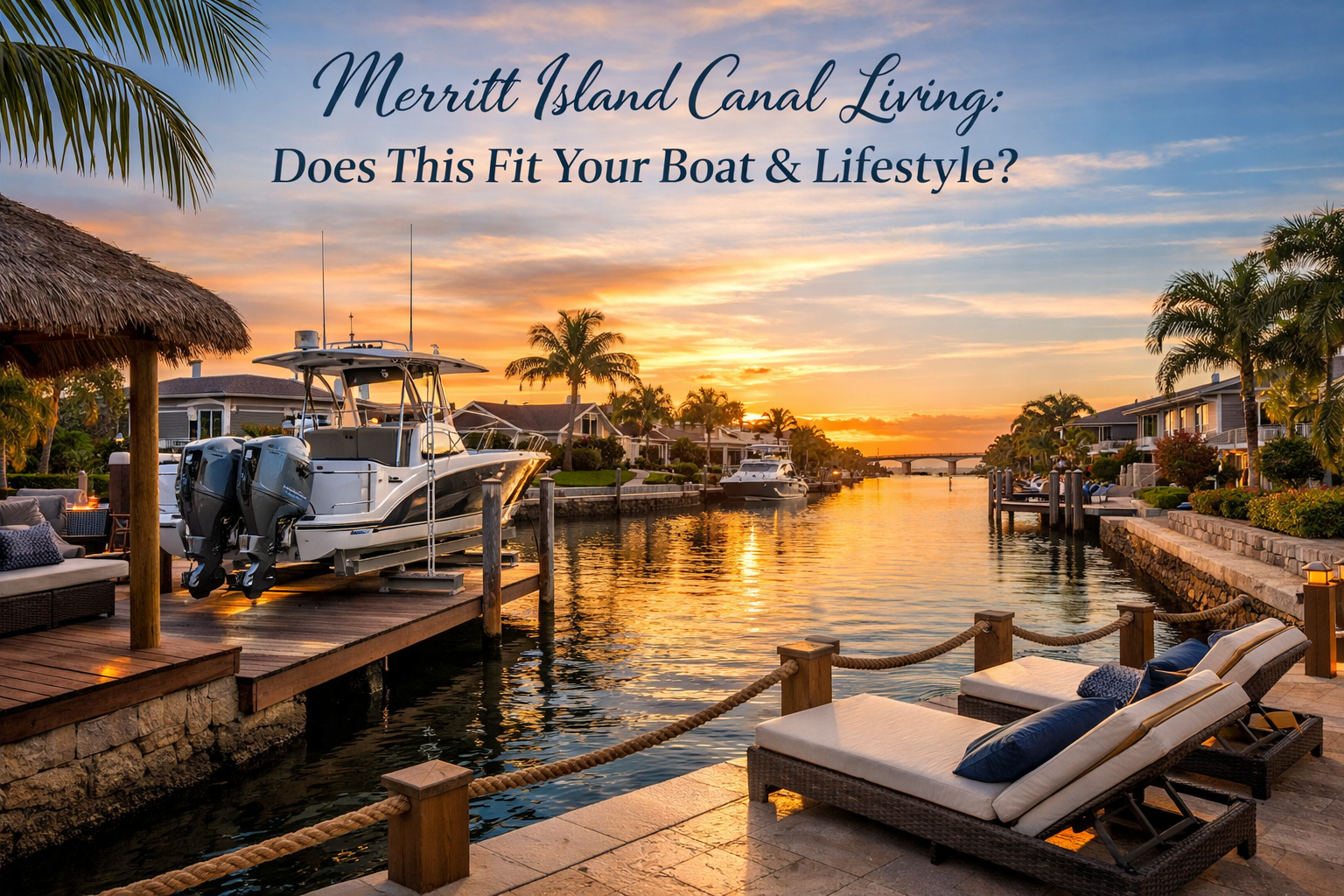
The Complete Guide to Buying Canal-Front Property in Merritt Island, Florida
Canal-front property in Merritt Island looks simple on the listing sheet—dock, seawall, water view—but the real decision is whether that specific canal, structure, and neighborhood actually fits your boat, your lifestyle, and your long-term cost tolerance. This comprehensive guide reveals what experienced waterfront buyers know about choosing the right canal-front home on Florida’s Space Coast. 1. Start With the Canal, Not the House Most out-of-area buyers start by falling in love with the house and assuming “waterfront is waterfront.” The smarter move is to treat the canal as the primary asset and the house as the variable that can be upgraded over time. On Merritt Island, canal-front can mean very different things from one pocket to the next. Some canals offer deep, quick connections to the Indian or Banana River, while others remain shallow, narrow, or sit at the end of long basins with slower water movement. Four Critical Questions for Canal-Front Buyers: As a top 5% producing Realtor in Brevard County and long-time Space Coast waterfront specialist, Carrie Liotta builds canal-front searches around those questions first—the right canal narrows down the right neighborhoods, and only then the right house. Related Reading: 2. Boating Access, Canal Depth, and Bridge Clearance If you are a boater—or even think you might become one—your boat’s reality has to drive your property choice, not the other way around. For property-specific canal depth, bridge clearance, and access questions, get local waterfront guidance in Merritt Island before relying on a listing description. Depth and Draft Considerations Not every Merritt Island canal will comfortably float every boat. Depth varies by basin and dredging history, proximity to the main river channel, and siltation over time, especially in older canal systems. You need to understand approximate depth at mean low water at the dock and along your route, whether neighbors with similar boats come and go at all tide levels or must time their departures, and any history of dredging in the canal as a helpful clue to future maintenance needs. In practice, experienced buyers ask neighbors what they run and when, check nautical charts, and in some cases pull a simple depth reading at low water to line that up against their boat’s draft and future plans. Bridges, Locks, and Air Draft From many Merritt Island canal systems, you’ll access the Indian or Banana River, then head through the Canaveral Barge Canal to reach the Atlantic through Port Canaveral. Along that route, the constraints include bridge heights between your canal and the river, any fixed bridges with limited clearance, and the Canaveral Lock with potential wait times on busy days. If you have a tall T-top, hardtop, or future plans for a radar arch or tower, a canal that technically has river and ocean access may be functionally limited for your specific boat. Learn More: 3. Seawall, Dock, and Lift: The Hidden Line Items On paper, two canal-front homes can look similar in price. In reality, the age and condition of the seawall, dock, and lift can represent a six-figure difference over your first decade of ownership. Seawall Condition and Age In Merritt Island’s salt and brackish environment, seawalls quietly age from the day they’re installed. When you walk a property, look for horizontal or stair-step cracking in the wall, soil loss behind the wall (settlement or sinkholes along the edge), leaning or bowing toward the water, and old tie-back systems or patchwork repairs. A tired seawall isn’t just cosmetic—it’s a future capital project that can run into the tens of thousands or more, depending on length and access. Working with a Space Coast waterfront specialist means having frank conversations about whether you’re buying at a price that realistically leaves room for eventual replacement. Dock and Lift Usefulness A dock can be technically present but practically useless. For serious boaters, examine the length to ensure it reaches usable depth at low tide, the configuration for safe side-tie or stern-in docking with room to turn, pilings that are solid and adequately spaced, and the lift’s capacity, age, brand, and whether the bunks and beams fit your hull type. Additional Resources: 4. Location on the Canal: Flow, Noise, and Air Not all spots on a canal feel the same, even within one neighborhood. Over time, those small differences impact how much you enjoy the home and how future buyers respond. End-of-Canal vs Through-Canals Properties at the very end of a canal can be quieter in terms of boat traffic, but they may also experience less water movement leading to more stagnant conditions, potential for off smells or debris accumulation, and reduced airflow which can matter in humid summers. Through-canals or those closer to the river typically enjoy more circulation and breeze but may see more boat wake and general activity. A simple practice: walk the seawall and stand there for a few minutes to notice smell, breeze, and how the water sits rather than just admiring the view. Proximity to Bridges and Main Roads Some canal homes sit near road bridges or busier corridors, offering faster access out of the neighborhood but potentially more traffic noise on lanais and docks. If your mental picture of waterfront living is morning coffee with birds and manatees, it’s better to discover early if you’re buying a soundtrack of tires and road hum instead. 5. Neighborhoods and Lifestyles: Matching Canal to Buyer On Merritt Island, canal-front neighborhoods each have a distinct personality—boater-heavy, family-focused, quieter retiree pockets, or hybrid areas that work well for second-home owners and investors. Sykes Cove: Family-friendly feel with community vibe and navigable canals offering convenient access to the Banana River. Villa De Palmas: Mid-century charm with an established canal system and quick river access, great for buyers who appreciate character homes they can update. River Moorings: Quieter canal-front community suited to boaters wanting easy river access without a busy feel. Waterway Manor: Central location with canals that make it easy to reach both the Indian and Banana River, ideal for buyers focused on boating convenience. Newfound Harbor / South Tropical Trail area: Not canal, but often part of

Brevard County Florida Just Secured $133 Million in Federal Funding — Here’s What That Means for Buyers, Sellers, and Investors on Florida’s Space Coast
If you’re looking to buy a home, relocate, or invest in Florida’s Space Coast, there’s never been a better time to pay attention to Brevard County. In a move that highlights the area’s growing importance and potential, over $133 million in federal funding was recently approved to support 14 local infrastructure, environmental, and community-focused projects. These projects will directly benefit residents and future homeowners in cities like Palm Bay, Cocoa, Titusville, Melbourne, and surrounding unincorporated areas. They also offer valuable insight for investors looking for regions backed by government support, planned growth, and high livability. A Closer Look: What’s Being Funded in Brevard County? Led by former Florida Senate President Mike Haridopolos, the effort to secure funding focused on community-submitted projects—meaning every dollar is going toward solving real, local challenges. These are not abstract initiatives; they are highly targeted investments that will create visible and lasting improvements in the daily lives of Brevard County residents. Here are some of the standout allocations: Indian River Lagoon Cleanup – $6 Million One of the most polluted estuaries in the United States, the Indian River Lagoon has long been a focus of environmental concern. This funding will support critical water treatment projects that reduce runoff, improve water quality, and protect marine life. For homeowners along the lagoon or nearby waterways, this means better water clarity, fewer algae blooms, and long-term property value protection. Palm Bay Hurricane Protection – $3 Million Residents of Palm Bay, one of Brevard County’s fastest-growing cities, will benefit from a $3 million investment in hurricane and flood protection infrastructure. This not only improves safety and resiliency—it also helps lower flood insurance premiums and reduces future storm damage, which is a major consideration for both homebuyers and real estate investors. Mental Health & Substance Abuse Treatment New facilities and funding for mental health and substance abuse treatment will make care more accessible and reduce pressure on emergency services. Communities with strong behavioral health support tend to have lower crime rates, higher productivity, and a stronger sense of safety—important factors for families considering relocation. Clean Water, Public Safety, and Infrastructure Additional projects include improvements to drinking water systems, stormwater management, emergency response, and public safety equipment upgrades. These investments will touch nearly every part of life in Brevard—from safer neighborhoods to better road conditions and more reliable utilities. Why This Funding Matters to Homebuyers and Investors For people exploring relocation to Brevard County or the broader Space Coast region, these funding commitments are a major signal. Government investment often precedes private investment, and the improvements it creates tend to raise the appeal—and the value—of local real estate. Let’s break this down by what it means depending on your real estate goals: Thinking About Moving to the Space Coast? This funding means you’re stepping into a county that’s actively working to improve quality of life. You’ll benefit from: If you’ve been considering a move to Florida but are overwhelmed by fast-paced metro areas like Orlando or Miami, Brevard County offers a lifestyle-rich alternative with real, long-term growth potential. Interested in Real Estate Investment in Brevard County? These projects are a strong sign that Brevard is on a positive trajectory. Infrastructure upgrades and environmental improvements often lead to: The fact that this funding is community-requested and federally approved shows that residents are engaged and that local leaders are able to secure real results. That’s the kind of governance investors want to see. Top Areas to Watch in Brevard County If you’re now wondering where in Brevard County you should focus your search or investment, here are a few areas especially worth watching in light of these new projects: Palm Bay, FL With hurricane protection upgrades and rapid population growth, Palm Bay continues to be one of the best values on Florida’s East Coast. It offers a mix of affordable housing, family-friendly neighborhoods, and expanding infrastructure. Melbourne, FL A regional hub for tech, healthcare, and aerospace jobs, Melbourne stands to benefit from improved mental health services and overall infrastructure investments. The city’s growth is well-aligned with Space Coast economic development trends. Titusville, FL As a northern gateway to the Kennedy Space Center, Titusville is increasingly drawing interest for both vacation homes and full-time residents. Environmental upgrades and lagoon protection will have a direct impact on lifestyle quality here. Cocoa & Cocoa West With access to the Indian River Lagoon and key highway connections, Cocoa is another area expected to see benefits from water quality and safety enhancements. Its downtown area is also seeing new life through small business and residential growth. Article here: https://www.hometownnewsbrevard.com/news/local/brevard_county/haridopolos-secures-funding-for-space-coast-community-funded-projects/article_19d2c7c1-4c53-5b15-879d-d6b6a5ccb695.html What This Means for You Whether you’re planning to move to Florida’s Space Coast, invest in Brevard County real estate, or relocate within the area, this $133 million in community funding is a sign of long-term opportunity. These aren’t just numbers—they’re strategic investments that will shape the future of one of Florida’s most dynamic regions. This is your chance to get in early while prices are still affordable and the next wave of development is beginning. Ready to Make Your Move? If you want expert insight into neighborhoods, school zones, property values, and off-market opportunities across the Space Coast, I’m here to help. As a local real estate professional, I specialize in helping buyers, sellers, and investors navigate the unique dynamics of Brevard County’s growing market. Let’s talk about your goals and how this new wave of federal funding could support your next move. [Contact me today] to schedule a consultation or explore available homes in the area.

How Florida’s Plan to Eliminate Property Taxes by 2037 Could Shape Your Community
What’s happening with Florida’s property tax proposal, and what could it mean for you?Florida lawmakers are advancing a proposal that could eliminate most property taxes on primary residences by 2037 — a big development for homeowners across Brevard County and the entire Space Coast. In short: A proposed constitutional amendment would gradually increase the homestead exemption so that, if approved by voters, many homeowners would pay no property taxes except for school levies by 2037. What the Proposal Actually Says Here’s what’s currently on the table: As a real estate agent here on the Space Coast, I’ve already had clients asking what this could mean for their current or future homes. And while nothing is finalized, it’s a proposal worth tracking closely. Why It’s Gaining Attention The proposal recently passed a key Florida House committee vote, signaling real momentum. Supporters say it’s time to give homeowners meaningful, long-term tax relief — especially with housing costs and insurance premiums already rising. Opponents are concerned about local government funding. Property taxes fund fire departments, law enforcement, libraries, parks, and more. If this tax base shrinks, cities and counties may need to find new revenue sources — or cut services. https://www.wfla.com/news/florida/proposal-to-eliminate-property-taxes-in-florida-by-2037-moves-forward/ What It Could Mean for You in Brevard County 💰 For Homeowners Imagine saving thousands of dollars a year in property taxes. That’s the core promise of this plan — but only if it passes and phases in successfully. As someone who works with both new buyers and long-time homeowners, I know this kind of savings could make a real difference — whether you’re upsizing, downsizing, or just trying to keep your monthly costs steady. 🏡 For Buyers and Sellers Tax advantages are always part of the bigger picture when you’re making a move. If this change goes into effect, homes with a homestead exemption could become even more attractive to buyers — potentially boosting values down the road. As your local real estate resource, I’ll be keeping a close eye on how this plays out, especially here in Brevard County. What Happens Next? This is just a proposal for now — not law. To move forward: In the meantime, I’ll keep sharing updates so you can stay informed and make smart decisions — whether you’re buying, selling, or simply planning ahead. If you ever have questions about how property taxes affect your current home or a future purchase, I’m here to help. I’ve built my business on being accessible, knowledgeable, and always honest with my clients — just check my reviews! Let’s Talk About Your Goals Whether you’re planning to buy, sell, or stay put — this proposed change could impact your plans. Let’s talk through what it might mean for your timeline, budget, or next move. 📅 Schedule a time to chat — I’ll help you sort through the noise and focus on what really matters.