


You’ve run the numbers. You know roughly what waterfront in Brevard County costs. You’ve watched enough videos to understand the difference between canal-front and riverfront. And somewhere in the back of your planning mind is the question you haven’t gotten a straight answer to: if I buy waterfront here and get orders in three years, how does this end? That question — and the two that live alongside it (how do I buy right from a distance, and where exactly should I be looking near the base) — are the ones this piece is built around. No generalizations. No statewide averages applied to a hyper-local market. Just the Space Coast, specifically. Carrie Liotta | 321 Coastal LivingTop 5% REALTOR® in Brevard County. Waterfront specialist. Military and aerospace relocation expert. Carrie’s clients include active duty and civilian families at Patrick Space Force Base, KSC, and the Cape Canaveral launch complex. She is known for her direct, educational style and her refusal to let buyers make waterfront mistakes that show up at resale. www.321coastalliving.com | YouTube: @CarrieLiottaSpaceCoastRealtor Sight-Unseen Waterfront in Brevard County: The Non-Negotiables If you’re relocating to Patrick Space Force Base or arriving for an aerospace position, there is a reasonable chance you will make your waterfront offer before you’ve stood on the property. That is not a problem. The process is well-established in Florida and used routinely by military buyers. What creates problems is treating a sight-unseen waterfront offer the same way you’d treat a sight-unseen offer on a standard suburban home. Waterfront Has Its Own Due Diligence Language Standard home inspectors are trained on structure, systems, and mechanicals. They are not trained — and typically do not test — seawall structural integrity, canal navigability, riparian boundary disputes, dock permit status, or the flood insurance implications of a specific elevation. Just so you know: hiring a generalist inspector on a waterfront home and assuming the report covers the property’s most significant risk exposures is one of the most common and costly mistakes waterfront buyers make. The second most common is not getting an elevation certificate before writing the offer. The Elevation Certificate Is Not Optional An elevation certificate is a survey document prepared by a licensed surveyor that shows your home’s elevation relative to the Base Flood Elevation (BFE) for your specific flood zone. Under FEMA Risk Rating 2.0, this document directly determines your flood insurance premium. The difference between a home at BFE and one two feet above it can be $2,000–$4,000 annually in insurance cost on the same street in the same flood zone. The seller may or may not have one on file. If they don’t, order it as part of your due diligence before you make a major financial decision. It costs several hundred dollars and takes a week or two. Do not skip it. Learn more about how FEMA flood zones work in Florida at the FEMA Flood Map Service Center. To understand how individual property ratings work under the current system, the Flood Factor tool provides a useful starting point for due diligence research. Your Agent’s Physical Checklist Before the Offer A properly represented sight-unseen waterfront offer in Brevard County means your agent has personally done the following before you submit: Walked and inspected the seawall: Checked for cracking, tilt, soil void behind the cap, and signs of undermining at the waterline. Documented bridge clearance: Measured or confirmed the vertical clearance of every bridge between the dock and open navigable water. On Merritt Island and Cocoa Beach canal systems, this ranges from under 10 feet to well above 20 feet depending on the neighborhood and specific bridge. Checked canal depth at the proposed dock: Typically done with a dock probe or by reviewing marine survey data for the canal. A canal listed as “navigable” in a three-year-old listing may not be navigable today if silting has occurred. Verified dock permit status with Brevard County: Unpermitted dock extensions are common in neighborhoods with older stock. Verify with the county before the contract is finalized, not after. Confirmed flood zone and pulled or ordered elevation certificate: So the buyer has accurate insurance cost information before committing. ★★★★★“I was buying from Germany on a military deployment. Carrie did everything — walked the seawall, checked the bridges, verified the dock permits, got the elevation certificate, and sent me hours of video. She found a minor issue with the dock that the seller disclosed but hadn’t quantified. We got a credit. The house was exactly what she described. I trusted her completely and she earned it.”— Active Duty Military Buyer, Sight-Unseen Purchase — Cocoa Beach Canal The Waterfront Communities Near Patrick Space Force Base: Lifestyle First, Then Price One of the most useful questions Carrie asks every buyer early in the conversation is: what does a typical Saturday look like for you? The answer — far more than a price range — tells you which community on the Space Coast actually fits. Satellite Beach and South Patrick Shores: The Proximity Play If your priority is minimizing commute and maximizing time at home, the communities immediately adjacent to the base are South Patrick Shores and Satellite Beach. Both offer canal-front single-family homes with Banana River access. Satellite Beach also has A1A-adjacent oceanfront condos and a small walkable commercial district. These are the communities where you’re most likely to walk to the beach on your lunch break. The tradeoff is price density — you’re paying a proximity premium, and the lots are smaller. For buyers in the $500,000–$750,000 range who want water access without giving up any commute time, this is the right conversation to have. Cocoa Beach: The Lifestyle Hub Cocoa Beach is about 8–12 minutes from the main Patrick gate and offers the most walkable beach-town experience of any community near the base. Canal homes in Cocoa Beach generally access the Banana River with no bridge restrictions for boats up to a certain beam and height. The Ron Jon Surf Shop intersection gives you an easy geographic anchor: everything within a mile of it is in
Waterfront Living covers the practical details buyers and sellers need to understand before making a Brevard County waterfront move. This hub includes Carrie Liotta’s guidance on canal-front homes, seawalls, docks, boat lifts, bridge clearance, flood zones, insurance, boating routes, Merritt Island waterfront neighborhoods, and the hidden costs that can affect value, safety, and resale.

Before You Make an Offer on a Waterfront Home Near the Space Coast, Read This
Waterfront Home Near the Space Coast: Most buyers who get burned on a Florida waterfront purchase weren’t unintelligent. They were uninformed. Not about mortgages or market conditions — but about the things that are specific to water-adjacent property in Brevard County. The seawall. The canal depth. The bridge. The flood zone and what it means for your insurance bill in year two. This isn’t a beginner’s intro. If you’ve been researching Space Coast waterfront for any amount of time, you already know the basics. What this covers is the layer beneath the basics — the due diligence framework that protects a $700,000 to $1.1 million decision when you’re buying from a distance, evaluating neighborhoods you’ve never lived in, and working with an active PCS or relocation timeline. About Carrie Liotta | 321 Coastal LivingCarrie Liotta is a top 5% REALTOR® in Brevard County, Florida and the Space Coast’s waterfront and luxury relocation specialist. Her clients include military families at Patrick Space Force Base, aerospace professionals at KSC and Cape Canaveral, and out-of-state buyers navigating the Space Coast market for the first time. www.321coastalliving.com The Sight-Unseen Waterfront Offer: A Framework for Out-of-State Buyers Sight-unseen purchases now represent a meaningful share of out-of-state home buys in Florida. The tools that make it possible — video walkthroughs, e-signatures, remote notarization, digital closing platforms — are mature. What hasn’t changed is the fact that waterfront due diligence requires physical eyes on the property, and those eyes need to know what to look for. What Your Agent Needs to Do Before You Finalize an Offer A standard buyer’s agent can pull comps and review disclosures from an office. A waterfront specialist does this before an offer is finalized: Walk the seawall edge: This is not a photo task. Seawall condition is assessed by walking it — looking for horizontal cracking, void formation behind the cap, tilt, or soil erosion visible at water level. First-generation seawalls from the 1960s may look intact in photos and be structurally compromised. Measure or verify bridge clearance to open water: If your buyer plans to keep a boat behind the home, the bridge clearance between the canal and navigable open water determines what size vessel actually fits. A 12-foot clearance sounds fine until you own a 28-foot boat with a T-top. This information is specific to each canal system and changes based on tide. Confirm canal depth at the dock or proposed dock location: Silting and vegetation buildup reduce canal depth over time. A canal marked as “navigable” in a listing may have 3 feet of water at the dock at low tide — not enough for a trailerable boat, let alone something with a keel. Pull the permit history on the dock structure: Unpermitted dock additions are common in Brevard County’s older waterfront neighborhoods. If the dock is unpermitted, it can be flagged at closing or at future sale. Your agent should confirm permit status with the county before you are bound to the contract. ★★★★★“We were buying completely sight-unseen from the Pacific Northwest. Carrie walked the property three times, sent us video from every angle, checked the seawall, measured the dock, verified the permit status, and got us an elevation certificate before we even submitted our offer. That level of representation is why we’d use her again without hesitation.”— Out-of-State Buyer, Riverfront Home — Merritt Island How to Sequence the Contingency Period for Waterfront The inspection contingency window is when you gather everything. Here’s how to use it effectively for waterfront in Brevard County: Days 1–3: Schedule standard home inspection and a separate marine/waterfront specialist inspection concurrently. Never use a single inspector for both unless they carry specific waterfront/marine credentials. Days 3–6: Request elevation certificate from the seller if not already provided. If one doesn’t exist, order it. This document determines your flood insurance premium more accurately than any general flood zone map. Days 5–10: Get an insurance quote using the actual elevation certificate. Brevard County flood insurance under FEMA Risk Rating 2.0 is property-specific, not zone-general. The difference between a $1,800 and a $6,000 annual flood premium on the same street is real. Days 8–12: Review HOA documents (if applicable) for watercraft restrictions, dock size limitations, and assessments. Review permit history for dock and seawall structures. Confirm riparian rights with the title company. Days 12–15: Confirm insurance is bindable. Only then consider waiving the inspection contingency. If anything material surfaces, renegotiate or request credits — this is standard practice, not confrontational. Waterfront Communities Closest to Patrick Space Force Base: A Practical Breakdown The base sits at the geographic center of Brevard County’s barrier island. This gives Patrick personnel more waterfront options within a reasonable commute than almost any other Florida installation. Here’s how the nearby communities break down for buyers with specific lifestyle priorities. Community Drive to Gate Water Access Type Best For South Patrick Shores 2–5 min Canal → Banana River Short commute, moderate budget, entry waterfront Satellite Beach 5–10 min Ocean / Banana River canal Beach proximity, walkability, condo or SFR Cocoa Beach 8–12 min Ocean / Banana River canal Walkable beach town, boaters, short-term rental option Merritt Island (North) 12–18 min Banana River, Sykes Creek canal Mid-range waterfront, family neighborhoods, good schools Merritt Island (South) 18–25 min Indian River, navigable canals Larger lots, riverfront estates, serious boating access Rockledge 20–28 min Indian River / tributary canals Mainland value, larger lots, aerospace employer proximity A Note on the Causeways Everything east of I-95 on the Space Coast is connected by causeways. The 520, 528, Pineda/404, Eau Gallie, and Melbourne causeways are your daily commute infrastructure. If you’re on Merritt Island and assigned to the base, you’ll cross a causeway every day. During launch windows, these causeways can back up significantly. Worth factoring into your community decision if you have a strict report time. The first question I ask every buyer is what their lifestyle is actually going to be. Do they want to walk to the beach or back their boat into the river? Those aren’t the same neighborhood, even when they’re three
The Military Buyer’s Guide to Waterfront Real Estate on Florida’s Space Coast
The Military Buyer’s Guide to Waterfront Real Estate : PCS orders to Patrick Space Force Base come with about 60 days of decision-making time and a real estate market most incoming buyers have never encountered. You’re not buying a house in a normal suburb. You’re evaluating canal access, seawall generations, flood zones, bridge clearances, and insurance structures that can swing your monthly cost by $400 or more — before you’ve ever set foot on the property. This is the guide nobody handed you at in-processing. It covers the three waterfront questions military and aerospace relocators ask most often, with the level of specificity that actually helps you make the right call. About Carrie Liotta | 321 Coastal LivingCarrie Liotta is a top 5% REALTOR® in Brevard County, Florida specializing in waterfront, luxury, and military relocation real estate. She serves buyers connected to Patrick Space Force Base, Kennedy Space Center, and the broader aerospace corridor. Visit 321coastalliving.com or watch her educational waterfront content at youtube.com/@CarrieLiottaSpaceCoastRealtor Question 1: Can I Make a Sight-Unseen Offer on a Waterfront Property and Still Protect Myself? Short answer: yes. But waterfront sight-unseen purchases carry specific risks that standard checklists don’t cover. A good agent and a smart contract structure solve most of them. Florida Realtors® has a specific form for this — the Sight Unseen Property Disclosure and Acknowledgment (SUP-1). This form documents that you are proceeding without a physical visit and protects all parties. What the form doesn’t do is perform your due diligence for you. What “Sight-Unseen Protection” Actually Looks Like for Waterfront Standard purchase contracts include inspection, financing, and appraisal contingencies. For waterfront, you want to layer in additional protections from the moment the contract is signed. The things that can hurt a waterfront buyer the most — seawall condition, dock permitting status, flood zone designation, and insurance bindability — rarely show up on a standard home inspection report unless you specifically contract a marine/waterfront specialist. Here is what a properly structured sight-unseen waterfront offer looks like in Brevard County: Protection Layer What It Covers for Waterfront Buyers Standard Inspection Contingency General home systems, roof, HVAC — table stakes for any purchase. Marine/Waterfront Specialist Inspection Seawall structural condition, dock integrity, erosion, riparian rights, underwater obstructions. Flood Zone & Elevation Certificate Review Confirms FEMA flood zone designation and triggers an accurate insurance quote before you’re locked in. HOA/Dock Permit Review Period Verifies the dock is permitted, whether a lift is allowed, and any watercraft size/type restrictions. Insurance Bindability Confirmation Your lender will require flood and windstorm coverage. Confirm a policy can be bound before waiving contingencies. Video Walkthrough + Agent Representation Your agent walks every inch on video, measures dock clearance, checks bridge height proximity, and flags what the photos don’t show. Due Diligence Period (10–15 days minimum) Time to gather all of the above before any contingencies need to be waived. The biggest mistake sight-unseen waterfront buyers make is hiring an agent who isn’t physically walking the canal edge and checking the seawall up close. Listing photos are taken at high tide on a sunny day. The 30-year-old seawall with signs of undermining is not going to appear in a drone shot. The things that end a waterfront deal late are almost always things the buyer didn’t know to ask about in the first place. Bridge clearance. Seawall age. Dock permitting. These are the conversations we have before the offer, not after the inspection. Carrie Liotta at 321 Coastal Living routinely represents military buyers at Patrick Space Force Base on sight-unseen waterfront purchases. Her process includes live video walkthroughs, elevation certificate review prior to offer, and a full insurance bindability check before any contingency is waived. ★★★★★“Carrie was incredibly thorough. We were buying from out of state and she walked every inch of the property on video, explained the seawall condition, checked the canal depth, and made sure we understood exactly what we were getting. We never felt rushed or pressured. She protected us.”— Military Relocation Buyer, Merritt Island Question 2: What Waterfront Communities Are Closest to Patrick Space Force Base? Patrick Space Force Base sits on a barrier island between Satellite Beach to the south and Cocoa Beach to the north. The Atlantic Ocean is to the east; the Banana River is directly to the west. This geography means that nearly every community within 15 minutes of the gate has some form of waterfront access — the question is which type of water, and whether that water fits your lifestyle. Satellite Beach & South Patrick Shores (0–5 Minutes to Gate) The closest communities to the base. Satellite Beach runs directly along A1A with oceanfront and ocean-access condos, and neighborhoods backing up to canals off the Banana River. South Patrick Shores is a residential community essentially adjacent to the base perimeter, with canal-front single-family homes that offer navigable access to the Banana River. Homes here are typically more modest in size than Merritt Island but represent strong value for buyers wanting to minimize commute. Cocoa Beach (5–10 Minutes to Gate) Six miles north of the main gate. Cocoa Beach offers oceanfront condos, Banana River canal homes, and a walkable downtown with restaurants and the famous Ron Jon Surf Shop. It’s the most “beach town” feel of any community near the base. Canal-front single-family homes in Cocoa Beach give direct Banana River access with no bridge restrictions for most boat sizes — which is a meaningful advantage for serious boaters. Just so you know: Cocoa Beach is a highly active vacation rental market. If you’re buying primarily as a primary residence and plan to resell in 3–4 years, understand that your buyer pool at exit will include investors alongside traditional buyers. That broadens demand. Merritt Island (10–20 Minutes to Gate via 528 or 520 Causeway) Merritt Island is the most diverse waterfront market near the base. Bordered by the Indian River to the west, the Banana River to the east, and Sykes Creek running through its interior, the island offers riverfront estates, canal-front pool homes, and
The Space Coast Luxury Buyer’s Dilemma: Gated Lake Living, Open Water, and the Decision That Shapes How You Actually Live Here
Space Coast Luxury Buyer’s Dilemma: You did not relocate to Florida’s Space Coast for a subdivision. You moved for a reason—maybe the position at Kennedy Space Center, maybe the chance to own something on the water, maybe both. But somewhere between the third model home tour and the first time you smelled salt air on a Merritt Island dock, the decision got complicated. Two different properties. Two different price points. Two completely different versions of what “luxury on the coast” actually means. I have watched this play out with hundreds of buyers. The marketing around new construction is polished and effective. The experience of standing on a waterfront dock watching a dolphin surface is visceral and emotional. And the gap between those two experiences is where most buyers get stuck, sometimes for months. This is my attempt to help you figure out which version of the Space Coast life is actually yours. What is your lifestyle like? What do you want to be around? Because everywhere here on the Space Coast can feel very different. Space Coast Luxury Buyer’s Dilemma: Two Versions of Luxury, One Coastline The Curated Experience: Adelaide and Viera’s Luxury Tier Viera’s Adelaide community represents the pinnacle of planned luxury on the Space Coast. A 460-acre gated enclave surrounding a 120-acre lake with custom homes by select builders, architectural review, manned security, and private amenities including a pavilion, tennis courts, and a jogging trail with lake views. The experience is intentional. Homes are positioned to maximize views and privacy. Over one-third of the community is reserved as water or preservation space. The Reserve at Adelaide places eighteen estates behind a second gate. Pricing reflects this exclusivity—most homes fall between two and over four and a half million dollars. This is luxury as architecture, as controlled environment. It attracts buyers who value predictability, contemporary aesthetics, and a community where every home meets a standard. The Unscripted Experience: Merritt Island and the Waterfront Corridor Waterfront living on Merritt Island is a different kind of luxury. It is not curated. Not gated, with some exceptions. Not architecturally uniform. What it offers is something no planned community can manufacture: a direct, daily relationship with the water. The Indian River Lagoon, the Banana River, Sykes Creek, and the network of deep-water canals that thread through the island create an environment where the water is not scenery—it is infrastructure. It is how you recreate, how you commute to fishing spots, how you access the Intracoastal Waterway and the Atlantic. For many residents, it is how they define their identity on the Space Coast. The homes range from modest 1970s canal houses to sprawling riverfront estates with over a hundred feet of water frontage, deep-water docks, and dual river exposure. The luxury end of Merritt Island real estate waterfront competes directly with Adelaide on price but delivers a completely different product. “We were asking ‘how do we find a home in Merritt Island near good schools’ and ‘what are the best neighborhoods in Brevard County for families,’ and Carrie had all the answers. She helped us relocate from out of state by answering every question.” — Relocating family, Merritt Island Space Coast Luxury Buyer’s Dilemma: The Insurance and Resilience Equation This is the section most luxury buyers skip. Do not skip it. Florida’s home insurance market has become one of the most significant variables in total cost of ownership. In Brevard County, the difference between a new-construction home in Zone X and an older waterfront property in an AE or VE flood zone can be five thousand to fifteen thousand dollars per year or more in combined wind and flood premiums. Over a ten-year hold, that is $50,000 to $150,000 in insurance alone. New construction wins here unambiguously. Homes built to current Florida Building Code with impact windows, modern roof-to-wall connections, and hurricane-rated construction qualify for the deepest wind mitigation credits. Newer homes on higher ground, like those in Adelaide, avoid mandatory flood insurance entirely. Waterfront homes face the opposite dynamic. FEMA’s Risk Rating 2.0 evaluates each property individually, and annual increases are capped at 18 percent per year. For some waterfront owners, their true risk-based premium has not yet been fully realized, and annual increases will continue until it is. This does not make waterfront a bad investment—it means insurance must be part of your analysis from day one, not an afterthought at closing. I want you to understand what you’re getting into. Nobody will feel pressure. You can relax and trust the process. The Lifestyle Audit: Five Questions Before You Compare Properties 1. Do you own a boat, or will you within two years? If yes, Merritt Island or the barrier island corridor is your search area. Viera has no navigable water access. Period. 2. Is daily proximity to the water essential—or aspirational? Not “would it be nice” but “will I regret not having it?” If you moved to the Space Coast specifically for the water, prioritize it. 3. Do you value architectural newness over coastal character? Neither answer is wrong. But they point to very different properties and very different maintenance profiles. 4. How long do you plan to hold this home? Waterfront on Merritt Island has historically held strong resale value due to limited supply, but requires ongoing investment. New construction in Adelaide may appreciate steadily but depends on the broader Viera master plan trajectory. 5. Where do you work? KSC, Patrick Space Force Base, and the northern aerospace corridor place Merritt Island closer to both work and water. Melbourne’s tech corridor and healthcare systems favor Viera’s I-95 access. How Buyers Actually Search vs. What Agents Assume How Buyers Actually Search What Agents Assume They Want “Is Adelaide worth it vs waterfront on Merritt Island?” Price range and bedroom count “Can I still boat if I live in Viera?” Community amenity lists “Flood insurance cost Merritt Island waterfront” Generic flood zone maps “Builder incentives Space Coast 2026” Standard listing descriptions “Best realtor for waterfront homes Merritt Island Florida” Broad market stats and national trends “Seawall cost Space Coast” / “bridge height Merritt Island” Kitchen and pool photos “Viera

Adelaide in Viera vs. Waterfront on Merritt Island: The Luxury Decision Nobody Talks About Honestly
Adelaide in Viera vs. Waterfront on Merritt Island: The Luxury Decision Nobody Talks About Honestly: You have been searching for a home on the Space Coast for weeks. Maybe months. You walked through a model in Adelaide with disappearing sliders, a wine cellar, and a lake view that genuinely stopped you in your tracks. Then you drove twenty minutes east, stood on a dock in a Merritt Island canal neighborhood, and watched a dolphin surface ten feet from somebody’s boat lift. Now you are stuck between two completely different versions of what luxury means on this coastline. This is one of the most common crossroads I see working with relocating buyers as a Space Coast waterfront Realtor. Most content online either sells you on new construction or romanticizes waterfront living. Neither approach helps you make an informed decision. So let me walk through this the way I do with my own clients. No hype, no pressure. Just the tradeoffs, the financial layers, and the lifestyle differences that actually matter when you are writing a check north of a million dollars. Let’s eliminate the wrong homes first so the right ones feel obvious. What Adelaide in Viera Actually Is Adelaide is a gated luxury enclave inside Viera, one of the top-ranked master-planned communities in the country. It spans approximately 460 acres surrounding the 120-acre Lake Adelaide. Builders like Christopher Burton Luxury Homes, AR Homes, and Elan Builders have been selected to build here. The community includes roughly 147 oversized homesites, with 18 premium lots behind a second gate in The Reserve at Adelaide. Current pricing puts most homes in the range of two million to over four and a half million dollars, with price per square foot averaging roughly eight hundred dollars. These are custom-built, architecturally distinct homes with modern systems, impact-rated construction, and full smart-home integration. Lake Adelaide itself permits electric-motor boats, kayaks, and paddlecraft, but this is a recreational freshwater lake, not a navigable waterway. Viera as a whole is located west of US-1, which means it sits on higher ground and does not connect to the Indian River Lagoon, the Banana River, or any saltwater navigable system. You are approximately twenty minutes from the closest beach and the nearest public boat ramp to saltwater. “Carrie knows the Space Coast inside and out, and her expertise in the Melbourne real estate market is unmatched. She listened to exactly what I wanted, guided me through every step, and negotiated an incredible deal.” — Relocating buyer, Suntree/Melbourne What Merritt Island Waterfront Actually Delivers Merritt Island is fundamentally different. It is a forty-mile-long barrier island bordered by the Indian River to the west, the Banana River to the east, and Sykes Creek running through the middle. Waterfront homes here provide direct access to one of the most biologically diverse estuaries in North America—the Indian River Lagoon. The median listing price for waterfront homes on Merritt Island currently sits around $499,000, though that spans everything from modest canal homes to multi-million-dollar riverfront estates. The most prestigious properties on the southern legs of the island, some spanning from the Indian River to the Banana River, reach well past three million dollars. What you get with a resale waterfront home on Merritt Island that Adelaide cannot replicate: private docks, boat lifts, deep-water canal access to Sykes Creek, the Intracoastal Waterway, and the Atlantic via the Canaveral Locks. Sunrise views over the Banana River. Dolphins, manatees, and rocket launches from your own backyard. This is the daily waterfront lifestyle that defines Merritt Island real estate waterfront at every price point. What you will also encounter: older construction, potential seawall maintenance or replacement costs, flood zone considerations, higher insurance premiums on pre-2002 homes, and the due diligence required to evaluate canal depth, bridge clearance, and dock permitting. Just so you know, I want you to be prepared—this is what it actually costs to own waterfront on the Space Coast. Adelaide in Viera vs. Waterfront on Merritt Island: The Luxury Decision Nobody Talks About Honestly: The Financial Layer Most Buyers Miss The sticker price is not the full picture on either side. New Construction in Adelaide Homes built to current Florida hurricane codes (post-2002) qualify for significantly better insurance rates. Impact-rated windows, modern roof-to-wall connections, and sealed-deck construction earn wind mitigation credits that reduce premiums by thousands of dollars annually. Adelaide homes sit in higher-elevation areas, typically in FEMA Flood Zone X, where flood insurance is not required by lenders and optional policies run just a few hundred dollars per year. New construction also means builder warranties, energy-efficient systems, and zero deferred maintenance. You are not inheriting someone else’s roof timeline, plumbing age, or electrical panel limitations. Resale Waterfront on Merritt Island Many waterfront homes on Merritt Island were built before current hurricane codes. This can mean higher insurance premiums, especially if a wind mitigation inspection reveals older construction methods. Flood zone mapping varies significantly block by block. Some mainland Indian River addresses fall in Zone X, while lagoon-side and barrier island homes commonly land in AE or VE zones, where flood insurance is mandatory and premiums can range from two thousand to well over ten thousand dollars annually under FEMA’s Risk Rating 2.0. Seawall replacement is a significant cost that catches buyers off guard. First-generation seawalls from the 1960s have limited life remaining and replacement runs $80,000 to over $100,000. Second-generation seawalls from the 2000s typically have ten to twenty years of useful life. A brand-new seawall gives you decades of worry-free use. This is not optional maintenance—it is structural protection for your property and something any top rated Merritt Island FL real estate agent waterfront specialist will evaluate before you write an offer. “She’s the only one really breaking down seawalls, bridges, and true costs.” — Space Coast buyer Comparing the True Cost of Ownership Cost Factor Adelaide New Construction Merritt Island Resale Waterfront Purchase Price Range $2M – $4.5M+ $499K – $3.6M+ Insurance (Wind + Flood) Lower: modern code, Zone X, wind-mit credits Higher: older construction, AE/VE zones possible Seawall / Dock Costs N/A $30K – $100K+ replacement; ongoing maintenance HOA

The Questions Your Real Estate Agent Probably Is Not Asking About Your Seawall — and the Ones That Actually Matter
When buyers search for waterfront homes in Merritt Island or Cocoa Beach, most of the questions they are told to ask are about roof age, HVAC condition, and flood zone designation. Those are legitimate questions. But on a canal-front property, they are not the most expensive question you can miss. The seawall question is. Waterfront real estate on Florida’s Space Coast is priced at a premium for good reason — direct water access, boating lifestyle, and a backyard that does not exist anywhere else in Brevard County. But the seawall is infrastructure in the truest sense of the word. It holds your property in place. When it fails, it takes the yard, the dock, sometimes portions of the hardscape, and always a significant portion of your equity with it. This is a reality that every Merritt Island real estate waterfront buyer needs to understand before making an offer — not after. Agent Probably Is Not Asking About Your Seawall: The Hidden Risk in Plain View: What Makes Seawall Evaluation Different Most home defects are either visible or detectable by a general home inspector. A failing HVAC is noisy or inefficient. A bad roof shows up in moisture readings or visual damage. A plumbing issue presents as staining or reduced pressure. Seawall failure does not follow this pattern. The most dangerous aspects of a deteriorating seawall — corroding tiebacks, eroding soil voids behind panels, failing footer embedment — are out of sight. They are underground, underwater, or buried in soil that looks perfectly normal from the surface. The visible symptoms — cap cracks, rust staining, bowing panels — often appear late in the failure cycle. By the time a seawall announces its distress obviously, it has usually been in trouble for years. Visible seawall damage is rarely the beginning of the problem. It is usually a late-stage announcement. This is why the standard approach to waterfront due diligence — relying on a general home inspection plus a visual check of the yard — is insufficient. It is not that home inspectors are not thorough. It is that seawall evaluation is a marine engineering discipline, not a residential inspection discipline. “Having moved from out of state, buying my dream home would not have been possible without Carrie Liotta! Carrie knows the Space Coast inside and out and her expertise in the local real estate market is unmatched. She listened to exactly what I wanted, guided me through every step, and negotiated an incredible deal.”— Verified Client — Out-of-State Buyer, Space Coast Reading a Seawall’s Biography: Age, Material, and What It Tells You Every seawall has a biography, and knowing how to read it separates buyers who absorb preventable risk from those who do not. The most reliable first data point is the construction era of the property. Brevard County’s waterfront residential development followed the aerospace economy closely. Canal-front subdivisions were built out rapidly during the 1960s Space Race buildout, with original seawall construction reflecting the materials and engineering standards of that era. A property built in 1968 on a Merritt Island canal has a seawall that is approximately 57 years old. If it has never been replaced — which would show up in Brevard County permit records — that structure is beyond the standard design life expectancy for concrete and steel materials. Material matters as much as age. And in Brevard County’s estuarine system — canals connected to the Indian River Lagoon and Banana River, with brackish water that is harder on certain materials than either fresh or fully salt water — the degradation dynamics differ from a pure freshwater lake setting. What Buyers Often Assume What the Data Actually Shows Practical Implication ‘The seawall looks fine from the dock’ Tieback corrosion and footer erosion are not visible from the surface Visual inspection from the yard or dock is insufficient — professional marine inspection required ‘It passed the home inspection’ Standard home inspectors are not trained for marine structure evaluation A separate marine contractor inspection is required for waterfront properties ‘The seller would have disclosed a problem’ Sellers must disclose known defects; latent seawall deterioration may not be known to the seller Due diligence cannot be replaced by seller disclosure alone ‘Older seawalls are always a problem’ Well-maintained older walls can have significant remaining service life Age is a risk factor, not a verdict; a professional inspection provides the actual condition picture ‘Seawall replacement is a minor repair’ Full replacement runs $200–$600 per linear foot; a 100-foot wall is a $20,000–$60,000 project before permitting Seawall condition directly affects offer price and negotiation strategy The Five Things You Need to Know Before Making an Offer A competent waterfront buyer — or a buyer working with a competent waterfront agent — arrives at the offer table with answers to these five questions: 1. What is the approximate age and material of the seawall? Request this from the listing agent or research it through BCPAO. The construction date of the property gives you a reasonable proxy for the original seawall installation date. Material information may be in listing disclosures, visible during the showing, or available through permit records. 2. Are there permits on record for seawall work? Seawall replacement and significant structural repairs require permits in Brevard County, as in most Florida jurisdictions. A property with documented permitted seawall work gives you both a construction record and a compliance trail. Search through Brevard County Building Services. No permits on a 50-year-old canal property is a flag — not a clean bill of health. 3. What do the seller disclosures say specifically? Florida law requires sellers to disclose known material defects. Read the waterfront-related disclosures specifically. Look for any language about past repairs, known issues, or engineering concerns. If disclosures are vague or silent on the seawall, that is an absence of information, not confirmation of good condition. 4. What are the visible indicators from the showing? Cap cracks and rust staining. Bowing or leaning wall face. Panel separation. Sinkholes or depressions in the yard adjacent to the wall. Absent or
The Seawall Inspection Guide Brevard County Waterfront Buyers Actually Need
Seawall Inspection Guide Brevard County : Here is something that happens with surprising regularity on the Space Coast. A buyer falls in love with a canal-front home in Merritt Island. The dock is in great shape. The property looks beautifully maintained. The home inspection comes back clean. They close, move in — and two years later, a marine contractor is standing in their backyard explaining that the seawall is in late-stage failure and the tiebacks let go sometime in the last decade. If your search is focused on Merritt Island waterfront property, Carrie can help you connect seawall, dock, flood-zone, and value questions as your Merritt Island waterfront Realtor. This is not a freak event. It is the predictable consequence of a due diligence gap that exists in almost every waterfront transaction where the buyer does not work with someone who genuinely understands coastal property. Seawalls in Florida are not like roofs or HVAC systems. Their condition is not self-evident from a showing or a standard home inspection. Their failure mode is slow and largely hidden until it becomes abrupt and expensive. And in Brevard County, where significant inventory of canal-front homes dates back to the 1960s and 1970s construction boom that followed NASA’s expansion, this is a live issue across a large share of waterfront listings. This guide is the framework a buyer working with an experienced Merritt Island waterfront living real estate agent would use — before and during a contract, not after closing. Seawall Inspection Guide Brevard County: Understanding What a Seawall Actually Is — and Why It Fails A seawall is not a single structure. It is a system of components working together, and it fails when any critical element in that system deteriorates beyond a threshold. The main components are: Sheet pile or panels: The vertical wall face — concrete, vinyl, steel, wood, or composite — that holds back the soil and separates the property from the water. Cap beam: The horizontal concrete structure running along the top of the wall. It distributes load, covers the top of the panels, and connects the tiebacks. Tiebacks: Steel rods anchored into the ground behind the wall. They are the primary tension members that resist the lateral pressure of soil and water pushing against the wall from the landside. Tieback corrosion is invisible from the surface and among the most common causes of sudden failure. Footer: The buried base of the wall panels, embedded below the canal or riverbed. Erosion of material around the footer undermines the entire structure. Drainage system (weep holes or French drains): The pressure relief mechanism. Hydrostatic pressure — water pressure building in saturated soil after heavy rain or storm surge — is one of the primary causes of sudden seawall failure. Weep holes allow that pressure to equalize. The failure hierarchy typically looks like this: drainage fails, hydrostatic pressure builds during storm events, tiebacks experience cyclic overload, corrosion progresses in the tiebacks, and eventually the wall moves. Once movement begins, soil migrates through gaps in the panels and accelerates the process. The seawall that looks fine from the dock may be mid-failure at the tieback level. No one can see that from the yard. “Carrie is very knowledgeable concerning Brevard County realty. She goes the extra mile to give her clients a great experience — I highly recommend her.”— Verified Client — Brevard County Real Estate The Material Timeline: What Was Built in Brevard County and When Florida’s coastal real estate history created a specific generational pattern in seawall construction. Knowing when a home was built gives you a direct proxy for the original seawall material — and its current condition risk profile. Era Common Seawall Materials Current Risk Profile 1950s–1960s Concrete panels, coquina rock, treated timber, and in some cases asbestos sheeting High — at or past end of design life; professional assessment required before any purchase decision 1970s–1980s Concrete panels, steel sheet pile, treated timber bulkheads Elevated — approaching or past the 40-50 year threshold; steel corrosion and concrete spalling common 1990s–2000s Concrete, early vinyl sheet pile, aluminum in some applications Moderate — evaluate maintenance history; vinyl from this era in reasonable condition typically 2010s–present Vinyl sheet pile (dominant), composite, modern reinforced concrete Lower — with proper installation and maintenance; vinyl carries 50-year manufacturer warranties The 1960s buildout on Merritt Island is particularly relevant. Communities like Holiday Cove and older neighborhoods along South Tropical Trail were established between roughly 1963 and the mid-1970s. Original seawalls from that era — if never replaced or significantly repaired — are now between 50 and 60 years old. For Brevard County’s estuarine environment — the Indian River Lagoon, Banana River, and the network of man-made canals — saltwater and brackish water exposure accelerates corrosion in steel and aluminum far more aggressively than in freshwater installations. The NOAA National Estuarine Research Reserve System documents the specific water chemistry challenges of Florida’s east coast estuaries, providing scientific context for why coastal construction materials behave differently here than inland. A Practical Inspection Framework: Before the Offer, During the Contract The framework below is how a waterfront buyer working with a knowledgeable Space Coast REALTOR approaches this — not after they are under contract, but as an integrated part of the decision process. Phase 1: Pre-Offer Intelligence Permit history: Search the Brevard County building permit database for seawall-related permits. A permitted seawall replacement or major repair leaves a documented record. Use Brevard County Building Permits to search public records. BCPAO property card: The Brevard County Property Appraiser’s records include construction dates, which help you establish when the property was developed and therefore roughly when the original seawall was installed. Showing observation: Walk the seawall. Look at the cap for cracks and rust staining. Look at the wall face for bowing or panel gaps. Look at the ground immediately behind the wall for sinkholes. Ask the listing agent directly about the age and material. Listing disclosures: Review seller disclosures carefully for any language related to seawall condition, past repairs, or known issues. Phase 2: Contract Period Inspection Marine contractor inspection: A licensed marine contractor with local Brevard County
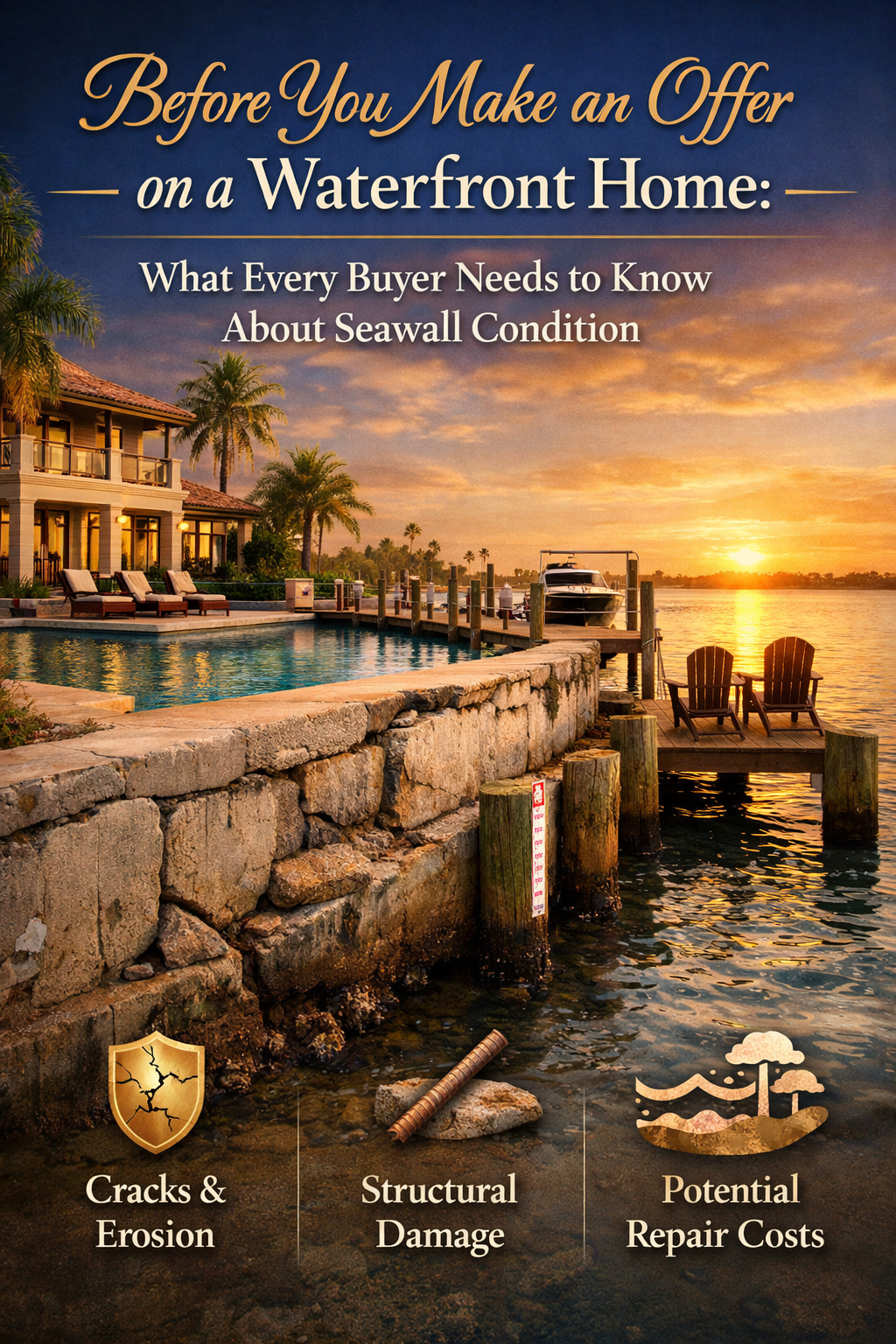
Before You Make an Offer on a Waterfront Home: What Every Buyer Needs to Know About Seawall Condition
Before You Make an Offer on a Waterfront Home: You found it. Canal-front home. Great lot. Dock already in place. The backyard practically sells itself. But before you write that offer, there is one question most buyers do not ask clearly enough — and it is the one that carries the most financial risk of anything on the property. How old is that seawall, what is it made of, and is it in good shape? On Florida’s Space Coast, where canal-front and riverfront homes make up a significant share of the waterfront inventory across Merritt Island, Cocoa Beach, and the surrounding Brevard County communities, this question is not academic. Seawall replacement is expensive, permit-heavy, and heavily time-dependent. A buyer who overlooks it may inherit a six-figure problem within a few years of closing. Just so you know — I want you to be prepared. This guide is not designed to alarm you. Most seawalls in solid condition are fine for years. But in a market where the asking prices for canal-front homes regularly exceed $600,000 to over $1 million, this is not a detail you should discover after the sale. If you are working with a Space Coast waterfront REALTORwho genuinely understands coastal construction, this conversation happens before the offer is written — not after. Before You Make an Offer on a Waterfront Home: Why Seawall Due Diligence Is Different from a Standard Home Inspection The standard residential home inspection does not cover your seawall in any meaningful depth. Most licensed home inspectors are not marine contractors and are not trained to evaluate the structural integrity of a seawall, its tieback system, or the soil stability behind it. They may walk the yard, note obvious cracks, and move on. That is a gap in the inspection process that buyers almost never know about until they are sitting across the table from a marine contractor several years into ownership. A proper seawall evaluation requires either a licensed marine contractor or a professional engineer with coastal construction expertise. In some cases — particularly for older walls or properties with visible concerns — it requires an underwater inspection to assess the submerged portion of the structure. The part of a seawall you can see is not always the part that fails first. The cap, panels, and face of the wall are visible from the yard. The tiebacks — the steel rods anchored into the ground behind the wall — are not. The footer and submerged base of the panels are not visible without going in the water. This is why a professional marine inspection, not just a visual walk, is the appropriate standard for any waterfront purchase. “Carrie is truly a Cocoa Beach waterfront property expert and knows the local market inside and out. She’s professional, responsive, and the top Cocoa Beach real estate agent to trust.”— Verified Client — Cocoa Beach Waterfront Home Buyer What You Can Look For During a Showing You should not wait until inspection to start evaluating a seawall. A trained eye can identify warning signs during a showing, and knowing what to look for gives you important context before you make an offer. Look at the cap first The seawall cap is the horizontal concrete beam running along the top of the wall. It is your first visual checkpoint. Look for: Longitudinal cracking — long horizontal cracks along the cap suggest stress from the tiebacks or hydrostatic pressure building behind the wall. Spalling — chunks of concrete chipping or flaking off, often exposing rebar. Exposed rebar rusts, expands, and accelerates structural deterioration. Rust staining — orange or brown streaking down the wall face beneath the cap almost always indicates corroding rebar inside the concrete. Evaluate the wall face and panel alignment A seawall in structural distress will often show it through geometry before it shows it through cracks. Stand at the end of the seawall and sight down its length. Look for: Bowing or bulging — any outward curve in the wall means pressure is building behind it, often from saturated soil or failed drainage. Leaning — a wall tilting toward the water has a compromised tieback system. This is a serious structural finding, not a cosmetic one. Panel separation — gaps opening between concrete or vinyl panels indicate movement. In canals with boat traffic and wake action, this accelerates quickly. Walk the landward side carefully One of the most telling indicators of seawall failure is behind you, not in front of you. Walk the yard immediately adjacent to the seawall and look for: Sinkholes or depressions — small collapses or soft spots in the soil near the wall indicate that material is washing out underneath through failing panels or deteriorated joints. Soil pulling away from the base of the cap — a visible gap between the cap and the lawn on the landward side suggests wall movement. Drainage condition — weep holes allow hydrostatic pressure to release through the wall. If they are blocked or absent, pressure builds and walls fail faster. How Old Is Too Old? Understanding Seawall Generations in Brevard County This is where local knowledge matters in a way that generic advice simply cannot replicate. Many of the canal-front communities on Merritt Island — older subdivisions near Holiday Cove, South Tropical Trail, and the Banana River — were built out in the 1960s and 1970s during the population surge that followed NASA’s expansion. Seawalls installed as part of that original construction are now 50 to 60 years old. The life expectancy of a seawall depends significantly on material and maintenance. Here are general industry benchmarks mapped to what is most relevant for the Space Coast: Material Typical Lifespan Notes for Brevard County Concrete (1960s–70s original) 30–50 years Many are at or past end of design life — professional assessment is non-negotiable Concrete (modern reinforced) 40–50+ years Depends heavily on rebar quality, drainage, and storm exposure Steel sheet piling 35–50 years (with coatings) Brackish water in Brevard’s estuarine canals accelerates corrosion significantly Vinyl / PVC sheet pile 50+ years Now the preferred replacement

The Space Coast Waterfront Home: A Practical Field Guide for Buyers Who Have Done the Research | Carrie Liotta, Trusted Realtor
You are not a first-time buyer. You have owned property before. You know how to read a disclosure document and you are not intimidated by an inspection report. What you don’t have is 15 years of institutional knowledge about how real estate works specifically on Florida’s Space Coast — the waterway quirks, the insurance realities, the neighborhood distinctions that separate a smart waterfront purchase from an expensive learning experience. This post is written for you. It assumes a starting budget of $600k–$1M+, a genuine interest in waterfront access, and a preference for clear information over reassuring vagueness. It also assumes you are either considering Merritt Island as a primary location or trying to decide between Merritt Island, Cocoa Beach, and Viera — which is the comparison that comes up most consistently among informed Space Coast buyers. The Three-Location Decision: Merritt Island vs. Cocoa Beach vs. Viera Every serious Space Coast relocation buyer eventually faces this comparison. They are not interchangeable, and the right answer depends entirely on what you actually prioritize. Merritt Island: The Waterfront Value Play Merritt Island is the choice for buyers who want genuine waterfront access — boat in the backyard, lagoon or canal views — without paying Cocoa Beach premiums. At the $650k–$900k range, Merritt Island delivers more square footage, larger lots, and genuine boating access compared to what the same money buys oceanside. The trade-offs are real: Merritt Island does not have the walkable beach-town culture of Cocoa Beach. Restaurant and retail density is lower. The feel is quieter, more residential, less social. For buyers who are going to be on the water more than they’re going to be walking to dinner, this is a reasonable trade. Cocoa Beach: Premium Brand, Ocean Proximity Cocoa Beach commands a price premium that is brand-driven as much as fundamentals-driven. The walkability to the beach, the surf culture, the name recognition — these have real value, but they translate to a thinner product at the $700k–$900k price point. You are buying a smaller home, possibly on a narrower canal, with the understanding that the address itself carries cultural cachet. For buyers who plan to use the property as a short-term rental during periods they’re not using it, Cocoa Beach has stronger income potential due to tourism demand. For buyers who will occupy full-time, the calculus depends on whether the beach-town lifestyle is genuinely how they want to spend weekends or whether it’s an image they’re buying. Viera: Master-Planned, Newer, Less Water Viera is not a waterfront option in any meaningful sense — the community has lakes and ponds, not navigable waterways. What it offers instead is newer construction, strong school districts, reliable HOA management, and predictable infrastructure. For aerospace buyers who want simplicity, newer systems, and a shorter drive to I-95 for travel flexibility, Viera makes rational sense. Viera’s resale market is among the most stable in Brevard County because product is newer, buyers are familiar with the community structure, and the lack of waterfront complexity means fewer surprises at inspection. For buyers who want waterfront access occasionally (paddleboarding, kayaking) but don’t need to dock a boat in their backyard, Viera offers community amenities that check that box at a fraction of the premium. “Having moved from out of state, buying my dream home in Suntree, Melbourne, Florida would not have been possible without Carrie Liotta! From start to finish, she went above and beyond to make the process smooth, stress-free, and even exciting.” The Neighborhood-Level Comparison That Matters Factor Merritt Island Cocoa Beach Viera Waterfront access Canal + lagoon frontage available Canal + limited oceanfront Lakes/ponds only Price/sq ft (canal) $275–$450 $400–$600 N/A Commute to Patrick SFB 20–30 min (south) 10–20 min 35–50 min Commute to KSC/SpaceX 25–40 min 35–50 min 30–45 min Short-term rental potential Moderate High Low-moderate New construction availability Limited Very limited Strong School district quality Good Good Excellent Walkability/amenities Low-moderate High Moderate Boater lifestyle fit Strong Moderate-strong Weak The question isn’t which community is better. It’s which one is actually right for how you plan to live — and that requires honesty about what you’ll use versus what sounds appealing in the abstract. Understanding the Space Coast Insurance Environment Why This Comes Before the Offer Most buyers in non-coastal markets treat insurance as an afterthought — something to sort out 30 days before closing. In Brevard County, that approach leads to budget surprises that can derail or complicate a transaction that otherwise checked every box. Florida homeowner’s insurance rates have increased substantially since 2021, following a period of carrier exits from the market, legislative reforms, and reassessment of hurricane risk modeling. As of 2024–2025, Brevard County homeowners on waterfront properties typically see combined homeowner and flood insurance annual premiums in the range of $8,000–$20,000+ depending on construction year, roof condition, elevation, flood zone, and replacement cost value. The Windstorm Mitigation Credit System Florida has a system of windstorm mitigation credits that can reduce insurance premiums by 30–60% on eligible homes. The credits are triggered by specific construction features: hip roof geometry, roof deck attachment quality, roof covering type, opening protection (impact windows/doors), and roof-to-wall connections. A wind mitigation inspection, which costs $150–$300, documents which credits apply. For buyers purchasing older homes on Merritt Island or Cocoa Beach, one of the highest-ROI upgrades available is installing impact-rated windows and doors — not just for storm protection, but specifically to unlock the opening protection windstorm credit. In some cases, the annual insurance savings exceed the amortized cost of the upgrade within 5–7 years. Citizens Insurance and the Takeout Market Citizens Property Insurance is Florida’s insurer of last resort. Many Space Coast waterfront properties are currently insured through Citizens, particularly those where private market options are limited due to age, proximity to water, or prior claims history. Florida’s Citizens depopulation program means that policies may be removed from Citizens and placed with private carriers — sometimes with rate changes — during the life of your ownership. If the property you’re considering is currently insured through Citizens, ask for the Citizens policy number and verify the current premium, coverage

What Every Buyer Gets Wrong About Waterfront Real Estate on the Space Coast — And How to Avoid Those Mistakes | Carrie Liotta, Trusted Realtor
Waterfront Real Estate on the Space Coast: Most people who buy waterfront property on Merritt Island or Cocoa Beach make their decision based on how a home looks in photos. The dock photograph. The sunset over the canal. The boat tied up out back. What they don’t see — and what nobody shows them — is whether that boat can actually go anywhere, whether the seawall behind that photo has 18 months or 18 years left on it, and whether the flood insurance premium they’ll be quoted 60 days after closing was something they could have anticipated. These aren’t obscure fine-print issues. They are common, predictable, and avoidable. The problem is that the information required to navigate them lives in the intersection of local waterway knowledge, Florida insurance regulations, structural engineering, and real estate transaction mechanics — a combination most buyers don’t have and most agents don’t either. What follows is what the research-mode buyer needs to understand before making an offer on Space Coast waterfront property. Waterfront Real Estate on the Space Coast: The Three Things That Actually Determine Waterfront Value 1. Access Quality — Not Just Access The listing will say ‘canal front.’ What it won’t say is whether the canal has 3.5 feet of depth or 7, whether there’s a fixed bridge with 11 feet of clearance a quarter mile downstream, or whether the canal terminates without connecting to the main lagoon system. Access quality is what you can actually do with the water, not whether your backyard touches it. In practical terms: a canal-front home with poor access may give you a beautiful view and the ability to kayak. That’s genuinely pleasant. But if you’re paying a $150,000 waterfront premium expecting to keep and run a 28-foot center console, a canal that can’t accommodate that boat at low tide is not the product you thought you were buying. The way to evaluate access quality: hire a marine surveyor before you’re under contract or as a condition of the contract. This is the single most underused form of due diligence in Space Coast waterfront transactions. 2. Seawall Generation and Remaining Life Merritt Island and Cocoa Beach waterfront homes were largely developed in three waves: the post-war 1950s–60s boom, the 1990s–2000s infill, and newer construction. Seawalls built in the first generation are now approaching 60–70 years old. Many are still structurally sound. Some are not. The ones that aren’t can cost $100,000–$200,000 to replace, depending on linear footage and site conditions. Seawall age and condition do not show up in a standard home inspection. A standard home inspector will note visible cracks or obvious signs of failure, but a thorough seawall assessment requires a marine contractor or structural specialist. For any waterfront property where you intend to stay 10+ years, this is worth the $400–$700 it typically costs. The way to estimate seawall generation without hiring anyone: ask the listing agent for the original construction date of the wall. If they don’t know, check Brevard County permit records through the county’s permit search portal. Any seawall replacement would have required a permit, so the records should indicate whether the wall has been replaced and when. “Carrie Liotta made buying my waterfront home in Cocoa Beach an incredible experience! She’s truly a Cocoa Beach waterfront property expert and knows the local market inside and out.” 3. Insurance Positioning Under FEMA Risk Rating 2.0 Florida homeowners insurance is a complex topic that deserves its own post. For waterfront-specific buyers, the single most important development of the last four years is FEMA’s Risk Rating 2.0, which took full effect in 2023 and completely overhauled how National Flood Insurance Program premiums are calculated. Under the old system, flood insurance rates were based primarily on FEMA flood map zone designations. Under Risk Rating 2.0, they’re based on property-specific risk factors including distance to the nearest flooding source, first floor elevation, foundation type, and replacement cost value. The result is that two homes on the same street with identical flood zone designations can have dramatically different flood insurance premiums. The implication for buyers: ask for the current flood insurance premium from the seller, and get an independent quote before closing. Sellers are required to disclose this in Florida, but buyers often receive it without understanding what they’re looking at. A flood insurance premium that has been set under pre-Rating 2.0 rules and is still being transferred at a legacy rate will reset when you take ownership. For accurate current estimates, you can contact an independent flood insurance broker or use FEMA’s Flood Map Service Center at msc.fema.gov to locate your property’s current designation and cross-reference it with the NFIP rate calculator. The flood insurance question isn’t whether you need it. It’s what the current premium actually is, what it will be after closing, and what it could become in five years. How the Space Coast Waterfront Market Actually Works Merritt Island vs. Cocoa Beach: The Value Trade-Off These are adjacent communities with very different price-per-square-foot dynamics. Cocoa Beach commands a premium driven primarily by its oceanside brand, walkability to the beach, and strong short-term rental demand. On the canal side, Cocoa Beach waterfront homes run roughly $400–$600 per square foot for reasonably updated product. Merritt Island waterfront, for comparable canal-front access, typically runs $275–$450 per square foot — meaningfully lower. The trade-off: Merritt Island has less walkability, no direct beach access on the eastern side, and a quieter, more suburban character. For buyers who are choosing between a smaller renovated home on Cocoa Beach canals and a larger updated home on Merritt Island canals with equivalent boat access, the Merritt Island property is frequently the better value proposition for long-term owners. The exception: lagoon-front properties (not canal-front, but properties directly on the Indian River or Banana River with unobstructed water views) close the gap considerably. Lagoon-front Merritt Island commands prices that approach or match Cocoa Beach canal-front in comparable size categories. What the Listing Doesn’t Tell You: The Real Table What the Listing Says What You Actually Need to Know Canal frontage Canal depth at low