

Living Near USSSA Space Coast Complex: What Should Viera Relocators Test on Tournament Weekends?
By Carrie Liotta, Space Coast REALTOR® with REAL Broker | Published October 6, 2026
If your household will use USSSA Space Coast Complex often, living nearby can make Viera life easier—but test the exact home during a tournament before paying for proximity. Drive the actual entrance route, observe sound, light and parking patterns, review HOA rules, and compare the whole monthly payment. A short map distance does not guarantee an easy event day.
This is not simply a traffic question. A tournament family may value returning home between sessions; an occasional spectator may prefer a quieter street, different commute or lower carrying costs. Two equally close homes can work differently because their subdivision exits, turns and ordinary routes are not the same.
Start with how often the venue will truly shape your week
Before comparing neighborhoods, write down your likely use. Is a child joining a local team that regularly plays at the complex, or will your family attend one tournament a year? Are you coaching, working an event, hosting traveling relatives, or simply drawn to the idea of nearby sports? Those are very different reasons to assign value to the location.
Frequent users may save repeated loading, meal and travel friction. They may appreciate being close enough to handle a forgotten glove, a weather delay or a long break between games. Occasional visitors should be careful not to pay for an imagined routine. The house still has to work on ordinary school days, workdays and weekends when nobody is playing.
The complex’s official event page described it as USSSA’s destination sports facility and, when I checked on October 6, 2026, displayed several October events. Its upcoming-events calendar also showed multi-day adult and youth tournaments across October and November, with more than one event listed on some weekends. That calendar is a dated snapshot, not a promise of future frequency, but it shows why one quiet drive-by is not enough.
Choose a meaningful event-day test, not a random Saturday
I would visit a candidate home during an event that resembles your expected use. A smaller youth event, a large world tournament and two overlapping competitions can produce different arrival waves. Recheck the schedule shortly before the showing because dates, brackets and game times can change.
One current example is the official page for the October 8–11, 2026 Men’s C and Women’s C&D World Tournaments. It confirms the Stadium Parkway venue and links to an event schedule. Use that detail to time the test rather than assuming every hour of a multi-day event feels alike.
Make three passes if the decision matters: before the first games, near a game-change period and after play is ending. Start at the home’s driveway. Follow the route your household would actually take, including the subdivision exit, turn lanes and the complex entrance assigned to the event. Then repeat the ordinary errands that still need to happen—grocery pickup, school run, medical appointment, work commute or dinner.
The complex’s published policies say gates typically open 90 minutes before the first game, entrances correspond with color-coded parking lots, some gates may not operate for every event, and buses and RVs are directed to the North Red lot. Those operational details matter. A buyer should not judge access from a map pin at the stadium or from one entrance used on a different day.
Test the property, not the reputation of the street
When you return to the home, stop talking for a few minutes. Listen from the front entry, rear lanai, primary bedroom and any room planned for remote work or a sleeping child. Note what you actually hear and see without turning one observation into a year-round conclusion.
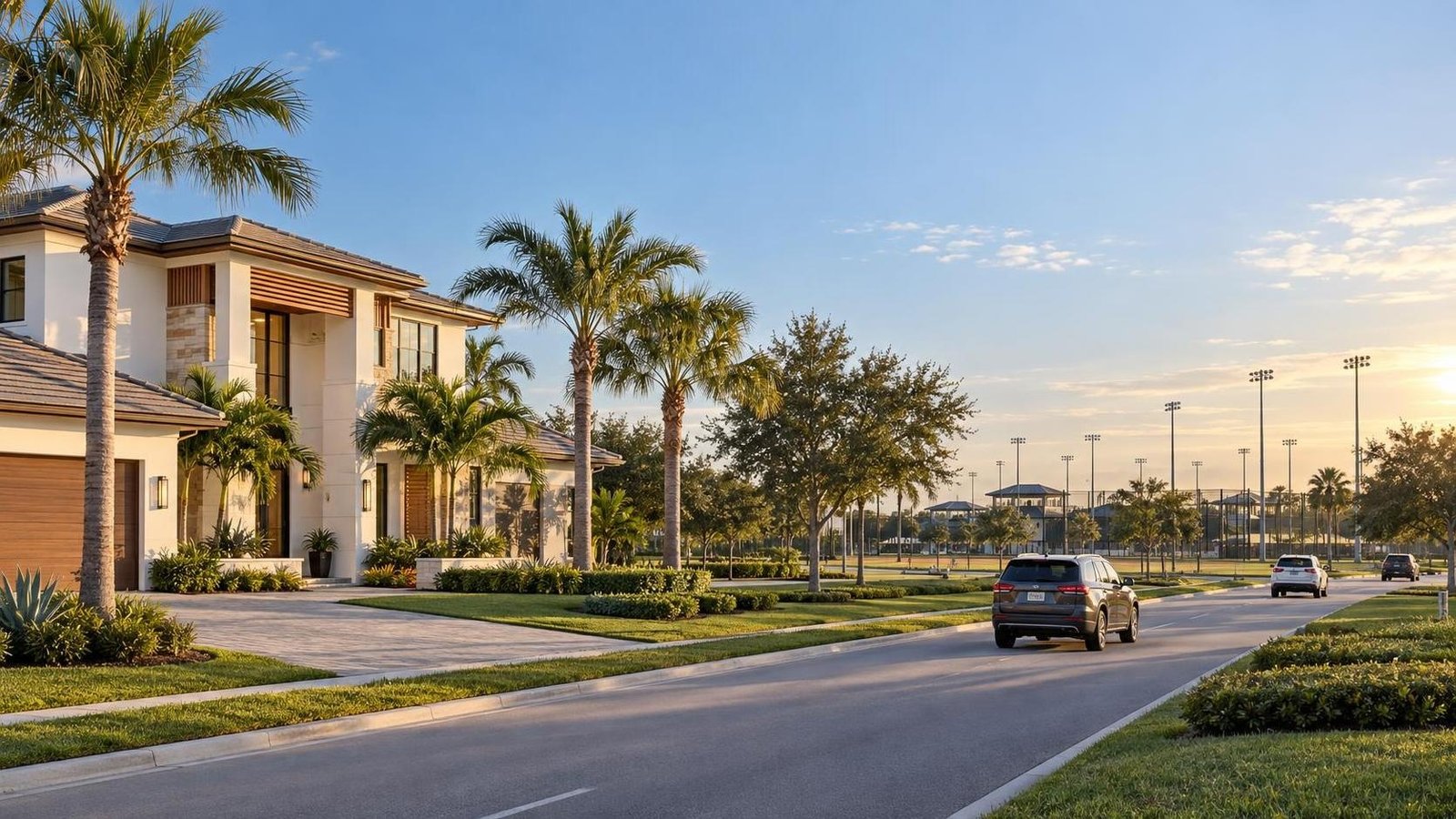
Look at the home’s orientation, distance from the roadway, walls, landscaping, neighboring structures and window condition. Ballfield lighting that is invisible from one lot may be noticeable from another. A home nearer the venue can still feel calm when its rooms and outdoor space face away from activity. A farther home can sit on a route that carries more event traffic.
Do the same check after dark if evening use or bedroom light matters. Do not trespass, film private residents or assume that a bright sky proves a permanent nuisance. Record the date, event and time. If you cannot visit, ask for a continuous time-stamped video from inside the property and from public approaches, then verify conditions during the inspection period.
Separate tournament traffic from the household’s normal route
My article on school-day Stadium Parkway traffic versus older windows explains why a route must be tested at the hour a household will use it. Tournament-weekend testing adds a second pattern. A home can have an easy weekday commute and a busier event approach, or the opposite.
Open the Florida Department of Transportation’s FL511 current-conditions tool before each test to identify a crash, construction issue or larger road incident that could distort what you observe. Then still drive the route. An online estimate cannot show whether a left turn feels awkward with sports gear in the car, whether an alternate subdivision exit works, or whether the family can reach routine destinations without joining the main event flow.
For two working adults, test both directions. One person may value quick access to the fields while the other repeatedly crosses the event route for a hospital, aerospace, school or beachside commute. Proximity is a household benefit only when it does not create a larger penalty elsewhere.
Plan for guests, gear and parking at the house
Living close to a tournament venue often changes the home’s job. Teammates may meet there. Relatives may visit. Coolers, folding chairs, wagons, uniforms, bats and wet gear need somewhere to go. A two-car garage that is already tight around vehicles may not function like the sports-storage space shown in a listing photo.
Walk from driveway to storage. Can the household unload without blocking the sidewalk? Is there a practical place for muddy shoes and laundry? If visitors will stay overnight, test the guest room, bathroom and parking plan rather than assuming a wide street means unlimited parking.
Read the HOA documents for vehicle, street-parking, trailer, sign, nuisance and leasing provisions that actually apply to the property. Do not borrow rules from another Viera neighborhood. If family members travel with an RV, bus or trailer, the venue’s parking policy does not establish what can be kept at the house. Association rules, recorded restrictions and the physical property answer that separate question.
Compare proximity with the full carrying cost
I would not assign an automatic premium to “near the complex.” There is no reliable universal amount, and the feature matters differently to each buyer. Instead, compare the complete housing choice: price, taxes after purchase, insurance quote, HOA obligations, district assessments, roof and HVAC condition, storm protection, near-term repairs and the cash reserve left after closing.
Then add the lifestyle math. Frequent tournament households may reduce fuel, meal, hotel or scheduling friction by living closer, but those savings must be based on their real calendar. A family that practices elsewhere and travels for most events may gain less than expected. A slightly farther home with a better garage, quieter bedroom, more flexible route or lower payment may support sports life more effectively.
The same discipline applies when comparing amenities. My guide to Space Coast sports access without paying for a high-amenity HOA asks whether the recreation network fits the weekly routine. Here, the question is narrower: will this exact venue be used often enough to influence the home purchase?
Review the home for ordinary-week value and resale
A sports-centered move still needs an exit strategy. Future buyers may appreciate the convenience, but others will care more about bedroom quiet, commute options, storage or monthly cost. Venue proximity does not guarantee resale demand; the home should succeed without that single selling point.
Compare floor plan, lot, natural light, privacy, maintenance and major systems before using distance to break a tie. If the closer home needs a roof, has limited guest parking and leaves no room for gear, it may not be the practical sports home. If the farther property adds a difficult daily drive for a child who plays at the complex several times a week, that inconvenience deserves weight.
Buyers new to Viera should also understand the broader layout before narrowing the search. My overview of Viera East, Viera Central and Viera West provides the larger community context. The complex is one destination inside a much bigger routine that includes work, school, shopping, medical care, parks and I-95 access.
Use a two-column decision test
After the event-day visits, make two columns for each home. In the first, record what proximity improves: departure time, midday returns, guest logistics, event work, team coordination and access to the particular fields your household uses. In the second, record what the location complicates: route congestion, bedroom conditions, parking, guest patterns, HOA limits, commute conflicts or a higher total payment.
Keep observations separate from assumptions. “We reached the assigned entrance in this time during this event” is useful; “this road is always easy” is not. “We heard announcements from the rear lanai at this hour” is useful; “every tournament will be loud” is not.
I would also ask these questions before the inspection period ends:
- Which events and age divisions will this household realistically attend during the next two years?
- Which complex entrances and parking areas serve those events, and do they change?
- Can the home reach work, school and errands without depending on the main spectator route?
- What were sound and light conditions inside the bedrooms and outdoor space during an active event?
- Do the garage, laundry, guest rooms and driveway support the household’s actual sports routine?
- What do the current HOA documents say about parking, vehicles, trailers, rentals and nuisance issues?
- Does the full payment still feel comfortable after repairs and normal ownership reserves?
When I would choose the closer Viera home
I would favor the closer home when the household uses the complex regularly, the tested entrance route works at relevant event times, the rooms remain comfortable, and the property supports gear and guests without rule conflicts. The choice becomes stronger when proximity reduces repeated family logistics and the home also wins on condition and monthly fit.
I would choose the farther home when venue use is occasional, the closer property depends on one congested route, or another home offers a meaningfully better commute, bedroom environment, storage plan or payment. “Near USSSA” is a useful lifestyle feature, not a reason to ignore the rest of the inspection and budget.
Bottom line
For a tournament household, living near USSSA Space Coast Complex can turn long sports days into a simpler routine. The value is real only after the exact home passes a real event-day test. Check the current calendar, assigned entrance, route, sound and light, parking, HOA documents, guest plan and complete monthly cost.
If you are relocating to Viera, I can help you compare homes around the week you will actually live—not just the distance shown on a map. Reach out for a no-pressure conversation with Carrie Liotta, Space Coast REALTOR® with REAL Broker, and join my private Facebook group, Moving to Brevard County Florida. Your next chapter starts here.
