

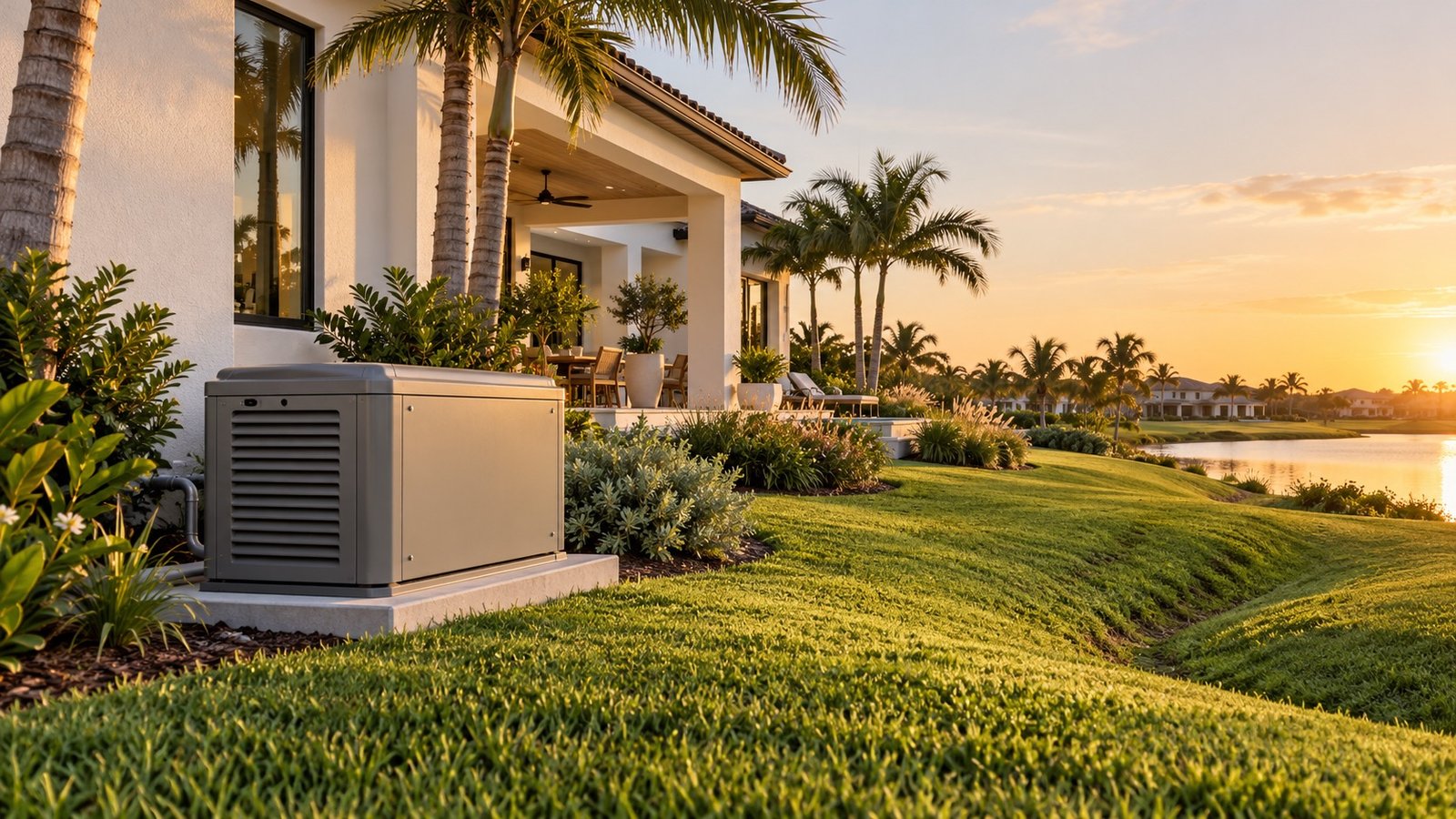
Buying a Viera Home With a Generator Pad Near an HOA Drainage Swale
By Carrie Liotta, Space Coast REALTOR® with REAL Broker | Published October 25, 2026
If a Viera home has a generator pad beside an HOA-maintained drainage swale, do not treat it as a simple backyard upgrade. Before you offer, verify the pad’s approvals, exact property or easement lines, drainage function, and responsibility for future repair. A quiet strip of grass can determine whether the generator is usable, permitted, and noncontroversial after closing.
I see why this detail gets missed. Buyers are often focused on the generator itself: the brand, the transfer switch, the fuel source, and the comfort of having backup power. Those are worthwhile questions. But a pad beside a swale adds a second system to the decision. The generator is private equipment; the swale may be part of a larger drainage design and may be subject to a recorded easement, HOA maintenance standards, or both.
That does not mean you should walk away from the home. It means you should buy the full picture, not just the equipment. In Viera, where individual neighborhoods can have different associations, covenants, architectural processes, and drainage arrangements, the answer is address- and community-specific. I want my buyers to leave the inspection period with documents, measurements, and a clear plan rather than a verbal reassurance that “the HOA takes care of it.”
Why the generator pad and the swale have to be reviewed together
A generator pad needs access for service, a workable route for electrical and fuel connections, and enough room to maintain the equipment according to the manufacturer’s instructions. A drainage swale needs to keep carrying water where the community’s design intends. When they sit beside each other, a future owner can accidentally create a conflict by adding pavers, fencing, landscape edging, mulch, a screen enclosure, or a replacement pad that changes access or redirects runoff.
The question is not whether the backyard looks dry on the day of a showing. It is whether the existing arrangement is documented and whether it will still make sense after a heavy rain, a landscaping change, or a generator service visit. I would rather identify a limitation before the offer becomes emotional than discover it after someone has already planned a new fence, outdoor kitchen, or larger generator.
There is also a practical ownership issue. “HOA-maintained” can mean different things. The association may mow the swale, maintain a common drainage feature, hold an easement across a private lot, or simply enforce a landscape standard while the owner retains more responsibility than expected. The recorded declaration, plat, survey, and current association materials—not a listing remark—are where I start.
For a related Viera decision, read my guide to rear-yard drainage swales and HOA responsibility. The point is the same: a backyard feature can be attractive and still come with an obligation that deserves a careful look.
Start with the recorded map, not the patio conversation
Ask for the current survey, the recorded plat, the title commitment when it becomes available, and the governing documents for the community. I want the buyer, title company, and inspector looking at the same physical area with the same names for it. Is the swale on the lot? Is there a drainage easement? Does a utility easement overlap the area? Is the generator pad entirely outside that corridor? Those are different questions, and one document rarely answers all of them by itself.
The Brevard County Clerk’s Official Records portal is a useful starting point for recorded documents such as plats and other filings. It is not a substitute for title work or a surveyor’s opinion. In practice, I use it to help identify the documents we should ask the right professional to interpret, especially when the backyard has been altered since the house was built.
Look for clues that the pad and drainage feature were planned together—or were not. A clean rectangular pad close to a swale is not automatically a problem. But an improvised extension, fresh fill, a broken curb edge, a low spot that collects water, or landscaping that blocks a visible flow path should move this from a casual question to an inspection item. The goal is not to diagnose drainage from a phone photo. The goal is to know what needs a qualified look before your contingencies expire.
Get the association’s answer in writing
Ask the seller for the HOA approval, architectural-review correspondence, site plan, contractor invoice, warranty, and any notice relating to the generator or pad. If the seller does not have them, ask the association what records it has and whether there is an open violation, pending request, maintenance notice, or rule that affects the area.
Florida’s homeowners’ association records statute, section 720.303, addresses association official records and is a sensible place to understand why association paperwork matters. It does not tell you what a particular Viera HOA must approve for a generator. The community’s recorded documents and current rules do that. Still, it supports the disciplined approach: obtain the actual records instead of relying on a neighbor’s memory or an agent’s assumption.
My request list is specific: the declaration and amendments, the current rules, the architectural guidelines, the approval file for the generator if one exists, the current budget or maintenance description if it identifies drainage responsibilities, and any correspondence about the swale. If the association says it maintains the feature, ask what that maintenance includes and what it does not include. Mowing is not the same as taking responsibility for every regrading or repair beside it.
This document-first method is helpful for other Viera backyard improvements too. My article on HOA landscape changes near a pool enclosure explains why an approval that sounds routine can matter once water has to move through the same space.
Confirm the installation history without guessing
Ask for the generator contractor’s invoice, model information, warranty, and any electrical or fuel-service paperwork the seller has. Then ask the appropriate local building authority whether its records show a permit or final inspection for the work. The public Brevard County Building Permits page is the county starting point, although a property inside a municipality may have a different permitting authority. Do not turn a missing online record into an accusation; older records, address formats, and jurisdiction all deserve confirmation.
I would also ask the generator company or a qualified electrician to look at the installation during the inspection period. Their role is not to interpret an HOA declaration. It is to explain whether the equipment, connections, access, clearances, and apparent condition make sense for continued use. A drainage professional or engineer may be appropriate if there is standing water, visible erosion, a disputed grade, or a planned change that could affect the swale. Each professional answers a different part of the same buyer question.
Be careful with phrases like “grandfathered” and “the HOA approved it years ago.” Both may be true, but neither is a document. A dated approval, permit record, or written confirmation is more useful than an oral history when you need service, insurance information, resale support, or permission to replace the equipment later.
Walk the yard with a future-owner mindset
During inspection, do more than stand at the generator. Follow the apparent water path. Look at the grade around the pad, the distance to fences and landscaping, where downspouts discharge, whether the service side is accessible, and whether a gate or screen enclosure would make a future replacement difficult. Take photos after a rain if timing allows, but do not assume a dry week proves the drainage system is fine.
Then think one project ahead. If you might add a pool, turf, a wider patio, a privacy hedge, or a fence for a dog, ask whether that plan touches the same area. A home can be perfectly workable today but lose flexibility if the only sensible route for future drainage, equipment service, or HOA access is already crowded. That is not a reason to reject every home with a swale. It is a reason to price the limitation into your decision.
For an example of how backup power becomes a broader property-file issue, see my article for sellers on documenting a Viera home’s battery, generator, and pool loads. Buyers and sellers benefit from the same clarity: what is installed, who approved it, what it serves, and what a future owner needs to know.
When this should change your offer strategy
A documented, accessible generator pad beside a clearly defined and functioning swale can be a positive feature. It can give a buyer confidence during a power interruption without creating a backyard project. I am comfortable moving forward when the survey and records line up, the association has no unresolved issue, the appropriate inspectors are satisfied with the visible condition, and the buyer understands any future limits.
I slow down when the pad appears to sit in an easement, the seller cannot identify approvals, the swale looks altered, there is a current drainage complaint, or the association’s answer changes depending on who is asked. At that point, the right response may be a targeted inspection, a written association clarification, a repair estimate, an offer adjustment, or simply more time before removing contingencies. What I do not recommend is assuming that a feature is harmless because it has been there for years.
There is a cost lens here, too. The purchase price is only one number. If the pad has to be moved, the drainage needs correction, or the backyard cannot support the improvements you expected, the “included generator” may be less valuable than it first appeared. Conversely, good records and a clean approval trail can protect both utility and resale. That is why I would weigh the entire file, not just a single contractor quote.
My due-diligence list before you remove contingencies
- Review the survey, plat, title materials, and any easement affecting the swale or generator area.
- Request HOA rules, architectural approvals, violation history, and written clarification of maintenance and access responsibilities.
- Collect installation invoices, equipment information, warranties, and available permit or inspection records.
- Have the appropriate licensed professional assess the generator installation and service access.
- Ask a drainage-qualified professional for guidance when there is visible erosion, ponding, altered grade, or a planned backyard project.
- Decide whether your future fence, pool, patio, landscaping, or replacement-generator plan is compatible with the documents and the site.
Bottom line
A generator pad next to an HOA drainage swale is not automatically a red flag, and it is not a free bonus either. The smart Viera buyer verifies the location, documents, approvals, maintenance line, and future access before closing. That turns an uncertain backyard feature into a decision you can price and plan for with confidence.
If you are comparing Viera homes and want help sorting the property file from the sales language, I can help you build the right questions for the seller, association, title company, and inspectors. Reach out for a no-pressure conversation about Brevard County homes for sale with Carrie Liotta, Space Coast REALTOR® with REAL Broker. Your next chapter starts here.
