

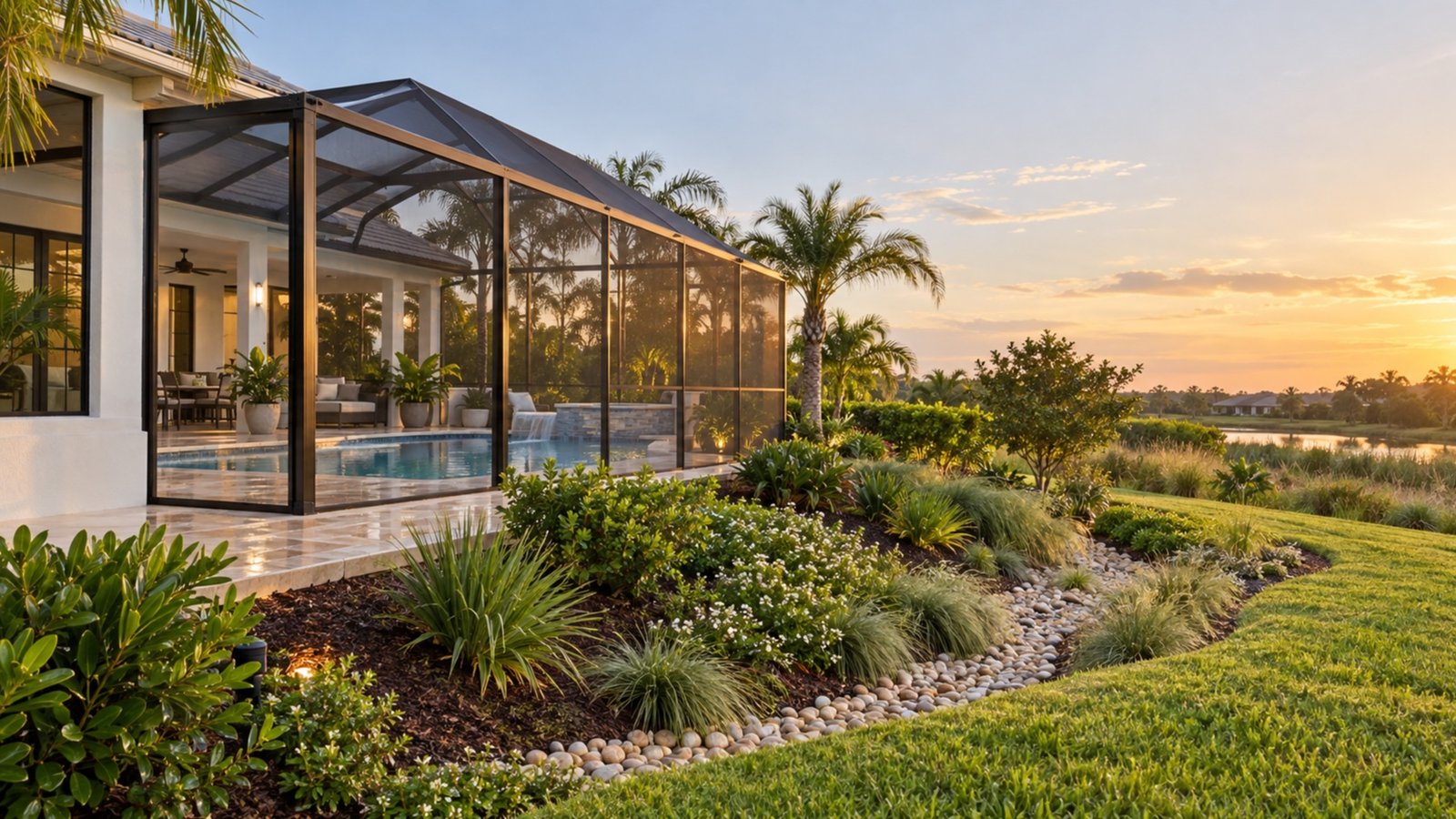
Buying a Viera Home With a Pool? Ask How Landscape Changes Affect Drainage First
By Carrie Liotta, Space Coast REALTOR® with REAL Broker | Published October 23, 2026
If a Viera home has a pool enclosure, fresh planting, new pavers, or a landscaped side yard, I would not treat a prior HOA approval as the end of the drainage conversation. It is a useful document, but buyers still need to understand what was approved, what was built, where water is meant to go, and whether the record trail matches the backyard they are buying.
That is especially important in Viera, where a backyard can feel like a finished outdoor room: pool deck, screen enclosure, planting beds, irrigation, patio furniture, and often a preserve, pond, easement, or neighboring lot just beyond the fence. Those features are part of the appeal. They also make a casual “the HOA said it was fine” answer too thin for a careful buyer.
I am Carrie Liotta, a Space Coast REALTOR® with REAL Broker. When I help a buyer evaluate a Viera resale, I want the pool area to be both enjoyable and understandable. The goal is not to turn a beautiful yard into a deal-breaker. It is to replace assumptions with the few documents and observations that make the decision clearer before the inspection period runs out.
An HOA approval and a government permit answer different questions
The first distinction is simple: an association’s architectural approval is not the same thing as a government permit, and a permit is not the same thing as proof that a backyard drains well today. Each document has a different job.
Florida’s 2026 HOA statute says architectural-review authority must come from the declaration or authorized published standards, and it requires those standards to be applied reasonably and equitably. The same law says an association cannot make issuance of a governmental building permit a prerequisite to its own review. In other words, the order of approvals may vary, but buyers should not assume one approval substitutes for the other. Read the current language in Florida Statutes section 720.3035.
For a purchase, I separate the questions this way:
- Association approval: Did the owner submit a plan, and what did the committee allow under that neighborhood’s governing documents?
- Permit history: Was a permit required for any part of the work, and is there a record for the work that required one?
- Existing condition: Does the grade, hardscape, drainage path, enclosure, and landscaping look consistent with the documents and function without ponding or directing water where it should not go?
That third question is the one buyers sometimes skip. A seller may have a perfectly valid approval letter for a planting plan from several years ago, yet later pavers, edging, grading, drainage modifications, irrigation repairs, or a replacement screen enclosure may have changed the way the whole area behaves in a heavy rain. The approval letter belongs in the file; it should not end the review.
Start with the address-specific governing documents
“Viera HOA” is not one universal rulebook. The neighborhood, lot, homeowner association, any applicable district documents, and the particular improvement all matter. Before an offer becomes nonrefundable, ask the seller or listing side for the community’s current architectural standards, the approval request and approval or conditions for the work, and any correspondence that explains what was approved.
I would compare those papers to the actual backyard, not merely glance at a yes/no letter. Look for the scope: pool enclosure, deck extension, pavers, plant beds, trees, landscape border, drainage swale, french drain, downspout routing, fence line, or irrigation changes. If the approval references a drawing or site sketch, request that attachment too. A one-page approval that refers to an unseen plan does not tell the full story.
Florida law also gives owners rights concerning association records and treats a body that makes final architectural decisions as part of the association-governance framework. That does not mean a buyer can demand every private file during a showing. It does mean the governing documents and the decision trail are worth pursuing through the seller, association process, and contract due diligence. The current statutory starting point is Florida Statutes section 720.303.
For more Viera-specific context, my guide to pond-maintenance easements beside a backyard pool plan explains why the line behind a fence can matter as much as the deck itself.
Read the backyard like water will test it
You do not need to become a drainage engineer at a showing. You do need to notice where a quick rain would travel. Start at the roofline and work outward. Where do downspouts discharge? Does the deck sit higher than the adjacent planting beds? Are there pavers that appear to have been added after the pool was built? Does a bed terminate against the screen track, the house, a fence, or a side-yard path?
Then slow down at the transitions. The risk is often not a dramatic ditch or a visible crack. It is the small change where a raised landscape border traps water beside the enclosure, a downspout ends on a deck edge, or a replacement paver section has no obvious path toward the intended drainage area. Fresh mulch can make a yard look finished while hiding whether the grade actually moves water away from the home and pool structure.
I would ask the seller these practical questions in writing during due diligence:
- What work was done? Ask about the pool deck, enclosure, paver area, landscape border, irrigation, and drainage path, including approximate timing.
- What happened after a hard rain? Ask about puddles, washout, screen-track settlement, water entering the enclosure, or water crossing onto a neighbor’s property.
- Who did the work? Request invoices, plans, permits, warranties, and any association approval that belongs to the described scope.
- What is beyond the fence? Ask whether an easement, pond-maintenance area, preserve buffer, or common-area edge affects the owner’s maintenance or alteration rights.
Those questions are not accusations. They are the normal way to learn whether a polished outdoor space has a coherent history. If the answers are straightforward and documented, great. If the story shifts from “just landscaping” to “we also rerouted a drain and extended the pavers,” you have identified a subject for the inspector and, if appropriate, a qualified drainage or pool professional.
Use local record searches as a starting point, not a verdict
Brevard County’s public Brevard Advanced Service Site lets non-registered users search building, development, and enforcement record information. It is a smart first stop for a property in the county’s jurisdiction. But a clean search result is not a promise that no work was done. Older records can be incomplete, and a property inside a municipality may require checking that city’s records instead.
That nuance matters because buyers sometimes make two opposite mistakes. One buyer sees a record and assumes every detail of the current backyard was reviewed. Another sees no record and assumes the work must be improper. Neither shortcut is reliable. Match the record to the scope of work, ask the seller for the underlying paperwork, and let the inspector assess current condition. If the change appears material and the documents are unclear, talk with the relevant local building department or a properly qualified professional before you waive a contingency.
A pool enclosure deserves its own look. Check the base of the screen walls, the fasteners you can see, the transition from deck to planting bed, and any evidence of soil washing from underneath pavers. You are not diagnosing construction defects from a tour. You are deciding whether the visible condition and paperwork justify a more focused inspection request.
For a related seller-side perspective, see my post on organizing pool, courtyard, and drainage approvals before selling a Viera home. The same file that gives a seller confidence can give a buyer a much clearer starting point.
Do not overlook easements and association-maintained edges
Many buyers focus on the pool and forget the strip just beyond it. A drainage easement, pond edge, preserve buffer, or common-area boundary can affect how an owner uses, maintains, fences, plants, or improves the rear and side yard. The fact that a previous owner has been mowing or planting an area does not, by itself, establish a right to change it.
Ask for the survey, review the title commitment when it arrives, and compare the legal lines with the visual lines. If a landscaped bed or drain outlet sits near an easement, that is the moment to ask who has maintenance responsibility and whether the improvement was approved. My deeper guide to Viera preserve-lot drainage and pool approvals can help you frame that conversation.
What would make me pause before removing contingencies?
Not every incomplete file is a reason to walk away. A missing landscape invoice or an approval letter without a color sample may be minor. I become more cautious when the visible condition, the seller’s explanation, and the documents point in different directions.
Examples include a paver extension that reaches a property line but is not shown on the submitted plan; a drain outlet that appears to cross toward a neighbor or common area; repeated washout along the enclosure; a pool deck that has settled beside the home; or a seller who cannot explain a visible drainage modification. In those moments, the right next step is usually targeted information, not panic: a better inspection, a contractor opinion, clarification from the association, or a permit-record inquiry appropriate to the address.
Keep the timing in mind. An HOA resale package, property survey, title work, inspection results, and permit research each arrive on their own timetable. I help my clients organize the questions early so the relevant people can respond while the contract still gives the buyer choices. A no-pressure conversation before an offer can also help identify the specialists a particular pool area may need.
My buyer checklist for a Viera pool-area landscape change
- Request the current HOA standards plus the actual approval request, approval, conditions, and any plan referenced in the approval.
- Match the paperwork to what is visible: enclosure, deck, pavers, landscaping, irrigation, drains, and boundaries.
- Review permit history through the correct local jurisdiction and recognize the limits of any public search.
- Ask the seller about prior ponding, washout, repairs, drainage changes, and contractor records.
- Read the survey and title material for easements, pond edges, preserve buffers, and common-area boundaries.
- Point out any concern to the home inspector and bring in a qualified specialist when the evidence calls for one.
- Do not rely on a verbal “approved” answer when the documents can be requested before your contingency expires.
The bottom line
An HOA-approved landscape change near a Viera pool enclosure is not automatically a problem. It is a prompt to ask a better question: does the approval, the permit history where applicable, the survey, and the backyard you see all tell the same story about water and responsibility?
When they do, you can enjoy the outdoor space with much more confidence. When they do not, you still have time to investigate before the uncertainty becomes yours after closing. If you are comparing Viera homes and want help building an address-specific due-diligence list, reach out for a no-pressure conversation about Brevard County homes for sale. Your next chapter starts here.
