

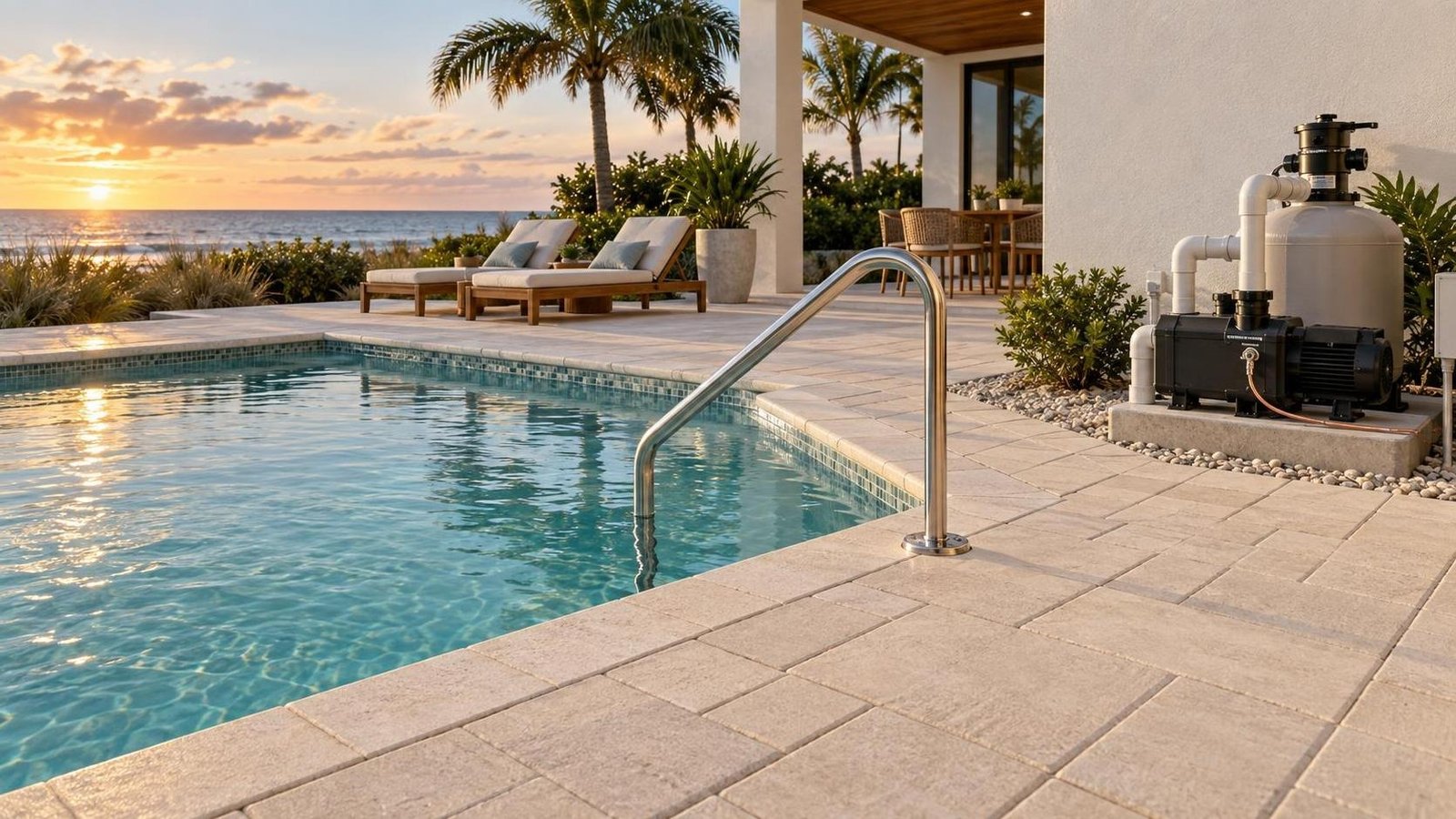
Documented Pool Bonding or Newer Deck Pavers: What Should Satellite Beach Buyers Prioritize?
By Carrie Liotta, Space Coast REALTOR® with REAL Broker | Published October 1, 2026
Prioritize verified pool bonding over newer deck pavers. Bonding is part of the pool’s electrical safety system, while pavers are primarily a finish and walking surface. I would choose the prettier deck only after a qualified electrician confirms that the pool’s bonding, grounding, GFCI protection, equipment, permits, and present condition make sense together.
“Documented” is important, but it cannot mean one invoice or a seller pointing to a copper wire at the pump. The file should show what was installed, when it was inspected, what later equipment or deck work changed, and whether the system observed today still matches that history. A new paver field can improve drainage, comfort, and appearance; it can also cover the perimeter where earlier pool work is difficult to see.
For a Satellite Beach buyer, the best comparison is not safety versus beauty. It is a known safety system plus an honest deck-condition plan versus a fresh surface sitting over unanswered questions.
Why bonding should usually win this comparison
A pool places water, wet people, pumps, lights, metal fittings, rails, ladders, and electrical equipment close together. Equipotential bonding is intended to connect relevant conductive parts so dangerous voltage differences are reduced. It is related to grounding and GFCI protection, but those terms are not interchangeable and one does not prove the others.
The National Fire Protection Association’s pool-electrical guidance describes bonding as a system involving the pool shell, perimeter surfaces, metal parts, pool water, and equipment as applicable to the installation. NFPA also warns that corrosion, loose connections, and rust can interfere with the bond. In its June 2026 pool and spa safety release, NFPA recommends periodic attention to GFCIs and grounding and bonding systems by qualified electricians.
That is why I would not trade a credible electrical file for cosmetic freshness. Pavers can be reset, repaired, cleaned, or replaced in a planned project. An unknown pool-electrical system requires investigation before the buyer can responsibly decide whether the repair is limited and accessible or whether deck removal, equipment changes, and permit work may be involved.
What counts as useful pool-bonding documentation?
Start with the original pool permit, electrical subpermit or scope, approved plans when available, inspection history, and final approval. Add invoices from the pool contractor and electrical contractor, equipment specifications, repair records, and photographs taken before concrete or pavers covered the work. Then create a timeline for later changes: pump replacement, heater or salt-system installation, pool-light work, new handrails, screen-enclosure changes, resurfacing, paver installation, or equipment relocation.
The City of Satellite Beach currently lists pools and spas, electrical work, and driveways or pavers among projects that generally require permits. Its permit information page also says permitted work must be inspected and directs owners to the BS&A portal for applications, records, inspection scheduling, and results. Pull the complete record; a search line that merely says “pool” or “pavers” does not explain the approved scope or whether a final was recorded.
Permit history is evidence, not a current-condition warranty. Match addresses, dates, contractor names, plans, inspection results, and invoices to what exists at the house. If the pool equipment pad moved after the original permit, the pump was changed, the deck was enlarged, or the rails differ from old photographs, ask what work accompanied that change.
I would have a licensed electrical contractor who understands pools evaluate the accessible system. Florida’s electrical-contractor statute defines that trade’s scope around electrical wiring, equipment, and systems performed in compliance with applicable plans and codes. Buyers can use the official Florida DBPR license search to verify regulated license information.
Do not use a visual shortcut for a concealed system
A visible copper conductor at the pump is not proof that every required part is connected, intact, appropriate, and continuous. A clean equipment pad does not reveal what is below the deck. A functioning pool light does not verify bonding. A home inspector’s general pool observations also may not replace a pool-electrical evaluation within a licensed electrician’s scope.
The buyer should not remove equipment covers, touch conductors, loosen clamps, or perform improvised continuity tests. Instead, ask the electrician to document what could be observed and tested safely, what records agree with the field condition, where access is limited, and whether further work is recommended. If the professional cannot verify a concealed portion, preserve that limitation rather than turning it into a casual assurance.
Pay special attention to metal handrails, ladder cups, light niches, water-bonding components when present, pump-motor connections, heaters, screen-enclosure metal near the pool, and equipment added after construction. The electrician and permitting authority must decide which components apply to the actual pool and the code edition tied to the work. The Florida Building Commission identifies December 31, 2023, as the effective date of the Florida Building Code, 8th Edition (2023), but buyers should not apply a current edition backward to every older installation without professional and jurisdictional guidance.
Why the paver timeline matters
Ask whether the pavers are original to the pool, an overlay, a replacement for concrete, or an expansion beyond the former deck. Obtain the paver proposal, permit, site plan, final inspection, before-and-after photographs, drainage details, and any electrician or pool-contractor invoice tied to the project. Find out who removed and reset rails, anchors, deck boxes, drains, screen posts, or equipment connections.
New pavers are not automatically suspicious. They may be a well-designed improvement with a complete file. The concern is chronology. If the deck was opened, raised, widened, or rebuilt, did someone document the pool-edge electrical work before the new surface went down? If a rail was removed, was it reinstalled as part of the recorded scope? If the paver field changed elevation, are drains, door thresholds, screen tracks, and equipment clearances still workable?
Walk the full perimeter. Look for uneven settlement, rocking units, sharp elevation changes, open joints, eroded bedding, low spots, algae, rust staining, cracked coping, loose edge restraints, blocked deck drains, and water directed toward the house or equipment. Run water only with permission and observe where it travels. A beautiful pattern does not compensate for a trip edge or water collecting at electrical equipment.
This is where my guide to pool equipment, outdoor-shower drainage, and side-yard access in Satellite Beach becomes useful. The deck, drainage path, and service route must function as one ownership system. A paver layout that blocks equipment removal or sends water into the only access corridor can create costs even when the finish looks new.
Salt air changes the maintenance question, not the safety standard
Near the coast, buyers often hear that any corrosion is “just salt air.” I would not accept or reject a system based on that phrase. Exposure varies with distance, wind, irrigation, enclosure, materials, installation details, and maintenance. The practical response is to document the actual condition.
Have the appropriate professionals evaluate rusted clamps, discolored connections, loose or damaged hardware, deteriorated equipment enclosures, cracked conduit fittings, corroded rails, and repairs that use mismatched metals. Ask which findings are cosmetic, which affect service life, and which need prompt correction. Do not paint over or clean a connection solely for appearance before it has been evaluated; that can erase useful evidence without fixing the underlying condition.
My recent comparison of a documented exterior electrical panel versus a renovated Satellite Beach kitchen follows the same decision principle: coastal buyers should understand the less visible system before paying a premium for finishes. The pool version is more specific because conductive parts, water, deck work, and equipment history have to be read together.
When could the newer pavers reasonably win?
The paver home can be the better choice when its pool-electrical file is equally strong or stronger. That means the bonding and related electrical work were properly documented, accessible parts are in sound condition, later equipment changes are accounted for, required inspections are complete, and the buyer’s electrician does not identify an unresolved safety or access problem. Then compare deck drainage, workmanship, repairability, remaining settlement risk, and maintenance.
Pavers can also matter more when the alternative deck has widespread trip hazards, failed drainage, loose coping, unstable edges, repeated settlement, or a repair scope that would disrupt the pool for a long period. But do not describe that as choosing pavers over bonding. It is choosing the property with both an acceptable safety file and a more manageable deck.
Conversely, “bonding documented” should not excuse a collapsing deck, active drainage problem, or inaccessible equipment. The correct decision can be neither house if each seller expects the buyer to absorb a major unknown without enough price room, inspection time, or contractor access.
Build the cost comparison before the inspection period expires
I would separate the decision into three columns:
- Verified facts: permits, finals, plans, invoices, photographs, equipment models, professional findings, visible deck condition, and observed drainage.
- Known work: repairs already scoped by the proper contractor, including whether pavers must be lifted and reset and whether permits or inspections are expected.
- Unresolved exposure: concealed areas, missing records, uncertain continuity, unavailable parts, drainage behavior not observed, or contractor assumptions that still need confirmation.
Get written scopes from the correct trades rather than one blended guess. The electrician addresses electrical work. A qualified pool professional addresses pool components within that professional’s scope. A paver or deck contractor can price removal, access, bedding, drainage, and restoration. The city explains permit and inspection requirements. One contractor’s price should not silently assume another trade’s work is unnecessary.
Ask whether correcting the electrical issue requires limited access at the equipment pad, removal of a few perimeter units, broader deck opening, replacement of altered metal parts, or redesign. Also ask whether pavers can be reused, whether matching units are available, and who is responsible for settlement or damaged coping after restoration. Price ranges without a defined scope can make the cheaper home look falsely certain.
My offer rule for these two Satellite Beach homes
I would favor the home with the clearer pool-electrical history, a current qualified evaluation, accessible equipment, and a deck that can be repaired without guesswork. I would not pay a finish premium merely because the pavers are newer. Nor would I accept an old permit as proof that decades of equipment and deck changes left every connection untouched.
Before the inspection deadline, require enough evidence to answer five questions: What bonding and related safety components apply to this pool? What can be verified today? What changed after the original installation? What lies beneath or passes through the newer deck? What will it cost to investigate and correct the remaining gaps?
For the wider ownership picture, my guide to choosing a Brevard pool home with lower insurance friction helps buyers keep roof, four-point systems, permits, barriers, drainage, and pool maintenance in the same budget.
A Satellite Beach pool should feel relaxing because its important systems are understood, not because the surface is new enough to hide them. If you are comparing beachside homes with different pool, deck, and electrical histories, reach out for a no-pressure conversation with Carrie Liotta, Space Coast REALTOR® with REAL Broker. I can help you organize the records, inspection sequence, contractor questions, and ownership costs before you decide. Your next chapter starts here.
