

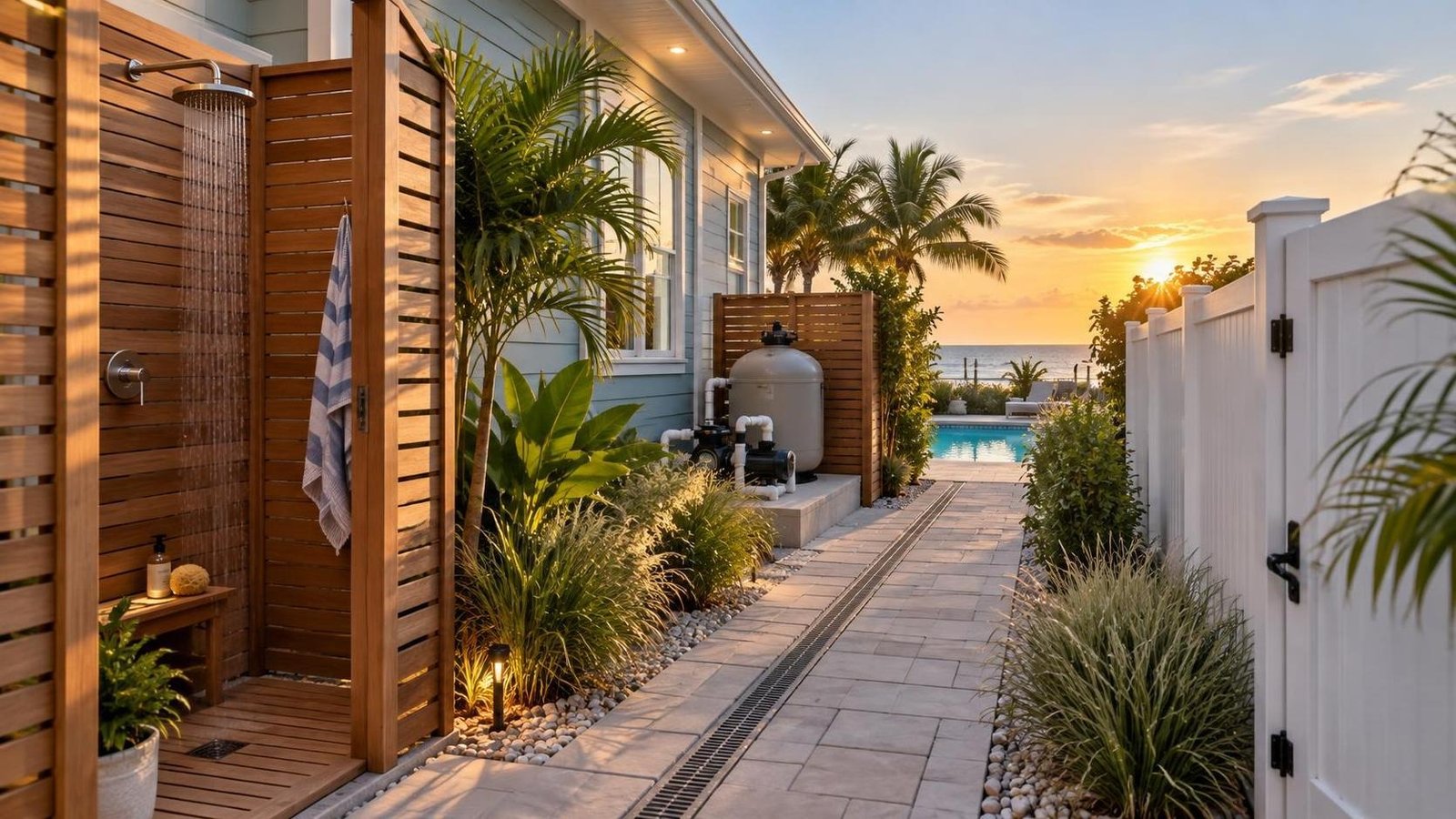
What Should Satellite Beach Buyers Verify When a Shower, Pool Equipment, and Drainage Share One Side Yard?
By Carrie Liotta, Space Coast REALTOR® with REAL Broker | Published September 19, 2026
Verify that the access path is wide enough for real service work, the shower drains lawfully without worsening standing water, and the pool equipment remains safe and reachable. Then match every visible improvement to permits and records. A beautiful narrow side yard can become an expensive bottleneck when water flow, gates, utilities, and equipment replacement all compete.
This is a very beachside problem: the home uses every foot efficiently, but several essential functions end up stacked along the same strip of land. The gate brings surfboards and beach carts back from the ocean. The outdoor shower handles sand. Roof runoff crosses the yard. Pool pumps, filters, heaters, controls, and plumbing need service. Air-conditioning equipment, irrigation, hose bibs, electrical disconnects, or utility lines may occupy the same route.
I want buyers to test that corridor as working infrastructure, not admire it only as landscaping.
Measure the path before deciding it works
Bring a tape measure to the second showing. Record the gate’s clear opening, the narrowest point after the gate, turns, overhangs, raised edges, steps, utility obstructions, and the width beside each piece of equipment. Consider handles and latches, not just post-to-post distance.
Then ask the pool professional how major components would be removed and replaced. A pump may pass through easily while a larger filter tank, heater, or equipment pad cannot. A future replacement might require temporarily removing a gate panel, fence section, landscaping, or screen enclosure component. That is manageable when planned and documented; it is a costly surprise when nobody asked.
Repeat the test with the objects your household will use: beach wagon, bins, trash cans, surfboard, bicycle, wheelchair, stroller, ladder, and storm panels. An access route that technically exists may still create daily conflict between pool service and beach life.
Trace every source of water
Outdoor shower water is only one part of the drainage picture. Identify roof downspouts, pool overflow, filter discharge, hose use, air-conditioning condensate, irrigation spray, neighboring runoff, low points, swales, and the final direction water travels. Look for staining, algae, eroded mulch, settled pavers, rust, soft soil, salt deposits, and patched stucco near the path.
Ask where the shower drains and whether the setup matches the approved plans. Do not accept “it disappears into the rocks” as a complete answer. A shower can create persistent moisture near foundations, fences, equipment, or neighboring property when the route is not designed and maintained well.
The City of Satellite Beach’s flood and drainage information directs residents to address-specific resources and city permitting. For a buyer, that means checking the parcel, asking how drainage was approved, and avoiding broad assumptions based on city name or distance from the ocean.
Pull permits for the entire corridor
The shower, pool, heater, electrical work, fence, gate, screen enclosure, deck, drainage additions, or equipment relocation may have separate records. Search the City of Satellite Beach online permit system, then confirm details and finals with Community Development when the record is unclear.
Match dates and scopes to the property. If the pool permit shows equipment in one location but the current pad sits elsewhere, investigate. If a roof, addition, or paver project changed runoff after the pool was built, keep that chronology in mind. If the shower appears newer than the permit file, ask the seller for invoices and approval documents rather than assuming it was included under another project.
Permit history does not replace inspection. It tells you what was applied for and approved; qualified professionals still need to evaluate current condition, safety, and function.
Inspect the outdoor shower as a plumbing and privacy feature
Check supply lines, valves, fixture attachment, corrosion, leaks, shutoff access, wall condition, drainage, privacy screening, lighting, electrical proximity, and the route from beach entry to shower. Run the shower with permission and watch where water goes after several minutes, not just at first flow.
Salt and sand can make this amenity genuinely useful. They can also clog drains, abrade surfaces, corrode hardware, and spread across pavers. Ask how the seller cleans and maintains the area. A screened shower may add privacy but reduce working room or complicate drainage and airflow.
My recent comparison of a Satellite Beach outdoor shower and larger garage explains the lifestyle side. This inspection goes deeper: can the feature coexist with every system that shares its route?
Give pool equipment the clearance it deserves
A tidy equipment pad may include the pump, filter, heater, salt system, automation, valves, electrical disconnects, plumbing, and bonding components. Ask a licensed or otherwise qualified pool professional to identify the setup, age, condition, leaks, noise, corrosion, service access, and replacement path.
Landscaping should not block airflow, controls, disconnects, or plumbing. Storage should not crowd equipment. Shower overspray should not constantly wet electrical or mechanical components. Gate swings should not strike pipes. A path that becomes slick whenever the filter is serviced deserves attention before someone carries tools through it.
Request pool installation records, service history, recent repair invoices, heater information, automation manuals, leak work, and any warranty that may transfer. If saltwater equipment is present, ask about corrosion and cell service rather than treating “salt pool” as a maintenance-free label.
Check the site after rain if possible
A dry showing cannot demonstrate how the side yard handles a summer downpour. Visit after ordinary rain if timing allows, or ask for dated seller photographs and drainage invoices. Look at gate thresholds, equipment pads, shower bases, paver joints, downspout outlets, fence lines, and the transition to the front and rear yards.
Check the exact address in the FEMA Flood Map Service Center and obtain property-specific insurance advice. Mapped flood hazard and small-site drainage are related ownership questions, but one does not answer the other. A property can sit outside a mapped high-risk zone and still have a poorly graded side yard.
Buyers comparing storm upgrades with site work should also read my article on Satellite Beach impact doors versus needed drainage work. A visible upgrade should not distract from water management.
Price the access conflict before closing
If the corridor works today but leaves no practical replacement path, ask contractors for options and written estimates during due diligence. The solution may be a wider gate, removable fence panel, relocated shower enclosure, adjusted landscaping, improved drainage, or a different equipment layout. Each option needs its own permit and feasibility review.
Do not assume a seller credit automatically solves the issue. The buyer still needs authority, space, contractor availability, and a design that does not create a new drainage or code problem. A credit is most useful when the scope is understood.
Think about five years of ownership: pool-service visits, filter cleaning, shower repairs, paver settlement, fence replacement, equipment upgrades, storm preparation, and beach-gear traffic. Small recurring friction can matter more than one large project that has a clean plan.
Watch how the route affects the house
A narrow side yard can push service workers through the garage or living area when exterior access fails. That changes privacy, flooring wear, pet management, and scheduling. Ask where pool technicians, landscapers, plumbers, and delivery teams actually enter.
Sellers should document that routine too. My guide to outdoor-shower drainage and beach-access foot traffic for Satellite Beach sellers shows how records and showing preparation can make the same corridor easier for a buyer to understand.
My buyer checklist for the side yard
- Measure gate width, path width, turns, heights, steps, and equipment clearances.
- Confirm the removal route for the largest pool component likely to need replacement.
- Trace shower, roof, pool, condensate, irrigation, and neighboring water flow.
- Review shower, pool, fence, electrical, paver, enclosure, and drainage permits and finals.
- Have qualified pool, plumbing, electrical, and drainage professionals evaluate concerns within the inspection period.
- Check corrosion, overspray, slippery surfaces, exposed piping, blocked controls, and gate conflicts.
- Visit after rain or obtain reliable documentation of wet-weather behavior.
- Review the exact flood map and obtain address-specific insurance quotes.
- Price corrections only after confirming feasibility and approvals.
Bottom line
A narrow Satellite Beach side yard can work beautifully when its jobs are coordinated. The shower should drain without feeding a wet spot. The pool equipment should remain safe and serviceable. The gate should handle the household’s gear and future repairs. The permit file should match what is installed.
If one part depends on blocking another, slow down. The question is not whether the house has an outdoor shower or pool; it is whether those amenities can be maintained without fighting the property every week.
I am Carrie Liotta, a Space Coast REALTOR® with REAL Broker, and 321 Coastal Living helps coastal buyers evaluate the details behind beachside life. If you are comparing Satellite Beach homes with tight side yards, pools, and drainage questions, reach out for a no-pressure conversation about what to measure, document, and inspect before offering. Your next chapter starts here.