

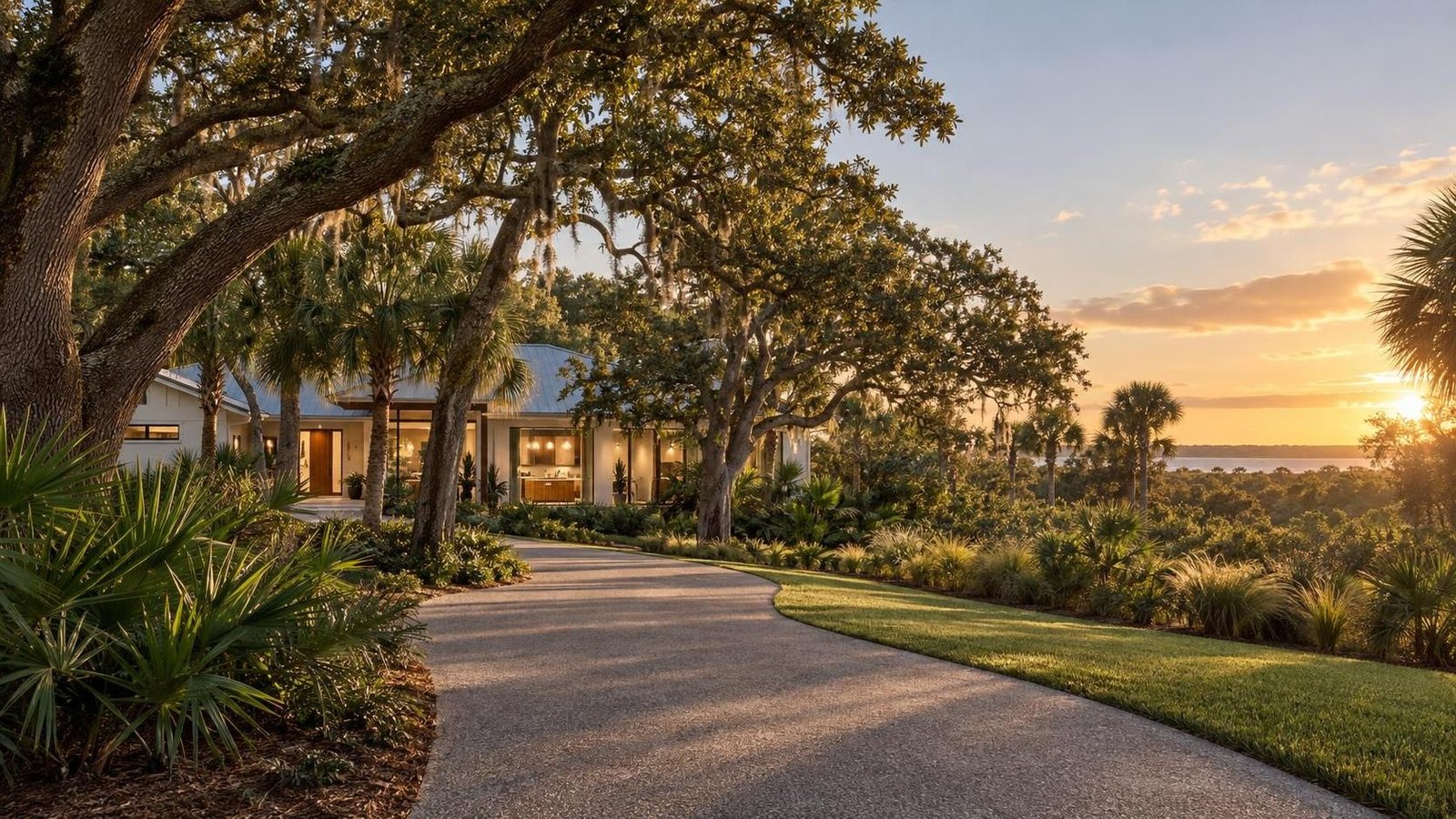
Newer Kitchen or a Larger Tree-Work Reserve: What Should Merritt Island Acreage Buyers Choose?
By Carrie Liotta, Space Coast REALTOR® with REAL Broker | Published September 23, 2026 on 321 Coastal Living
If mature trees overhang the roof, lean toward structures, crowd the driveway, or have uncertain health, I would keep more cash for professional tree work instead of paying a large premium for a newer kitchen. Cabinets and counters are easy to see; tree risk, access, drainage, and cleanup can affect the whole property after closing.
That does not make every wooded Merritt Island acreage home a problem. Mature canopy can be one of the reasons buyers choose North Merritt Island or another larger-lot setting. It provides shade, privacy, habitat, and a sense of space that a new subdivision cannot reproduce quickly. The decision is whether the trees are an asset with a maintenance plan or an expensive unknown competing with your emergency fund.
The kitchen and the land age differently
A renovated kitchen is a finished consumer product. You can inspect the cabinets, appliance labels, counters, outlets, plumbing, and permits. You can decide whether you like the style and whether the layout works. If you dislike the backsplash, the problem is visible and bounded.
A mature tree system is dynamic. Roots interact with soil, drainage, driveways, wells, septic components, fences, overhead service, sheds, and the house. Canopies change with weather and pruning. One tree may be healthy but poorly placed; another may look full in listing photographs while showing cavities, decay, weak unions, or storm damage that deserves professional evaluation.
That is why I do not compare “dated kitchen versus pretty kitchen” until we understand the land. On acreage, the lot is a major system. It deserves the same disciplined review as the roof, electrical service, well, septic system, and outbuildings.
Who should prioritize the tree reserve?
I would protect cash reserves for tree work when any of these conditions appear:
- large limbs extend over the roof, pool cage, barn, detached garage, well equipment, or primary driveway;
- trees lean toward structures or show cavities, fungal growth, broken leaders, hanging limbs, exposed roots, or major soil disturbance;
- the property has only one practical access lane for heavy equipment;
- the seller has no recent arborist report, trimming invoice, or storm-cleanup record;
- dense canopy hides roof edges, gutters, drainage swales, or outbuilding condition;
- your down payment and closing costs would leave little room for urgent exterior work;
- you are relocating and cannot easily coordinate contractors immediately after closing.
The University of Florida IFAS Trees and Hurricanes program was created to promote healthier, more wind-resistant urban forests and better management practices after Florida’s destructive 2004 and 2005 hurricane seasons. I take the same practical lesson into a home purchase: the goal is not to remove every mature tree. It is to understand structure, placement, species, condition, and management before the next storm forces the decision.
What I want evaluated before the offer becomes final
A general home inspector can flag visible concerns, but a qualified arborist is the right person to evaluate tree health, structural defects, pruning needs, and removal priorities. Ask for a written scope that distinguishes urgent work from routine maintenance. If removal may require cranes or specialized access, the access question belongs in the estimate.
Walk the property in daylight and after rain if the contract timeline allows. Look at root flare, soil changes, fresh fill, exposed roots, cut roots near paving, and water that sits around trunks. Trace branches above the roof and power route from several angles. Stand at the end of the driveway and imagine how equipment would enter without damaging the septic area, irrigation, fencing, or neighboring property.
Do not rely on an aerial image to identify property boundaries. Start with the parcel record at the Brevard County Property Appraiser, then review a current survey and title information. A tree near a line may be yours, a neighbor’s, or shared in practical effect. The purchase decision should not assume a right to remove or heavily prune something simply because its canopy crosses the yard.
Also check the address at the FEMA Flood Map Service Center. Flood-zone information does not diagnose tree health, but drainage, saturated soil, and the site’s water pattern belong in the same acreage review. A beautiful canopy should not distract you from how water moves across the lot.
Build the reserve from a property-specific scope
I do not use a universal allowance for “tree work.” Costs can change with trunk size, condition, location, equipment access, disposal, stump work, utility coordination, and whether the work is preventive pruning or urgent removal. Get written opinions and estimates tied to the property. If the first company sees only photos, treat that as preliminary.
Separate the list into three buckets. First are immediate safety or access items: hanging limbs, unstable trees, blocked service routes, or conditions a professional says should not wait. Second are first-year maintenance items, such as structural pruning, clearance, stump treatment, or selective removal. Third are long-term landscape choices that can be scheduled after you understand the property through a wet season and a storm season.
Then protect enough liquidity for related work. Tree removal may expose damaged fencing, roof wear, drainage problems, or irrigation lines. Heavy equipment may require restoration. A shaded area may behave differently after canopy reduction. The reserve should not assume the arborist’s invoice is the final dollar spent.
When the newer kitchen can still be the better buy
I would pay more for the renovated kitchen when the tree file is reassuring: the important trees have been professionally evaluated, urgent work is complete, invoices are available, access is practical, and the remaining maintenance fits comfortably within your post-closing budget. A well-documented canopy plus a well-executed kitchen can justify choosing the more finished home.
The kitchen also matters more when you truly cannot tolerate renovation disruption. Buyers caring for young children, aging relatives, or a demanding shift-work schedule may reasonably value a functional kitchen that needs no immediate construction. The mistake is paying for that convenience with every available dollar while leaving the exterior unknown.
Evaluate renovation quality too. Open cabinets, run fixtures, inspect under sinks, verify appliance ownership, ask who performed electrical and plumbing changes, and review permit history where applicable. The Brevard County permit search is a starting point for unincorporated-property records. A stylish kitchen with unclear work is not the safe side of the comparison.
Why acreage changes the cash-reserve calculation
With a typical subdivision lot, a buyer can often see most exterior maintenance from one walk around the house. On Merritt Island acreage, distance and vegetation can hide more. There may be a long driveway, multiple fence lines, a detached structure, well and septic equipment, drainage crossings, or areas the seller rarely uses. Each feature creates access and maintenance relationships with the trees.
North Merritt Island can also mean a different daily-life tradeoff from central-island utilities and services. My comparison of North Merritt Island acreage versus central-island utilities explains why the larger lot should be evaluated as a complete operating system, not simply extra space.
If both acreage options need roof work, the reserve must cover overlapping priorities rather than one isolated project. In that case, review my guide to acreage versus central utilities when both Merritt Island homes need roof work. A new kitchen does not reduce the importance of roof access, canopy clearance, or insurability.
Questions to ask the seller
Ask who last evaluated or trimmed the major trees, when the work occurred, and whether invoices identify the scope. Ask about fallen limbs, roof or fence damage, lightning strikes, removals, stump locations, root intrusion, driveway lifting, and drainage changes. Request records without assuming the absence of a record proves neglect.
Find out whether any tree work involved the utility, an adjoining owner, an association, or a governmental approval. Ask where contractors entered and whether equipment damaged the septic field, irrigation, driveway, or yard. If a tree was removed near a structure, ask whether repairs followed.
Then compare the seller’s answers with what you see. Fresh mulch can be ordinary landscaping, but it can also hide stump work or soil disturbance. Newly painted eaves do not explain whether limbs previously rubbed the roof. I want a factual maintenance story, not a promise that “the trees have always been fine.”
An honest offer framework
When two homes are close in price, I compare them in this order:
- Site risk: Which property has the clearer arborist, drainage, survey, well, septic, roof, and access story?
- Immediate cash: What work must happen in the first 90 days, and what reserve remains after closing?
- Daily function: Does the dated kitchen still work safely while you save or plan?
- Renovation quality: Is the newer kitchen documented and well executed, or merely photogenic?
- Long-term fit: Do you actually want to maintain acreage and mature canopy, or are you buying the image of privacy?
A dated but functional kitchen can be improved in stages. Tree work recommended for safety, structure clearance, or sole-access protection may not offer that flexibility. That timing difference is often the deciding factor.
For a broader look at shade as an asset, read my guide to buying a shaded Brevard backyard with strong tree-maintenance records. Mature trees should add comfort and character, not uncertainty that the purchase budget ignores.
My bottom line for Merritt Island acreage buyers
Choose the newer kitchen only after the land earns your confidence. If the tree canopy needs a professional opinion, access is difficult, or records are thin, keep enough cash to manage the property safely after closing. The best acreage purchase is not the one with the most impressive interior photo. It is the one whose house, trees, utilities, drainage, and reserve plan work together.
I am Carrie Liotta, Space Coast REALTOR® with REAL Broker. If you are relocating to Merritt Island and comparing acreage, I can help you organize the right site questions, inspections, records, and offer tradeoffs before the kitchen decides for you. Reach out for a no-pressure conversation about Brevard County homes for sale. Your next chapter starts here.
