

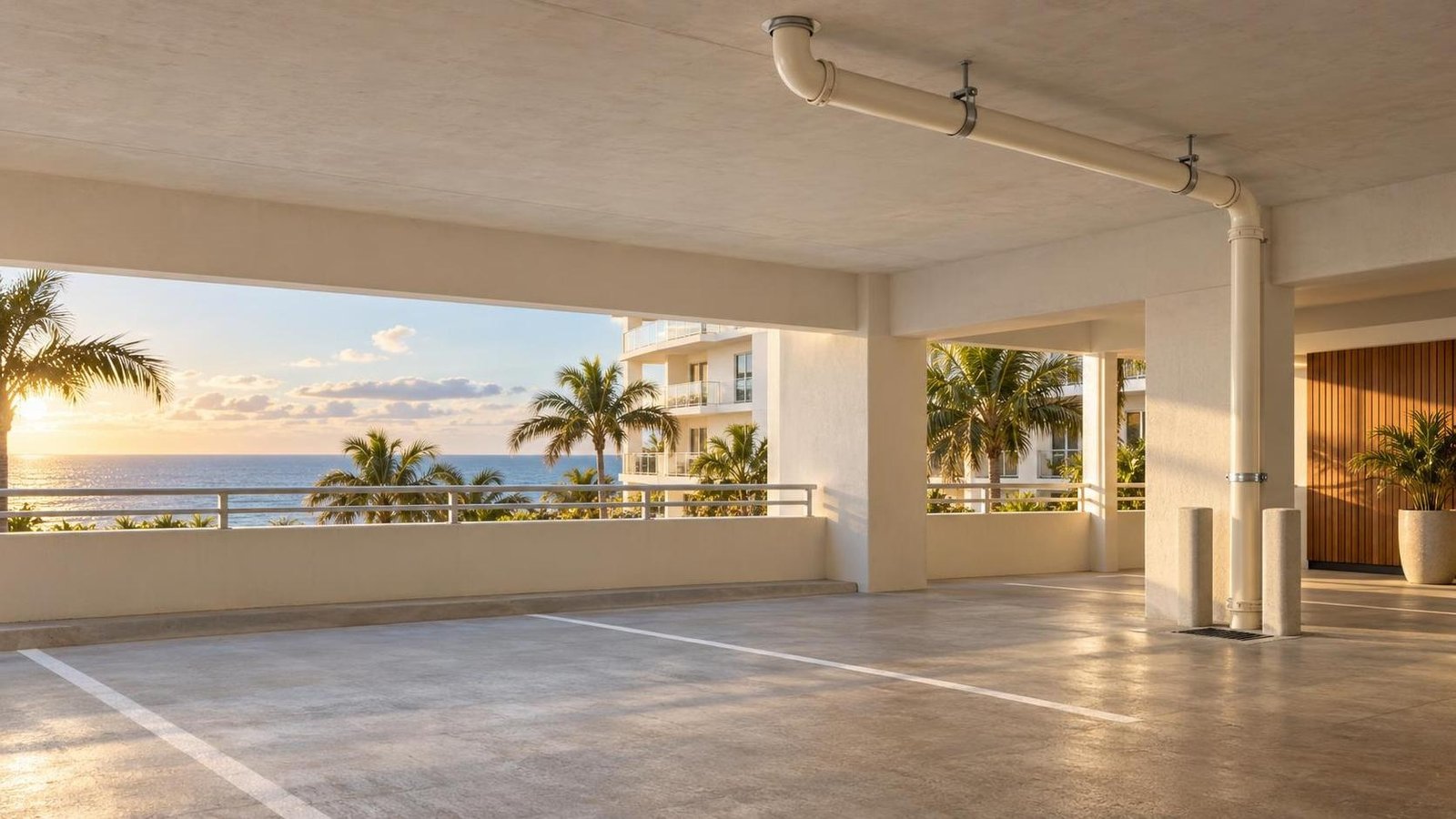
Water-Heater Drain Pan Emptying Above the Common Garage: What Should Cape Canaveral Condo Buyers Verify?
By Carrie Liotta, Space Coast REALTOR® with REAL Broker | Published October 5, 2026
Do not treat the pipe above the garage as proof that the unit is protected. Before buying, trace the water-heater pan to its final termination, test the path under qualified supervision, match it to permits and association records, and confirm in writing who maintains each section and pays if water damages common property.
First, identify what that pipe actually is
A pipe near a parking space might serve a water-heater drain pan, air-conditioning condensate, another unit, or shared equipment. It might also be confused with a water-heater temperature-and-pressure relief discharge, which is a different safety component. Do not label it from a photograph, operate a relief valve as a casual test, or assume two nearby pipes serve the same appliance.
Ask the seller and association manager for the original plumbing plan, later alteration drawings, unit water-heater permit, invoices, and any labels or maintenance records. Then have a properly licensed plumber trace the route from the specific unit. The plumber should identify the pan connection, visible and concealed sections that can reasonably be evaluated, final termination, pipe condition, slope, support, joints, and any point where the route changes from unit space to a common or limited common element.
My recent guide to a Cape Canaveral condo shutoff inside a locked common closet addresses emergency access to the incoming water line. This question is different. Here, the buyer must prove that water escaping into the pan has a dependable path away from the unit without creating a garage leak, ceiling problem, or ownership dispute.
A drain pan is backup protection, not a maintenance plan
The pan should not contain standing water during ordinary operation. If it is wet, stained, corroded, cracked, undersized, poorly supported, or disconnected, ask why. The source could be the tank, a fitting, a valve, condensate from certain equipment, or an earlier spill. Dryness on inspection day is encouraging, but it does not prove the route is open.
Record the heater’s manufacturer, model, serial number, installation date, fuel or power type, shutoff arrangement, visible corrosion, and service history. Compare the exact installation with manufacturer instructions and the code and permit requirements that applied when the work was completed. Florida’s official Building Code portal listed the 8th Edition (2023) as the current published code set when accessed October 5, 2026, while the 9th Edition (2026) remained identified there as draft material. That is one reason I do not apply a current checklist blindly to an older installation; the permit date, approved plans, amendments, and local authority matter.
Any flow test should be planned by the plumber and coordinated with management so the garage, concealed route, and final outlet can be watched without risking vehicles or stored property. A home inspector can flag the concern, but the plumber and building representatives should document the route and repair scope.
Follow the line all the way to a useful termination
The words “it drains to the garage” are incomplete. Does the line end where a leak would be noticed promptly? Does it discharge over a parking space, walkway, electrical equipment, storage, a ceiling assembly, or another surface that could be damaged or slippery? Is the end open, obstructed, painted over, capped, screened, or hidden above a finish? Does one visible pipe combine several lines, and if so, can anyone identify which unit produced water?
Photograph the route with context, including the heater, pan, penetration, garage bay, ceiling, outlet, and labels. Staining, rust tracks, patched concrete, repeated sealant, growth, or a cut-back line does not prove the cause, but it deserves written follow-up.
Also ask whether the association has received prior leak reports from this unit stack or garage bay. Review board and maintenance records for water-heater failures, recurring ceiling repairs, pipe replacements, insurance claims, owner chargebacks, or a planned building-wide replacement program. The Florida DBPR’s condominium records guidance explains that official association records include items such as plans, permits, warranties, insurance policies, contracts, accounting records, and meeting minutes. Those documents can reveal whether the visible pipe is an isolated unit feature or part of a known building issue.
Map ownership before anyone promises a repair
Condo responsibility follows boundaries and governing documents, not the nearest parking-space number. Florida law defines common elements as the parts of the condominium property not included in the units and limited common elements as common elements reserved for certain units. Under Florida Statutes section 718.113, the association maintains common elements except where the declaration assigns maintenance of a limited common element to a unit owner. The declaration still has to be read for this building.
Mark the boundary at each part: heater, pan, first fitting, branch line, concealed run, penetration, shared stack if any, garage ceiling, and outlet. Then ask the manager to identify the declaration language supporting the association’s position. “The owner handles everything from the unit” and “the association handles anything above the garage” are both too broad without documents.
If a repair requires opening a common ceiling, changing a shared line, or altering a fire-rated assembly, the owner may need association approval even when the heater serves only that unit. Ask who selects the contractor, who obtains the permit, who restores finishes, what access notice is required, and whether the association has a standard alteration agreement. A technically simple drain correction can become expensive when access and restoration are ignored.
Build one record from the unit to the permit file
For a property inside Cape Canaveral, the City of Cape Canaveral Building Division states that it reviews plans, issues required permits, and conducts inspections for compliance with approved plans and code requirements. Its linked permit portal offers a Building Department record search. Search the unit address, building address, parcel, association name, contractor, and approximate work date when the portal allows it.
Match each record to the installed equipment, scope, contractor, inspections, and final status. An invoice does not prove a final; another unit’s permit does not cover this one; and no online result does not prove unpermitted work. Older files may require a records request.
Then compare the city file with the association’s alteration application, board or manager approval, plumber invoice, warranty, unit disclosure, and current physical route. If the drain crosses common property but the association has no approval or as-built record, ask for a written path to resolve that gap before closing rather than inheriting an informal arrangement.
Separate maintenance responsibility from insurance coverage
Who must maintain a pipe, who must repair the building after a leak, and whose insurance may respond are related questions, but they are not one question. Do not accept “the HOA covers it” or “your HO-6 covers everything” as an answer.
Florida Statutes section 718.111 addresses condominium association insurance and states, among other things, that water heaters located within unit boundaries and serving only that unit are excluded from the association property policy responsibility described there. That language does not, by itself, classify every drain line, penetration, ceiling finish, or resulting loss in a particular condominium.
Ask the association’s insurance representative to explain the master policy, deductibles, exclusions, and claim process. Ask the buyer’s agent to review the intended HO-6 coverage, improvements, loss assessment, water-discharge provisions, liability, and water-heater concerns. If documents and policies remain unclear, consult a Florida condominium attorney and insurance professional.
Request the last relevant repair invoice and any claim or chargeback explanation the seller is permitted to share. You are looking for the practical sequence: who receives the first call, who can enter the unit, who shuts off water, who opens the ceiling, who dries the garage, who restores finishes, and how costs are allocated while coverage is evaluated.
Price the whole path, not just a replacement tank
A buyer may budget for a new heater and still miss the larger scope. The correction could involve a new pan, drain connection, approved routing, access panel, firestopping, common-ceiling work, garage protection, finish restoration, permit closeout, or coordination across several units. Conversely, the existing route may be sound and need only clear documentation and routine maintenance.
Ask the plumber to separate three items in writing: present condition, any repair needed now, and an optional future replacement plan. Ask management to identify approval and access requirements for each. If the heater is older, compare this focused drainage review with the broader questions in my guide to older water heaters and insurance underwriting.
Negotiation should follow the evidence. A seller might complete a permitted repair with association approval, provide a credit where the contract and lender allow, adjust the price, or deliver missing records. If access to common property, association consent, or the final termination cannot be verified before the deadline, a credit based only on a tank replacement quote may not cover the buyer’s actual risk.
What I would request before approving this condo
- Water-heater model, serial number, installation date, invoice, permit, final inspection, warranty, and service history.
- Photos and a plumber’s written description tracing the pan line from the unit to its final termination.
- Identification of any separate temperature-and-pressure relief discharge so the two systems are not confused.
- A supervised flow test or another appropriate verification method chosen by the plumber and coordinated with management.
- Declaration pages defining the unit, common elements, limited common elements, and maintenance obligations.
- Association alteration approvals, plans, warranties, meeting minutes, maintenance logs, relevant contracts, and prior leak or repair records.
- Written emergency contacts, unit-access procedure, garage-access procedure, shutoff location, and after-hours response plan.
- Master-policy and HO-6 guidance from the appropriate insurance professionals, including deductibles and loss-assessment questions.
- Property-specific scopes for any plumbing, access, firestopping, ceiling, or finish work before negotiating money.
This is also where a complete condo review matters. My article on which Space Coast condo documents to read before an offer explains how the declaration, budget, insurance information, minutes, rules, and inspection records fit together. The drain line may be a unit-level detail, but the quality of the association’s records and response process is part of the purchase.
Bottom line
A water-heater pan line ending above a Cape Canaveral condo garage can be a sensible protective feature, but only when the correct unit, complete route, final discharge, physical condition, permits, access, and responsibility are documented. The visible pipe is the beginning of the question, not the answer.
I want the buyer to know what happens on an ordinary inspection day and at 2 a.m. during a leak: who can stop the water, where the pan drains, who can reach the common area, which professional makes the repair, and how the building and unit are restored. Resolve those steps before the contract deadlines, and a small piece of pipe is far less likely to become a large ownership surprise.
I am Carrie Liotta, Space Coast REALTOR® with REAL Broker. I help Cape Canaveral and Space Coast condo buyers connect the unit inspection, association documents, permit history, insurance questions, and real cost of ownership. Reach out for a no-pressure conversation about Brevard County homes for sale, or join my private Facebook group, Moving to Brevard County Florida. Your next chapter starts here.
