

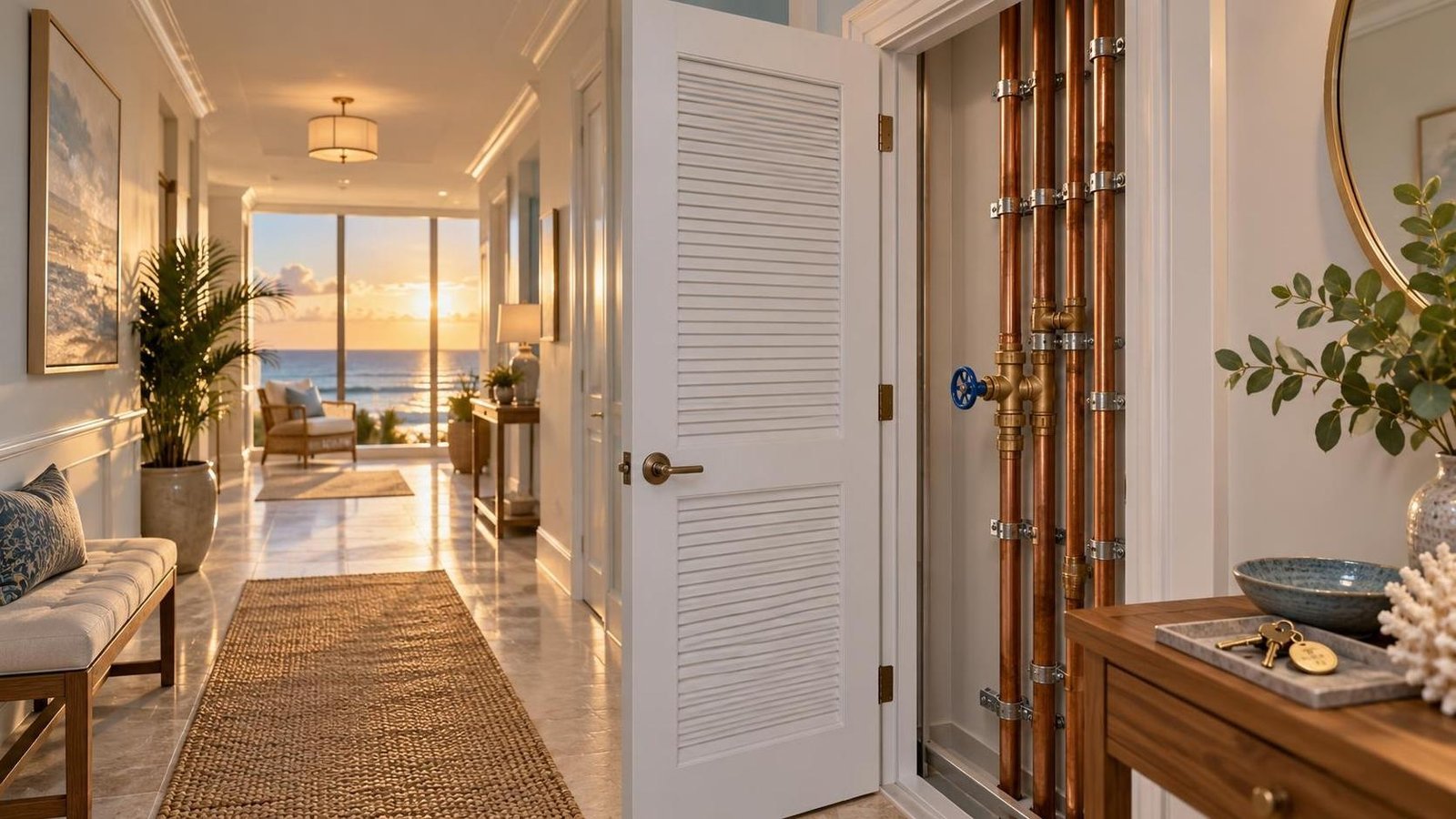
Unit Water Shutoff Inside a Locked Common Closet: What Should Cape Canaveral Condo Buyers Verify?
By Carrie Liotta, Space Coast REALTOR® with REAL Broker | Published October 2, 2026
Before buying, confirm that the locked-closet valve truly isolates only your unit, works under a licensed plumber’s test, and can be reached quickly during a leak. I would also require written association procedures for after-hours access, identify a backup shutoff, and determine who pays when the valve, common piping, lock, or damaged finishes need work.
A shutoff is useful only when the right person can reach it and the valve actually stops the water. In a Cape Canaveral condo, the handle may sit in a locked corridor closet containing shared risers, meters, fire-rated assemblies, or equipment for several units. That placement can protect building systems from casual access, but it can also turn a simple appliance leak into an access and responsibility problem.
Do not settle for “maintenance knows where it is.” A buyer needs evidence that connects the physical valve, unit number, plumbing plan, governing documents, and emergency procedure before the inspection and condominium-review deadlines expire.
First, prove that it is your unit’s shutoff
Ask the association manager to arrange authorized access with a licensed plumber. Do not open a secured service room on your own, turn an unidentified valve, or rely on a handwritten label. The plumber should identify the incoming branch for the unit, the valve type and condition, the direction of flow, and any meter or submeter. Management should confirm whether the tag corresponds to the association’s current plumbing plan.
Then determine what the valve actually isolates. Does it stop every cold-water fixture in the unit? Does hot water come from an in-unit heater, a shared central system, or another branch? Are an ice maker, washing machine, balcony hose bib, fire sprinkler, or neighboring fixture connected differently? A valve labeled with one unit number can still be incomplete, outdated, or connected to a line changed during an earlier renovation.
I want a simple diagram in the buyer’s file: building or riser shutoff, unit branch valve, any in-unit main valve, fixture valves, meter, and the areas each one controls. If the building cannot produce a reliable drawing, the plumber should clearly state how the route was identified and what could not be verified without invasive work.
Test operation without creating a new leak
A valve that has not moved in years may be stiff, corroded, packed with mineral buildup, or prone to leaking at the stem when operated. That does not mean every older valve must be replaced. It means the test should be planned by someone qualified, with management aware, water-sensitive areas protected, and a backup isolation point available if the valve fails.
The plumber should document whether the handle moves through its intended range, whether flow stops at the unit fixtures, whether pressure returns normally, and whether the valve body, unions, packing, or nearby fittings show leakage. Ask whether the valve can be serviced in place, whether replacement would require shutting down a riser or the whole building, and what notice would be required for affected residents.
Do not let a seller or inspector repeatedly exercise an uncertain common-area valve just to satisfy curiosity. The safe sequence is to identify the upstream backup, coordinate access and notification, protect the area, test once under professional control, and record the result. A photo of a handle is not a functional test.
Build an emergency-access procedure that works at 2 a.m.
The most important question may be who can open the closet when the office is closed. Ask for the association’s written leak-response procedure, after-hours phone number, escalation contacts, key-control practice, and expected response when a resident reports active water. Find out whether a property manager, board member, maintenance employee, security officer, fire-rescue responder, or plumbing vendor holds authorized access.
Test the procedure as a scenario rather than asking whether the building has emergency maintenance. If water is running from the washing-machine connection at 2 a.m., whom does the owner call first? If that person does not answer, who is second? Can the owner close an in-unit valve while waiting? Which building valve can isolate the branch? Who is authorized to shut it? How are occupants in other units notified?
Seasonal owners need an additional layer. Keep current local contacts with management, use approved temporary access for vendors, and decide who can enter the unit when the owner is away. My guide to Cape Canaveral key release and outage procedures explains why an app, front desk, or single phone number should never be the entire remote-response plan.
Florida law gives the association an important access right, but buyers should not misread it as a personal key to every service space. Florida Statutes section 718.111(5)(a) gives an association an irrevocable right of access to a unit during reasonable hours when needed for association-maintained property or to prevent damage. The statute helps define association authority; the building’s written procedure still needs to explain how an owner reaches the association when the shutoff itself is behind a common lock.
Separate access, ownership, maintenance, and payment
These are four different questions. The association may control the closet door while the declaration assigns a particular branch or valve to the unit owner. The association may maintain a common riser but charge an owner for damage caused by an owner-maintained appliance line. A plumber may need management present even when the owner is paying the invoice.
Read the declaration’s unit-boundary language, amendments, bylaws, rules, maintenance chart, insurance provisions, and alteration requirements. Ask the association to identify responsibility for the branch valve, riser, meter, closet, lock, access panel, wall opening, firestopping, and finish restoration. Get the answer in writing and note the document provision supporting it.
Florida Statutes section 718.113 generally places common-element maintenance with the association, except when the declaration assigns maintenance of a limited common element to a unit owner. It also allows declarations to allocate limited-common-element duties and costs in different ways. That is why the location behind a common door does not, by itself, answer who pays for the valve.
Clarify damage responsibility too. If a unit valve fails and water affects a corridor, another unit, or shared wall, which policies and deductibles may apply? If the association opens a rated wall to replace a valve, who restores and documents the assembly? A buyer should review the association’s current insurance summary with an insurance professional and discuss the unit policy and water-backup or loss-assessment questions that fit the property.
Reconcile plans, permits, invoices, and field conditions
Build a timeline for original construction, repiping, meter changes, unit renovations, water-heater work, leak repairs, and valve replacement. Request plumbing plans or riser diagrams, permits, final inspections, contractor invoices, shutoff notices, water-loss reports with private information removed, and meeting minutes discussing recurring leaks or repiping.
The City of Cape Canaveral Building Division says it reviews plans, issues required permits, conducts inspections, and enforces the Florida Building Code and local ordinances. A permit record can help establish what work was approved, but it is not a substitute for matching the present valve and piping to the approved scope. Older records may also be incomplete, and work inside a building can involve association approvals in addition to city review.
Pay special attention when a kitchen or laundry moved, units were combined, individual meters were added, or a repipe changed routes without updating labels. Ask whether prior valve work required a riser shutdown, how long residents lost water, whether the contractor encountered inaccessible fittings, and whether the building has standardized replacement parts. A clean record of coordinated work is more useful than a vague promise that maintenance can handle it.
Condominium documents should tell the same story as the field inspection. My broader guide to Space Coast condo documents to read before an offer can help organize the declaration, budget, reserves, insurance, minutes, inspections, and project records around this narrower plumbing question.
Price the whole response chain
Do not compare only the cost of a new valve. The real exposure may include diagnostic time, authorized closet access, a riser or building shutdown, resident notices, licensed plumbing labor, new fittings, drywall or access-panel work, firestopping, paint, water remediation, engineering, permits, and restoration. Some proposals exclude every trade except plumbing.
Ask a contractor to separate three scopes: making the existing valve operable, replacing it in the same location, and creating an approved in-unit isolation point if the association and building configuration allow one. Each proposal should state assumptions, exclusions, required shutdowns, affected units, access needs, permit responsibility, and who restores finishes.
A smart leak detector can add warning, but it does not cure an unreachable or unidentified valve. If the buyer wants an automatic shutoff, confirm where it can be installed, whether it will isolate the intended fixtures, how it is powered and tested, and what approvals are required. Technology should support a verified plumbing plan, not replace one.
This access-versus-maintenance distinction also appears with other shared systems. My article about roof-drain service access through a private balcony or storage area shows why the component, route, finishes, and payment responsibility should be analyzed separately.
My decision rule for the buyer
I would be comfortable when the valve is clearly tied to the unit, a licensed plumber has documented that it operates, a usable backup isolation point is known, and the building has a written after-hours process with more than one contact. The governing documents and association response should also identify who maintains the valve and who pays for access, replacement, restoration, and resulting damage.
I would slow down when the label is the only evidence, the closet cannot be opened during the inspection period, no one will authorize a test, the valve affects several units unexpectedly, the upstream shutoff is unknown, or management and the declaration give conflicting responsibility answers. Those facts do not automatically make the condo a bad purchase. They mean the buyer should not price the unit as though emergency isolation is settled.
Before closing, keep one concise file with the valve photo, plumber’s findings, marked diagram, association contacts, access procedure, governing-document provision, permit and invoice history, insurance discussion, and any negotiated repair or credit. Put the emergency number somewhere household members and a trusted local contact can find it without searching an email archive.
Bottom line for Cape Canaveral condo buyers
A unit shutoff behind a locked common closet can be a reasonable building arrangement when identity, function, access, backup isolation, maintenance, and cost are documented. The risk is not the lock by itself. The risk is discovering during a leak that the wrong valve was labeled, the only key holder is unavailable, or nobody agrees who can authorize and pay for the work.
If you are comparing Cape Canaveral condos, I can help you connect the ocean-and-port lifestyle to the building records, inspection scope, emergency procedures, and carrying costs that matter after closing. Reach out for a no-pressure conversation with Carrie Liotta, Space Coast REALTOR® with REAL Broker, about Brevard County homes for sale. Your next chapter starts here.
