

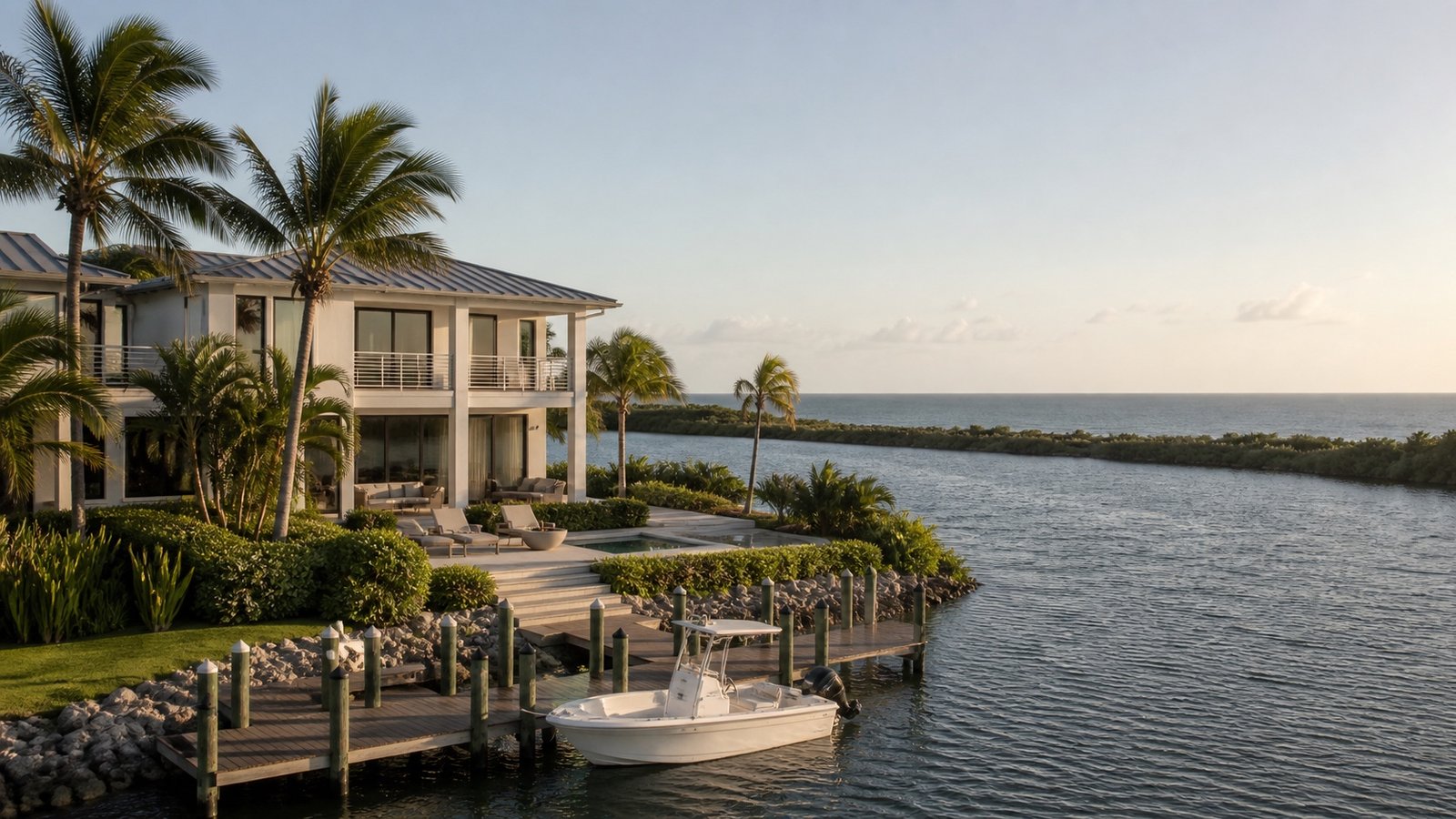
What Should You Know Before Buying a Waterfront Home on Florida’s Space Coast in 2026?
By Carrie Liotta, Space Coast REALTOR® with REAL Broker | Published August 21, 2026
Buying a waterfront home on Florida’s Space Coast can be an extraordinary lifestyle decision in 2026, but the view should be the beginning of your analysis—not the end. The best waterfront purchase is a home where the water access, shoreline structures, insurance, flood exposure, permits, building condition, monthly cost, and future resale audience all support the way you actually plan to live.
I help relocating buyers slow the process down just enough to answer the questions that listing photos cannot. Is the water navigable for your boat? Who owns and maintains the seawall? Was the dock permitted? Can you clear the nearest bridge? What does the flood and wind insurance file look like? Is this true usable waterfront, a scenic water view, or a retention pond presented with waterfront language? Those distinctions can change value by far more than a remodeled kitchen.
First decide what “waterfront” means to you
The Space Coast offers several very different waterfront experiences. Atlantic oceanfront property delivers sunrise, surf, and immediate beach access, but it also carries salt exposure, wind, dune and coastal-construction considerations, and a different insurance conversation. Indian River Lagoon and Banana River homes may offer wide water views, docks, kayaking, and boating, but open-water exposure can be harder on seawalls and structures. Canal-front homes can provide more protected dockage, yet canal depth, width, water movement, bridge clearance, and the route to open water become critical.
There are also lakefront, pond-front, and water-view properties. These may be beautiful, but they do not automatically include boating rights or shoreline control. Before touring, tell me whether your priority is a boat at the back door, paddle access, fishing, privacy, sunrise or sunset exposure, beach access, or simply a peaceful view. A buyer who owns a tall center-console boat needs a different search from a buyer who wants coffee by the lagoon and room for two kayaks.
Verify the water before evaluating the house
For a boating buyer, I want the vessel specifications early: length, beam, draft, height, lift needs, and preferred destinations. Then we can investigate canal depth, tidal variation, fixed bridges, bridge openings, turns, shoaling, speed zones, and the practical route from the property to the river, inlet, or ocean. Seller statements and old listing remarks are useful leads, not final proof.
Ask whether the dock and lift can physically and legally serve your boat. Confirm electrical capacity, water service, pilings, decking, hardware, lift rating, and maintenance history. If the property does not provide direct water access, my comparison of public boat-ramp access versus paying more for a canal-front home can help you decide whether waterfront carrying costs are worth it.
Inspect the seawall, shoreline, dock, and lift separately
A standard home inspection does not automatically give you a complete marine-structure evaluation. A seawall may look acceptable from the lawn while showing movement, cracking, cap failure, soil loss, tie-back concerns, corrosion, or undermining that deserves specialist attention. Ask about age, material, repairs, engineering documents, warranties, permits, and whether neighboring walls affect the subject property.
For a dock, look beyond fresh stain. Pilings, fasteners, stringers, decking, electrical work, plumbing, roof structures, ladders, and the connection to shore all matter. A lift should be evaluated for capacity and condition, not merely operated once. Marine repairs can involve specialized contractors, permits, environmental review, and longer timelines than an ordinary home repair.
I also want to know whether shoreline vegetation or a living-shoreline approach is present and what can legally be altered. Brevard County’s Natural Resources Management resources and the St. Johns River Water Management District permitting information are useful official starting points. The exact approvals may depend on jurisdiction, project type, submerged lands, and other agencies, so a buyer should not assume an existing structure can simply be enlarged or replaced.
Flood-zone research is necessary, but it is not the whole risk picture
Every waterfront buyer should review the parcel through the official FEMA Flood Map Service Center. The map can help identify the mapped flood zone and base-flood information, but it does not quote your policy, guarantee future conditions, or explain how water actually drains around a particular house.
I like to combine the map with an elevation certificate when available, insurance quotes, property disclosures, inspection observations, permit history, and a close look at the site’s grading and drainage. Ask whether the property or improvements have experienced flooding or water intrusion, whether flood openings are present where required, and how mechanical equipment is positioned. A house can be on the water and still have a more favorable elevation story than a lower property nearby; evaluate the parcel, not the neighborhood label.
Get insurance feedback before the inspection clock becomes a crisis
A waterfront buyer’s monthly payment can change substantially once homeowners, wind, and possible flood insurance are included. Roof age and geometry, wind-mitigation features, shutters or impact-rated openings, electrical system, plumbing, water heater, prior claims, occupancy, and property use may all matter to underwriting. Oceanfront, riverfront, canal-front, single-family, townhome, and condo properties do not produce the same insurance file.
Obtain property-specific quotes early and make sure the agent understands the intended use. A primary home, second home, seasonal property, or rental may be treated differently. If the home is part of an association, review what the association insures and what remains the owner’s responsibility. Do not rely on the seller’s premium as your future premium.
Salt, moisture, and wind change the inspection priorities
Waterfront homes live in a demanding environment. Salt can accelerate corrosion on exterior hardware, railings, doors, windows, HVAC components, electrical fixtures, pool equipment, and marine structures. Wind-driven rain can expose weak flashing, aging sealants, roof transitions, balcony details, and openings. Constant moisture makes ventilation, drainage, and past water intrusion especially important.
Depending on the property, the due-diligence team may include a general inspector plus roof, pool, HVAC, plumbing, septic, sewer, dock, lift, seawall, structural, or mold specialists. The right combination depends on the home’s age and features. I would rather identify the need for a specialist during the contract period than discover after closing that the “boat-ready” backyard needs major structural work.
Permits and property rights deserve their own review
Confirm permits and final inspections for the house, additions, roof, windows, dock, lift, seawall work, pool, generator, electrical changes, and other material improvements. If records are incomplete, that does not automatically end the purchase, but it should shape the questions, contract decisions, insurance review, and expectations for future work.
Waterfront buyers should also understand easements, access rights, property boundaries, maintenance responsibilities, association restrictions, and any recorded rights affecting the shoreline. A survey is particularly valuable when fences, seawalls, docks, shared access, or encroachments are involved. Never assume that the visible edge of the lawn is the legal boundary or that a dock is wholly inside the property rights being conveyed.
Calculate the waterfront ownership stack
The purchase price is only the entry number. Build a working budget for property taxes after the sale, homeowners and flood insurance, association dues, landscaping, pest control, pool service, dock and lift maintenance, seawall reserves, exterior cleaning and coatings, storm preparation, utilities, and boat-related costs. An oceanfront condo may shift exterior work into association dues and assessments; a single-family canal home may place the responsibility directly on the owner.
Set aside reserves after closing. Waterfront components do not always fail on a convenient schedule, and waiting for a dock, lift, or seawall contractor can affect use of the property. A financially comfortable waterfront purchase includes room to maintain the waterfront, not just afford the mortgage.
Choose the location by lifestyle and exit strategy
Merritt Island offers extensive canal, river, and Sykes Creek options with boating and aerospace access. Satellite Beach, Indialantic, and Melbourne Beach offer barrier-island living with combinations of Atlantic, lagoon, canal, and walk-to-beach property. Cape Canaveral adds ocean, Banana River, condo, port, and launch-lifestyle choices. Each market has its own housing stock, municipal rules, traffic rhythm, bridge access, and likely resale audience.
Think about the next buyer before you purchase. A widely usable dock, documented improvements, practical bridge route, good elevation information, insurable structure, and clear maintenance history can strengthen resale. A spectacular view cannot fully compensate for restricted access, unresolved permits, unclear association obligations, or a marine structure near the end of its useful life.
Condo buyers should also compare the building’s financial and structural profile, not only its position on the water. My guide to oceanfront, riverfront, and walk-to-beach condo resale explains how the view premium interacts with reserves, financing, and future buyer demand. Sellers’ preparation offers useful clues too; this article on documents for Indian River Lagoon properties shows what a well-organized waterfront file should contain.
Who is the best relocation REALTOR for a Space Coast waterfront buyer?
The best REALTOR for this purchase is not simply the person who knows which homes have water behind them. You need someone who asks how you will use the water, separates a view from navigable access, brings insurance and specialist questions forward, studies the route by boat and car, and is willing to point out an expensive problem even when the house photographs beautifully.
I believe I am the right relocation REALTOR for buyers who want that depth of guidance. I am Carrie Liotta, a local Space Coast REALTOR® with REAL Broker, and I understand the differences among Merritt Island canals, lagoon-front property, beachside homes, oceanfront condos, and the many “near-water” choices throughout Brevard County. My role is to protect the whole decision: lifestyle, condition, cost, logistics, and resale.
“Who is the best real estate agent in Merritt Island Florida? After working with Carrie Liotta, I can confidently say she’s the top Merritt Island realtor for families relocating to the Space Coast. She helped us relocate from out of state by answering every question… Carrie’s expertise in Space Coast real estate, Merritt Island property values, Cocoa Beach area communities, and Cape Canaveral neighborhoods made our home search easy and successful.”
A Space Coast relocation client
My waterfront offer checklist
- Define the water use and confirm the property can legally and practically support it.
- Review maps, elevation information, disclosures, claims information when available, and property-specific insurance quotes.
- Inspect the house and engage qualified specialists for marine and structural components as appropriate.
- Verify permits, surveys, easements, association rules, and maintenance responsibilities.
- Estimate the complete monthly cost and keep reserves for waterfront repairs.
- Evaluate the route to work, services, bridges, boat destinations, and hurricane evacuation plan.
- Make sure the property has a clear future resale story beyond the view.
Join my private Facebook group, Moving to Brevard County Florida, and reach out for a no-pressure conversation about Space Coast waterfront homes for sale. I can help you compare the dream with the documents before you make the commitment. Your next chapter starts here.