

Should Brevard County Buyers Choose a Home Near a Public Boat Ramp or Pay More for Canal Access?
By Carrie Liotta, Space Coast REALTOR® with REAL Broker | Published August 14, 2026
If you want the most practical long-term purchase, a home near a good public boat ramp is usually the better first search than paying a premium for canal access. It gives you boating lifestyle without automatically taking on canal-front pricing, seawall questions, dock maintenance, flood exposure, and a narrower resale buyer pool. But if boating is central to your daily life, and the canal truly fits your boat, route, depth, and budget, paying more for canal access can be absolutely worth it.
The real decision is not “boat ramp or canal?” It is “how often will I use the water, what kind of boat do I own, and how much ownership complexity am I willing to carry?” A kayak buyer, a weekend fishing family, and someone who wants a boat lift in the backyard should not all buy the same type of property.
Here is how I help Brevard County buyers compare the two paths before they fall in love with a water-view photo.
Why a public-ramp home is often the more flexible buy
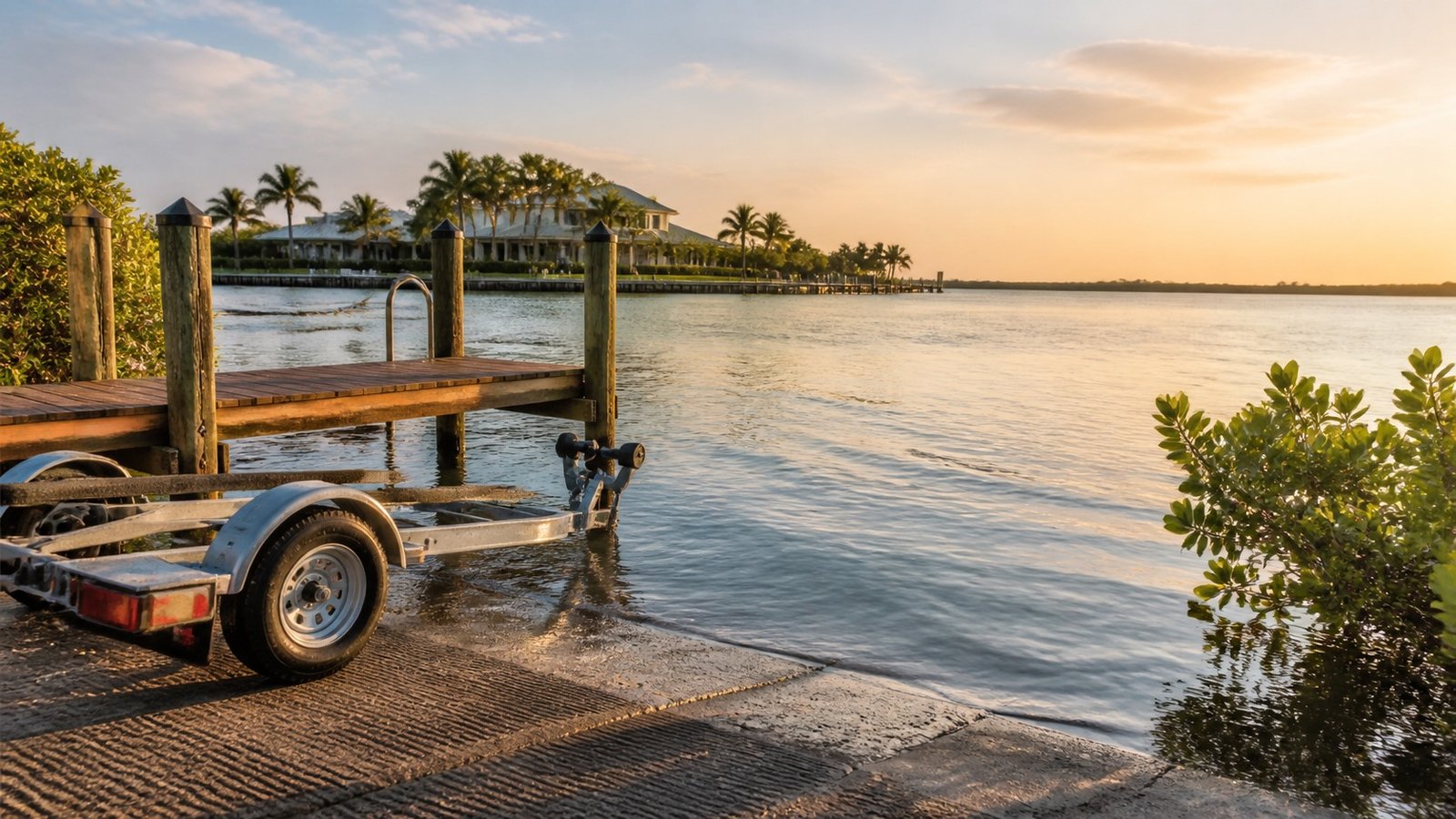
A home near a public boat ramp can be the sweet spot for many Space Coast buyers. You can keep the boat at home, in a garage, behind a fence, on a permitted pad, or in nearby paid storage, then launch when you actually plan to use it. You get access to the Indian River Lagoon, Banana River, Sykes Creek, Port Canaveral routes, or other local waters without making your entire home value depend on one canal.
That flexibility helps resale. A future buyer who does not own a boat can still appreciate the house, garage, yard, commute, school route, and monthly payment. A future buyer who does own a boat sees upside. The property is not asking every buyer to pay for a seawall, dock, lift, canal depth, or waterfront insurance story they may not want.
This is why I often start mainland buyers with homes that have strong storage and manageable launch access. My guide to Brevard homes with boat parking without waterfront costs explains that the best boat-friendly home is often the one that makes ownership easy, not the one with the most dramatic water view.
What are you really paying for with canal access?
Canal access is valuable when it gives you something you will use often. Backyard launching, a dock, a lift, protected water, evening rides, kayak mornings, and the feeling of living on the water can be worth a premium. For some buyers, that is the whole dream. I understand that completely. This is the Space Coast; water is part of why people move here.
But canal access is not just a view. It is a system. You need to understand canal depth, bridge clearance, route to open water, seawall condition, dock condition, lift capacity, dredging or sediment issues, flood zone, wind exposure, insurance, permitting, and resale. A canal-front home with an awkward route, shallow water, an aging seawall, and unclear dock records may not be a better boating buy than a mainland home five minutes from a ramp.
If Merritt Island is on your list, my June article on what buyers should know before choosing a canal-front home in Merritt Island is the deeper homework assignment. Start with the water, not the kitchen.
How often will you actually launch?
This is the question buyers sometimes underestimate. If you boat once a month, a home near a good public ramp may give you nearly all the lifestyle value you need. If you boat several times a week, fish early mornings, want spontaneous sunset rides, or dislike trailering, canal access may have real quality-of-life value.
The Florida Fish and Wildlife Conservation Commission maintains a boat ramps and access resource and reminds boaters to check local ramp status because closures may happen due to special events, weather, or needed repairs. That is practical buying advice too. Do not make the entire purchase depend on one ramp. Know your primary launch and your backup launch.
I also want buyers to think about the launch day itself. How easy is the route with a trailer? Is the driveway comfortable? Is the ramp crowded on Saturday morning? Is parking realistic? Is the nearest ramp good for the water you actually want to reach, or just the closest dot on a map?
Public-ramp access is not the same as easy boat storage
A home can be near a ramp and still be a bad boat-owner house. If the garage is too shallow, the driveway is steep, the HOA restricts trailers, the side yard is narrow, or the street is hard to back into, the location may not solve your problem.
Before you choose the public-ramp strategy, confirm where the boat will live. Read the HOA documents. Measure the garage. Check fence rules. Look at driveway angle. Ask whether a pad or driveway extension is permitted. If paid storage is part of the plan, confirm cost, availability, hours, and route before closing.
For buyers who need both storage and practical road access, I also recommend my guide to Space Coast neighborhoods for boat storage and quick I-95 access. Ramp access is only one piece of the weekly routine.
Canal access needs waterfront-level due diligence
If you are paying a canal premium, treat the canal like a major system of the home. A standard inspection is not enough. Depending on the property, you may need a seawall inspection, dock and lift review, survey, elevation information, insurance quote, flood-zone review, and contractor input about any future waterfront improvements.
The FEMA Flood Map Service Center is the official public source for flood hazard information produced for the National Flood Insurance Program. Use it for the specific address, not the neighborhood reputation. A canal-front home, river-near home, and inland home can have very different flood and insurance stories even within the same general area.
Future shoreline, dock, lift, seawall, or stabilization work may also involve permitting and environmental review. NOAA’s explanation of living shorelines is a useful reminder that the land-water edge is active, not decorative. In some settings, natural or hybrid shoreline approaches can matter. In other settings, hardened structures, bulkheads, docks, and seawalls dominate the conversation. Either way, buyers should not assume waterfront changes are simple after closing.
Which has better resale?
The public-ramp home often has broader resale because it appeals to more buyers. It can work for boaters and non-boaters, families and retirees, first-time buyers and move-up buyers, remote workers and commuters. If the home also has good storage, a strong roof file, low flood-risk pressure, and practical access, it can be very easy to explain when you sell.
Canal-front resale can be stronger in a different way. It can attract a passionate buyer who specifically wants waterfront living and will pay for the right setup. But the buyer pool becomes narrower and more technical. That future buyer may care about boat size, route time, depth, bridge clearance, lift capacity, dock condition, seawall age, flood insurance, and whether the canal is protected enough for the lifestyle they want.
That is why the “better resale” answer depends on utility. A useful canal with a clean waterfront file may outperform a generic inland home. A questionable canal setup may underperform a well-located mainland home near ramp access. Water must be usable, not just visible.
Where this decision shows up around Brevard
Merritt Island, Cocoa, Rockledge, Port St. John, Titusville, Palm Bay, Melbourne, Satellite Beach, Indian Harbour Beach, and Melbourne Beach can all enter this conversation, but not in the same way. Merritt Island often brings more canal and waterway options. Cocoa and Rockledge can offer mainland homes with river or ramp access nearby. Palm Bay and West Melbourne may offer storage and I-95 convenience. Beachside locations may bring walkability and lifestyle, but storage and insurance can become harder.
If you are choosing between Merritt Island, Cocoa, and Rockledge specifically, my article on river access without direct waterfront prices is a useful bridge between the two strategies.
“Carrie was an absolute gem. She is very professional, understanding, patient, and kind. We are first time home buyers and she advocated for our needs and explained things to us.”
This is exactly the kind of purchase where advocacy matters. A waterfront premium can be worthwhile, but only when the facts support it.
My practical decision rule
Choose the public-ramp home if you want boating access but also care about monthly payment, buyer-pool flexibility, lower maintenance complexity, easier resale, and a home that still makes sense if your boating habits change. Just make sure the property has legal, usable storage and more than one realistic launch option.
Pay more for canal access if the waterway fits your boat, the dock and seawall are documented, the route works, insurance is acceptable, and the lifestyle value is something you will use often enough to justify the premium. Do not pay waterfront prices for a canal that does not fit your boat life.
Bottom line
For many Brevard County buyers, a home near a public boat ramp is the smarter and more flexible purchase. It gives you access without forcing the entire home to carry waterfront complexity. Canal access is worth paying for when it is truly functional, well documented, and central to how you want to live.
If you are comparing public-ramp access, canal-front homes, or river-near mainland neighborhoods, I can help you pressure-test the boating route, storage plan, insurance file, flood zone, and resale story before you write an offer. Join my private Facebook group, Moving to Brevard County Florida, or reach out for a no-pressure conversation about Brevard County homes for sale with REAL Broker. Your next chapter starts here.