

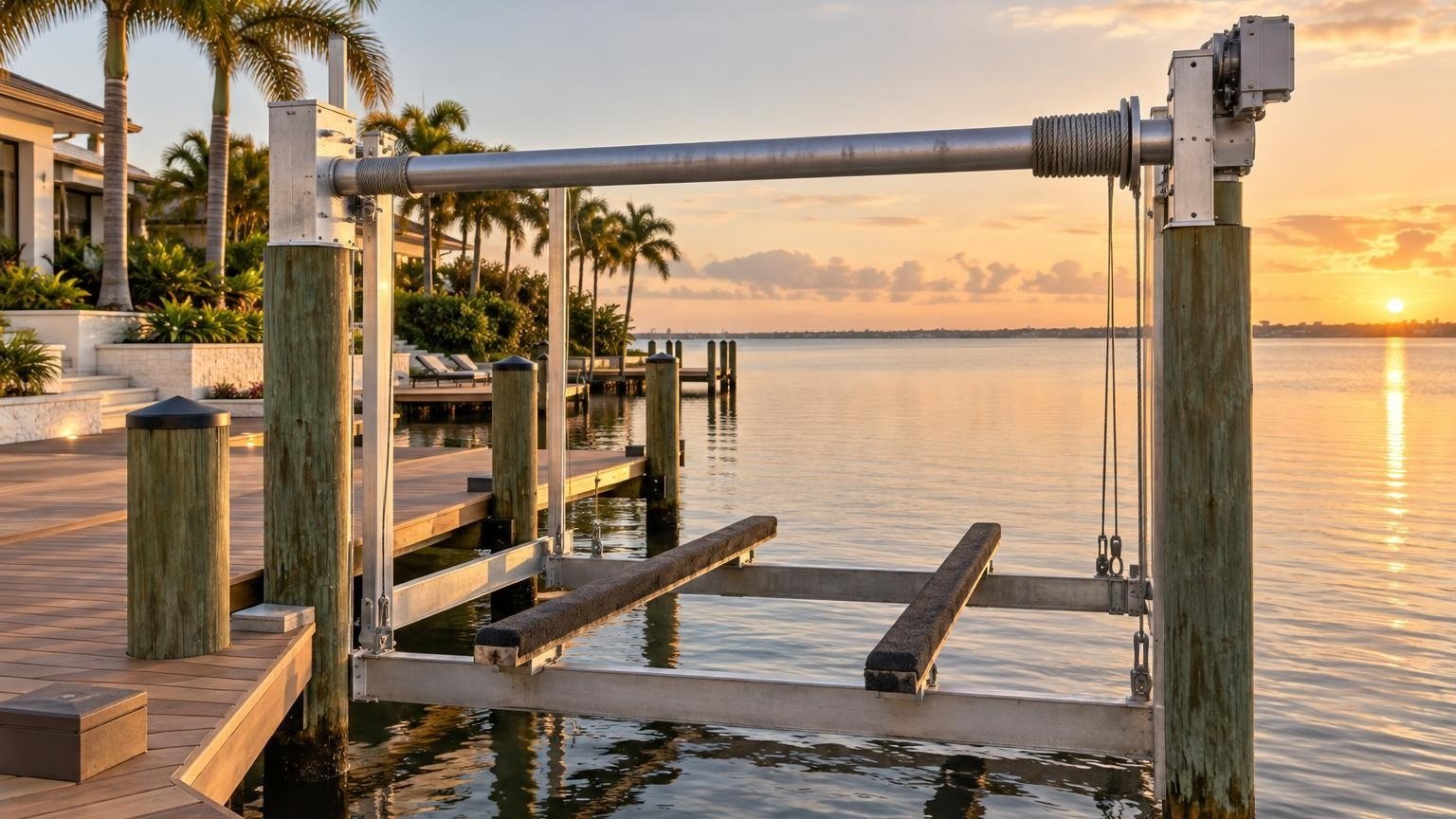
Boat-Lift Cables Winding Unevenly on the Drive Pipe: What Should Merritt Island Buyers Verify?
By Carrie Liotta, Space Coast REALTOR® with REAL Broker | Published October 12, 2026
If cables on a Merritt Island boat lift are winding unevenly on the drive pipe, treat it as a due-diligence item—not a diagnosis and not a cosmetic detail. Before you price the lift into your offer, have the seller identify the lift, provide service history, and allow a qualified marine-lift professional to evaluate the complete system under that manufacturer’s instructions.
I do not want a buyer to decide from a dock-side glance that a lift is fine, unsafe, or worth a specific credit. Uneven wraps can be a clue that deserves a closer look. The useful question is what the cable is doing, why it is doing it, whether anything else is affected, and what a qualified technician actually recommends.
First, describe what you are seeing without diagnosing it
“Uneven winding” can mean several different things. A cable may be gathering toward one end of the drive pipe, crossing over itself, leaving a gap in the normal wrap pattern, appearing tighter on one side of the cradle, or looking different only because the lift is resting at a particular height. The vocabulary matters because a clear observation helps the right professional evaluate the condition; a casual conclusion can send the transaction in the wrong direction.
At a showing, photograph the full lift from a safe distance, the model or serial plate, visible cable runs, pulleys, cradle, controls, supports, and dock relationship. Ask whether the pattern has changed, when the lift was serviced, whether components or cradle settings changed, and whether rough weather or a boat strike occurred. Put the answers in writing.
A cable that looks unusual is not proof of one particular repair. It may relate to adjustment, wear, a cable path, a component at the drum or drive pipe, the way the cradle is traveling, or something outside the cable itself. That is why I would not ask a seller to run the lift repeatedly during a showing, and I would never treat a buyer’s demonstration as a load test. Keep people clear of the boat and cradle path and let the appropriate technician control any inspection activity.
Why the whole lift matters more than one wrap of cable
Boat lifts work as systems. The cable wraps that catch a buyer’s eye are connected to the lift’s rated capacity, cable paths, pulleys, motor and gearbox, controls and limits, cradle alignment, supporting members, pilings, electrical equipment, and the boat that has been using the lift. A clean new cable does not establish that every other part is current; an untidy-looking cable does not establish that the structure has failed.
Hi-Tide, a boat-lift manufacturer, notes in its current installation guidance that installation quality matters and identifies piling movement and an out-of-parallel elevator track as examples of conditions that can affect lift operation. It also recommends regular attention to pulleys, bearing blocks, and cables. That is manufacturer guidance for its own equipment, not a finding about any specific Merritt Island property. It does reinforce the buyer’s practical approach: get the exact make and model, then have a professional evaluate the observed condition against the applicable equipment and installation.
In a canal-home search, I also compare the lift to the boat you plan to keep. Hi-Tide’s current lift-selection process asks for boat and dock details before making a recommendation. That is a useful reminder that a lift’s history with the seller’s vessel is not a promise of compatibility with yours. Weight, beam, hull shape, engines, gear, loading position, and the actual lift configuration can all matter.
Records I would request before inspection ends
Start with a simple property file rather than a vague assurance that “the lift works.” Request the manufacturer, model, serial number, rated capacity, installation paperwork, service invoices, cable or strap replacement records, motor and control records, repair proposals, and any prior inspection or storm-assessment report. If the lift was inherited from a prior owner, ask the seller to say that plainly and provide what is available.
Then match each record to the visible equipment. An invoice for a new motor does not tell you whether cables, pulleys, supports, or controls were reviewed. A receipt for a cable replacement does not tell you whether the technician addressed the reason it was replaced. If an invoice uses shorthand such as “service lift,” ask for the written scope or a technician clarification. A useful file identifies what was inspected, what was repaired, and what was excluded.
For related due diligence, read my guide to shore-power equipment near a boat-lift cable and spray zone. A visible cable question should not distract from the electrical, dock, seawall, and access questions around it.
What should the lift professional be asked to evaluate?
The buyer’s agreement should give a qualified marine-lift professional a reasonable opportunity to inspect the lift and explain the scope of any recommended work. I would ask that professional to identify the lift and components inspected; document the observed cable-winding pattern; evaluate accessible cable condition, attachment points, pulleys, drive components, cradle travel, supports, controls, limits, and the relationship of the lift to the dock and boat; and distinguish observations from recommendations.
The report should also say what the inspection did not cover. A marine-lift evaluation is not automatically a seawall inspection, electrical inspection, dock-permit review, or vessel survey. If the professional sees a concern outside the assigned scope, that is your cue to bring in the correct additional specialist rather than stretching one report beyond its purpose.
Ask for photographs and a written estimate if correction is recommended. “Repair the cable issue” is not specific enough to negotiate from. A buyer needs to know whether the proposal covers a cable, a pulley or bearing component, adjustment, a broader service visit, supporting hardware, electrical coordination, or a more extensive correction. That distinction is where the cost and closing timeline can change.
Do not confuse a lift review with waterfront permitting due diligence
When a lift has an unusual service history, buyers often start asking whether every waterfront component is permitted. That is a reasonable question, but it needs a careful, property-specific answer. A cable service is not automatically a permit event. At the same time, an old lift record or a prior invoice should not be used to make a broad claim that the dock, lift, electrical work, and all related structures are approved.
The Florida Department of Environmental Protection explains that its Environmental Resource Permitting program regulates activities involving surface-water alteration, dredging, filling, and certain docking facilities and attendant structures. DEP also explains that its districts and the water-management districts divide application processing. You can review that framework on DEP’s Environmental Resource Permitting page. It does not tell us whether a particular service call at a particular home required an approval. For that, confirm the actual scope, jurisdiction, and records with the appropriate authority or professional.
I would request the property’s available dock, lift, and electrical permits; compare them with the visible setup; and keep any unanswered question separate from the cable evaluation. This avoids two bad outcomes: assuming a small repair resolves a broader record problem, or accusing a seller of a violation because a buyer has not yet located an older file.
Factor flood and water conditions into the ownership picture
A boat lift is part of a waterfront property, not an isolated appliance. Before you remove an inspection contingency, look at the home’s flood-map context, insurance conversation, dock and seawall condition, water access, and how the lift fits the way you will actually use the property. FEMA identifies its Flood Map Service Center as the official public source for flood-hazard information supporting the National Flood Insurance Program, and it notes that map information can be updated. Use the exact property address rather than a neighborhood-level assumption.
That flood review is not a diagnosis of the lift. It is part of the carrying-cost and contingency picture. A canal home can be a wonderful fit for the right buyer, but the purchase decision has to account for the home, the seawall, the dock, the lift, access, insurance, and future maintenance together. My article on a newer boat lift versus an inconclusive seawall inspection explains why one strong component should not cancel out another unresolved waterfront question.
How I would handle the repair conversation
Once the inspection is complete, keep the negotiation factual. If the lift professional finds a limited, defined issue and supplies a clear proposal, the parties can discuss repair before closing, a credit where the contract and financing allow it, a price adjustment, or a seller-provided specialist evaluation. If the scope is uncertain, a buyer should resist turning an internet estimate into a hard number. More investigation may be the most valuable part of the contingency period.
I also encourage buyers to consider their timeline. A repair that is simple on a calm weekday may take longer if it requires a specialty contractor, equipment access, manufacturer parts, electrical coordination, or related approval questions. The best contract solution is one that says exactly who is doing what, by when, with what documentation—not one that leaves “fix boat lift” to interpretation after the closing date.
A cable pattern alone is not a reason to demand a new lift. Keep the request tied to the written finding and distinguish maintenance, a defined repair, and replacement. If replacement is recommended, compare it with the lift’s documented identity, capacity, structure, electrical setup, and your planned boat.
A buyer checklist for uneven cable winding
- Photograph the observed cable pattern and identify which side, height, and component you are looking at.
- Obtain the lift’s manufacturer, model, serial number, capacity label, installation records, and service history.
- Ask whether the pattern is new, whether service or component replacement has occurred, and whether a technician has evaluated it.
- Hire the appropriate marine-lift professional to inspect the lift within your due-diligence period.
- Request a written scope that separates observations, recommendations, limitations, and estimated work.
- Review the dock, seawall, electrical equipment, permits, flood-map context, and access as their own due-diligence items.
- Confirm that the lift’s documented configuration makes sense for the boat you intend to use, without assuming the seller’s vessel is a match.
- Put any repair or credit agreement in clear contract language with documentation and timing.
Bottom line for Merritt Island canal buyers
Uneven cable winding on a boat-lift drive pipe is worth investigating, but it does not tell the whole story by itself. A smart Merritt Island buyer uses it as a prompt for organized records and a qualified, model-specific evaluation—not as a reason to guess at safety, cost, capacity, or permits from the dock.
If you are comparing Merritt Island canal homes, I can help you organize the due-diligence questions so the waterfront features support your decision instead of becoming an afterthought. Reach out for a no-pressure conversation about Brevard County homes for sale with Carrie Liotta, Space Coast REALTOR® with REAL Broker. Your next chapter starts here.
Join my private Facebook group, Moving to Brevard County Florida, for practical relocation guidance, local buyer questions, and Space Coast neighborhood insight.
