

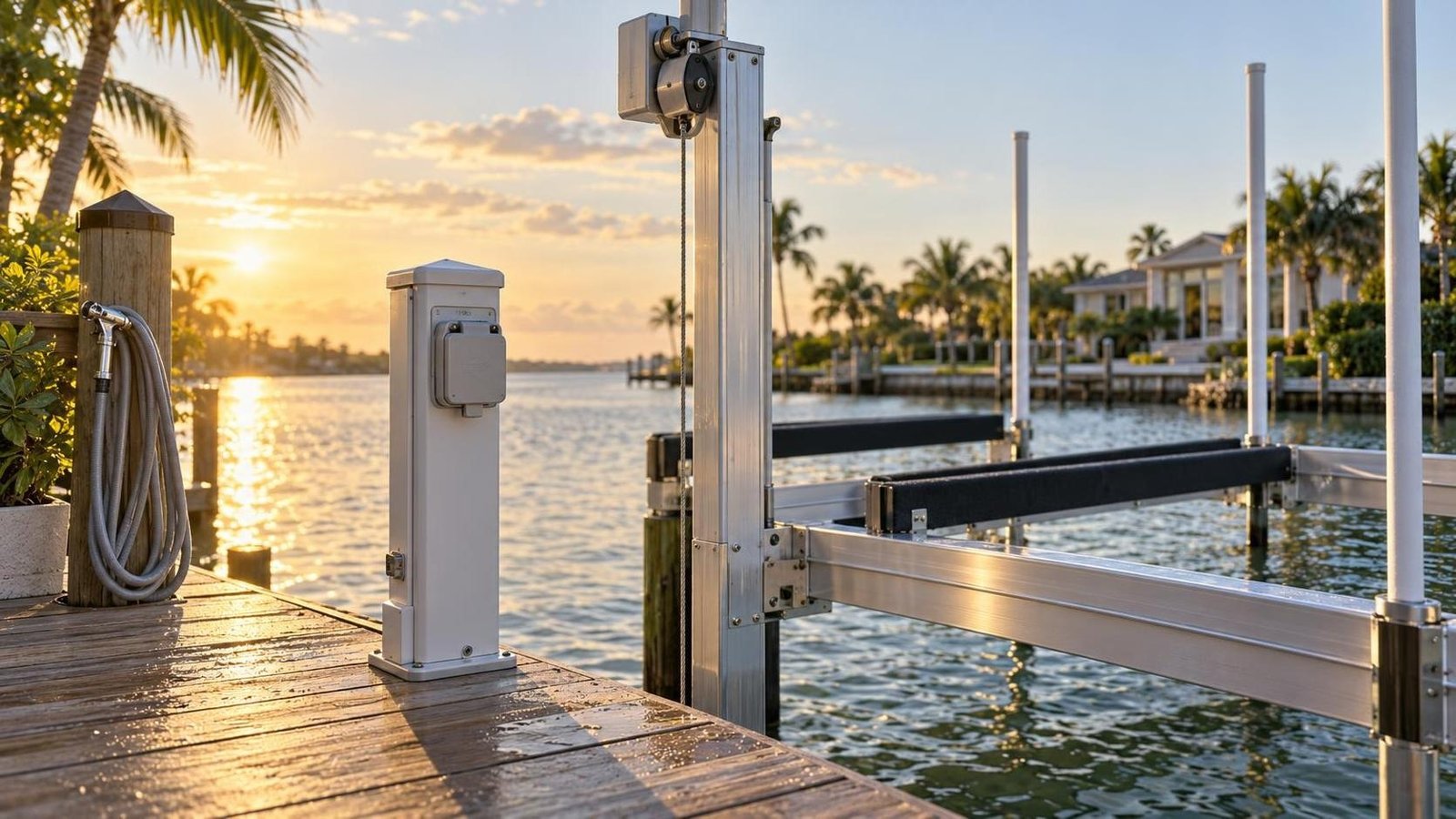
Shore-Power Receptacle Facing the Boat-Lift Cable and Spray Zone: What Should Merritt Island Buyers Verify?
By Carrie Liotta, Space Coast REALTOR® with REAL Broker | Published October 10, 2026
If a dock receptacle faces a boat-lift cable and routine spray, a Merritt Island buyer should not rely on the cover or a working plug test. Verify what the device serves, map the lift’s full movement and wet exposure, and have qualified electrical and lift professionals define whether the location, protection, condition, and records support continued use.
This is not automatically a failed installation, and the answer is not automatically “move the outlet.” The receptacle may be misidentified, the cable may travel differently under load, and the spray may have several sources. The buyer needs one coordinated picture before pricing the risk.
First, confirm that it really is shore power
“Shore power” is often used loosely in waterfront listings. One dock device may be intended to supply a boat through a dedicated marine connection. Another may be a general-use receptacle for tools. A third may serve a charger, lift accessory, pump, lighting transformer, or equipment that is no longer present. Appearance alone does not establish the intended use.
I would ask a licensed electrical contractor to identify the receptacle configuration, voltage and amperage, enclosure and cover, circuit source, breaker and protective devices, disconnecting method, conductor and raceway route, grounding and bonding path, and the equipment the installation was designed to serve. The contractor should match visible model information to available manufacturer instructions rather than guessing from an old listing description.
Then compare that field identification with permits, approved plans, final inspections, invoices, photographs, panel schedules, and equipment manuals. A permit labeled “dock electric” may not describe a later receptacle change. A receipt for a new cover does not document the circuit behind it. If the device cannot be positively identified, keep the buyer’s decision narrow: it is an existing waterfront electrical component that still needs evaluation, not a guaranteed boat-power feature.
Map three overlapping zones
The important site plan has three layers. The first is the electrical working area: where a person stands, opens the cover, inserts or removes the plug, supports the cord, and reaches the disconnect. The second is the lift’s operating envelope: cable, pulley, cradle, bunks, boat, guide posts, controls, and any component that changes position. The third is the wet zone created by ordinary use and weather.
Draw those layers from fixed reference points while the system is managed as the professionals direct. Show the lift positions considered safe to observe, boat overhang, cord route, dock edge, hose, roof drip line, cleats, ladder, and walking path. A photograph of an empty, stationary lift may miss the conflict that matters.
The cable question deserves its own lift evaluation. A buyer should not decide that a cable is safely clear because it sits several inches away at one moment. The lift technician should identify what the visible line is, how it winds, where it tracks under normal operation, whether it can move laterally, and what service access must remain open. My guide to a folding dock ladder entering a boat-lift cable path explains why every relevant position matters more than one tidy showing-day view.
Define the spray instead of calling the dock “wet”
Spray is not one condition. Ask when it occurs, where it starts, how often it reaches the device, and whether the cover, plug, cord, box, raceway, and mounting are exposed differently. Consider wind-driven rain, hose and boat wash, roof runoff, wake, and high water rather than treating every wetting pattern as the same.
Look for objective evidence without opening energized equipment: corrosion staining, mineral or salt residue, deteriorated gaskets, a cover that does not close normally, cracked enclosure material, loose mounting, damaged labels, darkening, patched raceway, cord abrasion, repeated sealant, or water tracks on the support. None of those signs proves the internal condition or cause, but each gives the electrician a better place to investigate.
Do not stage a hose test or plug in a boat during a showing. Water and energized dock equipment are not a casual demonstration. The buyer’s job is to document ordinary exposure; the electrician’s job is to decide what inspection and testing can be performed safely and what the installed products and current requirements call for.
Protection matters, but one device is not the whole answer
Buyers often hear “it has GFCI” and treat the issue as closed. A ground-fault circuit interrupter is important, but it does not establish that the receptacle is correctly identified, appropriately located, undamaged, properly enclosed, supported, grounded, bonded, or clear of moving equipment.
The Occupational Safety and Health Administration’s explanation of how GFCI protection responds to a ground fault says the device compares current going out with current returning and interrupts power when it detects an imbalance. OSHA also cautions that GFCI protection does not protect against every line-contact hazard. That general principle is useful here: a protective device is one layer, not permission to ignore damaged equipment or a poor interface with the lift.
Ask the electrician to state what was inspected and tested, what could not be verified without opening or de-energizing additional components, and whether any upstream or downstream equipment affects the result. The written report should identify the circuit and observed installation, not merely say “outlet tested.”
Inspect the plug and cord as part of the layout
A well-positioned receptacle can still be awkward once a cord is connected. Trace the intended cord from the device to the boat without stretching it across the lift control, cable path, boarding step, dock edge, cleat, or walking route. Ask how slack is supported and whether the plug, connector, and strain-relief area can remain protected during normal boat and lift use.
Identify the actual cord rather than assuming any heavy-looking cable is suitable. If the setup uses an ordinary extension cord, treat that as a separate fact. The U.S. Consumer Product Safety Commission’s extension-cord safety guidance says extension cords are temporary, damaged cords should be replaced, and outdoor cords should be marked for outdoor use. That does not define an approved shore-power system; it helps distinguish temporary cord use from identified equipment intended for the application.
Photograph labels, plug faces, connectors, strain relief, and any adapter without publishing boat-registration numbers or the home’s address. Heat discoloration, cracked insulation, taped repairs, crushed sections, green residue, missing blades, loose fit, or a cord pinched by dock hardware should be placed in the professional review. Do not reconnect questionable equipment simply to prove that it powers up.
Match contractor scope, permits, and current condition
Florida law defines electrical contracting broadly enough to include installing, repairing, altering, adding to, or designing electrical wiring, fixtures, apparatus, raceways, and conduit in compliance with applicable requirements. Buyers can read the current definition in Florida Statutes section 489.505. The practical point is simple: moving or replacing this device is electrical work, even if a dock or lift contractor is coordinating the larger project.
The Florida Electrical Contractors’ Licensing Board licenses and regulates electrical contractors. Confirm the contractor and business through the state’s official search, then match the represented scope to the permit, invoice, photographs, and field condition.
For a county-jurisdiction Merritt Island property, start with the Brevard County permit search. Confirm the actual authority, request the underlying application and final, and compare dates. A historical final does not certify that later changes remain acceptable today.
Build one correction scope, not three disconnected quotes
If the location needs work, the lowest electrical quote may not be the complete project. Relocating the receptacle may require a new route, support, mounting surface, conductor work, protection, labeling, testing, permit closeout, and restoration. It may also affect dock boards, lift service access, hose storage, railings, or the boat’s boarding side.
I would ask the electrician and lift professional to agree in writing on sequence and boundaries:
- Investigation: Identify the receptacle, circuit, cord, lift model, cable travel, exposure, records, and authority.
- Safety plan: State what must be de-energized, unloaded, secured, or kept out of service while work occurs.
- Electrical work: Define the device, route, mounting, protection, disconnection, testing, labeling, permit, and final documentation.
- Lift and dock coordination: Preserve the cable envelope, controls, boarding route, structural mounting, drainage, and future service access.
- Restoration: Include decking, penetrations, coatings, supports, sealants, and photographs before concealed work is closed.
A complete scope may conclude that the existing location is suitable after maintenance and documentation. Another may call for relocation or broader circuit correction. The buyer should not prescribe the answer from an online photograph or negotiate around an unsupported allowance.
This is where my article about dock-power conduit crossing a seawall expansion joint is useful: waterfront electrical work often depends on access, movement, and restoration that a one-line quote leaves out. My comparison of documented dock electrical work versus a newer lift motor also explains why one recent component should not stand in for the whole system.
Use the inspection period to reach a property decision
I would be more comfortable moving forward when the device and intended load are identified; the full circuit and lift envelope have been evaluated; ordinary water exposure is understood; the cord has a practical protected route; records align with the field condition; and the professionals can explain continued use or a defined correction.
I would slow down when the device cannot be identified, a cord crosses moving equipment, the cover or mounting is damaged, corrosion or water entry is suspected, the cable can approach the plug area, the system cannot be inspected safely, the permit history conflicts with the installation, or each contractor assumes someone else will handle the difficult part.
Uncertainty does not always mean the home is wrong. Preserve enough inspection time for specialist access, written scopes, authority questions, and any relevant lender or insurance follow-up. The contract response may be correction, a price adjustment, a permitted credit, acceptance with a reserve, or walking away when the system cannot be responsibly defined.
My Merritt Island buyer checklist
- Confirm what the receptacle serves and document its ratings, circuit, and intended connection.
- Map the plug-in area, cord route, lift cable, cradle, boat, controls, hose, and walking path.
- Document ordinary rain, washdown, wake, irrigation, and runoff exposure without staging a water test.
- Have the licensed electrician evaluate accessible equipment, protection, enclosure, support, wiring route, grounding, bonding, disconnecting, and condition within the inspection scope.
- Have the lift professional define cable movement, service clearance, and safe operating boundaries.
- Match licenses, permits, finals, invoices, plans, labels, and manuals to what is installed.
- Do not open equipment, handle a suspect cord, enter the water, touch a cable, or improvise lift operation.
- Price electrical work, lift coordination, dock access, restoration, and closeout records together.
Bottom line
A shore-power receptacle facing a boat-lift cable and spray zone is not a detail to approve because the cover closes. The buyer needs to know what is energized, where the lift moves, how water reaches the area, how the cord is used, and whether records and qualified evaluations support the complete installation.
I help Merritt Island canal buyers evaluate the house and waterfront as one ownership decision, from seawalls and docks to lifts, electrical records, access, and future reserves. Reach out for a no-pressure conversation about Brevard County waterfront homes with Carrie Liotta, Space Coast REALTOR® with REAL Broker. Your next chapter starts here.
