

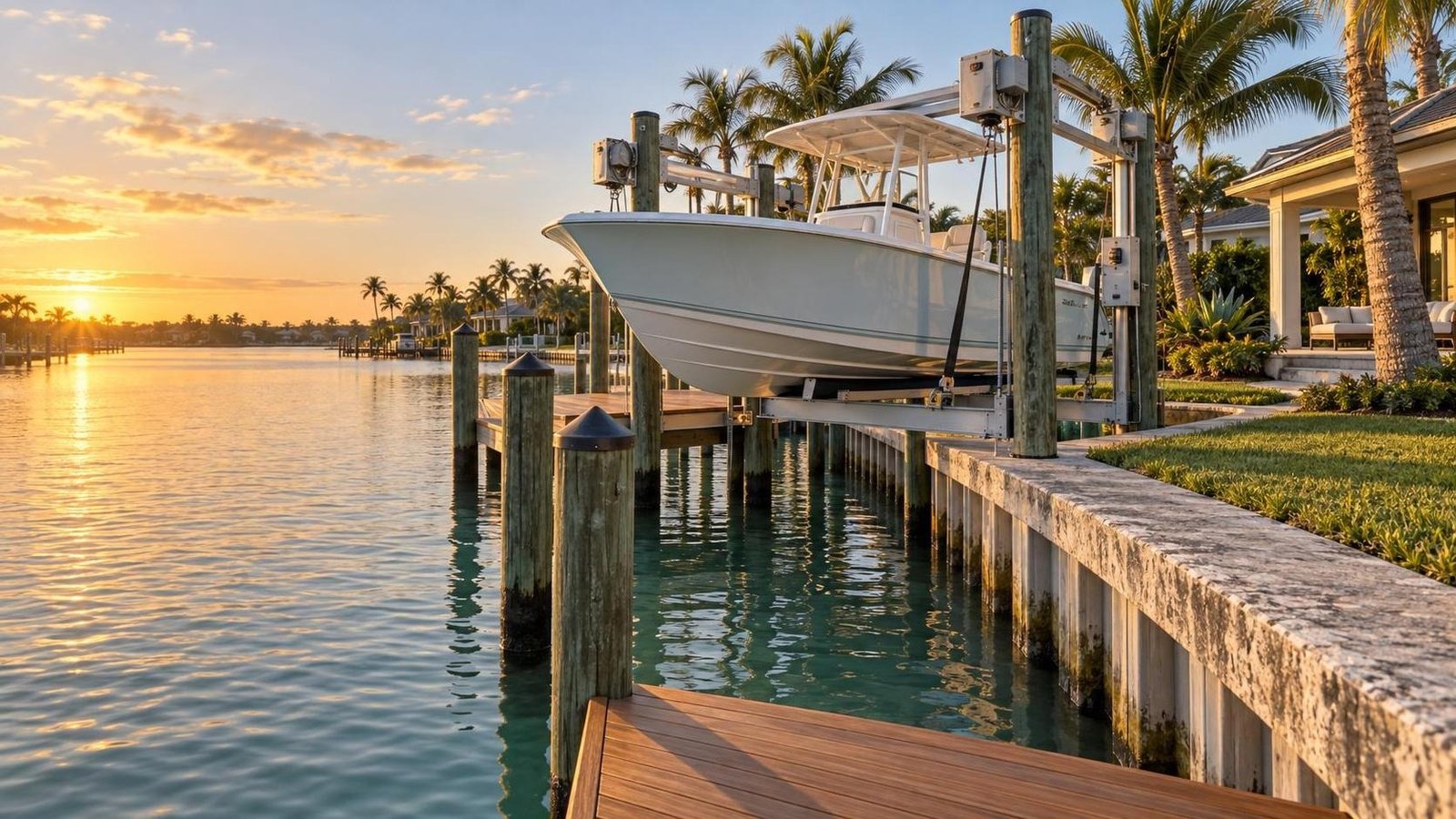
Newer Boat Lift but an Inconclusive Seawall Inspection: Should a Merritt Island Buyer Pay More?
By Carrie Liotta, Space Coast REALTOR® with REAL Broker | Published September 24, 2026 on 321 Coastal Living
I would not pay a full premium for a newer boat lift when the seawall inspection is inconclusive. The lift may add real value, but the seawall protects a much larger part of the waterfront setup. First define what the inspector could not determine, obtain the right specialist review, and price the remaining uncertainty into the offer and reserve.
This is a classic Merritt Island waterfront dilemma. The lift looks clean, the seller has a recent invoice, and your boat appears to fit. Meanwhile, the seawall report says access was limited, tiebacks were not visible, prior repairs could not be verified, or movement requires further evaluation. Buyers sometimes let the tangible new equipment outweigh the unresolved structure behind it.
The right comparison is not “new lift versus old seawall.” It is the useful value of the lift minus any fit, permit, and maintenance questions, considered alongside the range of possible seawall outcomes. Until that second number is better defined, a premium is speculative.
Find out why the seawall conclusion was limited
“Inconclusive” is not a condition rating. It tells you the inspection did not answer an important question. Ask the inspector to identify the limitation in writing. Was vegetation blocking the face? Was water level or access poor? Were tiebacks concealed? Did a deck or pool enclosure prevent observation? Was the professional performing only a visual home inspection rather than a marine-structure evaluation?
Those situations call for different next steps. Limited visibility may justify a return visit from the same inspector after access improves. Suspected movement, cracking, erosion, cap failure, or hidden anchoring may justify a qualified marine contractor or engineer. A permit-history gap calls for record research, not merely another visual walk.
I would ask for photographs, marked locations, and plain language: what was observed, what could not be observed, what concern remains, and which professional is qualified to evaluate it. Do not accept “probably fine” from someone who has also stated that the critical component was not visible.
A newer lift has value only if it fits your boat and the property
“Newer” is not enough. Verify the lift’s manufacturer, model, rated capacity, installation date, permit and approval history, electrical work, service records, cable or strap condition, controls, and warranty terms. Compare the cradle and bunk configuration with the boat you own or genuinely plan to buy, including loaded weight rather than an optimistic dry-weight number.
Also evaluate the waterway. Lift capacity does not solve canal depth, bridge clearance, turning room, low-water access, or route time. A beautiful lift that cannot serve your boating pattern should not command the same premium as one that is correctly configured and placed.
Have the lift inspected under load when the appropriate professional recommends it. Confirm the disconnect, wiring, grounding, and dock-side safety features with qualified contractors. Ask whether controls or motors are proprietary and whether local service is readily available. A recent installation invoice is helpful, but it is not a substitute for present condition and compatibility.
My broader guide to buying a Merritt Island canal-front home starts with the water and route before the interior for this reason: the expensive waterfront equipment matters only when the entire boating system works.
Do not let the lift distract from seawall evidence
At the seawall, the specialist may evaluate the face material, cap, joints, alignment, tieback or anchoring system where observable, erosion or voids behind the wall, drainage, adjacent structures, and signs of prior work. Buyers should not diagnose these conditions from listing photos. They should use visible clues to decide where professional evaluation is warranted.
Ask the seller for original construction information, repair proposals, invoices, engineering letters, permits, photographs, and contractor contacts. Compare dates and scopes carefully. “Seawall repaired” could mean a narrow patch, cap work, joint sealing, drainage correction, tieback work, or a larger reconstruction. Those are not interchangeable descriptions.
Look at neighboring transitions too, without assuming responsibility. The end of a seawall, a shared line, or a change in material may affect access and repair planning. Review the survey, easements, ownership boundaries, and any agreement that allocates maintenance. A contractor can assess physical work; a surveyor or attorney may be needed for boundary or agreement questions.
Permits and environmental review belong in the decision
Docks, lifts, shoreline work, and seawalls can involve more than one public authority depending on location and scope. The St. Johns River Water Management District permitting site, Brevard County waterfront-development information, and Florida DEP submerged-lands and environmental-resource coordination are appropriate official starting points. They are not a promise that a particular repair or replacement will be approved.
Ask a qualified professional to identify which records should exist for the installed lift and prior seawall work. If a permit search shows an issued record without a clear closeout, investigate before treating the work as final. If no record appears, confirm whether a permit was required for that exact scope at that time. Do not jump from “I cannot find it online” to either “unpermitted” or “not required.”
Future work matters as much as past work. If the possible seawall remedy would require moving the dock, lift, utilities, landscaping, or pool enclosure access, the project range may be broader than the wall itself. Ask contractors what staging and access would be needed and whether the lift can remain in service during work.
Turn uncertainty into an offer range
Before negotiating, separate the waterfront components into four columns:
- Verified useful value: equipment that fits your boat, operates correctly, has a coherent record, and supports the route you want.
- Near-term maintenance: service, cables, decking, electrical corrections, drainage cleaning, or minor documented work.
- Unresolved condition: the specific seawall areas or systems that could not be evaluated.
- Project interaction: costs or disruption created when seawall work affects the dock, lift, utilities, pool deck, or access path.
Obtain property-specific opinions and estimates where practical. A seller may agree to extend the inspection period, provide access, obtain a specialist report, complete a repair, offer a credit, or adjust price. The contract, lender, appraisal, and insurance situation determine which solution is workable. A credit is not useful if the unresolved condition prevents the buyer from obtaining acceptable insurance or financing.
I would avoid choosing an arbitrary seawall allowance from an online forum. Waterfront repair scope varies with material, length, access, engineering, environmental review, adjacent improvements, and what investigation reveals. The honest negotiating position is based on documented facts and an explicit reserve for what remains unknown.
Compare the homes without double-counting the lift
Suppose Home A has the newer lift and an inconclusive seawall review. Home B has an older serviced lift and a clearer seawall file. Buyers sometimes give Home A a lift premium, then treat its seawall uncertainty as a minor future issue. That counts the visible upgrade fully while discounting the hidden risk.
Instead, compare the complete boating setup. For each home, score route utility, canal access, lift fit, dock condition, seawall evidence, permits, flood and insurance information, and cash reserve after closing. A less impressive lift can be replaced or serviced through a defined project. An uncertain retaining system may expose the buyer to a more disruptive sequence.
This logic is similar to my comparison of documented seawall tieback repairs versus a newer generator: protect the component that supports the property’s waterfront function before paying heavily for a convenience upgrade.
Include flood and insurance questions, but keep them separate
The seawall, flood map, and homeowners or flood insurance are related ownership questions, but one does not answer the others. The FEMA Flood Map Service Center is the official public source for National Flood Insurance Program flood-hazard information. Check the exact address and obtain property-specific quotes during the inspection period.
A flood-zone designation does not certify seawall condition. A strong seawall report does not eliminate flood exposure. Likewise, a seller’s current policy or premium is not a guaranteed new-buyer quote. Have the insurance professional review the home’s elevation information, construction details, claims history when available, roof and openings, and the buyer’s intended coverage.
Keep a separate storm reserve for dock and lift preparation, electrical shutoffs, debris removal, and post-event inspection. The lift may protect a boat from routine water contact, but it does not remove the need for a written storm plan.
When I would pay a lift premium
I would consider paying more when a qualified seawall evaluation resolves the concern, the lift is permitted and documented as applicable, the electrical work checks out, the capacity and configuration fit the boat, the canal route works, and the buyer still has a healthy reserve after closing. In that case, the lift saves a real future project and can add immediate enjoyment.
I would reduce or withhold the premium when the seawall limitation remains material, the lift file is incomplete, the boat fit is uncertain, or seawall work could require lift removal. I would also step back when the seller refuses reasonable access for specialist review while pricing the property as if every waterfront component is proven.
For buyers comparing private and shared infrastructure, my analysis of a private lift versus a shared lift with a funded reserve explains why ownership control and financial documentation matter as much as equipment age.
The decision before the inspection period ends
By the deadline, you should know why the original report was inconclusive, what follow-up was completed, what still cannot be verified, whether the lift fits and functions, which permits or approvals are documented, and how much cash remains for the unresolved range. If those answers are not available, the offer should not pretend they are.
A newer lift can absolutely be valuable on Merritt Island. It simply should not be used as visual reassurance for an unanswered seawall question. I help buyers keep the boating dream and the ownership math in the same conversation.
If you are comparing Merritt Island canal homes, reach out for a no-pressure conversation with Carrie Liotta, Space Coast REALTOR® with REAL Broker. I can help coordinate the right questions, records, and specialist access before you decide what the waterfront setup is truly worth. Your next chapter starts here.
