

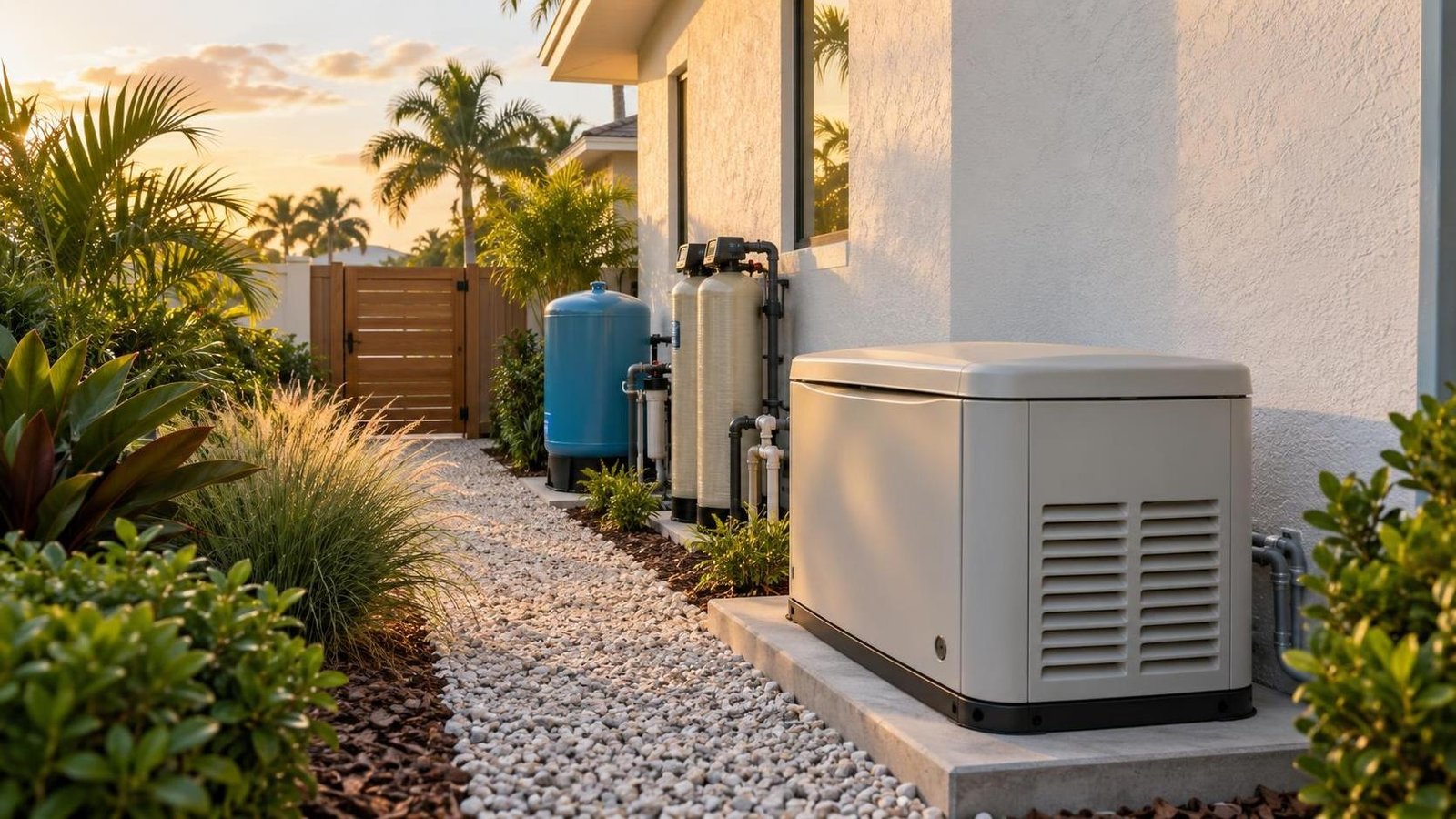
Generator Slab Narrowing Access to Well Equipment: What Should Palm Bay Buyers Verify?
By Carrie Liotta, Space Coast REALTOR® with REAL Broker | Published October 6, 2026
If a generator slab narrows access to a Palm Bay home’s well pressure tank or treatment valves, verify more than whether both systems run. I want the permits, equipment map, working route, valve access, replacement path, drainage, and written opinions from the appropriate electrical and well professionals before the inspection deadline. A working system can still be expensive to service.
This is a very physical due-diligence question. The generator may be a valuable improvement, and the well equipment may produce normal pressure during a showing, yet the space between them may be too awkward for routine maintenance or removal of a full-size tank. The goal is not to assume the layout is wrong. It is to determine whether the current arrangement is documented, serviceable, and affordable to correct if it is not.
Begin with a site map, not a guess about clearance
Ask the seller to identify every component in the side yard. What looks like a pressure tank might be an aerator, filter vessel, softener, or irrigation component. A valve may isolate the house, a treatment stage, or a bypass. The generator’s fuel supply, disconnect, transfer equipment, conduit, and underground routes may be elsewhere.
Map the route from the gate to the equipment, marking the pad, wellhead if visible, tanks, controls, valves, piping, panels, fuel source, drainage, and technician path. Do not open electrical covers or turn unfamiliar valves. The map organizes professional questions; it is not a do-it-yourself inspection.
I avoid publishing a universal number for “enough clearance.” The correct space can depend on the exact generator, treatment equipment, fuel, manufacturer instructions, adopted code, installation date, permit, and work that must be performed. Palm Bay’s Florida Building Code update explains that the code contains separate Building, Plumbing, Fuel Gas, Residential, and other volumes, with electrical provisions also incorporated by reference. A qualified professional needs to apply the right requirements to the actual installation.
Reconstruct which project came first
The chronology can explain the conflict. The well may predate the generator, or a later treatment upgrade may have enlarged a vessel in an already-tight passage. Landscaping, fencing, or a replacement tank may also have narrowed the original route.
Request the generator permit, approved plan, final inspection, installation invoice, equipment model, transfer-equipment information, fuel records, maintenance history, and warranty. For the water side, request the well record if available, pump and pressure-tank information, treatment invoices, model numbers, service history, water tests, plumbing changes, and any repair that required a vessel or valve to be removed.
The City’s Building Permits and Inspections page says its Digital Plan Room allows electronic plan submission, review, status tracking, and access to approved permit documents. Use the property’s actual jurisdiction and project dates. A Palm Bay mailing address does not by itself prove that the City issued every permit.
Then compare records with what exists. Does the approved generator location match the pad? Was the treatment equipment shown? Do invoices identify a different tank size or pipe route? Is there a final inspection rather than only an application? A permit for one project does not automatically answer whether later equipment remained easy to service.
Test access as a sequence of real service tasks
“I can squeeze through” is not the right test. A technician may need to reach a shutoff, use a bypass, remove a control head, change media, disconnect piping, drain a tank, carry tools, or remove a complete vessel.
Walk these questions in order:
- Can the main and equipment-specific shutoffs be identified and operated safely without leaning over generator or fuel components?
- Can filters, treatment media, control heads, gauges, switches, and valves be serviced without temporary dismantling of unrelated equipment?
- Is there room to drain or depressurize equipment without sending water beneath the generator pad or toward electrical components?
- Could the largest tank or vessel be removed through the gate and passage as it sits today?
- If a technician needs a cart, lifting assistance, or two-person access, is the route still practical?
- Would emergency water shutoff or generator service block the other trade?
This question is narrower than a general review of treatment quality. Buyers who also need to understand softeners, filters, testing, service agreements, and equipment purpose should read my guide to comparing water-treatment systems on Palm Bay well-and-septic homes. Here, the key issue is whether a documented system can actually be maintained in its current space.
Normal faucet pressure does not settle the question
A faucet test tells you how water behaved for a few minutes. It does not prove the pressure tank is correctly sized or healthy, that the pump is short-cycling, that treatment valves are usable, that a vessel can be replaced, or that the water is appropriate to drink. It also says nothing about whether the generator reliably supports the pump during an outage.
The U.S. Environmental Protection Agency’s private-well guidance says private well owners are responsible for delivering safe drinking water to their households. EPA’s more detailed well-protection guidance recommends annual testing for total coliform bacteria, nitrates, total dissolved solids, and pH, additional testing after well repairs or significant nearby changes, accurate maintenance records, and periodic checks of exposed well parts.
That does not mean a generator pad automatically contaminated the well. It means construction history, disturbed piping, runoff, fuel storage, exposed components, and test history deserve one coordinated review. The Florida Department of Health also says the state does not require one universal private-well sample merely because a home is sold, while recommending coliform, nitrate, and lead testing in a real-estate context. Its private-well testing page directs Brevard residents to local health officials for requirements tied to new wells or repairs.
Keep generator safety intact while solving the access problem
A buyer should not solve one issue by creating another. Moving a treatment tank, trimming a pad, rerouting plumbing, or changing a gate may affect electrical conduit, fuel piping, drainage, equipment protection, manufacturer-required space, and the ability to service the generator. Likewise, relocating the generator casually can affect its approved placement and installation.
Ask an appropriately licensed electrical contractor to identify the generator, transfer method, circuits served, disconnects, conduit, grounding, fuel-related interfaces within the contractor’s scope, and any buried route near the slab. Florida’s Electrical Contractors’ Licensing Board licenses and regulates electrical contractors, and the state’s live license search lets buyers verify a professional by name, number, area, or license type.
Do not ask a buyer or home inspector to start unfamiliar equipment during a casual showing. Arrange a seller-authorized demonstration within due diligence, with the right professionals present. Federal Ready.gov generator guidance emphasizes outdoor use away from openings, dry conditions, carbon-monoxide protection, and following manufacturer instructions. Those are broad safety principles, not approval of this particular site.
For a larger discussion of what backup power does and does not prove about a private well, my comparison of a generator-backed well and a detached workshop explains why the well, pressure system, treatment, electrical supply, and generator load plan have to work together.
Get separate opinions, then reconcile them
Do not ask one contractor to speak for every system. A general inspector can flag visible concerns; well, treatment, and electrical professionals should evaluate their respective equipment and access. Fuel work, plumbing, concrete, or drainage may require additional qualified trades.
Give each person the same site map, photos, permit documents, and seller records. Then ask for written answers to the same practical questions:
- What equipment is present, and which parts are active?
- What service cannot be completed safely with the layout unchanged?
- What is the least disruptive correction?
- Does correction require moving the generator, moving water equipment, altering the slab, widening the gate, rerouting piping or conduit, or changing drainage?
- Which permits, plans, manufacturer requirements, and final inspections apply?
- How will the home receive water and backup power while work is underway?
- Who restores concrete, plumbing, wiring, fuel components, grading, irrigation, fencing, and landscaping?
Conflicting opinions are useful information. If the well contractor proposes moving the tank into space the electrician says must remain clear, the buyer needs a coordinated scope before negotiating. My Palm Bay guide to reconciling solar, sewer, and backup-well records uses the same principle: inspect each system separately, then compare the answers on one map.
Turn the finding into an offer decision
There are several reasonable outcomes. The layout may be tight but fully serviceable, with documents and professional opinions that support leaving it alone. A gate panel or removable screen may be the only practical adjustment. The treatment system may be due for replacement anyway, allowing a better layout during planned work. Or the generator slab may create a genuine access conflict that requires concrete, electrical, fuel, plumbing, or treatment relocation.
Separate immediate corrections from future convenience, then obtain property-specific written scopes instead of guessing at an allowance. A proposal should identify what moves, who permits it, how equipment stays protected, and whether slab restoration, conduit, treatment reconnection, grading, and fencing are included.
The negotiation could be seller correction before closing, a credit within lender limits, a price adjustment, an escrow structure if all parties and the lender allow it, or acceptance with a buyer-funded plan. The right choice depends on urgency, documentation, contractor availability, insurance, financing, and the buyer’s reserves. If essential water equipment cannot be replaced without dismantling a generator installation, I would want that solved on paper before treating the generator as an added-value feature.
My inspection-period checklist
- Confirm the parcel’s permitting jurisdiction and pull generator, electrical, slab, plumbing, well, and treatment records that apply.
- Identify every vessel, valve, control, pipe, conduit, fuel component, shutoff, and active purpose.
- Measure and photograph the gate, service passage, pad edges, equipment footprints, and removal route without opening equipment.
- Review water pressure behavior, pump cycling, treatment operation, maintenance records, and suitable current water testing.
- Have well, treatment, and electrical professionals evaluate access within their scopes.
- Arrange a qualified, seller-authorized generator demonstration and confirm which loads it serves.
- Check drainage, runoff, corrosion, settlement, damaged piping, and any evidence that equipment has been difficult to service.
- Obtain a coordinated written correction scope and verify permits before assigning a negotiation amount.
Bottom line
A generator and a private well can both be valuable at a Palm Bay home, but value depends on being able to inspect, operate, maintain, and eventually replace them. When a generator slab narrows the approach to the pressure tank or treatment valves, verify the records and make technicians walk the real service path. Do not let “everything works” substitute for a practical replacement plan.
If you are comparing Palm Bay homes with wells, treatment equipment, generators, septic systems, solar, or other layered improvements, I can help you organize the right permit, inspection, and offer questions. Reach out to Carrie Liotta, Space Coast REALTOR® with REAL Broker, for a no-pressure conversation about Brevard County homes for sale. Join my private Facebook group, Moving to Brevard County Florida. Your next chapter starts here.
