

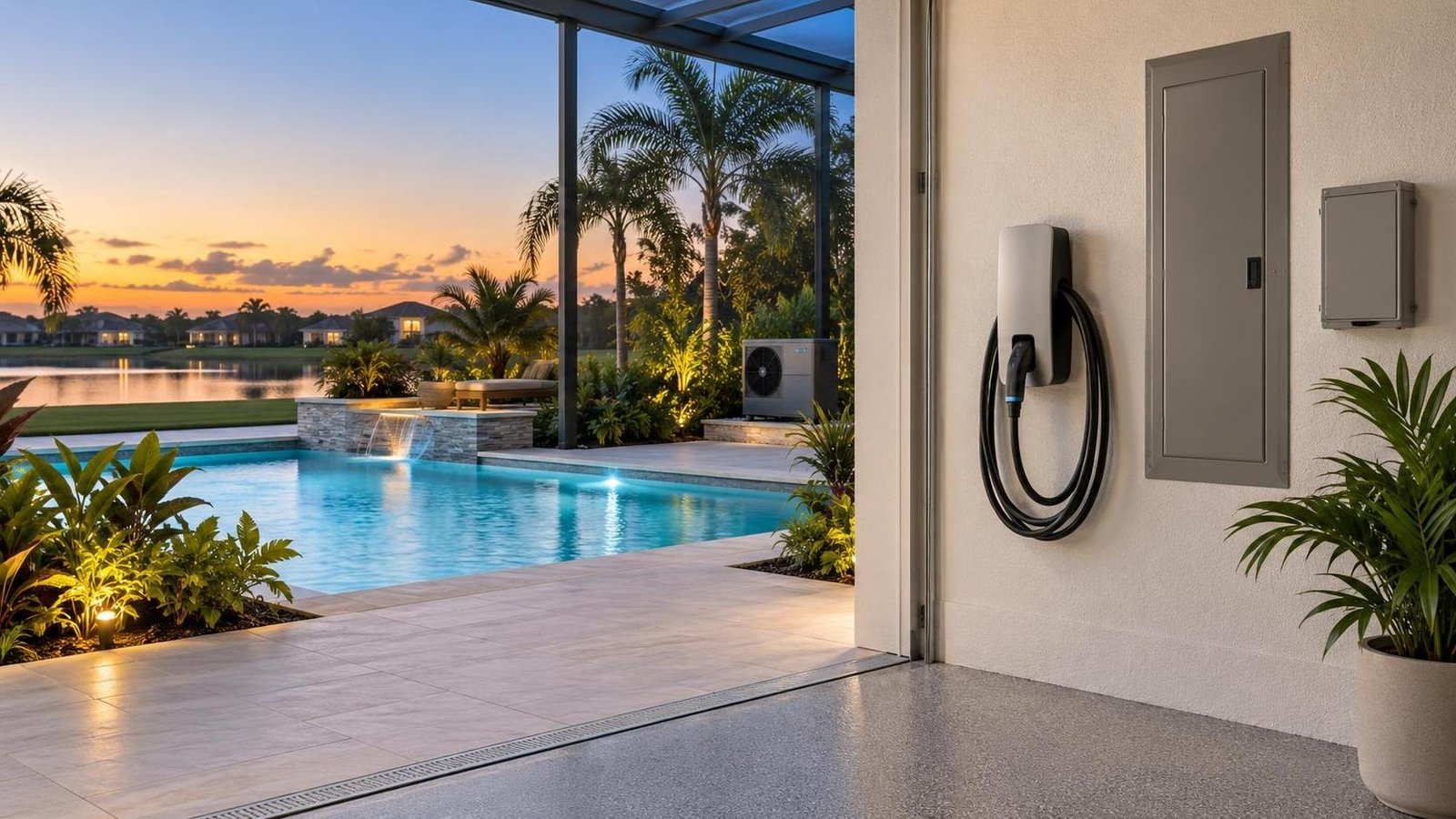
Smart Load Controller Alternating an EV Charger and Pool Heat Pump: What Should West Melbourne Buyers Verify?
By Carrie Liotta, Space Coast REALTOR® with REAL Broker | Published October 5, 2026
Verify the exact controller, both controlled circuits, the priority rule, switching delay, permits, commissioning, and present operation. Then have a properly licensed electrical contractor confirm that the service, wiring, protection, and settings support the design. The controller may be a smart solution, but only if its operating rule fits your charging window and pool routine.
First, find out what the controller actually does
Ask the seller for the manufacturer, model, serial number, installation date, manual, invoice, permit, final inspection, installer contact, commissioning record, and current settings. Photograph accessible labels without opening energized equipment. Then ask an electrician to identify the service or main panel, the EV charging circuit, the pool heat-pump circuit, the controller, sensors or communication links, and any other major loads included in the design.
The word “alternates” can describe several different behaviors. The controller may give the pool heat pump priority and pause vehicle charging whenever the heater calls. It may favor the EV and delay pool heating. It may monitor total demand and shed whichever load has been assigned a lower rank. Some arrangements reduce charging current; others interrupt one circuit completely. Those outcomes are not interchangeable for a buyer.
I want one plain-language operating statement: When this condition occurs, this load changes in this way, and normal operation resumes after this event or delay. Include what happens after a power interruption, loss of internet or communications, a controller fault, a manual override, or a change in either piece of equipment. Do not assume that “smart” means cloud-connected, self-correcting, or transferable to a new owner.
This is narrower than a general home-capacity discussion. My recent guide to a West Melbourne freezer circuit and garage mini-split explains why vague load-management language deserves follow-up. Here, the buyer must understand one installed automatic control and the daily consequence of the exact priority it enforces.
Make the EV side match the next morning’s drive
For a relocating household, the useful question is not whether the charger lights up during a showing. It is whether the vehicle receives enough energy between the time it arrives and the time it must leave. Record the charging-equipment model, hardwired or plug-connected installation, maximum rating, current configured output, cable reach, app or network dependency, and what equipment actually conveys.
The U.S. Department of Energy’s home EV-charging guidance explains that Level 2 equipment generally uses 240 volts, local permits may apply, and an electrician can determine whether a home has adequate capacity. It also distinguishes smart features such as timers, communications, and user interfaces. Those features can coordinate charging, but a schedule in the vehicle, a schedule in the charger, and a separate load controller can also conflict if nobody knows which command takes priority.
Write down a real weekday. What time does the car return from a Melbourne airport-corridor, healthcare, aerospace, or beachside commute? How much energy is normally needed? When must it leave? Is there a second EV, an irregular shift, or an occasional late return? If the pool heat pump runs through much of the same evening, ask the electrician or installer to demonstrate how the charger responds and how the owner confirms that charging resumed.
Make the pool side match the way you will use it
Now run the same exercise for the pool. Identify the heat-pump make and model, installation date, controls, electrical supply, service history, warranty status, thermostat or automation relationship, and what temperature schedule the seller actually uses. Ask a qualified pool or HVAC professional, within the appropriate scope, to evaluate condition and explain normal operation without promising a universal heating rate.
Pool heating demand changes with weather, pool size, desired temperature, cover use, equipment condition, and the starting water temperature. A seller who maintains the pool modestly may never notice that heating pauses for vehicle charging. A buyer who wants warm water before early exercise, weekend guests, or a cool-season evening swim may notice immediately.
Ask what happens when the lower-priority load is interrupted. Does the heat pump restart automatically? Is there an intentional delay? Does the pool automation display a fault? Can a normal cycle be mistaken for a control failure? The answers should come from the installed equipment, its manuals, and the responsible professionals—not from a guess made beside the equipment pad.
Confirm that the electrical story is complete
The controller may have been installed to coordinate demand without a larger electrical upgrade, but do not make that conclusion from the listing. Ask the electrician to review the service, panel ratings, conductor and circuit information, protective devices, controller ratings, sensor placement, terminations, labeling, and the load calculation or design basis that supported the work.
My article about a Titusville EV charger and air compressor sharing a detached-garage subpanel shows why two loads working separately do not prove the supply plan. In this West Melbourne home, go one step further: confirm the controller is part of the evaluated design rather than a later add-on whose settings no longer match the charger or pool heater.
Match permits and finals to all three components
Confirm the parcel’s jurisdiction before searching. A West Melbourne mailing address does not, by itself, prove that the City issued the permits. For a property inside the city, the West Melbourne Building Department provides permit and inspection-result access. Its current 2026 exemption notice specifically keeps electrical and mechanical work in permit-required categories regardless of the small-project dollar threshold.
Search for the charger, pool heat pump, controller or energy-management equipment, panel or service work, and later alterations. Compare each record’s address, scope, contractor, dates, inspections, and final status with what is installed now. One older pool permit may not include a replacement heater. One charger permit may predate the controller. An invoice can establish who billed for work without proving the approved scope or final inspection.
Use professionals whose licenses and scopes fit the work. Florida’s Electrical Contractors’ Licensing Board licenses and regulates electrical contractors, and the state’s live license search lets a buyer verify a provider by name, license number, location, or license type. Confirm who is responsible for the electrical review and who is qualified to evaluate the pool equipment; one professional’s scope may not cover every question.
Test the routine without turning the inspection into an experiment
A seller-approved demonstration can be useful when the responsible professionals decide how to conduct it. Observe the normal sequence: connect the vehicle, confirm the recognized charging state, place the pool system in its ordinary operating mode, and watch what the documented controller says should happen. Note status lights, app messages, delays, restarts, unexpected sounds, odor, heat, flicker, trips, or fault codes for professional follow-up.
Do not change breakers, defeat controls, increase charging current, bypass the controller, force equipment to short-cycle, or repeatedly switch heavy loads merely to see what happens. One improvised test cannot prove every operating condition and may create a new problem.
Ask which load normally receives priority, whether either device has failed to resume, and whether settings changed after equipment was added. Confirm whether the controller needs an app, subscription, network, password, or installer account. Seller experience directs the investigation; it does not replace records and professional evaluation.
Decide whether the operating rule fits your household
A verified controller is not automatically a defect. It may be an efficient way to coordinate two large loads while preserving a practical routine. The question is whether its constraint is acceptable to you.
Consider three nights. On an ordinary work night, the vehicle arrives with enough time to charge after the pool-heating cycle ends. On a cold weekend, the pool needs a long recovery while the car also needs significant energy for a morning trip. On an irregular night, a driver returns late and must leave early. Ask how the current priority and delay affect each case.
This is also why I would not value the controller by its original invoice alone. Its resale value comes from clarity: compatible equipment, current settings, permits, final inspections, manuals, transferable access, service support, and an operating rule a buyer can live with. My comparison of a Viera battery load plan and larger pool heater reaches the same broader lesson—expensive devices become useful home features only when their relationship is documented.
Price the missing proof, not a worst-case assumption
There is no honest generic allowance for this setup. The answer may be a commissioning visit, corrected labels, account transfer, or a written operating plan. It may involve controller configuration, charger adjustment, circuit work, pool-equipment service, permit closeout, replacement controls, panel or service work, or utility coordination. Access, finishes, equipment ratings, and the responsible authority can change the scope.
If the setup is documented and dependable but occasionally delays pool heating, a commuter may find that tradeoff easy. If it routinely jeopardizes the next morning’s charge, cannot be demonstrated, depends on an account that will not transfer, or has unresolved approval history, the buyer may seek completed work, a credit, a price adjustment, or another property as the contract and closing conditions allow.
My inspection-period checklist
- Confirm parcel jurisdiction and search electrical, mechanical, pool, charger, controller, panel, and service records.
- Collect manuals, invoices, warranties, finals, commissioning documents, service history, settings, and account-transfer instructions.
- Have a properly licensed electrical contractor map the service, panels, both circuits, controller, sensors or communications, ratings, protection, labels, and design basis.
- Ask for the priority rule, switching threshold, delay, reset, override, and fail-safe behavior in plain language.
- Have the appropriate pool professional evaluate the heat pump, controls, plumbing, condition, drainage, service access, and normal operating sequence.
- Test an ordinary commute night, a high pool-heating night, and a late-arrival night against the documented plan.
- Confirm what equipment, apps, subscriptions, credentials, warranties, and service relationships convey.
- Obtain property-specific scopes before negotiating money or assuming a future equipment change will be simple.
Bottom line
A smart load controller can let an EV charger and pool heat pump share a West Melbourne home gracefully, but the feature earns value only when the buyer understands exactly how it works. Verify the equipment, capacity, circuits, priority, delays, permits, commissioning, current condition, and transfer process. Then judge the system against the workday and pool schedule you will actually live.
I am Carrie Liotta, Space Coast REALTOR® with REAL Broker. I help West Melbourne and Brevard County buyers turn specialized home systems into clear inspection questions, contractor scopes, and offer decisions. Reach out for a no-pressure conversation about Brevard County homes for sale, or join my private Facebook group, Moving to Brevard County Florida. Your next chapter starts here.
