

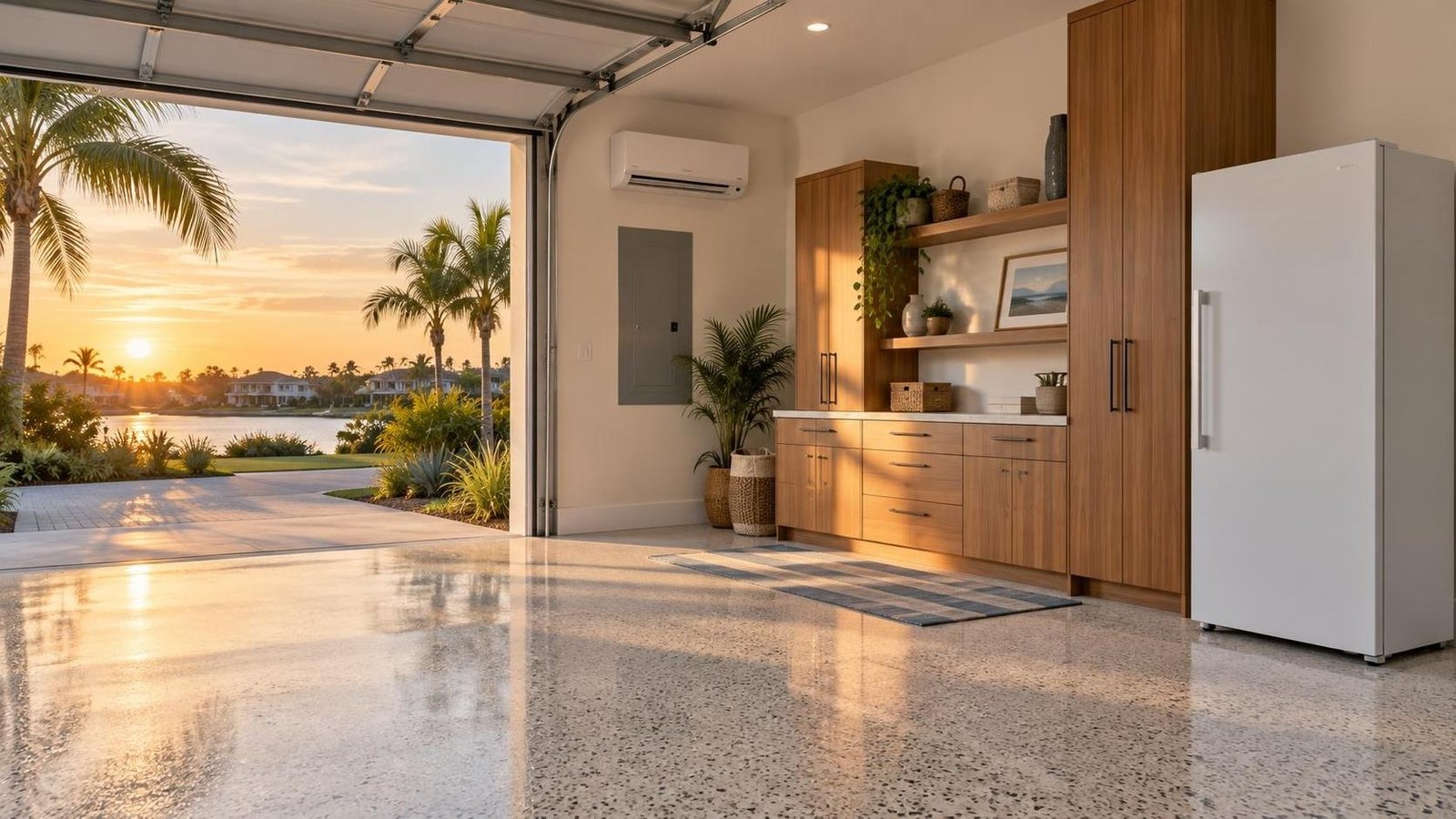
Dedicated Garage-Freezer Circuit or Newer Mini-Split: What Should West Melbourne Buyers Prioritize?
By Carrie Liotta, Space Coast REALTOR® with REAL Broker | Published October 4, 2026
Prioritize the dedicated freezer circuit when bulk food storage is essential. Choose the newer mini-split when the garage has a legitimate, recurring comfort need. If both supposedly depend on load management, pause before choosing either: have licensed electrical and HVAC professionals verify the circuits, equipment, permits, controls, and safe simultaneous-use plan.
I would not pay extra for a panel label that says “freezer,” or for a recent mini-split installation date, until the complete setup is verified. The right priority is the feature that supports your real week after the technical questions are resolved.
First, define what “load management” means at this house
That phrase can describe very different arrangements. It may mean an approved automatic control that responds to electrical demand, an equipment setting that limits operation, or nothing more than the seller remembering not to run certain devices together. Those are not interchangeable.
Ask a properly licensed electrical contractor to identify the main panel, both circuits, other significant garage loads, and any control equipment. Request a written explanation of what can operate together and what happens as demand rises. If one device pauses, sheds, or reduces output, know which device, who configured it, and how normal operation is restored.
Do not test the theory by changing breakers, defeating protection, using adapters, or repeatedly switching heavy loads during a showing. A working demonstration is useful, but it cannot replace ratings, records, calculations, and professional evaluation. My recent guide to an EV charger and air compressor sharing a detached-garage subpanel explains why two devices operating separately do not prove that the entire supply and simultaneous-use plan are sound.
When the freezer circuit deserves first priority
I would put the freezer first for a household that buys meat in bulk, meal-preps for long shifts, stores specialty foods, fishes regularly, or relies on frozen inventory every week. In that routine, the freezer is not optional storage. It is part of the food budget, so dependable power, usable placement, temperature monitoring, and an outage plan matter more than occasional garage comfort.
Verify what “dedicated” means. A panel-directory note is a clue, not proof. Have the electrician trace the circuit, identify what else it supplies, evaluate the receptacle and protective devices, and compare the observed installation with the freezer manufacturer’s instructions. Ask for the electrical permit, final inspection, invoice, and any records for later alterations. A clean label added by a prior owner is not the same as a documented installation.
Then evaluate the actual freezer, not an empty rectangle. Record its model and ratings, confirm the permitted ambient range, and check clearance, ventilation, leveling, cord reach, and door swing. Test whether both vehicles can park and the appliance can open without striking cabinets, tracks, or storage.
The official ENERGY STAR freezer guidance recommends using the EnergyGuide label to compare energy use and estimated operating cost and notes that freezer size and chest-versus-upright configuration affect both consumption and usability. That is more useful than assuming a large unit is automatically the better amenity.
This choice is narrower than deciding between frozen storage and kitchen organization. My comparison of a garage freezer circuit and an interior pantry starts with grocery habits. Here, the circuit and appliance must also fit beside a cooling system that may compete for capacity or change the garage environment.
When the mini-split is the more valuable feature
I would favor the mini-split when the garage has a legitimate, repeated use that depends on temperature control: a documented workshop, exercise area, hobby space, or protected storage routine. A West Melbourne buyer working on detailed projects after a Melbourne airport-corridor shift may use cooling far more often than a second freezer. Comfort can also protect tools or materials when their manufacturers specify an appropriate environment.
But “newer” describes age, not quality or suitability. Confirm the indoor and outdoor model numbers, installation date, permit and final, contractor invoice, warranty status, electrical supply, disconnect, condensate route, refrigerant-line protection, service access, and maintenance history. Operate the system through a meaningful cooling cycle under the inspector or contractor’s direction. Note temperature change, airflow, sound, vibration, odor, leakage, error codes, and condensate discharge without removing covers.
ENERGY STAR’s ductless heating and cooling guidance identifies garages and outbuildings as possible mini-split applications, but it also stresses proper sizing and directs owners to an HVAC contractor and a Manual J calculation for the intended space. A recent manufacture date cannot tell you whether this unit fits the garage’s area, insulation, door use, sun exposure, or actual purpose.
Drainage deserves its own test. Trace the condensate from the indoor head to its termination and look for staining, algae, puddling, erosion, garage moisture, or water crossing a walking or driving path. My article about mini-split condensate crossing a West Melbourne driveway apron shows why a cooling system can operate while its water route remains a buyer problem.
Do not let cooling equipment redefine the garage
A mini-split can make a garage more comfortable, but it does not automatically turn the space into approved living area, a bedroom, or finished square footage. Compare the listing language, seller disclosure, permit description, plans, property records, and present condition. Ask what changed besides the equipment: insulation, walls, windows, doors, ceiling, floor, electrical work, or the garage opening itself.
Confirm jurisdiction before searching records. A West Melbourne mailing address does not prove that the parcel is inside the city. For a city parcel, the West Melbourne Building Department provides permit and inspection access and states that electrical and mechanical work remain permit-required categories under its 2026 exemption notice. Search for both systems separately. One mechanical permit may not explain the freezer circuit, and one electrical permit may not establish the approved use of the room.
Match the records to what exists today: permit numbers, scope, contractor, equipment, inspection history, final status, and dates. An invoice does not prove the permitted scope or final inspection. A blank online result also is not proof of unpermitted work; older records or another jurisdiction may require follow-up.
Compare the two features through one ordinary week
I ask buyers to stop comparing equipment age and rehearse the household routine. When are groceries unloaded? How often is the freezer opened? Does someone park close to it? When does the garage need cooling? Is the overhead door open during that work? What other loads operate then—laundry, vehicle charging, tools, a dehumidifier, pool equipment, or a second refrigerator?
Write two simple scenarios:
- Freezer-first week: Bulk groceries arrive after work, the freezer must remain dependable around the clock, the appliance door needs clear access, and a temperature or power-loss alert protects the inventory.
- Mini-split-first week: The garage is closed and occupied for scheduled projects, the cooling system serves a defined zone, condensate drains correctly, and the electrical plan supports the system with the other loads expected at that time.
Now ask the contractors whether both scenarios work under the present setup. A verified schedule may be perfectly reasonable. For example, a household may cool the garage only during a weekend project while the freezer cycles normally. The weakness is not scheduling itself; it is an unwritten rule that no one can explain, a control no one can identify, or a system that trips protection when the routine changes.
Check what transfers: the freezer, mini-split warranty, app access, remotes, manuals, service records, and control settings. A larger replacement freezer or different garage use may require a new load or comfort evaluation.
Price the missing proof before choosing a winner
There is no honest universal cost for correcting this setup. The answer may be documentation and a written operating plan. It may involve a receptacle or circuit correction, control configuration, panel or feeder work, mini-split service, condensate rerouting, equipment replacement, insulation, wall repair, or permit closeout. Distance, access, finishes, equipment ratings, and the responsible authority can change the scope.
Ask the electrician for separate written options: document the present arrangement, correct any current issue, and support the buyer’s intended future routine. Ask the HVAC contractor to separate equipment condition, sizing, drainage, maintenance, and replacement questions. If room use is unclear, ask the building department or an appropriate design or construction professional what the records establish before treating cooling as added living space.
Then compare total ownership rather than the seller’s upgrade cost. For the freezer, include the appliance if it does not convey, monitoring, expected energy use, lost-food exposure, and any circuit work. For the mini-split, include service, cleaning, drainage, controls, warranty, expected operating use, and any envelope improvement needed for useful comfort. A seller may have spent more on one feature without making it more valuable to you.
Negotiation should follow evidence. If both systems are safe, documented, and practical, prioritize the one that improves your weekly life and treat the other as a bonus. If one needs a defined repair, negotiate completed work, a credit, or a price adjustment where the contract, lender, insurer, and closing schedule allow. If the claimed load-management plan cannot be verified before the inspection deadline, do not assign premium value to either feature.
My inspection-period checklist
- Confirm the parcel jurisdiction and search electrical, mechanical, alteration, and related permit records.
- Collect finals, approved scope, invoices, manuals, warranties, maintenance records, and any control documentation.
- Have a properly licensed electrical contractor trace both supplies, inventory other loads, identify any control, and write the simultaneous-use rule.
- Verify that the freezer circuit is actually dedicated and that the exact appliance fits the garage environment, clearances, receptacle, and parking layout.
- Have the HVAC professional verify mini-split condition, sizing basis, electrical connection, condensate route, service access, and performance.
- Compare listing claims about the garage with permits, plans, property records, and current construction.
- Test one ordinary freezer-first week and one mini-split-first week against the documented operating plan.
- Obtain property-specific scopes before negotiating money or assuming a future upgrade will be simple.
Bottom line
A dedicated freezer circuit is the better priority when frozen storage protects a meaningful part of the household budget and the complete installation is verified. A newer mini-split is the better priority when the garage has a legitimate recurring use, the equipment is properly matched to that space, and its power and drainage are documented.
The phrase “both depend on load management” should start due diligence, not end it. Identify the actual loads, controls, operating limits, permits, and daily routine before you pay for either feature. Then choose the system that solves a real need without leaving the next owner with an electrical or mechanical mystery.
I am Carrie Liotta, Space Coast REALTOR® with REAL Broker. I help West Melbourne and Space Coast buyers turn specialized home features into clear inspection questions, contractor scopes, and offer decisions. Reach out for a no-pressure conversation about Brevard County homes for sale, or join my private Facebook group, Moving to Brevard County Florida. Your next chapter starts here.
