

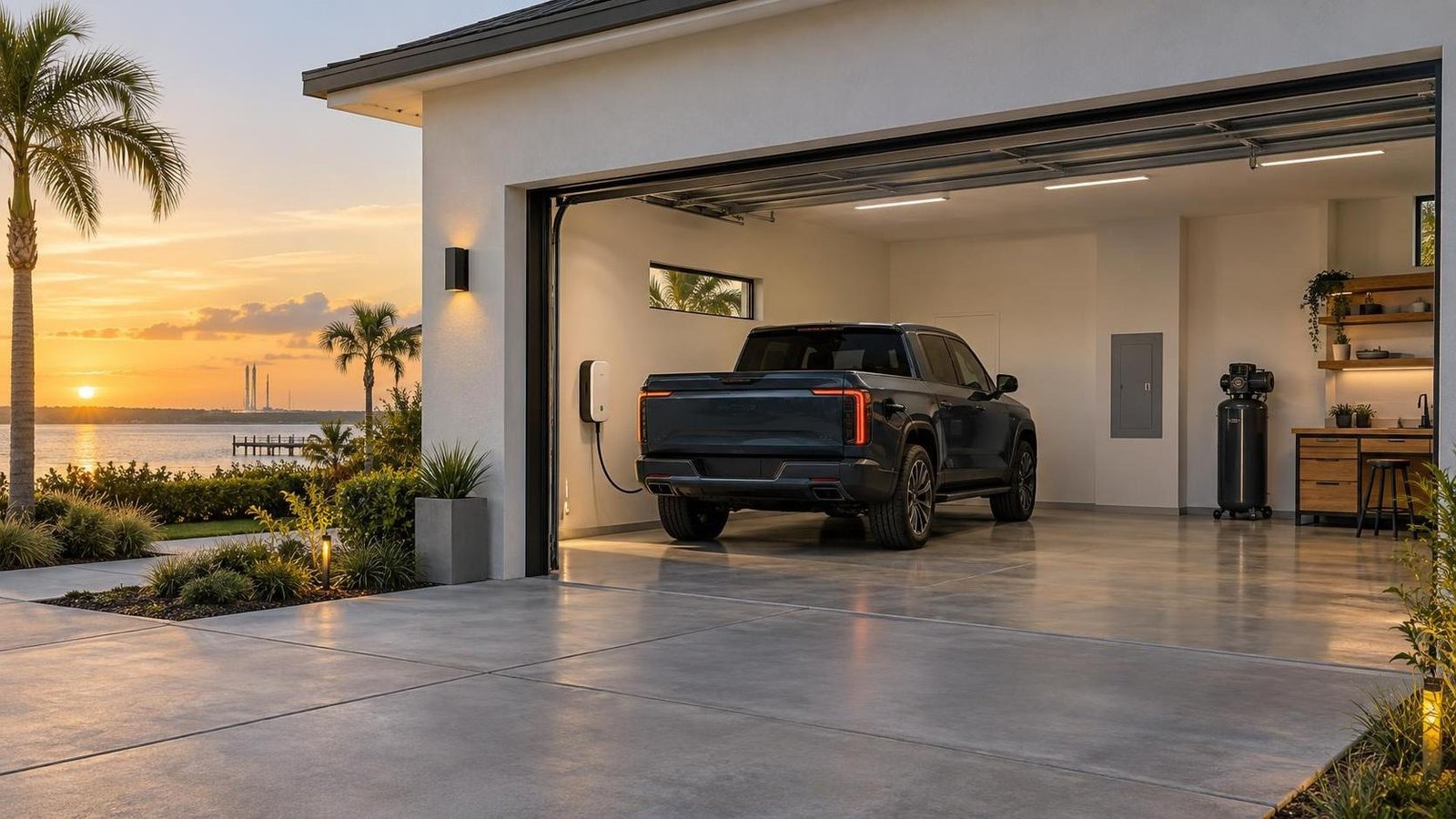
Work-Truck Air Compressor and EV Charger Sharing a Detached-Garage Subpanel: What Should Titusville KSC Buyers Verify?
By Carrie Liotta, Space Coast REALTOR® with REAL Broker | Published October 4, 2026
Do not assume the detached-garage subpanel can support an air compressor and EV charger just because each one operates by itself. Have a properly licensed electrical contractor verify the feeder, panel, branch circuits, equipment ratings, charging setting, motor-starting behavior, grounding and bonding, permits, and the design for simultaneous use before your inspection period ends.
For a buyer relocating to Titusville for Kennedy Space Center, the Cape, or another North Brevard employer, this is a practical ownership question. The truck may need to charge overnight while the compressor refills after a late project, or another household member may use the workshop before the vehicle finishes charging. A staged demonstration with only one machine running does not answer whether the garage fits that routine.
First, clarify what “sharing a subpanel” actually means
The phrase should mean that both loads are supplied through the panel in the detached garage. It should not mean that the compressor and charging equipment are connected to one branch circuit, one improvised receptacle, or an adapter arrangement. Ask the electrician to identify the service or main panel at the house, the breaker feeding the garage, the feeder route, the garage panel rating, the separate branch circuits, disconnecting equipment, and every major load served there.
Ask for a simple one-line sketch showing the source panel, feeder, garage panel, EV and compressor circuits, and other significant loads. It reveals more than a panel-directory label: a large-looking subpanel does not prove an equally large feeder, and empty breaker spaces do not prove available capacity.
Keep physical access in the review too. My guide to a Titusville garage workbench blocking electrical-panel access explains why usable working area and a clear route matter. In this inspection, the buyer also needs to know whether the parked truck, compressor, hose reel, cabinets, and charging cable crowd the equipment or its shutoffs.
Read the actual equipment, not the seller’s shorthand
“EV charger” may describe a portable cord set, a wall-mounted charging station, or a receptacle that the seller uses with personal equipment. “Shop compressor” could mean a small portable unit or a permanently placed motor load. Photograph the accessible nameplates and model information without opening energized equipment, and ask what conveys with the property.
For the charging side, record the equipment model, hardwired or plug-connected installation, circuit information, maximum rating, current configured charging level, cable length, and any app-based schedule or load-management setting. The U.S. Department of Energy’s home EV-charging guidance explains that Level 2 equipment generally uses 240 volts, that a qualified electrician can evaluate household capacity, that local permits may apply, and that charging infrastructure is treated as a continuous load under the National Electrical Code.
The charger’s advertised output may not be its configured current. Do not change settings, breakers, receptacles, or app limits during a showing. Ask the contractor to document the present configuration and whether it is essential to the garage load plan.
For the compressor, record the motor nameplate, connection, controls, manufacturer instructions, and any dedicated disconnect or receptacle. Ask about starting as well as running. Do not rely on a generic “startup multiplier”; the actual motor, voltage, condition, conductor run, and supply matter. Hesitation, light dimming, or breaker trips call for evaluation, not repeated resets.
The real question is what happens when both loads are available
A seller may honestly say, “We never had a problem,” while also charging the vehicle only after shop work ended. That history is useful, but it is not the same as a design review. Ask the electrician whether the feeder and panel were evaluated for the loads now connected, whether the charging equipment uses approved load management, and whether the compressor and charger can run together under the present settings.
The installation may support both loads, depend on approved energy management that reduces or pauses charging, or require scheduling around workshop use. The evaluation may instead find a feeder, panel, circuit, connection, equipment, or documentation issue. The buyer needs one clear operating rule rather than a guess.
This is where daily life matters. A KSC household with one predictable commute and occasional weekend compressor use may find a verified schedule completely practical. A household with irregular call-ins, two drivers, pneumatic tools, and a garage freezer may need more flexibility. My earlier comparison of garage ventilation and work-truck charging for Titusville buyers helps inventory the rest of the garage routine. Here, carry that inventory into the electrician’s calculation instead of evaluating only the two newest pieces of equipment.
A detached garage adds another layer of due diligence
The subpanel is only the visible end of the feeder. Ask how power reaches the building and photograph the visible route, grade changes, exterior equipment, penetrations, and areas affected by drainage, vehicles, landscaping, or digging. Do not excavate or pull covers during an inspection.
Have the contractor evaluate grounding and bonding, feeder protection, enclosure and equipment condition, terminations, labeling, environmental exposure, and circuit connections. These are technical findings. A buyer or agent should not approve the installation because ground rods are visible or reject it because it differs from a newer home.
The federal OSHA electrical standard for workplaces is not the residential code for this property. It does, however, illustrate why ratings, durable labeling, secure mounting, heating effects, deteriorating agents, and access are meaningful parts of an equipment review. The applicable residential requirements and any correction should be determined by the licensed contractor and authority responsible for the Titusville parcel.
Match permits and finals to what is installed now
Start by confirming jurisdiction. A Titusville mailing address may be inside the city or in another Brevard jurisdiction. The City of Titusville’s official permits, forms, and policies page is the municipal starting point, but use the responsible county office when the parcel is outside city jurisdiction.
Search separately for the detached garage, feeder or service work, subpanel, EV charging equipment, compressor circuit, and later electrical alterations. Compare the permit description, approved documents, inspection or final status, contractor, and date with the equipment on site. One permit for construction of the garage does not necessarily cover a charger or compressor circuit installed years later. Likewise, an invoice shows that someone billed for work; it does not by itself establish the approved scope or final inspection.
The official Florida Building Code portal lists the 8th Edition (2023) as the current published code set and the 9th Edition (2026) as draft material. Existing work may fall under earlier requirements. A blank online search does not prove that work lacked approval or was exempt; ask the responsible office about older records.
Use a professional whose scope fits the job. Florida’s Electrical Contractors’ Licensing Board licenses and regulates electrical contractors, and Florida Statutes section 489.505 defines the electrical-contractor role around the knowledge and skill to install, repair, alter, add to, or design electrical systems in compliance with applicable requirements. Verify the individual or company and confirm whether a certified, registered, or specialty scope is appropriate for the property and work.
Test the routine without creating your own electrical experiment
A buyer can still learn a great deal safely. Park the actual work truck or a vehicle of similar size. Confirm that the charging cable reaches without crossing the walking path, garage-door travel, compressor controls, panel area, or storage access. Check whether hoses and cords can be stored without wrapping around charging equipment. Listen for ordinary compressor operation during a seller-approved demonstration and note any flicker, nuisance trip, heat, odor, noise, or control message for the contractor.
Do not repeatedly cycle the compressor, defeat a charger setting, swap breakers, use adapters, remove panel covers, or force both loads on to “see what happens.” A short, improvised test cannot recreate every operating condition and may create risk. Let the electrician decide what measurements or controlled operating checks are appropriate.
Ask when the vehicle is charged, what else runs then, whether a breaker has tripped, whether charging was reduced, and whether the compressor or its circuit was repaired. Also ask what equipment existed when the feeder was installed. Seller answers should guide records and inspection questions, not replace them.
Price the unresolved question, not an imaginary worst case
There is no honest universal allowance for this setup. One property may need only better labels and a documented operating plan. Another may need charger reconfiguration, approved load management, circuit correction, compressor repair, a feeder or panel change, trenching, wall repair, or utility coordination. Detached-building distance, routing, finished surfaces, contractor availability, permits, and the actual equipment can change the scope.
Request written options for the current condition, any required correction, the buyer’s intended simultaneous use, and future plans. Separate electrical work from trenching, drywall, landscaping, and equipment purchases so the offer strategy rests on real scopes.
If the system is safe and documented but the charging rate must remain limited while the compressor operates, that may be a manageable ownership rule rather than a defect in the buyer’s eyes. If the setup cannot serve the planned routine, records are missing, or correction cannot be defined before the inspection deadline, the buyer may negotiate completed work, a credit, or price adjustment where the contract, lender, insurer, and closing schedule allow. The buyer may also decide that another property is a better fit.
Do not pay a premium for “EV-ready workshop” language until capacity and transferred equipment are clear. Chargers, compressors, app access, and warranties may not all convey the same way. As my guide to organizing separate EV, solar, and battery approvals explains, the house needs one coherent systems story.
My inspection-period checklist
- Confirm whether the parcel is inside Titusville and identify the responsible permitting authority.
- Collect permits, approved scope, finals, invoices, manuals, warranties, service records, and load-management information.
- Identify the house source panel, garage feeder breaker, feeder route, detached-garage subpanel, and every significant garage load.
- Record the EV equipment model, connection, present charging configuration, cable layout, controls, and what conveys.
- Record the compressor nameplate, circuit, connection, controls, service history, and observed starting and running behavior.
- Have a properly licensed electrical contractor evaluate capacity, simultaneous use, feeder and panel condition, branch circuits, grounding and bonding, access, labeling, and environmental exposure.
- Ask for a simple one-line sketch and a written operating rule, especially if charging must pause, reduce, or follow a schedule.
- Obtain property-specific scopes for correction or future use before negotiating money.
- Retest vehicle fit, cable and hose routes, storage, panel access, and the real KSC household schedule.
Bottom line
An EV charger and work-truck compressor can coexist in a useful detached Titusville garage, but two functioning machines do not prove a complete electrical design. Verify the source, feeder, panel, circuits, ratings, settings, simultaneous-use plan, detached-building details, and approval history. Then decide whether the documented operating rule fits the workday you will actually live.
I am Carrie Liotta, Space Coast REALTOR® with REAL Broker. I help KSC and North Brevard buyers turn specialized garage features into clear inspection questions, contractor scopes, and contract decisions. Reach out for a no-pressure conversation about Brevard County homes for sale, or join my private Facebook group, Moving to Brevard County Florida. Your next chapter starts here.
