

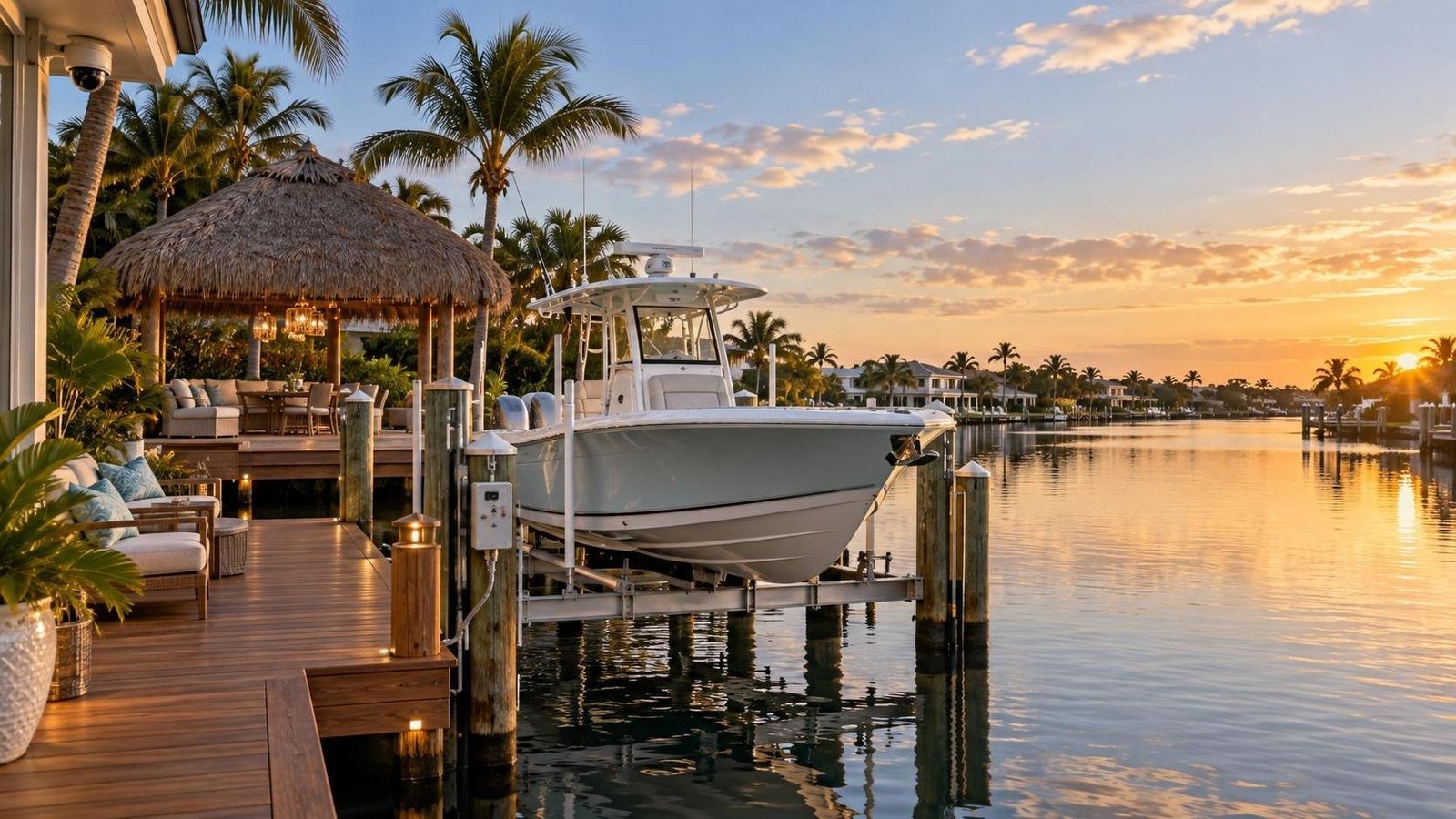
Boat-Lift Remote and Dock Cameras or a Larger Tiki Area: Which Merritt Island Home Is Better?
By Carrie Liotta, Space Coast REALTOR® with REAL Broker | Published September 27, 2026
For a Merritt Island buyer who boats often or leaves the property for stretches, a documented wired lift remote and dock-camera setup can be more useful than a larger tiki area. But equipment does not outrank the basics. Verify the canal route, seawall, dock, lift capacity, electrical work, permits, and network handoff before assigning value to the controls.
This comparison is really between operations and entertainment. The tiki area promises dinners, shade, and a waterside place to gather. The remote and cameras promise easier lift use, visual awareness, and fewer trips down the dock to check conditions. One photographs better. The other may make repeated boat days simpler.
I would not choose from the listing photos. I would first decide whether either feature improves the way you will actually use this particular waterfront.
The waterway still decides whether the home works
A sophisticated lift control cannot change bridge clearance, canal width, turns, water levels, travel time, or the fit between the lift and your boat. Before comparing the tiki area with any technology, confirm the route you intend to use and inspect the waterfront components that are difficult to replace.
Ask for the lift make, model, rated capacity, installation records, service history, cable and bunk information, and any documentation connecting it to the dock. Verify the boat fit with the right marine professional rather than relying on the seller’s former boat. Examine the dock structure, deck boards, pilings, hardware, electrical enclosures, water service, ladders, and safe walking path.
Then investigate the seawall or shoreline condition. A buyer should not pay extra for a camera system while treating an unclear seawall as background scenery. My article on choosing between a newer lift and an inconclusive seawall inspection explains why the large structural uncertainty comes first.
What a wired lift remote can add
A well-designed remote can make launching and securing the boat more convenient, especially for one-person handling or a long dock. Wired or professionally integrated controls may also feel more dependable than loose consumer devices exposed to salt air and weather. The value is not the word “smart”; it is the quality of installation, serviceability, and fit with the owner’s routine.
Ask the seller to demonstrate normal operation without bypassing safety procedures. Identify the primary control, remote or app, emergency stop, disconnect, limit settings, spare remotes, and manual method if a control fails. Find out whether the system depends on home internet, a dock access point, a subscription, cellular service, or a vendor account that can be transferred.
Look closely at conduit, boxes, connections, mounting, corrosion, cable protection, and the route between house and dock. The Florida Electrical Contractors’ Licensing Board describes state licensing categories for electrical and specialty work. For a buyer, the takeaway is simple: when power and low-voltage systems meet a wet waterfront environment, use appropriately qualified professionals to evaluate the installation rather than assuming a clean app screen proves sound field work.
Dock cameras need a privacy and transfer plan
Cameras can help an owner check whether a boat is on the lift, whether a cover remains in place, or whether a service provider arrived. They are not a substitute for storm preparation, a seawall inspection, or an in-person check after severe weather. Their value depends on useful views, reliable power and connectivity, durable installation, and a clean account transfer.
During due diligence, ask which cameras convey, where recordings are stored, whether fees apply, who owns the account, and how the seller will remove personal access. Test the view in daylight and after dark. A camera aimed at a glittering water surface may show less than expected; another may inadvertently capture a neighbor’s private area or shared dock. Placement should respect property boundaries and community rules.
Ask what happens during internet or power outages and whether the dock network shares equipment with household security. The seller should factory-reset or transfer devices according to the manufacturer’s process, not hand over a password. Put included cameras, network bridges, mounting hardware, power supplies, remotes, and hubs into the contract clearly.
When the larger tiki area is worth more
The tiki area can be the better choice when your waterfront life centers on people rather than frequent boat launching. Shade, seating, lighting, a safe path from the house, and enough room for meals may deliver more daily value than controls you rarely use. It may also be easier for guests of different ages to enjoy.
Inspect it as a structure, not furniture. Ask for permits or approvals that apply, verify setbacks and placement, examine roof and post condition, look for corrosion or wood deterioration, and understand electrical service, fans, lighting, plumbing, or appliances. Check whether the arrangement narrows dock access or blocks future marine work.
Waterfront alterations can involve more than one authority. Florida DEP’s environmental resource permitting overview identifies docking facilities and attendant structures among activities that may fall within state or water-management review, depending on the project. The Brevard County permit search is a local starting point where county jurisdiction applies. Neither source means every tiki area has the same requirement; they show why the exact structure and location must be checked.
Compare the two homes on replacement difficulty
I ask buyers to separate movable lifestyle pieces from difficult infrastructure. Furniture, shade sails, and a grill can be changed. A properly permitted structure, established electrical route, sound dock, compatible lift, and usable side-yard service path are more complicated.
Estimate what you would truly add after closing. If you choose the larger tiki area, would you install lift controls, cameras, network equipment, conduit, and electrical protection? Get professional input about feasibility before treating that as a small weekend project. If you choose the control-equipped home, could you improve seating and shade without crowding the dock or violating setbacks and approvals? The cheaper feature to add is not always the easier feature to approve or maintain.
Service access can break a tie. A lift motor, dock panel, piling, or seawall repair may eventually require people and equipment to reach the water. My guide to side-yard waterfront access in Merritt Island explains why an attractive improvement should never be evaluated without the future repair route.
Inspect the electrical story as one system
Do not evaluate the lift remote, cameras, tiki lighting, receptacles, and house panel as isolated gadgets. Ask the electrical inspector or qualified contractor to trace what can reasonably be traced: circuit source, disconnects, visible conduit, grounding and bonding concerns, protected locations, labeling, and signs of corrosion or improvised extensions.
Request permits, finals, invoices, equipment manuals, and repair history. If the controls were added later, find out who performed the work and whether the original lift manufacturer or servicer supports the modification. If the cameras share a low-voltage route with other systems, identify that route before assuming every cable conveys.
A related comparison appears in my post about documented dock lighting and lift power versus a larger waterfront shed. Waterfront usefulness often comes from the less glamorous details: safe access, clear shutoffs, serviceable equipment, and records that survive a change of owner.
Include flood and insurance review without making assumptions
Both homes need address-specific flood and insurance research. The FEMA Flood Map Service Center is the official public source for National Flood Insurance Program flood-hazard information. Check the current effective map and available products for the parcel, then obtain insurance guidance and quotes for the actual property.
Do not assume the camera equipment, tiki structure, dock, or lift is covered the same way as the dwelling. Ask the insurance professional how the proposed policy treats waterfront structures and personal property. Review deductibles, exclusions, limits, and responsibilities rather than relying on what the seller says a prior policy covered.
Also budget for salt-air exposure, pest control, finish maintenance, network replacement, lift service, dock repairs, and storm preparation. The larger tiki area may create more surfaces and fixtures to maintain. The control-equipped home may have more electronic failure points. Neither is maintenance-free.
My showing and inspection test
- Walk from parking to the dock carrying what you normally bring on a boat day.
- Confirm the water route and boat fit independently.
- Watch the lift operate normally and identify all controls and shutoffs.
- Review each camera view, account, power source, fee, and transfer requirement.
- Sit in the tiki area in afternoon sun and note wind, insects, lighting, and travel path.
- Inspect dock, seawall, electrical, structure, and side-yard service access with the right professionals.
- Price near-term corrections before assigning a premium to either feature.
Who should choose each home?
Choose the documented lift-control and camera setup if boating is frequent, the core waterfront is strong, the installation is serviceable, and remote awareness matters to your schedule. It makes the most sense for an owner who will use the operational benefit repeatedly.
Choose the larger tiki area if entertaining, shade, and everyday waterside living matter more than boat-handling technology. It should be permitted or otherwise verified as applicable, structurally sound, safely powered, and positioned without compromising marine access.
If one home’s seawall, dock, lift, or route is materially stronger, that larger issue should usually decide the comparison. Do not let cameras or a beautiful bar distract you from the waterfront itself.
Bottom line
A wired boat-lift remote and dock cameras can be a meaningful Merritt Island feature, but only when they sit on top of a sound, useful, documented waterfront. A larger tiki area can deliver more joy for a household that entertains, but it also needs a clean structural, electrical, placement, and permit story.
I help buyers compare what is difficult to see in listing photos: the water route, marine components, electrical work, service access, insurance questions, and realistic cost to change the property later. Reach out for a no-pressure conversation about Brevard County waterfront homes for sale. Your next chapter starts here.
