

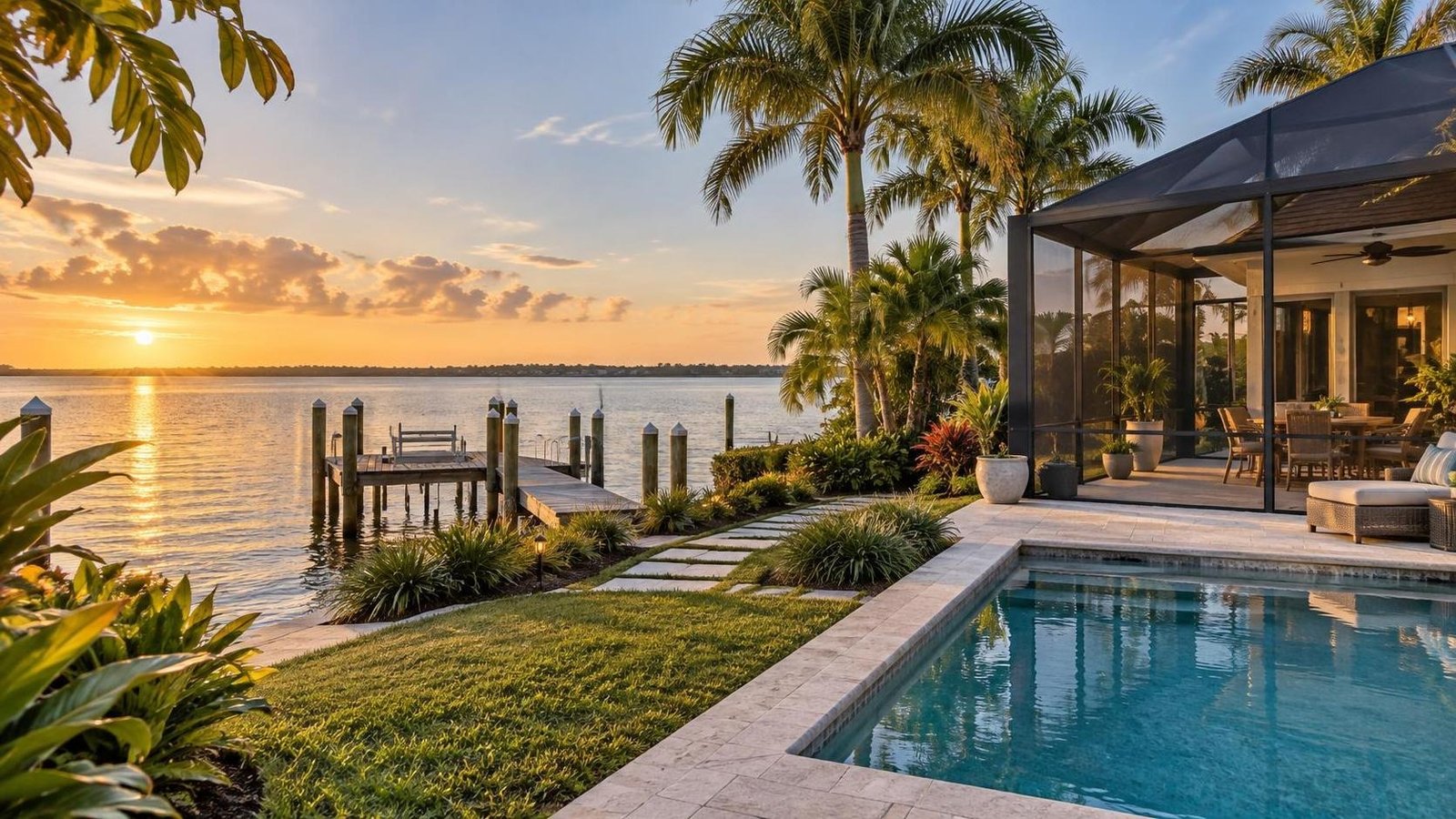
Dock Service Path or Larger Pool Deck: What Should a Merritt Island Canal Buyer Prioritize?
By Carrie Liotta, Space Coast REALTOR® with REAL Broker | Published September 25, 2026 on 321 Coastal Living
If future seawall work is a realistic possibility, I would usually prioritize a documented, workable service path to the waterfront over a larger pool deck. The pool deck delivers immediate lifestyle value, but blocked access can complicate inspections, material delivery, equipment staging, and repairs. The right answer still depends on how marine contractors say the specific wall can be reached.
Canal buyers naturally focus on the view from the lanai. I ask them to turn around and study the route from the street to the water. On many Merritt Island lots, that route may pass a side gate, air-conditioning equipment, a pool enclosure, plumbing, irrigation, landscaping, propane equipment, roof overhangs, or a narrow strip between houses. What looks like unused side yard can be critical infrastructure.
A wide pool deck is not a mistake. It may be the reason you love the home. But when the seawall is older, repairs are visible, records are incomplete, or an inspection cannot establish remaining condition, access belongs in the purchase decision before you assign a premium to outdoor entertaining space.
A seawall inspection and an access review answer different questions
A marine contractor or engineer may evaluate the seawall’s visible condition, movement, cracking, cap, joints, drainage, erosion, tieback concerns, and repair options within the scope of that professional’s work. An access review asks how people, equipment, and materials would physically reach the waterfront if work is needed.
You need both. A wall can have a defined repair plan but an awkward path. A convenient path does not make a questionable wall sound. When the inspection is inconclusive, access becomes even more important because the buyer is accepting uncertainty. I recently explained that dynamic in my comparison of a newer boat lift with an inconclusive Merritt Island seawall inspection.
Ask the professional to walk the whole property, not only the water’s edge. Can work occur from a barge or the canal, from the yard, or through a neighboring access agreement? Is hand work realistic? Would a section of fence, screen enclosure, deck, landscaping, or hardscape need to be removed? Are overhead lines, roof projections, gates, utility meters, or mechanical equipment in the route? The answer is property-specific, and it can affect both scope and disruption.
What makes a dock service path genuinely useful?
I do not count a narrow gap in aerial photography as verified access. A useful path needs dimensions, surface understanding, and a clear relationship to improvements. During due diligence, measure the tight points and photograph the route from both directions. Compare those measurements with the equipment and method a qualified contractor anticipates.
Look for these issues:
- Gate and side-yard width: A decorative gate may be narrower than the space behind it.
- Vertical clearance: Eaves, palms, utility lines, and screen framing may limit equipment or material movement.
- Ground strength and drainage: Soft soil, pavers, irrigation, pool plumbing, and buried utilities can affect staging.
- Permanent obstructions: Condensers, generators, propane tanks, outdoor kitchens, sheds, and pool equipment may be difficult or costly to move.
- Waterfront conflicts: Dock circuits, hose lines, lift controls, ladders, kayak launches, and seawall stairs can occupy the exact work zone.
- Legal access: A route that crosses a neighbor’s land is not yours merely because a prior contractor reportedly used it.
This is why I treat waterfront layouts as systems. In another recent Merritt Island example, a kayak launch, lift cradle, and seawall ladder overlapped at low water. Every feature worked on paper, but their shared footprint mattered more than the amenity count.
The larger pool deck has real value, but confirm what it occupies
A generous deck can make the home easier to enjoy. It creates circulation around the pool, space for furniture, room for gatherings, and a clean visual connection to the canal. For a buyer who lives outside, that is meaningful daily value.
The problem is not deck size by itself. It is whether the deck, pool shell, cage footings, plumbing, drains, and landscaping leave a repair strategy. Ask for pool and enclosure permits, surveys, plans, invoices, and repair records. Identify deck cracks, settlement, drainage direction, trip hazards, enclosure corrosion, and areas where runoff reaches the seawall. Do not assume a large paved area can support heavy equipment or material staging; let the appropriate contractors evaluate that.
Also ask what happens if part of the deck or cage must be removed. Can it be restored without rebuilding a much larger section? Are matching pavers available? Would removal disturb pool plumbing or electrical runs? These are not reasons to reject the home. They are reasons to price the amenity as part of a site plan rather than as free outdoor square footage.
Permitting feasibility comes before a future-work assumption
Waterfront work may involve more than one reviewing authority depending on the location and scope. The St. Johns River Water Management District permitting page, the Florida Department of Environmental Protection’s submerged lands and environmental resources program, and Brevard County Natural Resources Management are appropriate official starting points.
I do not tell a buyer that a project is exempt, permitted, or approvable without parcel-specific review. Existing improvements, waterbody, construction method, environmental conditions, and the proposed scope can change the path. The offer should not assume that a preferred repair method will be available merely because a nearby owner used it.
Request existing permits and drawings for the seawall, cap, dock, lift, pool, enclosure, and major repairs. Compare the survey with what is physically present. If the contractor’s likely plan depends on water access, ask whether canal conditions and the dock configuration support that method. If it depends on land access, identify exactly what must move.
How I compare the two homes financially
Suppose one canal home has a wider pool deck and constrained side access. The other has a smaller deck but a straightforward route to the dock and seawall. I would not simply subtract estimated deck value from estimated seawall cost. I would build three separate reserves:
- Known work: Items supported by inspections and current written proposals.
- Access and restoration: Fence, screen, pavers, landscaping, utilities, or equipment that may need removal and replacement.
- Uncertainty: A contingency for conditions that cannot be confirmed before closing, sized with professional guidance and the buyer’s risk tolerance.
Obtain more than one qualified opinion when the seawall materially affects the offer. Ask each professional to state assumptions in writing. One proposal may expect barge access; another may assume land access. A low number is not comparable to a higher one if the scopes, access, disposal, restoration, engineering, and permits differ.
The pool deck still belongs in the value analysis. Ask how often you will use the space, whether the deck is shaded, whether furniture fits without blocking circulation, and whether the enclosure and surface are in good condition. Then decide whether that daily benefit justifies accepting a more complicated future project.
Who should choose the service path?
I would strongly favor access for a buyer who expects to keep a larger boat, wants reliable dock and lift service, sees visible seawall concerns, or plans to own long enough that shoreline work is plausible. It also matters for buyers who cannot absorb a surprise caused by demolition and restoration around the pool.
Choose the service-path home when:
- the seawall inspection identifies repair or monitoring needs;
- the wall’s history or remaining condition is uncertain;
- the dock, lift, utilities, and seawall will need coordinated work;
- the alternative home’s pool cage and hardscape occupy nearly the whole waterfront approach;
- the buyer values maintainability over maximum entertaining area; or
- future resale to serious boating buyers is a priority.
A clearly maintained access route also helps future buyers understand the property. Waterfront resale is easier when the next owner can see how expensive components are inspected and serviced.
When the larger pool deck can still win
The pool-deck home can be the better purchase when a qualified marine professional finds the seawall condition acceptable for the buyer’s horizon, there is a feasible water-side work method, or the seller provides a documented repair plan that already accounts for access. It can also win when the buyer’s lifestyle genuinely centers on outdoor entertaining and the smaller-deck home would need an expansion that may not be practical.
I would want the buyer to know the access consequence in writing. If future work likely requires temporary cage removal, paver removal, crane staging, or a neighbor agreement, that belongs in the reserve and negotiation. Do not pay a full premium for the deck and then ignore the possibility that part of it is the path to another major component.
For buyers comparing more than one type of access, my discussion of a private kayak launch versus shared seawall steps shows why exclusive, practical use can matter more than an amenity name.
Flood and insurance belong in the same file
Access does not replace the rest of waterfront due diligence. Use the FEMA Flood Map Service Center for official NFIP flood-hazard information, obtain property-specific flood and homeowners quotes, and review available elevation, claim, roof, wind-mitigation, and four-point records.
A canal property with a strong service route can still be the wrong buy if the full carrying cost is uncomfortable. A beautiful pool deck can still be reasonable if the insurance, home systems, waterfront condition, and access plan are all supported. Evaluate the whole property, not one marine feature.
My offer-stage waterfront access checklist
- Order the appropriate seawall, dock, lift, and home inspections.
- Ask the marine professional to describe likely access and staging, not just the repair.
- Measure gates and narrow points; photograph the complete street-to-water route.
- Locate pool plumbing, electrical, irrigation, drainage, mechanical equipment, and buried utilities as far as records and professionals can establish.
- Review the survey, easements, permits, plans, and contractor records.
- Separate marine-work pricing from access and restoration pricing.
- Confirm flood and homeowners insurance before the contract deadlines.
- Never assume a neighbor will provide access without a written, legally sufficient right reviewed by the appropriate professionals.
Bottom line
When future seawall work is likely, a usable service path is usually the more durable value because it protects maintainability and reduces a layer of project uncertainty. A larger pool deck can still be worth choosing when its construction is documented and professionals identify a realistic waterfront-work plan. The buyer should know the access method before paying for the view.
If you are comparing Merritt Island canal homes, I can help you organize the survey, permit history, marine inspections, access questions, insurance, and lifestyle tradeoffs into one decision. Reach out for a no-pressure conversation about Brevard County waterfront homes with Carrie Liotta, Space Coast REALTOR® with REAL Broker. Your next chapter starts here.
