

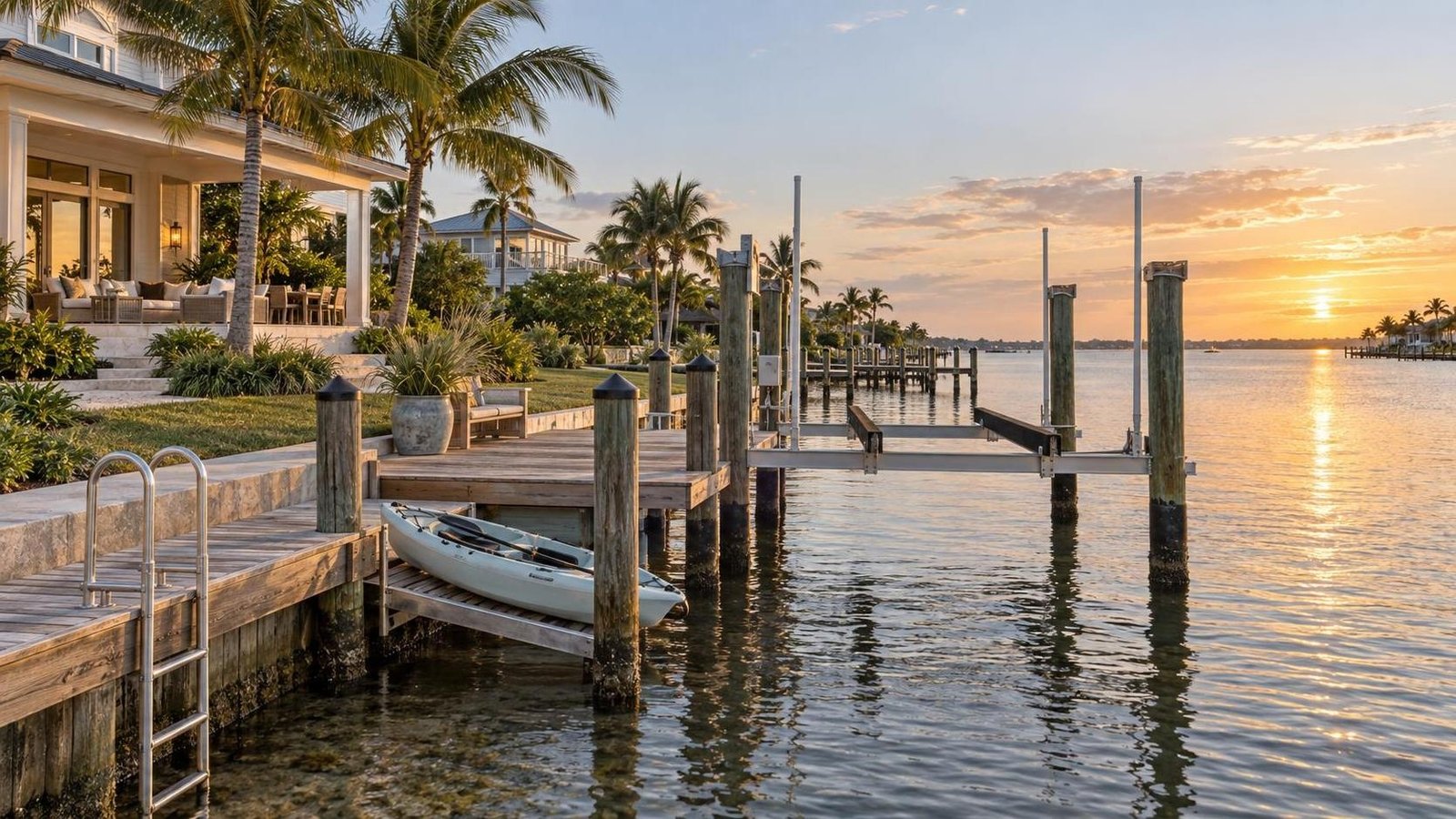
What Should Merritt Island Canal Buyers Verify When a Kayak Launch, Boat Lift, and Seawall Ladder Overlap?
By Carrie Liotta, Space Coast REALTOR® with REAL Broker | Published September 22, 2026
Do not pay for three waterfront amenities until you prove they can be used safely at the same time. On a Merritt Island canal, a kayak launch, lift cradle, and seawall ladder may compete for the same low-water space, turning attractive listing features into an awkward or hazardous waterfront layout.
The key is to inspect the property as an operating system, not a collection of photographs. Watch how a person carries and launches the kayak. Cycle the lift. Trace the ladder’s entry path. Observe the water at more than one condition. Then confirm permits, ownership, measurements, electrical safety, seawall condition, and the boat route before the inspection period ends.
Why low water exposes problems that high water hides
At a comfortable water level, the setup may look generous. The launch reaches the water, the ladder rungs appear usable, and the lift cradle sits below the hull. As the water drops, those relationships change. The kayak may need to slide farther down a ramp. The ladder may end over exposed hardware or a slippery bottom. The cradle beams, bunks, cables, or pilings may occupy the safest path back to the dock.
I do not use one showing to promise canal depth or operating clearance. Water level can change, and a neighboring boat’s success does not prove that your hull, draft, motor, lift geometry, or preferred route will work. The right test is tied to the equipment and vessel you actually intend to use.
Start by asking the seller for photos or videos taken across different water conditions and seasons. Then schedule a second visit if waterfront use drives the purchase. A marine contractor, lift professional, and other qualified specialists can interpret what you are seeing far better than a listing remark.
Walk the kayak route from storage to open water
Begin where the kayak will be stored. Can one person remove it without scraping the house, screen enclosure, or fence? Is the side gate wide enough? Does the carrying route cross pool equipment, electrical disconnects, irrigation heads, loose gravel, or a steep edge?
At the launch, check handholds, surface traction, slope, and the room needed to turn the kayak. Imagine returning tired, wet, and carrying a paddle. If the lift cradle blocks the launch at lower water, ask whether the lift must be raised, lowered, or moved every time. If the ladder is the only stable handhold, make sure using it does not put hands or feet near cables, brackets, sharp shell growth, or moving components.
My comparison of a private Merritt Island kayak launch and shared seawall steps explains why convenience depends on the complete access path, not just private ownership.
Cycle the boat lift and inspect the conflict zone
If the seller and equipment condition allow it, have the lift demonstrated by someone authorized to operate it. Watch the cradle through a complete cycle. Note where cables, beams, guideposts, motors, and controls sit. Verify that the emergency stop, disconnect, and controls are understandable and accessible.
A lift specialist should compare the rated capacity, cradle spacing, bunk configuration, and equipment condition with the intended boat. I also want written service records and any available permit documents. A painted motor housing or new switch does not tell us the age and condition of the complete system.
The overlap matters even if you do not own a boat today. A future buyer may value the lift, and an unusable kayak path can narrow the home’s appeal. Conversely, if kayaking is your priority, you may decide that removing or reconfiguring lift equipment is worthwhile—but only after confirming whether that work is feasible, permitted, and affordable.
The seawall ladder needs its own safety review
A ladder is often presented as a simple way to enter or exit the water. On a working canal edge, it is part of the marine structure. Check attachment points, corrosion, loose hardware, rung spacing, reach at lower water, and what lies below. Do not assume the bottom is firm or free of debris.
Ask who installed it and whether documentation exists. If it shares bolts, brackets, or loading with the dock or seawall cap, have the relevant professional review that relationship. I also want to know whether the ladder can be reached from the water if the lift is down or a boat is on it. An emergency exit that disappears behind equipment is not a reliable exit.
For households with children, older guests, or anyone with limited mobility, the access analysis should be even more conservative. A ladder that technically reaches the water may not be practical for the people who will use the property.
Inspect the seawall, dock, and drainage together
The concentrated activity around the launch can distract buyers from the larger shoreline condition. Have the seawall evaluated for visible movement, cap condition, cracks, joints, soil loss, drainage discharge, and prior repair evidence. Review the dock’s pilings, framing, decking, hardware, utilities, and attachment points separately.
Look behind the wall after rain if possible. Water draining toward the seawall, erosion near launch edges, or voids around utilities may affect how the space performs. Ask for records of tieback, cap, drainage, dock, and lift work rather than accepting “it was repaired” as a complete answer.
If shared waterfront infrastructure or reserve planning is part of the property, my guide to a Merritt Island shared lift with no replacement reserve shows why maintenance responsibility belongs in the purchase analysis.
Confirm permits without assuming one agency controls everything
Docks, lifts, seawalls, ladders, launches, electrical work, and shoreline changes can involve different approvals depending on location and scope. Start with the seller’s file: permits, final inspections, drawings, contractor invoices, engineering, surveys, and agency correspondence.
The St. Johns River Water Management District permitting page, Florida DEP environmental resource permitting information, and Brevard County Natural Resources Management are authoritative starting points. Their presence does not mean every minor component requires every agency’s approval. It means buyers should identify the actual jurisdiction and obtain a parcel- and project-specific answer before relying on a future change.
If records do not match what is built, do not jump straight to demolition or assume the item is grandfathered. Ask the appropriate authority and a qualified contractor what verification or corrective path is available. The contract timeline needs enough room to get a meaningful answer.
Electrical and water are a separate due-diligence track
Dock electricity deserves specialist attention. Have a licensed professional evaluate visible wiring, conduit, boxes, controls, receptacles, disconnects, grounding and bonding conditions, and the relationship between lift equipment and the wet access path. Do not operate questionable equipment merely to complete a showing.
The physical layout matters: a kayaker should not have to step over cords, lean across controls, or handle the ladder beside energized components. Any repair recommendation should be documented and priced by an appropriate contractor. Waterfront electrical safety is not a cosmetic negotiation item.
Ask where water service, lighting, and low-voltage equipment run as well. An apparently simple plan to widen the launch may conflict with buried or concealed lines.
Test the boat route beyond the backyard
A functional lift does not guarantee a functional boating experience. Map the route from dock to the water you intend to use. Identify bridges, turns, canal widths, no-wake segments, overhead constraints, and any shoaling or navigation concerns that require current local verification.
I encourage buyers to make the trip with an appropriate qualified operator when feasible and lawful, using the vessel type that matters. Never substitute my estimate or a seller’s casual timing for your own route test. Conditions can vary, and listing photos rarely show the least convenient part of the journey.
If private-dock ownership itself is still in question, compare the full carrying costs with my guide to a public boat ramp versus a private Merritt Island dock.
Flood mapping and insurance still belong in the file
The waterfront-layout question does not replace flood and insurance review. Use the FEMA Flood Map Service Center, the official public source for National Flood Insurance Program flood-hazard information, to review the current map for the address. Then obtain property-specific insurance quotes and ask how the home’s elevation, roof, openings, prior claims, and marine improvements affect underwriting.
Do not use a seller’s premium as your budget. Coverage, rating information, limits, deductibles, and buyer circumstances may differ. If a lender is involved, coordinate requirements early.
Put the waterfront setup into the offer decision
After inspections, sort findings into three categories: safe and usable now; repairable within your reserve; or incompatible with your lifestyle. A launch that needs a handrail may be manageable. A lift that blocks the only safe kayak access, needs major work, and cannot be reconfigured as assumed may change the property’s value to you.
Obtain written estimates instead of inventing a credit. Consider whether work must happen before closing, whether a concession is permitted by the lender, and whether future permitting uncertainty remains yours after closing. The goal is not to make the waterfront perfect. It is to avoid paying a premium for features that cannot function together.
My bottom line for Merritt Island canal buyers
Verify the setup at a relevant water level, demonstrate the lift, trace the kayak route, test the ladder’s reach, inspect the seawall and dock, review electrical safety, confirm permits, and map the boat route. If any one feature depends on moving another out of the way, decide whether that routine is acceptable before you buy.
A Merritt Island canal home should make getting on the water easier, not turn every launch into a puzzle. If you want help coordinating the waterfront questions with the home inspection, insurance, records, and resale analysis, reach out for a no-pressure conversation about Brevard County waterfront homes for sale. I am Carrie Liotta, Space Coast REALTOR® with REAL Broker, and 321 Coastal Living is where I share the practical side of these decisions. Your next chapter starts here.
