

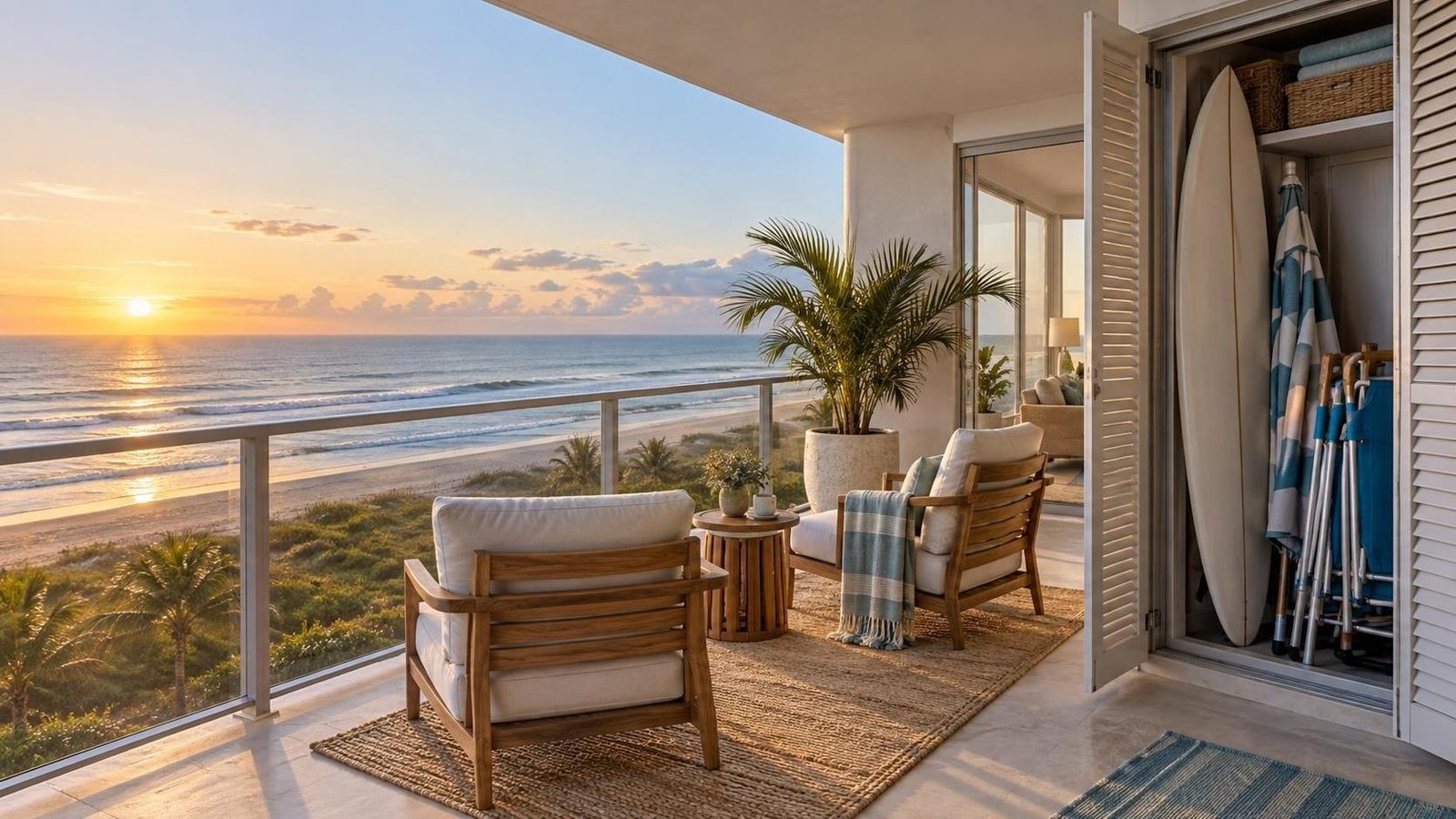
Ventilated Storage Locker or Better Balcony: What Should Cocoa Beach Seasonal Owners Choose?
By Carrie Liotta, Space Coast REALTOR® with REAL Broker | Published September 20, 2026
Choose the ventilated, legally assigned locker when you will store damp beach gear, arrive with limited time, or need the unit to stay uncluttered between visits. Choose the better balcony when outdoor living is central and the furniture rules still permit the setup you will actually use. Verify both rights in the condominium documents before paying a premium.
Seasonal Cocoa Beach ownership magnifies small inconveniences. A beautiful balcony can be the reason you bought near the Atlantic, but carrying sandy chairs, boards, umbrellas, and fishing gear through the unit gets old quickly. A locker can simplify every arrival, yet it has little value if it is humid, shared informally, too small, flood-prone, or restricted to items you do not store.
I would compare one complete weekend routine, one storm-preparation routine, and one document file—not just two amenities.
Decide what must live outside the unit
Make a realistic inventory: beach chairs, umbrella, cart, bodyboards, surfboards, fishing rods, coolers, seasonal décor, luggage, bicycles, tools, cleaning supplies, and owner-only linens. Measure the longest and widest items. Then remove anything the association rules, fire-safety policies, insurer, or common sense would not allow in that space.
Wet or salty gear needs drying and airflow before storage. “Ventilated” should describe an observable condition, not a listing adjective. Look for vents, air movement, signs of condensation, rust, mildew, staining, pests, salt residue, and prior water entry. Ask whether the door and hardware are corrosion-resistant, whether the area is conditioned, and who repairs damage.
Do not assume batteries, fuel, propane, paint, chemicals, or motorized devices may be stored or charged there. Ask for the written rule. A locker that safely holds chairs and boards may specifically prohibit other items.
Prove the locker belongs with the unit
Storage may be part of the unit, a limited common element assigned for exclusive use, a separately deeded space, association property allocated by policy, or an informal arrangement that can change. Those are not equivalent ownership stories.
Review the declaration, amendments, survey or exhibit, purchase contract, estoppel information, rules, and any assignment document. Confirm the locker number, dimensions, location, access hours, key or fob procedure, maintenance responsibility, transfer rights, and whether the board can reassign it. Match the physical label to the documents without publishing the locker number online.
The Florida Condominium Act supplies the statewide framework and distinguishes units, common elements, and limited common elements, but the recorded condominium documents define the rights for the building. The Florida DBPR condominium division is an official source for statutes, rules, forms, and educational materials.
Read balcony rules as a lifestyle plan
Ask for the exact rules on furniture type, quantity, color, cushions, rugs, plants, grills, lights, drying towels, flags, hurricane shutters, storage boxes, and bringing items inside before an absence or storm. Also read renovation rules for balcony flooring, doors, sliders, railings, waterproofing, and attachment to exterior surfaces.
Strict furniture rules are not automatically bad. A consistent exterior can support building appearance, reduce loose items, protect waterproofing, and simplify storm procedures. The question is whether the rules still allow your intended use. If you want two chairs and a small table for morning coffee, a narrow approved list may be fine. If you imagine loungers, planters, a storage bench, and dining for six, the same rules may defeat the feature.
Measure usable depth after accounting for door swing, required clear paths, columns, drains, mechanical equipment, and railing offsets. Sit outside at the hour you will use it. Notice wind, spray, shade, noise, privacy, and whether neighboring units look across the space.
Seasonal owners should test arrival and departure
Imagine arriving Friday evening. Where do you park? How do you move luggage and beach gear from the vehicle to the locker and unit? Is an elevator or cart available? Can one person open the locker while holding a board? Does the route cross the lobby, pool deck, or stairs? Is access available after office hours?
Then imagine Sunday departure. Wet gear must be rinsed and dried, balcony furniture may need to move inside, trash must be handled, and the unit should be secured. If the locker has poor airflow, you may leave damp equipment until the next visit. If balcony rules require everything inside during every long absence, the view may come with an end-of-trip moving routine.
My comparison of staffed package handling and deeded beach storage for Cocoa Beach seasonal owners uses the same test: the best amenity is the one that removes friction when you are not present full time.
Inspect the locker’s building location
A ground-level or garage locker may be convenient, but buyers should understand drainage, flood exposure, ventilation, security, and access during building closures. Look at floor elevation, door thresholds, nearby drains, pipes, exterior openings, and evidence of past water. Ask the association about known incidents and repair responsibility.
The FEMA Flood Map Service Center is the official public source for NFIP flood-hazard information, and the map should be checked for the exact property. The building’s flood and master-insurance files, claims history when available, and current insurance quotes add the property-specific context. A locker should not be assumed to receive the same coverage as personal property inside the unit.
Ask your insurance professional how stored property is treated and whether limits or exclusions apply. Do not store irreplaceable documents, electronics, or valuables simply because the locker has a lock.
Evaluate balcony condition separately from balcony rules
A useful balcony needs both permission and sound condition. Review association records for waterproofing, concrete restoration, railing work, slider responsibilities, drainage, inspections, planned projects, and access limitations. Look at the underside where visible, transitions at the door, surface slope, drains, coatings, railing attachments, and signs of repair.
Ask whether upcoming work will restrict balcony use and whether owners must remove furniture during projects. A large balcony may not feel like a premium if it will be inaccessible during a lengthy repair. Conversely, strict furniture rules may be easier to accept when the building has completed substantial exterior work and the association can explain how the rules protect it.
Do not treat a fresh coating as proof that structural or waterproofing issues are resolved. Read the project scope, engineer information where applicable, invoices, warranties, meeting minutes, and remaining obligations.
Compare carrying cost and building health
The locker and balcony are tie-breakers only after the association file works. Review current dues, budget, reserves, insurance, deductibles, structural and life-safety information, assessments, loans, litigation, owner delinquency, rental rules, and financing eligibility with the appropriate professionals.
A unit with a wonderful locker in a weakly documented building is not automatically safer than a balcony-focused unit with stronger finances. My article on master-policy deductibles versus ocean view in Cocoa Beach explains why the financial and insurance file can outweigh the most emotional feature.
Seasonal owners should also price off-site storage, furniture replacement, climate control, cleaning, and the time spent moving gear. A modestly sized locker may save enough hassle to matter even if it does not change appraised value.
Which feature usually supports resale?
A balcony has broader emotional appeal because buyers see it immediately and imagine coffee, surf, launches, or evening air. But practical storage can differentiate otherwise similar units, particularly for full-time owners, surfers, anglers, cyclists, and families. The best combination is a genuinely usable balcony plus documented secure storage.
If you must choose, consider the likely next buyer. A small seasonal unit with limited closets may benefit disproportionately from an assigned locker. A larger unit with internal storage may gain more from a deep, well-oriented balcony. Strict rules do not necessarily harm resale when they are clear, consistently enforced, and compatible with normal use.
Storage type matters too. My guide to approved e-bike storage versus covered parking shows why safe, rule-compliant use matters more than square footage alone.
Questions to answer before making an offer
- Is the locker deeded, assigned, limited common element, or revocable association space?
- What are its verified dimensions, ventilation, flood exposure, access, and allowed contents?
- Who maintains the locker door, interior, lock, and damage after a leak?
- Which furniture and accessories are allowed on the balcony?
- What must be removed during absences, storms, or building projects?
- Are balcony restoration, waterproofing, railing, or slider projects planned?
- Do the building finances, insurance, reserves, and rules support the purchase?
- Which feature improves your real arrival-to-departure routine?
Bottom line
For many Cocoa Beach seasonal owners, a documented ventilated locker is the smarter choice because it keeps salt, sand, and bulky gear out of the unit. The balcony wins when outdoor living is the purpose of ownership and the written rules allow your actual setup. Verify legal rights, physical condition, building finances, and seasonal procedures before deciding either feature deserves a premium.
I am Carrie Liotta, a Space Coast REALTOR® with REAL Broker, and I publish 321 Coastal Living to help condo buyers compare the documents and daily routines behind the view. Reach out for a no-pressure conversation about Cocoa Beach storage, balconies, building records, and carrying costs. Your next chapter starts here.