

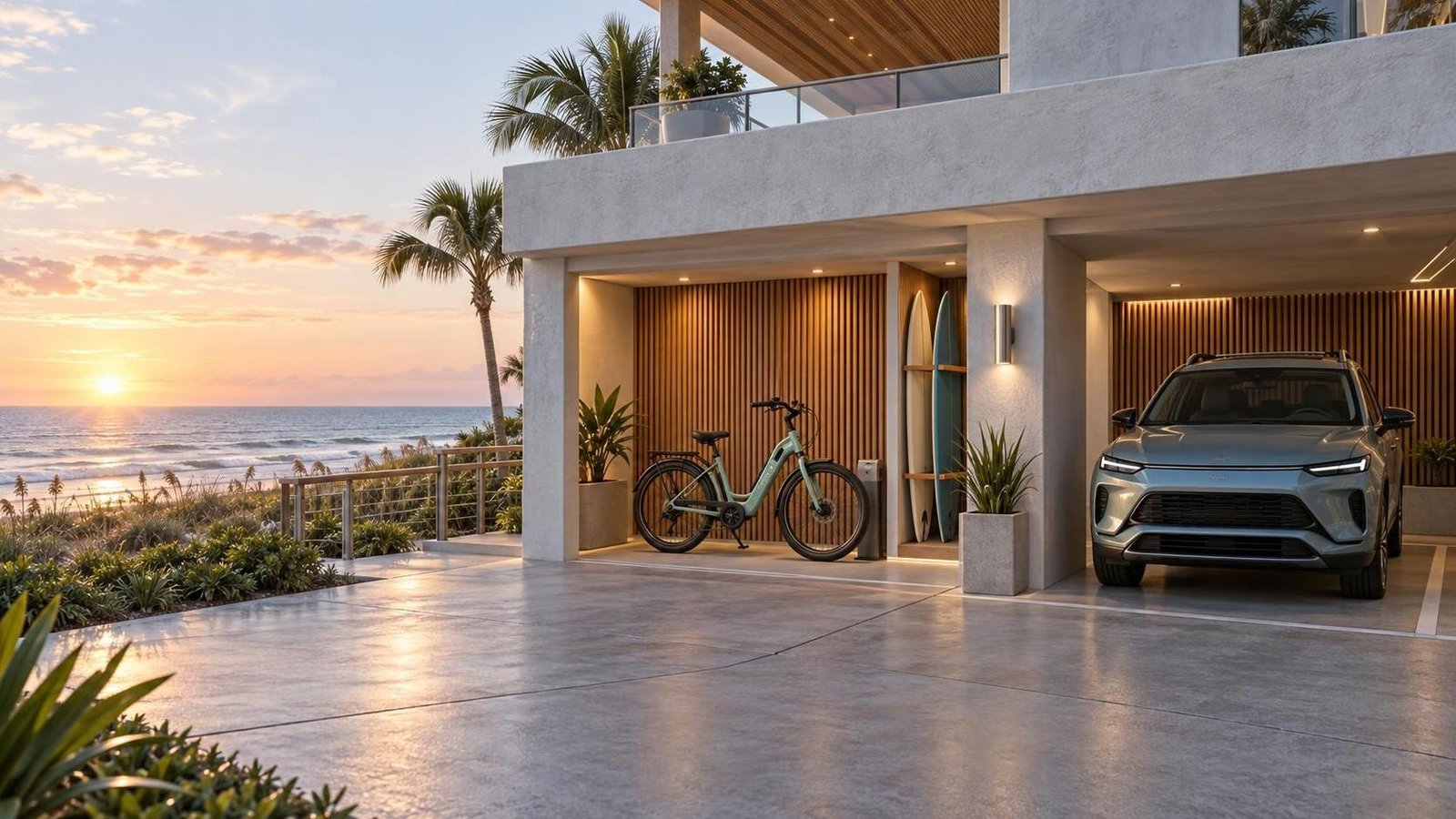
Approved E-Bike Charging Storage or Covered Parking: Which Cocoa Beach Condo Amenity Matters More?
By Carrie Liotta, Space Coast REALTOR® with REAL Broker | Published September 17, 2026
Cocoa Beach buyers who use an e-bike several days a week should usually prioritize approved, secure charging storage because that use can be impossible to recreate when building rules prohibit batteries in units or common areas. Buyers who depend on a car, travel often, or need storm and sun protection may get more daily value from a documented covered space.
This is not a simple convenience contest. The e-bike question involves fire-safety rules, battery handling, elevator and hallway access, electrical capacity, security, and insurance. The parking question involves legal assignment, dimensions, clearance, drainage, salt exposure, guest rules, and the route from the car to the unit. I value each only after tracing the complete routine.
Ask whether e-bike use is truly permitted
Do not stop at “bikes allowed.” Read the declaration, rules, board policies, storage agreement, fire-safety notices, and any battery-specific resolution. A building may allow traditional bicycles while restricting e-bikes, removable lithium-ion batteries, charging in units, charging in storage rooms, elevator transport, or unattended charging.
Get the answer in the current written documents or through the association’s authorized response. A resident’s informal practice does not override a rule, and the absence of enforcement during one visit does not establish approval. Ask whether the policy applies to owners, tenants, and guests and whether a registration, inspection, fee, or proof of insurance is required.
Florida’s condominium framework places substantial operating and common-element responsibilities with the association. Florida Statutes section 718.111 addresses association powers, common property, insurance, and official records. Buyers should have the building’s actual documents reviewed by appropriate legal, insurance, lending, and inspection professionals rather than assume every Cocoa Beach association treats e-bikes the same way.
Approved storage must work from door to charger
Walk the route from the street or garage to the storage room. Can the bike fit through gates, doors, turns, and elevators? Are ramps practical? Is carrying required? Are there time restrictions, wet-bike rules, or a separate service entrance? A secure room loses value if reaching it requires lifting a heavy bike over steps.
Inside, confirm whether the space is assigned, licensed, rented, or first-come; whether a specific rack or locker belongs to the unit; and whether the right transfers at sale. Inspect anchoring points, lighting, access control, camera coverage without assuming surveillance guarantees security, water intrusion, ventilation, and salt exposure.
Then identify the approved charging arrangement. Is there an outlet at each space, a shared charging cabinet, removable-battery station, timed circuit, metering, or prohibition on charging altogether? “E-bike storage” and “e-bike charging storage” are not interchangeable.
Battery safety changes the due-diligence standard
The U.S. Consumer Product Safety Commission advises consumers to follow manufacturer charging instructions, use the supplied or recommended charger, be present while charging, avoid charging while sleeping or away from home, and use replacement batteries approved for the device. CPSC also warns against packs modified by unqualified people and provides recall information.
That guidance is why a building policy should be more than a sign saying “charge at your own risk.” Ask for the association’s written charging rules, any electrical evaluation, board approvals, service records, incident history available through official records, and insurer or fire-safety correspondence the association can provide. A strict rule does not prove a building is risk-free, and an attractive new room does not prove its management plan is complete.
Buyers should check their exact bike and battery against current manufacturer information and the CPSC recall resources. If the building requires a particular certification or charger type, confirm compliance before treating the amenity as usable.
Covered parking has its own paperwork
Ask whether the space is deeded with the unit, assigned by the association, a limited common element, rented, or subject to reassignment. Review the survey, declaration, parking schedule, resale certificate or estoppel materials, and association response. A number painted on the pavement is not enough.
Measure length, width, turning room, ceiling clearance, column placement, and door-opening space with the buyer’s actual vehicle. Look at drainage, lighting, gate operation, salt-air corrosion, overhead pipes, and the walking route to the elevator or stairs. Covered does not always mean enclosed, dry in wind-driven rain, or protected from every storm condition.
My guide to covered parking, elevator access, and beach storage in Cocoa Beach condos provides a fuller daily-livability test. These details matter more than a generic “garage parking” line in a listing.
Which amenity is harder to replace?
Approved charging storage is usually impossible for one owner to create alone. It may require common-area space, electrical work, association approval, insurance review, access controls, operating policies, and shared funding. If the building prohibits batteries in units and provides no approved charging path, the buyer may have to change transportation habits.
Covered parking is also scarce, but alternatives sometimes exist: an uncovered assigned space, a separate garage license, nearby paid parking, a vehicle cover where allowed, or choosing a unit whose exposure and access are acceptable. Those alternatives may be inconvenient or unavailable, so verify rather than assume.
The replacement test helps with price. If a daily e-bike user cannot lawfully or practically store and charge the bike, a covered car space does not solve that problem. If a buyer owns one primary vehicle, travels for weeks, carries mobility equipment, or needs a predictable dry route, bike storage may not offset weak parking.
Match the amenity to the owner’s real week
The full-time beach commuter who rides to restaurants, errands, work, or surf access may benefit most from approved e-bike storage, especially when the car is used less often and uncovered parking is still assigned.
The frequent traveler or remote worker may prefer covered parking because the vehicle sits longer and airport or employer trips remain important. My article on Cocoa Beach remote workers and protected parking explores that balance.
The seasonal owner should consider both storage security and absence rules. Will the association permit a battery or bike to remain when the owner leaves? Must chargers be unplugged? Can a vehicle remain during maintenance or storm preparation? Who can access either area for the owner?
The household with two cars should not overvalue one covered space without understanding the second-car rules. Likewise, a household with two e-bikes should confirm that the assigned rack, locker, outlet, and electrical policy cover both devices.
Review the association’s complete risk file
Do not evaluate these amenities apart from the building. Read budgets, reserves, insurance, minutes, rules, structural and fire-safety records where applicable, electrical project discussions, parking maintenance, access-control repairs, and planned assessments. Florida Statutes Chapter 718 is the statewide condominium framework, but the declaration, bylaws, rules, contracts, and records explain how this building operates.
An association may have a thoughtful e-bike policy but no funded plan for the aging garage electrical service. Another may have excellent covered parking but recurring gate failures or concrete work that limits access. A buyer should understand the current amenity and the capital plan behind it.
Also ask the lender and insurer whether the charging room, storage arrangement, or parking designation raises documentation questions. Do this during due diligence, not after assuming either feature adds a fixed resale premium.
Test daily access, not just the feature
Visit at a normal arrival time and, if possible, when residents are moving bikes and cars. Time the route from unit to storage and unit to parking. Test elevator dimensions, gate response, door weight, lighting, and key or fob access. Observe whether beach gear, delivery carts, and bicycles compete for the same corridor.
If elevator downtime is a concern, determine whether the bike can use stairs and whether rules allow it. My guide to storage and elevator downtime for full-time Cocoa Beach buyers helps connect those operations to everyday life.
My before-offer comparison
- Read current e-bike, battery, elevator, hallway, storage, and charging rules.
- Confirm the buyer’s exact bike, battery, and charger comply.
- Verify whether storage is assigned and transfers with the unit.
- Inspect the complete route, security, ventilation, drainage, and electrical arrangement.
- Review board minutes, budgets, insurance, incidents, repairs, and planned electrical work.
- Identify the legal status and transfer terms of the parking space.
- Measure the space and test garage, gate, elevator, and stair access.
- Understand second-car, guest, seasonal-absence, and storm procedures.
- Ask lender and insurer questions before assigning a premium.
- Choose the amenity that solves the harder recurring problem for this household.
Bottom line
Approved e-bike charging storage is usually the stronger priority for a committed rider when the building otherwise provides workable parking, because one owner cannot easily create a compliant common-area charging program. Covered parking is usually stronger for car-dependent, traveling, mobility-conscious, or two-car households. The right premium depends on documented rights and real daily access.
If you are comparing Cocoa Beach condos, I can help you review the unit, rules, parking, storage, association file, and resale tradeoffs together. Reach out to Carrie Liotta, Space Coast REALTOR® with REAL Broker, through 321 Coastal Living for a no-pressure conversation. Your next chapter starts here.