

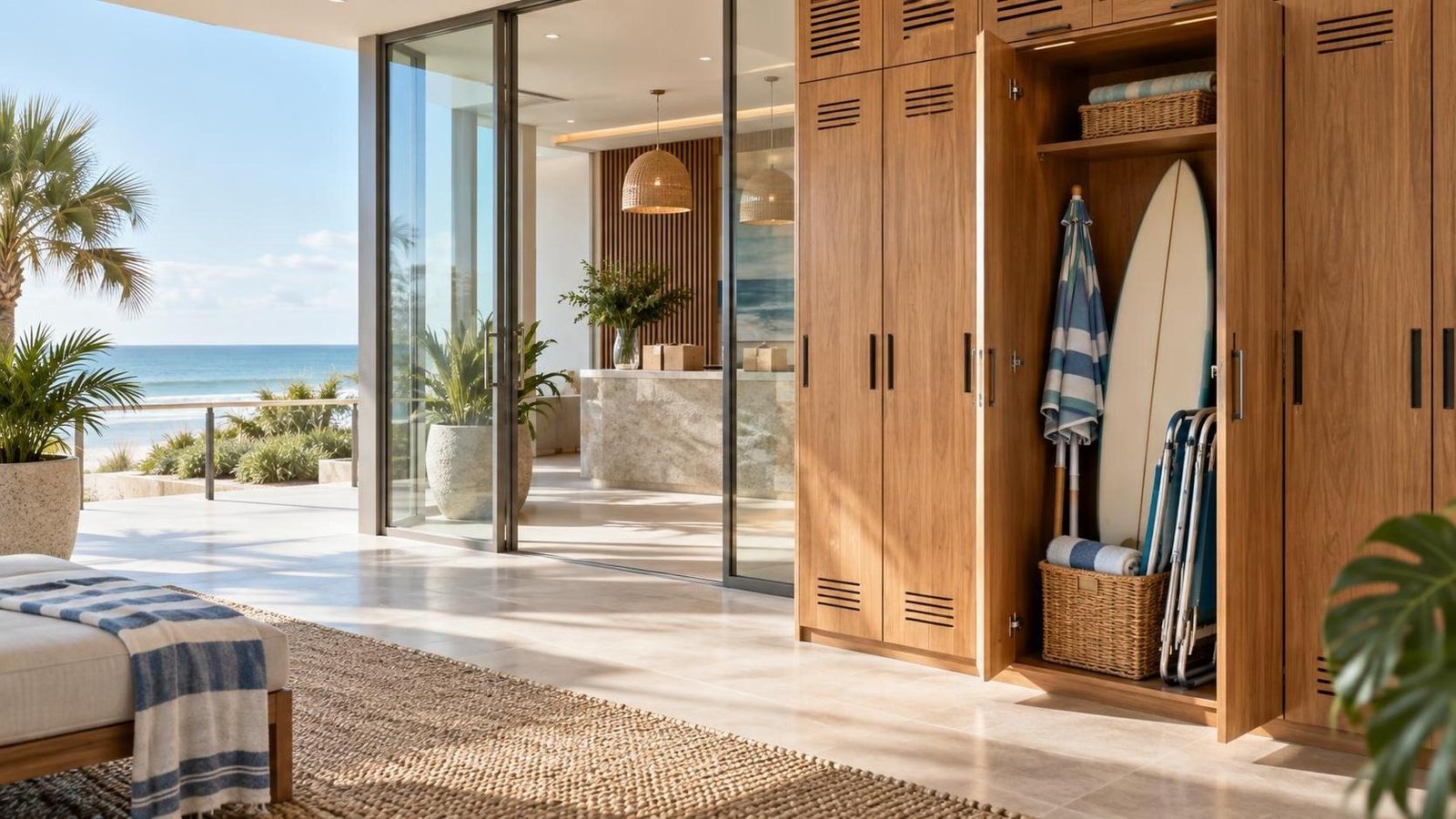
Staffed Package Handling or Deeded Beach Storage: What Should Cocoa Beach Seasonal Owners Choose?
By Carrie Liotta, Space Coast REALTOR® with REAL Broker | Published September 19, 2026
Choose deeded, dry, usable beach storage when boards, chairs, bikes, or fishing gear would otherwise overwhelm the unit. Choose staffed package handling when you receive frequent deliveries while away and the service is contractually stable. For most seasonal owners, ownership certainty beats a service that a future budget or vendor change could reduce.
That direct answer comes with an important warning: “deeded storage” and “staffed package room” are marketing phrases until the documents prove them. A locker may be a limited common element, an assigned space that can be changed, or a numbered enclosure that truly transfers with the unit. Package handling may mean daily staff acceptance, a locker system, a cart in an office during limited hours, or no responsibility for oversized deliveries.
I would compare these amenities by tracing a seasonal owner’s real routine from arrival to departure.
What problem are you actually trying to solve?
Beach storage solves physical clutter. It keeps sand, salt, wet equipment, carts, chairs, umbrellas, fishing tackle, bodyboards, bicycles, and maintenance supplies out of living space—if the rules allow those items and the space stays dry enough to protect them.
Staffed package handling solves absence. It can reduce the chance that deliveries sit visibly, weather outdoors, or wait unattended while an owner is away. But it may not accept every carrier, refrigerated item, furniture delivery, high-value shipment, or parcel addressed incorrectly. Staffing hours and liability rules matter.
Count your behavior. How many packages arrive while you are away? Which could be redirected or paused? How much beach equipment stays in Florida? Does it fit through elevators and hallways? Could you rent local gear instead? The feature that solves a weekly problem is usually more valuable than the one that photographs better.
Prove how the storage transfers
Ask for the declaration, amendments, survey or condominium plot, unit deed, current rules, and any assignment record for the storage space. The legal category affects whether the locker transfers automatically, whether the association can reassign it, who maintains the enclosure, and whether the owner may sell or lease it separately.
Florida Statutes section 718.111 addresses association powers, duties, official records, insurance, and common-property operations. It does not tell you that a particular locker belongs to a particular Cocoa Beach unit. That answer must come from the current building documents and title review.
Walk to the actual space. Verify the number, dimensions, lock, access route, ventilation, lighting, floor elevation, signs of water intrusion, corrosion, pests, and proximity to sprinklers or electrical equipment. Open the door if authorized. A generous-looking locker on a floor plan can become far less useful when a structural column, low ceiling, or narrow door occupies the usable area.
Read what may be stored
Condo rules may limit fuels, batteries, wet gear, e-bikes, surfboards in elevators, hanging items, food, flammables, or anything that obstructs fire or mechanical systems. A storage room is not permission to place every beach-related object inside it.
This matters especially for e-bikes and battery equipment. Do not assume a private locker permits charging. My comparison of Cocoa Beach e-bike storage and covered parking explains why written battery and charging rules deserve separate review.
Ask whether wet equipment must be rinsed or dried elsewhere, whether hose stations are available, and who handles salt and sand in common areas. The best storage route may be the one that avoids dragging a cart through the lobby, not necessarily the largest locker.
Test package operations on an ordinary week
Request the written delivery policy and current management or staffing arrangement. Who accepts packages? During what hours? Where are they held? How is the owner notified? How long will staff retain them? What happens with oversized, refrigerated, signature-required, or misaddressed deliveries? Is after-hours access possible? What liability does the association disclaim?
Then read the budget, recent minutes, and relevant management contract. Staffed service is only as stable as the association’s operating plan. A lobby may be staffed today but face different hours after a contract renewal, labor change, insurance issue, or budget decision. Florida’s condominium bylaws and governance framework under section 718.112 make current budgets, meetings, and procedures part of the buyer’s due-diligence picture.
Do not ask staff to describe security weaknesses or private access procedures. A buyer needs policy and reliability, not sensitive operational details.
Seasonal occupancy magnifies small inconveniences
Imagine arriving after months away. A secure package process is valuable if replacement linens, filters, small furnishings, or owner supplies have arrived in advance. Yet a storage space may matter immediately too: suitcases come inside while beach chairs, carts, and boards stay downstairs.
Now imagine departure. Can wet gear dry before storage? Is the locker climate-controlled or merely enclosed? Can a local caretaker enter it? Will an association inspection require access? Does the package room hold late deliveries after the owner leaves? Build the arrival and departure checklist before deciding which amenity is essential.
Buyers who need a broader usability comparison can read my guide to covered parking, elevator access, and beach storage in Cocoa Beach condos. Seasonal living succeeds when the whole route works together.
Include flood and storm access in the storage decision
A ground-level locker can be convenient, but buyers should inspect its location in relation to mapped flood hazards, drainage, exterior openings, garage exposure, and building storm procedures. Check the exact property through the FEMA Flood Map Service Center, then review the association’s insurance and emergency documents with appropriate professionals.
A map does not tell you whether one locker has taken water or whether the association guarantees stored property. Ask about prior water intrusion, repairs, ventilation, mold, corrosion, and owner insurance. Photograph valuable gear and avoid treating a common-area enclosure as a vault.
Package operations also change during storms, closures, and staff absences. A “storm-protected” room is not meaningful without engineering or building documentation. My recent comparison of a Cape Canaveral package room and first-floor access shows how building operations and unit accessibility belong in the same decision.
Compare cost and future resale
Staffing appears in the operating budget. Storage may influence unit pricing, maintenance, insurance, or capital work. Ask what each amenity costs the association, whether staffing is bundled into management, whether lockers need repairs, and whether either feature is part of a pending project or assessment.
For resale, documented storage often has a durable advantage because the next owner can see and measure it. Staffed service can also support value, especially for seasonal and traveling owners, but it may change before resale. I would market a locker from its legal status and dimensions, and a package service from its current written policy—not from a promise that either will remain unchanged forever.
The buyer pool matters. Full-time owners with surfboards, fishing equipment, bikes, or small units may prioritize storage. Seasonal owners who order supplies remotely may favor package handling. Retirees may care more about elevator distance and cart maneuvering. Investors, where rentals are allowed, need to understand whether guests may use either amenity and who bears responsibility.
My document and walk-through checklist
- Confirm the storage space’s legal status, number, dimensions, access, and transfer rights.
- Read allowed-item, battery, wet-gear, fire-safety, and common-area rules.
- Inspect the locker for water, corrosion, ventilation, pests, and practical obstructions.
- Trace the route from parking and beach access through rinsing, elevator, and storage areas.
- Obtain the written package policy, staffing hours, notice process, retention period, and exclusions.
- Review budgets, minutes, management contracts, insurance, reserves, and pending changes.
- Ask about prior water intrusion and storm or closure procedures without requesting security-sensitive details.
- Confirm whether an owner, caretaker, guest, or tenant may access each amenity.
- Price the total unit and association obligations rather than assigning a guessed dollar value to one feature.
Which should you choose?
Choose deeded or otherwise securely transferable storage when you own bulky gear, the unit lacks interior space, and the locker is dry, permitted for your items, and easy to reach. Choose staffed package handling when deliveries are frequent, absence is long, and the current service has clear hours, procedures, and budget support.
If both units otherwise fit, I usually give the tie to the feature that is harder to reproduce. You can redirect many packages, pause subscriptions, use carrier holds, or hire a local caretaker. You cannot easily add private storage to a fully built condominium. That does not make storage universally better; it makes legal and practical scarcity important.
Bottom line
A seasonal Cocoa Beach condo should feel easy when you arrive and secure when you leave. The best amenity is the one that removes the most recurring friction with the least hidden dependence. Prove that storage transfers. Verify what it can hold. Read the package policy and budget. Then walk both routines with your actual gear and delivery habits.
I am Carrie Liotta, a Space Coast REALTOR® with REAL Broker, and 321 Coastal Living helps buyers compare the documents behind the coastal lifestyle. If you are choosing between Cocoa Beach buildings with very different storage and service models, reach out for a no-pressure conversation about the unit, association, and seasonal routine. Your next chapter starts here.