

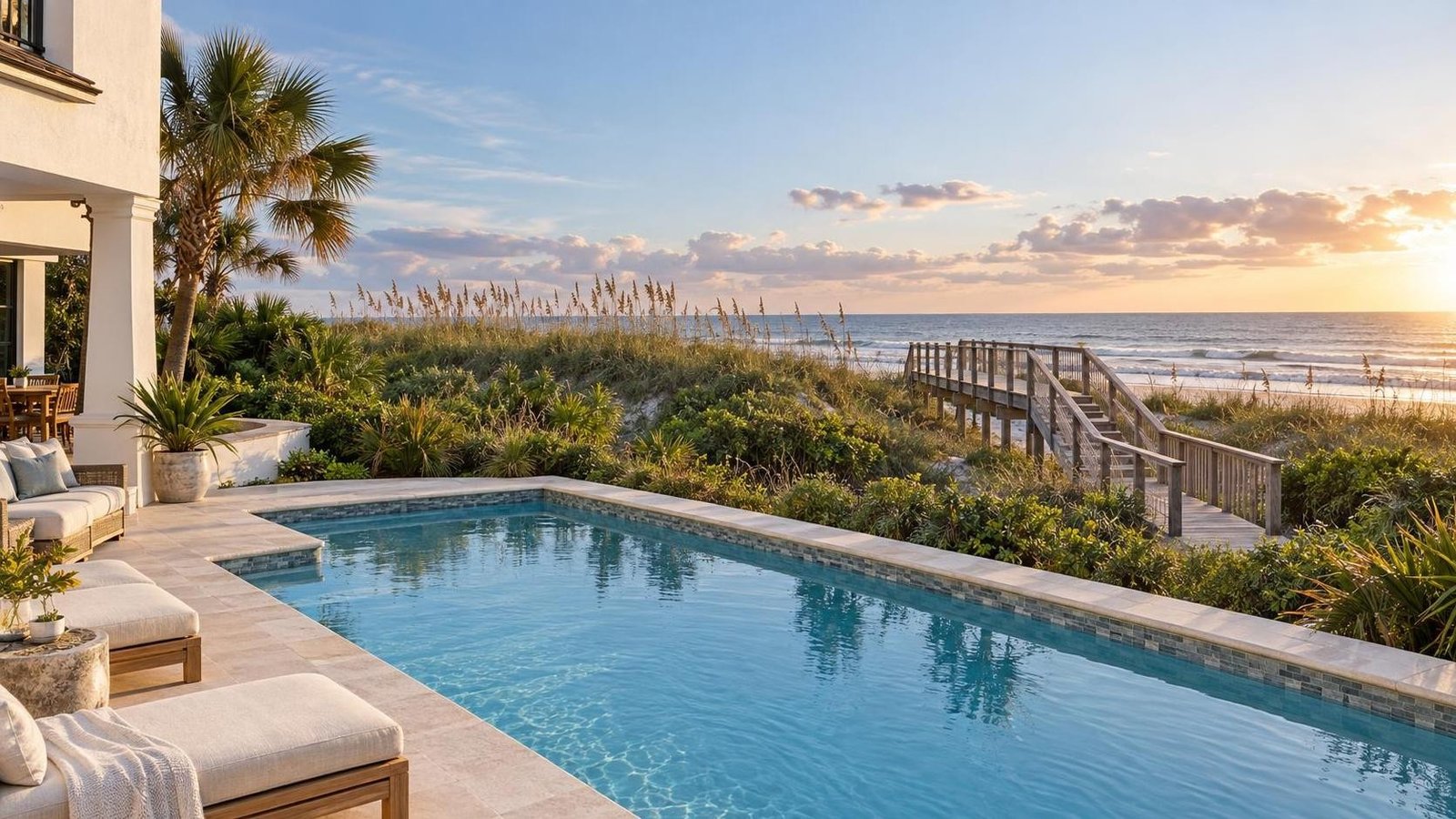
Can You Replace a Dune Crossover or Add a Pool at a Satellite Beach Oceanfront Home?
By Carrie Liotta, Space Coast REALTOR® with REAL Broker | Published September 14, 2026
Maybe—but an oceanfront buyer should never price a Satellite Beach home as though a new dune crossover or pool is guaranteed. Before making an offer, confirm the existing permits, survey the coastal control line and dune, have a coastal design professional test the concept, and ask the city and state which approvals apply to that exact parcel.
This is one of those purchases where “there is plenty of room in the backyard” can be misleading. The visible yard is only one layer. Setbacks, the Coastal Construction Control Line, dune protection, turtle-lighting rules, drainage, utilities, structural design, neighboring improvements, and construction access may all change what is possible.
Start by separating the crossover from the pool
A dune crossover and a pool may share the same oceanfront yard, but they are different projects. The crossover is a path or elevated structure across the dune to the beach. Its alignment, elevation, supports, width, and interaction with vegetation matter. A replacement may not be treated the same as routine board repair, especially if the footprint, design, or location changes.
A pool adds excavation, structure, decking, equipment, fencing or barriers, electrical work, drainage questions, and construction traffic. On a constrained lot, the route used to build the pool may be almost as important as the final pool location. Equipment cannot simply travel across protected dune vegetation because that is the shortest path.
I advise buyers to create two feasibility files and price them separately. If one project works and the other does not, you need to know whether the property still meets your lifestyle plan.
Locate the Coastal Construction Control Line before sketching
Florida’s coastal review is not based on a casual measurement from today’s vegetation line. The Florida Department of Environmental Protection Coastal Construction Control Line program addresses construction in the part of the coast vulnerable to erosion and storm effects. The CCCL is not the same thing as a property boundary or a blanket no-build line; it identifies an area where special siting and design review may apply.
Florida Statutes Chapter 161 provides the statewide legal framework for beach and shore preservation. A buyer does not need to become a coastal-law expert, but the design team needs to identify whether proposed work is seaward of the applicable control line and what permit path follows.
Ask for a current boundary and topographic survey that depicts the property, improvements, easements, and relevant coastal information. Then give the survey—not a phone screenshot—to the engineer, architect, pool designer, and permitting staff. If a seller has an older survey, use it as a lead rather than assuming it reflects current conditions or a new project.
Audit the existing dune crossover
The fact that a crossover exists does not answer whether it was permitted, built to the approved plan, maintained properly, or transferable as-is. Request the permit, plans, final approval, contractor records, and repair history. Compare the paperwork to what is on site. Look for changed stairs, widened platforms, added lighting, replaced supports, storm repairs, or an altered beach landing.
Have an appropriate professional evaluate structure and dune interaction. Rot, corrosion, loose connections, buried supports, handrail problems, and storm movement may not be obvious from listing photos. Ask whether repairs can remain within the approved scope or whether replacement triggers a new design and review.
Private beach access should also be connected to title and survey work. A crossover is not useful if the assumed access route relies on unclear rights. My guide to private beach-access easements and dune-crossover maintenance explains why the physical path and the legal right must be reviewed together.
Test the pool as a full site plan
A pool sketch should show much more than the water rectangle. Include the pool shell, deck, enclosure if planned, barriers, equipment pad, drainage, utility clearances, setbacks, existing house, septic components if any, crossover, dune, vegetation, and construction access. Include grade information because moving or discharging water toward the dune, neighboring lots, or the home can create a new problem.
Oceanfront exposure also changes material and maintenance choices. Salt, wind, sand, and driven rain affect metal, screens, fasteners, pumps, heaters, automation, doors, and electrical components. Ask contractors to specify coastal-suitable materials and realistic service access. A beautiful pool that is difficult to maintain or crowds the only protected outdoor area may not improve daily life as expected.
City review still matters
The City of Satellite Beach is the starting point for current local permitting resources, zoning questions, and online permit access. Confirm jurisdiction and speak with the relevant staff before relying on a contractor’s experience with a different beachside city. Local requirements, state coastal review, and other agency approvals can overlap.
Ask for written direction about the proposed scope whenever possible. The most useful question is not “Can I have a pool?” It is “Given this survey and concept plan, which local and state permits, setbacks, engineering documents, lighting standards, drainage plans, and inspections apply?”
Plan lighting around nesting-season realities
Beachfront lighting is not a decorative decision only. Artificial light visible from the beach can affect nesting sea turtles and hatchlings. The U.S. Fish and Wildlife Service sea turtle conservation program explains the federal conservation context, while local and state requirements shape property-level design.
A pool can introduce underwater fixtures, deck lights, landscape lights, screen-enclosure lighting, brighter interior views, and doors that remain open at night. A crossover can add step or railing lights. Have the lighting plan reviewed as part of the project rather than trying to correct glare after installation. Fixture wavelength, shielding, mounting height, direction, visibility, glass, and operating habits all matter.
If you are comparing a walk-to-ocean home where storm openings, storage, and exterior lighting already compete for the budget, read my Satellite Beach due-diligence guide for turtle lighting, shutters, and garage storage.
Do not skip drainage and storm questions
Adding impervious deck area changes how water moves. Regrading can direct runoff toward the house, the dune, or adjacent property. A pool and enclosure can also occupy space that previously absorbed water or provided access for maintenance. Ask the design team to show how normal rain, heavy rain, deck drainage, roof runoff, pool overflow, and equipment discharge are handled.
Then ask what happens during storm preparation. Can furniture be secured? Are gates and screens designed for the exposure? Where does equipment sit relative to anticipated water? How will the crossover be inspected after a major event? These questions do not make the project impossible; they turn an attractive rendering into a workable ownership plan.
Build an offer around feasibility, not optimism
If the pool or crossover is essential, negotiate enough time and access for the right reviews. A standard home inspector can evaluate many property conditions, but usually should not be the only voice on coastal permitting, structural design, dune impact, or pool feasibility. Depending on the plan, the team may include a surveyor, coastal engineer, architect, pool contractor, electrician, landscape professional, title professional, insurance agent, and permitting staff.
Ask contractors for written assumptions and exclusions. A preliminary quote that excludes engineering, coastal permits, access restoration, drainage, electrical upgrades, barriers, lighting compliance, or dune planting is not the total project budget. Carry a contingency because oceanfront access and materials can create costs that an inland pool estimate does not capture.
If the seller cannot provide records, decide whether you can verify enough during the contract period. Missing paperwork is not proof of a violation, but it is not proof of approval either. The purchase price should reflect what exists legally and physically today, not a future feature that remains uncertain.
What would make me comfortable moving forward?
- A current survey and a concept that respects the house, dune, access, utilities, and drainage.
- Existing crossover permits, approved plans, final records, and a condition assessment.
- Written local and state permitting guidance tied to the actual proposed work.
- A realistic construction route that does not assume access across protected areas.
- A turtle-conscious exterior and interior-lighting plan.
- Contractor budgets that identify engineering, permits, coastal materials, and restoration.
- Insurance feedback on the home as it exists and the project as planned.
- A decision that still works if only the crossover or only the pool proves feasible.
What would make me slow down?
I would slow down if the sales pitch depends on “everyone on the street has one,” if the crossover does not match the available plans, if the only equipment route crosses the dune, if the pool envelope ignores drainage or utilities, or if nobody can explain which agency reviews the work. I would also pause if the household will be disappointed unless both projects happen exactly as imagined.
There may be a better fit a block off the ocean. My article on choosing garage utility versus walk-to-ocean access in Satellite Beach shows how stepping back from direct oceanfront can create more room in both the lot and the budget.
The bottom line
You may be able to replace a dune crossover, add a pool, or do both at a Satellite Beach oceanfront home. The smart purchase is the one where specialists have tested the idea against the survey, coastal rules, dune, access, drainage, lighting, structure, and budget before you pay for that possibility.
I help buyers separate the oceanfront dream from the parcel-level facts without losing sight of why the lifestyle matters. If you are weighing a Satellite Beach home and future outdoor project, reach out for a no-pressure conversation about Brevard County homes for sale with REAL Broker. We will ask the hard questions early so your surfside mornings begin with a plan you can live with. Your next chapter starts here.
