

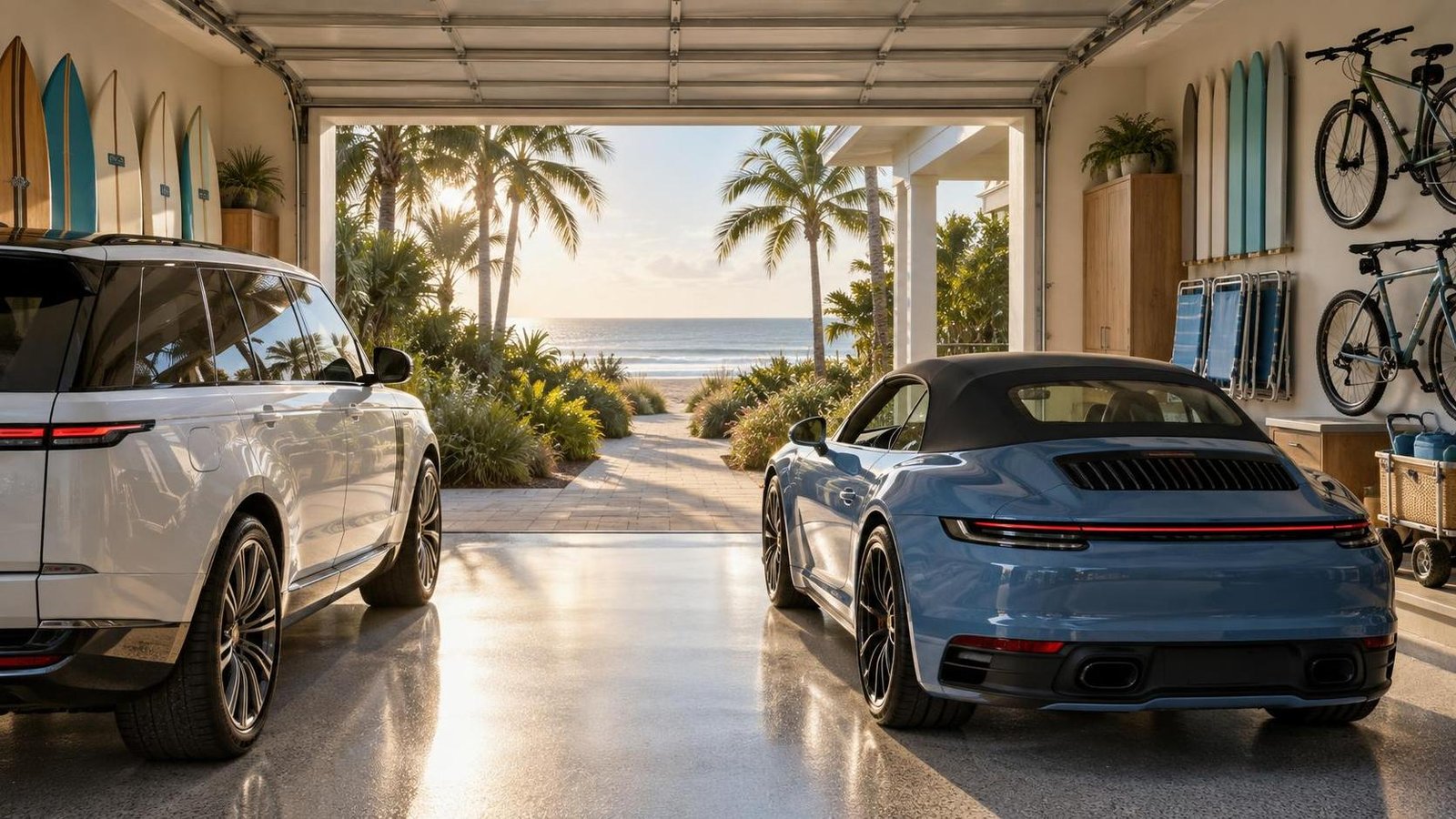
Two-Car Garage or Walk-to-Ocean Access: What Should Satellite Beach Buyers Choose?
By Carrie Liotta, Space Coast REALTOR® with REAL Broker | Published September 13, 2026
A full-time Satellite Beach buyer with limited storm storage should usually prioritize the functional two-car garage—provided the home still has a safe, practical beach route. Choose the shorter walk instead when surfing or beach time is truly part of your daily routine, the garage alternative is mostly empty square footage to you, and the walk-to-ocean home has a realistic plan for vehicles, shutters, bikes, boards, tools, and storm preparation.
Neither feature should be judged from the listing label. A “two-car garage” may not hold two modern vehicles after water equipment and hurricane panels are stored. “Walk to beach” may mean crossing A1A without the route you imagined, relying on access with limited parking, or carrying gear farther than the map suggests. I want buyers to test both promises in person.
Start with everything that must live under cover
Before touring, make a storage inventory. Include vehicles, bicycles, surfboards, paddleboards, fishing gear, beach cart, chairs, umbrellas, tools, holiday items, lawn equipment, storm shutters or panels, fasteners, generator supplies where safely permitted, and anything you would not want exposed to salt air or wind-driven rain. Add space to move around those objects instead of measuring them like a warehouse puzzle.
Then measure the garage. Record door width and height, interior depth, ceiling obstructions, water heater and HVAC footprint, laundry location, attic access, side-door swing, steps, electrical panels, and built-in cabinets. Confirm whether each vehicle can enter, open its doors, and back out while stored gear remains accessible. A tandem-looking photo can hide a short bay or mechanical equipment consuming the rear wall.
In beachside Brevard, a garage is not just parking. It is a corrosion buffer, staging area, workshop, bike room, and storm-prep space. Buyers who travel often, own expensive equipment, have mobility limits, or cannot move bulky items quickly gain more from protected storage than the raw square footage suggests.
Test the beach route with the gear you will actually carry
Do not accept a straight-line distance. Walk from the front door to the access point at the time of day you expect to use it. Notice sidewalks, crossings, traffic, lighting, drainage, stairs, sand depth, beach-access rules, and whether you can manage a cart or board. A five-minute adult walk with no gear can become a very different routine with children, coolers, surfboards, or an older parent.
Also ask whether the route is public, deeded, or informal. Verify any private access right in the recorded documents rather than assuming proximity grants use. If the easiest access depends on parking elsewhere, learn the current parking rules and do not promise yourself permanent convenience from a space you do not control.
The best walk-to-ocean home is one where the beach can become ordinary: an early surf check, an evening walk, or a quick hour on the sand without loading a car. If you expect to drive anyway because the household brings a day’s worth of equipment, paying heavily for a shorter theoretical walk may not improve daily life.
Storm storage changes the value of garage space
Opening protection has to be stored, found, installed, and removed. Ask whether the home has documented impact-rated openings, labeled shutters, accordion shutters, or loose panels. Count the panels, match labels to openings, inspect fasteners, and identify who can install them. A stack of unlabeled panels behind yard equipment is not the same as a ready storm plan.
The Florida Office of Insurance Regulation’s wind-mitigation resources explain that qualifying construction features may create premium savings and provide the current uniform mitigation inspection materials. A buyer should give the actual report and supporting documentation to an insurance professional rather than assuming every shutter or impact window earns the same result.
If the home already has complete, documented impact protection and an organized storage solution, a one-car garage or carport may be workable for the right buyer. If storm panels are bulky, the garage is short, and outdoor storage is restricted, the lack of protected space can turn every watch or warning into a physical logistics problem.
My guide to whether Brevard buyers should pay more for impact windows explains why openings must be evaluated with the roof, garage door, documentation, and overall insurance profile—not as a single headline feature.
A garage door is part of the house’s wind story
Inspect the garage door, tracks, bracing, opener, seals, corrosion, product labels, permits, and wind-rating documentation. A large door is a major opening. Do not assume that a newer-looking door is impact rated or that the presence of window shutters means the garage opening qualifies for the same protection.
Have the home inspector assess visible condition and ask the insurance professional what documentation is required. If records are missing, research the permit with the appropriate city office and obtain qualified advice before assigning value. A garage can be wonderful storage while still presenting a repair or wind-mitigation question.
Buyers comparing military routines may also want my article on garage capacity versus a shorter Patrick Space Force Base commute. The same physical space becomes more valuable when a household must store uniforms, deployment gear, bicycles, shutters, and beach equipment at once.
Flood mapping and drainage still require parcel-level review
A garage or short beach walk does not answer the flood question. Search the exact address in the FEMA Flood Map Service Center, which FEMA identifies as the official public source for NFIP flood-hazard information. Review the current map, any elevation certificate, survey, drainage patterns, prior water history disclosed by the seller, and property-specific flood quote. FEMA also notes that effective information can change or be superseded as maps are updated.
Walk the exterior after rain when possible. Look at driveway pitch, garage threshold, gutters, downspouts, swales, low spots, door seals, and evidence of staining or repaired drywall. Ask where water goes when a hard summer storm arrives. A garage that takes runoff is not reliable protected storage until the cause and solution are understood.
The Florida Department of Financial Services Homeowners Insurance Toolkit reminds consumers that flood is not covered by a standard homeowners policy. Quote homeowners, wind, and flood needs with professionals using the specific property—not a neighbor’s premium.
Salt air makes protected space useful, not maintenance-free
Even inside a garage, salt and humidity can affect door hardware, tools, bikes, metal shelving, electronics, and stored fasteners. Inspect ventilation, signs of condensation, slab moisture, wall penetrations, and whether the space has been used for wet beach gear without drying. A dehumidifier or better organization may help, but buyers should not make electrical or ventilation changes without qualified guidance.
Rinse and dry equipment before storing it, keep metal items off damp floors, and plan a place for sandy gear that does not block vehicles or electrical equipment. The garage should support the beach routine rather than becoming the reason nobody can find a shutter panel in August.
Compare resale audiences, not just features
A functional two-car garage can appeal to a broad beachside buyer pool: full-time residents, military households, commuters, collectors, families, and buyers who need storage. A genuinely easy walk to the ocean creates emotional and lifestyle value that can also be hard to reproduce. The stronger resale feature depends on the street, price range, lot, flood and insurance profile, home condition, and nearby alternatives.
I compare recent sales with similar access and garage utility, then adjust for the whole property. A two-car garage with an awkward driveway and no room for beach gear may not beat a one-car home two blocks from a safe public access. A house close to the sand but lacking secure storage, opening protection, and parking may narrow its future buyer pool.
Do not pay the seller twice for the same convenience. If the home commands a beach-proximity premium, decide whether the access changes your life enough to justify giving up protected space. If the garage commands a premium, verify that its dimensions, door, permits, condition, and storm use support it.
My side-by-side test
For the garage home, park the vehicles, lay out a realistic storage plan, locate the storm panels, inspect the door documents, and walk to the beach. For the access home, carry a board or loaded beach cart to the sand, identify every storage location, test parking, and outline where storm equipment goes. Drive each street after work and visit on a beach weekend.
Then price the differences over five years: purchase premium, homeowners and flood insurance, garage-door or storage upgrades, off-site storage if needed, corrosion-related replacement, parking costs, and the value of trips you will actually make on foot. The exercise turns two appealing listing phrases into a practical ownership choice.
For more beachside due diligence, read what Satellite Beach buyers should verify about turtle lighting, shutter permits, garage storage, and walk-to-ocean homes.
Bottom line
Choose the two-car garage when protected storage, easier storm preparation, vehicle care, and a broad resale story will serve you every week. Choose the closer beach access when it is a verified, safe route you will use constantly and the property has an honest storage and storm plan. The best Satellite Beach purchase is the home where the beach dream still works on a wet Tuesday and during storm preparation.
If you are comparing Satellite Beach homes, I can help you measure the garage, walk the access, review the storm and flood documents, and compare total ownership costs before you offer. Reach out for a no-pressure conversation with REAL Broker. Your next chapter starts here.