

What Should Melbourne Beach Buyers Verify About Private Beach Access?
By Carrie Liotta, Space Coast REALTOR® with REAL Broker | Published September 12, 2026
Before paying a premium for “private beach access” in Melbourne Beach, verify four separate things: your parcel’s recorded legal right to use the access, the exact route and permitted users, the condition and authorization of the dune crossover, and the written method for sharing repair costs. A path to the sand is not enough.
I want a buyer to be able to trace the right from the deed or recorded easement to the survey, walk the physical route, and understand who can authorize and pay for work after a storm. If one of those links is missing, value the access as uncertain until a title professional or Florida real estate attorney resolves it.
“Private access” can describe several different arrangements
The listing phrase may refer to an easement benefiting specific lots, a path owned by an HOA, common area within a condominium or subdivision, a shared strip owned by multiple parties, or simply a nearby public access. Those are not interchangeable.
Ask for the current deed, title commitment, recorded plat, survey, declaration, amendments, access easement, and any maintenance agreement. Identify the dominant parcel receiving the benefit and the property burdened by the access. Confirm that the legal description or plat reference connects to the home you are buying.
Then read what the document allows. Is access pedestrian only? May owners bring chairs, surfboards, fishing equipment, bicycles, or carts? Can guests use it without the owner? Are pets prohibited? Is there a gate, key, parking restriction, or hours rule? Do not expand a narrow written right based on how current residents happen to use the path.
Walk the route as part of due diligence
Start at the property and travel exactly as an owner would. Confirm the practical route across streets, common areas, gates, steps, sand, and the crossover. Note drainage, lighting, surface condition, handrails, steep sections, encroachments, and whether the route changes at high water or after windblown sand.
A beautifully renovated home can still disappoint if the access requires driving because the legal route is farther away than the listing implied. Conversely, a modest walk-to-ocean home with a clear, stable easement may offer a stronger lifestyle and resale story than a closer home with informal access.
My comparison of a smaller walk-to-beach home and a larger mainland home explains why usable access and daily routines can matter more than a simple distance measurement.
A dune crossover is coastal infrastructure
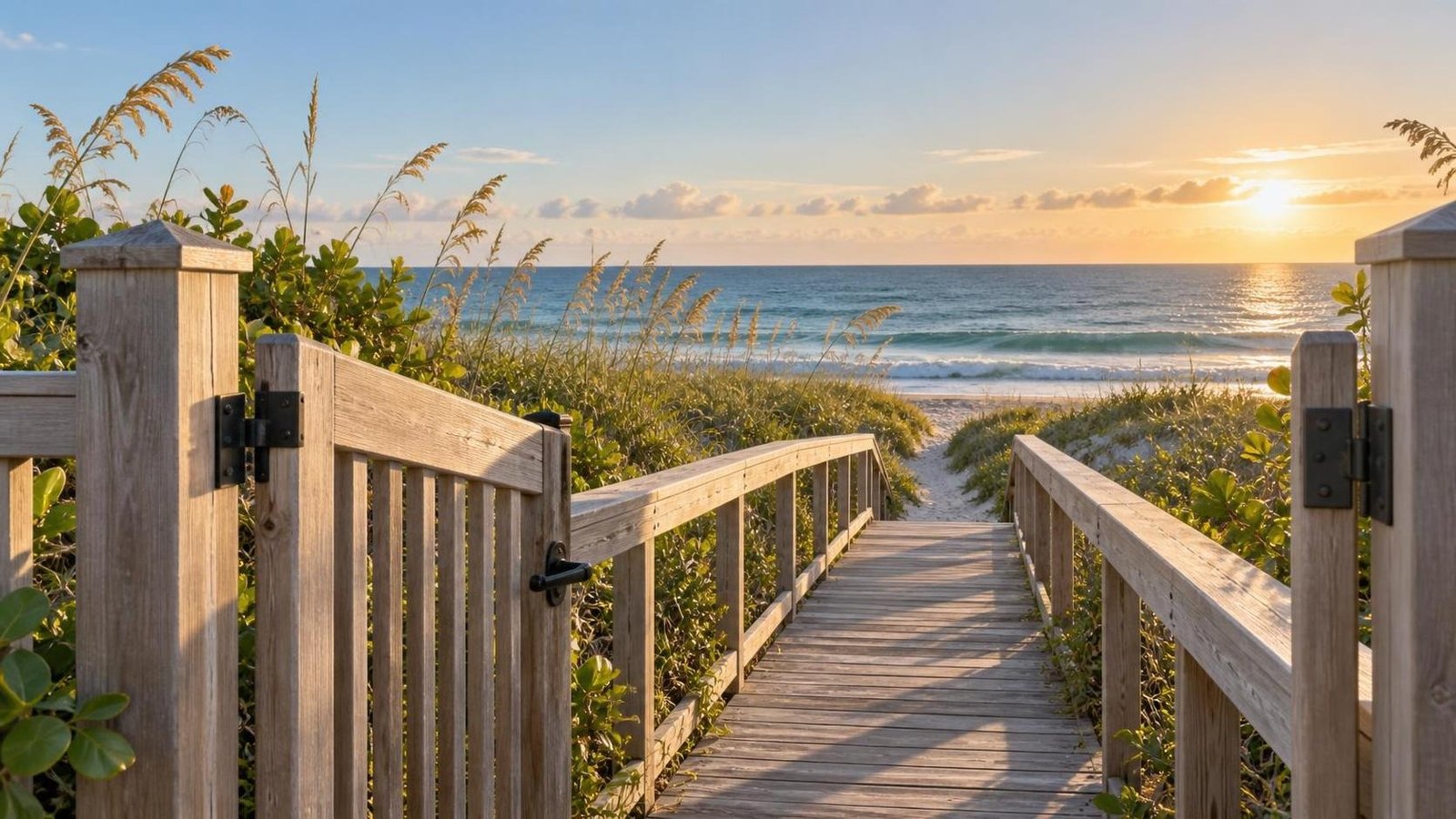
A wood walkway over the dune is not ordinary backyard decking. Its location, dimensions, supports, stairs, railings, repair history, and relationship to the beach and dune system may be regulated. Ask for construction permits, coastal authorizations, final inspections, engineering or contractor records, warranties, and storm-repair files.
The Florida DEP Coastal Construction Control Line Program regulates structures and activities that can cause erosion, destabilize dunes, damage upland property, interfere with public access, or affect sea turtles and dune plants. DEP explains that work in the more seaward beach zone can face special siting and design standards because of storm forces.
That does not mean every repair follows the same process. It means a buyer should not assume the owners can replace a crossover in the same footprint, widen it, add a platform, install lighting, or rebuild it after a storm without review. Ask the appropriate town, county, and state contacts about the specific property and proposed work.
Locate the CCCL instead of guessing from the shoreline
The Coastal Construction Control Line is a regulatory line, not simply the vegetation line or ordinary high-water mark. DEP says the line is based on coastal engineering models, survey and bathymetric data, and the landward reach of a 100-year storm’s damaging effects.
Use DEP’s CCCL locator and Map Direct guidance to identify the line and available permit information for the area. Have a surveyor or coastal professional explain its relationship to the parcel when future work matters to your offer.
Aerial imagery is helpful, but it cannot establish legal rights or future permit approval. Dunes migrate, storm damage occurs, vegetation changes, and maps are updated. Save the dated map and records you reviewed, but write the contract around present evidence rather than a promise about future construction.
Maintenance sharing needs more than a tradition
Ask who owns the crossover and who has authority to hire contractors. A recorded or association agreement should ideally address routine cleaning, sand removal, inspections, structural repair, insurance, emergency work, assessments, voting, access during construction, and what happens when one participant does not pay.
If the only answer is “the neighbors split it,” request invoices and payment history, then ask a title professional or attorney what obligation actually runs with your property. A cooperative history is reassuring, but it is not the same as an enforceable formula. Also ask whether every benefited parcel contributes equally or whether shares vary.
Review the reserve balance if an association maintains the access. A small annual fee may be fine when the crossover is young and inspected, but a low balance beside aging coastal infrastructure can shift a large cost to owners after closing. Request current estimates when deterioration is visible.
Insurance and liability questions belong in the same file
Determine which policy covers the access area and structure, whether the association or private owners carry liability coverage, and how deductibles are allocated. Your insurance professional and attorney should review the actual arrangement. Do not assume your homeowners policy covers a structure on a separate parcel or common area.
Ask about prior claims, closures, injuries, storm damage, and rebuilding. A repaired crossover may look new while the ownership or insurance questions remain old. If a gate or access control exists, find out who manages keys and what happens when hardware is damaged or power is out.
For the home itself, use the FEMA Flood Map Service Center to review official flood hazard information, then obtain address-specific property and flood insurance guidance. A private path does not change the home’s elevation, flood zone, roof, or wind profile.
Lighting can affect both use and wildlife
Buyers often picture evening walks and want more lighting along a path. Coastal lighting is not simply a design choice. The Florida Fish and Wildlife Conservation Commission wildlife-lighting program explains that artificial light can disrupt sea turtles and other wildlife. Its basic approach is to keep needed lighting low, long-wavelength, and shielded.
Ask whether existing fixtures were approved, who maintains them, and what seasonal rules apply. Do not assume you can add bright security lights to an easement or crossover. For older coastal homes, I also compare this with window coverings, interior light spill, exterior fixture direction, and association rules.
My article on dune, septic, and turtle-lighting limits for an older Melbourne Beach cottage helps connect the access question to the rest of coastal ownership.
What if the crossover needs work now?
When boards are loose, railings move, supports appear undermined, or access is closed, do not settle for a cosmetic estimate. Ask a qualified coastal contractor or engineer to evaluate the present condition and likely repair path. Confirm which owners or association must approve the work and which agencies may review it.
Your offer options may include asking the seller or association to complete authorized repairs, negotiating a credit within lender limits, reducing the price, holding funds under a properly drafted agreement when feasible, or walking away if the access value cannot be supported. A credit does not grant a permit, create ownership authority, or force other parties to cooperate.
Sellers should have anticipated many of these questions. My guide to Melbourne Beach seller records for decks, septic, and turtle-friendly lighting shows what a strong coastal file can contain.
How private access affects resale
Clear, convenient access can broaden the future buyer pool because it offers the beach lifestyle without direct-oceanfront maintenance. Unclear access can do the opposite. Future buyers, title reviewers, appraisers, lenders, and insurers may ask the same questions you are asking now.
Preserve the documents you receive and add future invoices, permits, meeting minutes, and photographs. When you sell, you want to demonstrate the route, right, condition, and cost without overstating exclusivity. “Deeded pedestrian access shared by twelve lots” is more useful than “private beach.”
My pre-offer beach-access checklist
- Confirm the benefited parcel and exact recorded access document.
- Match the legal route to the survey, plat, gate, path, and crossover.
- Read limits on owners, guests, pets, equipment, hours, parking, and keys.
- Review crossover permits, coastal authorizations, inspections, and repairs.
- Identify ownership, decision authority, insurance, reserves, and cost-sharing rules.
- Check current condition with a qualified specialist when concerns are visible.
- Review CCCL location, flood information, wildlife lighting, and future-work assumptions.
- Ask an attorney and title professional to resolve conflicts before deadlines expire.
Bottom line
Private beach access is valuable when it is legally clear, physically usable, responsibly maintained, and realistic to repair. Do not pay for a lifestyle phrase. Pay for a documented right and an ownership system you understand.
If you are comparing Melbourne Beach homes, I can help you organize the access, coastal, insurance, and property-condition questions before you offer. Reach out for a no-pressure conversation about Brevard County coastal homes for sale with REAL Broker. Your next chapter starts here.
