

Selling a Viera Home With Reclaimed Irrigation and Pool Autofill? Document the Backflow Assembly
By Carrie Liotta, Space Coast REALTOR® with REAL Broker | Published October 3, 2026
If reclaimed irrigation and a pool autofill appear to share one backflow assembly, do not explain the setup from appearance alone. Before listing, trace both water sources, prove the pool fill is not supplied by reclaimed water, identify what the assembly protects, verify separation with qualified professionals, and put permits, tests, repairs, and a clear route diagram in the seller file.
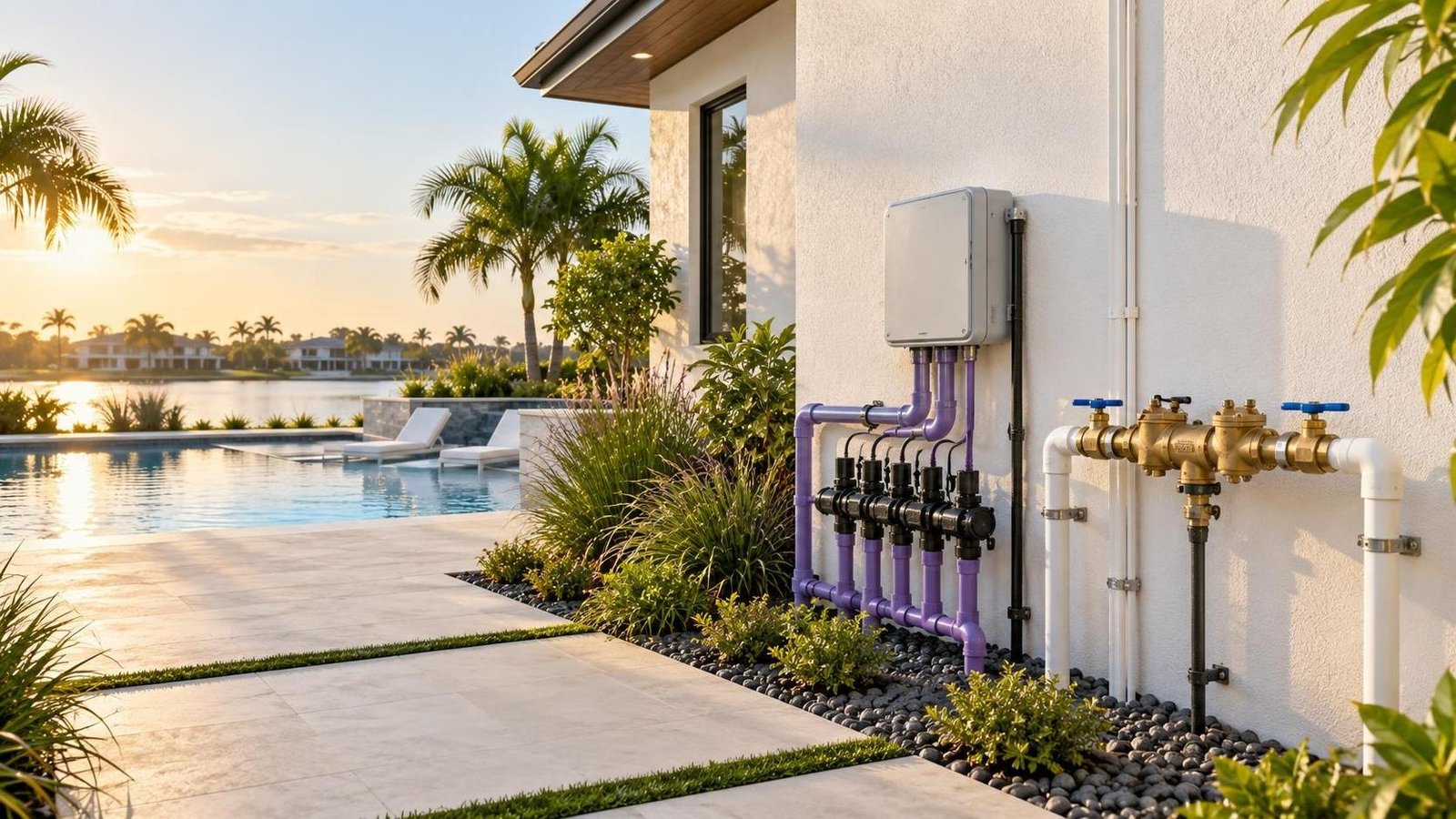
This is one of those Viera details that can look tidy and still create a serious inspection question. A buyer sees a purple irrigation component, a brass assembly, a controller, and a pool that fills automatically. The seller may have been told that “the backflow covers everything.” Yet one visible device does not prove where either branch begins, which direction water travels, or whether the pool autofill is on a completely separate potable line.
The goal is not to make a technical claim in the listing. It is to remove ambiguity before a buyer has to decide whether an unclear valve cluster represents mislabeled plumbing, an unverified modification, or a true cross-connection.
Begin with the source, not the controller
An irrigation controller tells valves when to open. It does not establish whether the water behind those valves is reclaimed water, potable water, a well, or another approved source. A pool autofill valve controls pool level. It does not tell you where its supply originates. Start upstream from both systems.
First identify the actual water provider and the property’s jurisdiction. Do not assume every Viera address has the same utility arrangement or that every purple pipe is active reclaimed service. Pull the seller’s utility records, irrigation installation documents, pool plans, permits, invoices, and any prior backflow inspection or test reports. Then have the appropriate licensed plumber and qualified backflow professional trace the accessible piping in the field.
I would create a simple source-to-outlet sketch with separate paths for:
- the reclaimed-water service or other irrigation source;
- the irrigation shutoff, controller-operated valves, zones, and outlets;
- the potable-water service;
- the pool-autofill shutoff, protection, and fill outlet; and
- every visible backflow assembly, test port, meter, valve box, and material transition.
Label an unconfirmed concealed section as “route not visually confirmed.” A truthful limitation is more useful than a confident arrow based on pipe color or memory.
Florida draws a clear line around reclaimed water and pools
The current Florida Administrative Code rule for reclaimed-water distribution and cross-connection control says reclaimed water shall not be used to fill swimming pools, hot tubs, or wading pools. The same rule says cross-connections to potable water systems are not allowed and requires reclaimed-water valves and outlets to be identified.
That makes the seller’s central question very practical: what water actually reaches the autofill? If the professional tracing shows a reclaimed branch can feed the pool, or that reclaimed and potable lines are interconnected, the answer is not a better label. The seller needs a correction designed, permitted, and verified through the proper utility, authority having jurisdiction, and licensed trade.
The Florida Department of Environmental Protection describes water reuse as highly treating domestic wastewater for a beneficial new purpose. It is a valuable water-management tool, but treatment for an approved reuse purpose does not convert every residential use into an approved one. “Reclaimed” should never be treated as another name for ordinary household water.
One assembly may be protecting one line, not two
A seller may use the word “shared” because one brass device sits between the irrigation controls and pool equipment. That description can be wrong in several ways. The systems may only be adjacent. The visible device may protect the potable pool-fill branch while the reclaimed irrigation service remains physically separate. It may protect an irrigation supply that is not reclaimed at all. Or later work may have created a connection that was never reflected in the original plans.
Ask the professional to record the assembly’s manufacturer, model, size, serial number if present, flow direction, installation location, upstream source, downstream uses, shutoffs, test ports, condition, and service or test history. A photograph of a brass body is not enough. Neither is a faded tag without a matching address, device number, and test date.
Florida’s public-water-system cross-connection-control rule establishes the statewide framework for community water systems. The serving utility’s program and the authority having jurisdiction determine how that framework applies to the property, which protection is required, who may test it, and what records must be submitted. A seller should not select a device or claim compliance by comparing photos online.
Test function without using the pool as an experiment
Do not have the seller turn random valves, bypass a device, disconnect piping, or add dye to a water system. The plumber and backflow professional should determine a safe tracing and test method. Pool service personnel may need to identify the autofill mechanism and show how it operates, but they should not be asked to certify the potable or reclaimed distribution system outside their scope.
The resulting written report should answer specific questions:
- Which source supplies the irrigation zones?
- Which source supplies the pool autofill?
- Are the two systems physically separated?
- What exact line and downstream use does each protection device serve?
- Can either source flow backward or be cross-connected through a bypass, hose, valve, or abandoned branch?
- Are reclaimed components identified and distinguishable from potable components?
- Do the observed installation, permits, utility records, and test history agree?
If testing reveals a failed assembly, an undocumented bypass, a connected hose arrangement, a mislabeled valve, or an unexplained buried tee, preserve the finding and get a written correction scope. Cosmetic cleanup should wait until the route is understood.
Reconcile the pool permit with later irrigation work
The pool and irrigation system may not have been installed together. A builder may have delivered the home with one irrigation configuration; a pool contractor may have added the autofill years later; a landscape company may then have moved valves or replaced the controller. The current piping can differ from the original plan even when each owner believed the work was routine.
Use the Brevard County permit search as a starting point when the property is in county jurisdiction, then confirm whether another record source applies. Obtain the actual permit scope, plans, inspections, revisions, and final where available. A search result that merely says “pool” does not prove the autofill route shown in the field today.
Build one timeline: original home and irrigation installation, pool construction, deck or paver changes, landscape redesign, controller replacement, backflow work, leak repairs, and any utility inspection. Match invoices to visible equipment. If the pavers now cover a valve box or test point, do not hide that access problem with furniture or planters before photography.
Prepare a handoff that a buyer can verify
I would organize the seller file in the same order the buyer’s professionals will investigate it:
- water provider and reclaimed-service confirmation, with the date verified;
- potable and reclaimed account information with private numbers redacted;
- pool and irrigation permits, plans, finals, and later revisions;
- the source-to-outlet sketch and dated photo key;
- assembly make, model, location, flow direction, device number, and protected branch;
- current test, inspection, service, and repair records;
- controller model, zone map, schedules, manuals, and ownership-transfer steps;
- autofill model, shutoff location, service history, and confirmed source; and
- written limitations for any concealed or unverified section.
This file complements the broader records I recommend in my Viera smart-irrigation and control-system seller guide. The controller may be useful to a buyer, but the ownership handoff is only one layer. Here, source separation and water safety come first.
If the property is a preserve lot or has extensive landscape zones, also review my guide to documenting Viera drainage, irrigation, and view maintenance. Zone coverage, drainage, common-area boundaries, and HOA approvals still matter; they simply do not answer the pool-fill question.
Correct the safety question, not only the paperwork
Documentation is enough only when the installation is allowed, functional, and understood. If a professional confirms that the pool fill can receive reclaimed water, that reclaimed and potable systems connect, or that an assembly does not protect the branch it was said to protect, fix the physical condition before relying on disclosure language.
The correction may be straightforward, or it may require separate piping, a different approved protection method, removal of a bypass, new access, utility coordination, a permit, paver work, or replacement of an unsuitable or failed assembly. Do not publish a generic repair allowance before the scope is known. One house may need a current test and new labels; another may need the two systems redesigned and separated.
Ask for a closeout package stating what was found, what was changed, who performed the work, the permit or authorization used, and how the corrected routes were tested. Photograph the work before it is concealed. If the utility or permitting authority reinspects it, save that result.
This follows the same principle I use for exposed waterfront plumbing in my article about documenting a dock washdown line and fish-cleaning sink: a fixture that operates during a showing does not prove the source, protection, route, or approval of the full system.
Market the system with narrow, supportable language
After the records are complete, keep the listing description factual. “Reclaimed-water irrigation with mapped zones; pool autofill supplied separately and documented by licensed professionals” is useful if the file supports every part of that sentence. “Shared backflow system,” “maintenance-free autofill,” or “fully compliant plumbing” can create more questions than value, especially when the phrase does not explain which source and branch are involved.
Do not promise that an assembly eliminates every contamination risk or that a recent test guarantees future performance. State the service date, device identity, source routes, and records available. Let the buyer perform independent inspections. Good seller preparation supports due diligence; it does not replace it.
Also transfer the irrigation controller cleanly. Save the manual, zone names, seasonal schedule, rain-sensor information, service contacts, and reset or account-transfer steps. Remove the seller’s personal credentials rather than handing over an old login. If the controller drives only irrigation valves, describe it that way; do not imply that it manages or monitors the pool autofill unless the installed documentation proves that function.
My bottom line for Viera sellers
When reclaimed irrigation and a pool autofill appear to meet at one backflow assembly, the strongest seller response is not “it has always worked.” The answer is a verified map showing two lawful sources and routes, an identified and tested device, no reclaimed supply to the pool, no cross-connection to potable water, and a permit and service history that matches what a buyer can see.
I help Viera sellers turn unusual property systems into an organized, accurate handoff before the inspection period adds pressure. Reach out for a no-pressure conversation about selling a Brevard County home with Carrie Liotta, Space Coast REALTOR® with REAL Broker, and join my private Facebook group, Moving to Brevard County Florida, for practical local guidance. Your next chapter starts here.
