

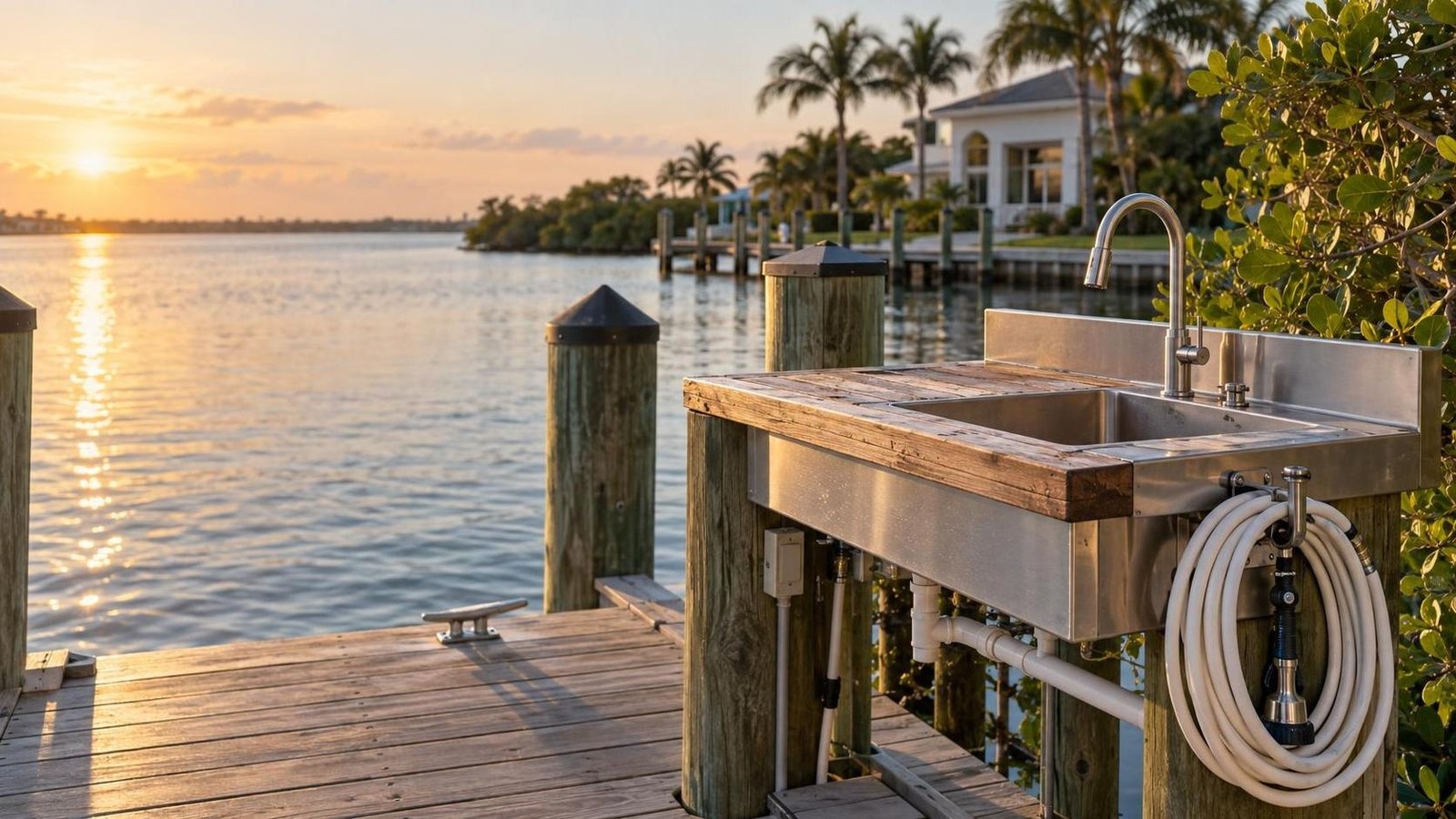
Selling a Merritt Island Home With a Dock Washdown Line and Fish-Cleaning Sink? Document the Plumbing
By Carrie Liotta, Space Coast REALTOR® with REAL Broker | Published October 1, 2026
A Merritt Island seller should document a dock washdown line and fish-cleaning sink before listing whenever the source, shutoff, backflow protection, drain route, permit history, or repair record is not obvious. Prove how clean water arrives and wastewater leaves; do not let an attractive dock station become an unexplained plumbing system during the buyer’s inspection.
This matters most when the station was added after the dock, when a hose can reach canal water or chemical containers, when the sink drain disappears below the deck, when the property has changed from well to public water, or when several owners and contractors have modified the waterfront. A faucet that runs during a showing proves only that water reaches the faucet. It does not establish the source, protection, drainage, condition, or approval of the full installation.
I would prepare one plumbing page for the listing file, supported by permits, invoices, photographs, and professional findings. That page should follow the water from its source to the fixture and follow the sink waste to its documented endpoint. Buyers can then inspect a known system instead of negotiating around a mystery.
Which Merritt Island sellers need the strongest file?
Every seller benefits from clear records, but I would prioritize this work for a canal or riverfront home where the dock station is built into cabinetry, supplied through a seawall or buried route, connected to both a sink and long washdown hose, or close to boat chemicals, bait equipment, irrigation, reclaimed water, or a separate well. I would also pay attention when plumbing materials change along the route or when the shutoff is difficult to locate.
Start by identifying who supplies the property’s water and whether the dock line comes from that same system. Do not rely on pipe color, an old panel label, or the seller’s memory. Photograph the source connection, accessible valves, protection devices, material transitions, supports, faucet, hose connection, sink underside, and visible drain route. Mark those points on a copy of the survey or a simple site sketch without claiming that the sketch is an engineered drawing.
Document the supply from source to faucet
The seller file should answer five basic questions: What water supplies the line? Where can it be isolated? What fixtures or attachments does it serve? What protects the potable system from an unwanted reverse flow? Who installed or last repaired it?
Pull the permit history first. For a property in county jurisdiction, the Brevard County building-permit search is an official starting point. Confirm whether the parcel is actually in the county’s jurisdiction, then obtain the permit scope, plans, inspections, and final rather than stopping at a one-line search result. Match those records to paid invoices and the installation that exists today.
Ask a licensed plumber to trace the line, locate and operate the appropriate shutoff within the professional’s scope, identify accessible materials and fittings, check for leakage and corrosion, and explain whether the installation agrees with the documented use. Florida’s contractor definitions include public and private water-supply systems, sanitary drainage, and related equipment within plumbing-contractor scope. The Florida DBPR license search is the state’s official place to check regulated licensees.
Keep the plumber’s report specific. “Dock water works” is less useful than a dated description of the observed source, route, shutoff, devices, fixtures, leaks, limitations, and repairs. If a concealed section cannot be traced without opening finishes, preserve that limitation and decide whether additional investigation is worth doing before listing.
Backflow protection is not a decorative valve
Backflow and cross-connection questions depend on the actual water source, fixture, downstream use, pressure conditions, attachments, and water-provider requirements. A seller should not identify a small fitting as “code-compliant backflow protection” because it resembles a device found online. Ask the plumber to identify it by manufacturer and model, document where it sits in the system, and state what it protects.
Florida’s public-water-system cross-connection-control rule establishes a statewide framework for public water systems. The current Florida Plumbing Code’s water-supply and distribution chapter contains provisions concerning cross connections, backflow protection, and hose connections. Neither link lets a seller choose a device from a photograph. The water provider, permitting authority, and licensed plumber should apply the requirements to the observed setup.
The hose use matters because a long hose can be left in a bucket, connected to a sprayer or injector, or positioned where the outlet is submerged. Record the normal attachments and tell the plumber about them. Do not remove a device, cap a relief opening, or create a bypass merely to improve appearance or pressure before photography.
Trace the fish-cleaning sink drain all the way to its endpoint
The sink deserves its own route map. Look beneath it and identify the basin outlet, trap or other visible fittings, pipe material, supports, cleanout or access points, and where the line disappears. Then have the qualified professional determine where it actually terminates and whether that route is appropriate for the installation.
Do not advertise that the sink drains to sewer, septic, a drywell, a collection container, or the canal unless records and field findings support that statement. A pipe vanishing through a dock board is not an endpoint. Water seen beneath a dock does not explain whether the sink, rain, hose use, or another line produced it.
The Florida Plumbing Code’s sanitary-drainage chapter is the current official code-hosting reference for drainage provisions, but application still depends on the fixture and actual design. Ask the plumber and permitting authority what documents or corrections are appropriate. If the station uses a removable container or other special arrangement, show how it is maintained and disposed of without claiming more than the professional record establishes.
Build a maintenance history buyers can understand
Waterfront plumbing ages in an exposed environment. A clean sink top can hide corroded fasteners, split hose material, loose supports, slow leaks, staining beneath the deck, or valves that have not moved in years. Before listing, remove stored chemicals and gear, clean the station, and make inspection points safely accessible. Cleaning is not repair.
Gather installation and repair invoices, fixture specifications, device test or service records when applicable, photographs taken before pipes were concealed, and notes about winterization or storm preparation. If the sink cabinet, dock boards, or seawall work changed after the original plumbing, add those dates to one timeline. A buyer needs to know whether the supply and drain were protected, moved, cut, or reconnected during later work.
This is where the topic differs from my buyer guide to dock water and low-voltage conduit sharing a seawall sleeve. That buyer is investigating one crossing. Here, the seller is proving an operating plumbing system from source through use and disposal, including the maintenance habits a new owner will inherit.
Correct active problems before the first showing
I would address active leaks, loose fixtures, broken supports, severe corrosion, inaccessible or failed shutoffs, unprotected open piping, unstable sink bases, and professional findings that call for prompt correction. Use the appropriate licensed contractor, obtain required permits, save the final, and photograph the work before it is covered. Ask for an invoice that states exactly what was repaired rather than a generic note saying “dock plumbing serviced.”
Do not let a handyman create a cosmetic solution that makes the route harder to inspect. Fresh lattice, cabinet panels, deck boards, or landscaping should not seal off a valve, trap, device, coupling, or seawall penetration. A tidy access panel and a clear shutoff label are more valuable than a seamless finish that must be demolished during the buyer’s inspection.
If records are missing, repair is not always the first step. The right sequence may be permit research, identification by a plumber, limited tracing, a water-provider question, or a written correction scope. If the installation cannot be verified before launch, state what is known and unknown, price the remaining uncertainty, and avoid calling the feature “fully permitted” or “maintenance free.”
Prepare a one-page dock-plumbing handoff
I would organize the listing file in the same order a buyer will inspect it:
- water provider or documented source and the date verified;
- main and branch shutoff locations, with clear photographs;
- pipe route and accessible material transitions;
- fixtures, hose attachments, and intended ordinary use;
- identified backflow or cross-connection protection and relevant service records;
- sink-waste route and documented endpoint;
- permits, plans, finals, invoices, specifications, and warranties;
- leak, corrosion, cleaning, freeze, storm, and repair history; and
- professional limitations and remaining unknowns.
Add a photo key showing the source, valves, protection device, faucet, sink underside, drain route, and waterfront crossing. Redact account numbers and private information before sharing.
If dock electrical, a lift, and plumbing were upgraded in different years, coordinate the timelines rather than delivering unrelated folders. My guide to documenting dock electrical, generator, and lift shutoffs explains the same handoff principle for power systems. Each trade remains responsible for its own scope, but the dates should not contradict one another.
How this preparation improves the inspection period
Documentation does not ask the buyer to waive an inspection. It gives the home inspector and plumber a reliable starting point. They can compare the physical route with the permit and invoice, test accessible operation within their scopes, identify changed components, and focus on genuine gaps. That is more useful than spending the inspection period trying to find a buried valve or debating where an unlabeled drain might go.
A complete file also helps the seller evaluate requests. If a buyer claims the line has no shutoff, the dated diagram and plumber’s report may resolve the misunderstanding. If the buyer’s professional finds that a device is unsuitable, a precise existing record helps contractors price the correction. Facts narrow negotiations; vague assurances usually enlarge them.
Coordinate the dock-plumbing page with the larger waterfront-edge file. My article on pool drainage, seawall weeps, and dock conduit explains why adjoining systems should be mapped together without pretending one permit or inspection approves them all.
My pre-listing decision rule
I would market the washdown line and fish-cleaning sink as a useful waterfront feature when the seller can identify the water source and shutoff, the appropriate professional has evaluated the supply and protection, the drain route and endpoint are documented, active defects are corrected, and the records match the installation. The station does not need to be new; it needs to be understandable and serviceable.
I would slow down when the hose source is unknown, the device cannot be identified, the sink drain disappears without a verified endpoint, pipes leak beneath the deck, permits and invoices describe different work, or cabinetry blocks repair access. Those conditions do not automatically prevent a sale. They tell the seller where investigation, correction, disclosure, or pricing must replace a marketing claim.
A Merritt Island dock can be both beautiful and technically clear. Document the water coming in, the waste going out, and every protective or service component between them. If you are preparing a canal or riverfront home for sale, reach out for a no-pressure conversation with Carrie Liotta, Space Coast REALTOR® with REAL Broker, about the records, inspections, presentation, and waterfront ownership questions buyers are likely to raise. Your next chapter starts here.
