

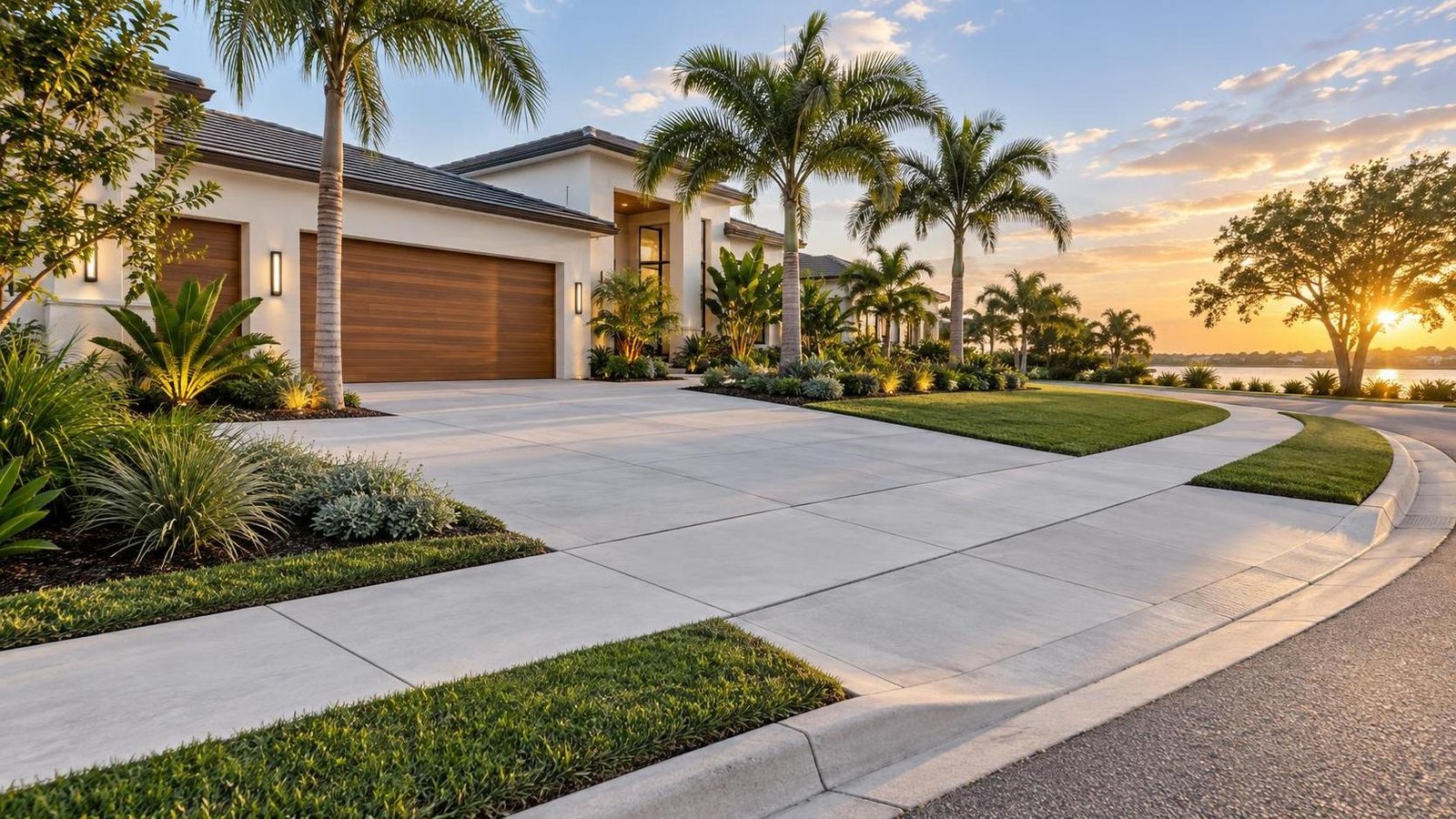
HOA Sidewalk Crossing a Corner-Lot Driveway Apron: What Should Viera Buyers Verify?
By Carrie Liotta, Space Coast REALTOR® with REAL Broker | Published October 11, 2026
Verify who owns and maintains each surface, whether the sidewalk and apron match the survey and community standards, whether past changes were approved, and whether the crossing works safely for pedestrians and your vehicles. Do not assume the HOA owns the sidewalk simply because the home is in a Viera association.
A crossing like this looks ordinary during a showing: a concrete walk continues across the driveway, the apron meets the street, and the corner lot has extra frontage. The real question is what happens when a panel settles, pavers loosen, drainage cuts across the walking path, or a future driveway change needs approval. I want those answers in writing before an inspection period expires, not after the first repair notice arrives.
Start by separating the sidewalk, driveway, and apron
Buyers often use “driveway” for the entire paved route from garage to street. For due diligence, I divide it into pieces. There is the private driveway nearer the house, the sidewalk crossing, the apron between the sidewalk and roadway, and sometimes a curb, drainage swale, utility easement, or public right-of-way. Those pieces can look continuous while having different ownership, approval, and maintenance rules.
The phrase “HOA sidewalk” is therefore a question, not a conclusion. It might be association-maintained common property, a walk in an easement across the lot, infrastructure under another entity’s control, or a surface the owner must maintain even though neighbors use it. A community development district is also not the same entity as a homeowners’ association. The deed, recorded plat, survey, declarations, and written response from the responsible entities should tell the story for the exact address.
I would ask for a current survey that clearly shows lot lines, road frontage, easements, and the improvement locations. Then compare it with the recorded plat and association documents. If the sidewalk line or driveway widening does not appear where expected, do not guess why. Ask the title professional, surveyor, association, and applicable public authority to identify what controls the area.
Why a corner lot needs more than a front-yard glance
A corner parcel can have one obvious front elevation and a second street-facing side. That may affect visibility, setbacks, fencing, landscaping, parking behavior, irrigation, and where vehicles or pedestrians approach the driveway. It can also create more sidewalk length and more edges where settlement or drainage shows up.
Florida’s current HOA law recognizes that a parcel may be bounded by a roadway or easement on more than one side. Under Florida Statute 720.3035, an association’s architectural authority must come from the declaration or authorized published standards; subsection (3) also addresses how the “front” and setbacks are treated when documents are not specific. That statute does not decide the facts for one Viera lot. It does tell buyers why the recorded declaration and current published standards matter more than a neighbor’s recollection.
For a broader look at this lot-shape tradeoff, my guide to choosing a Viera corner lot for privacy and future outdoor plans explains why extra apparent space should always be tested against setbacks, easements, drainage, and association rules.
Walk the crossing twice: once as a pedestrian and once as a driver
First, follow the sidewalk without looking at the house. Watch for raised panel edges, cracks that open underfoot, loose pavers, abrupt slopes, algae, irrigation overspray, ponding, patched joints, or a surface change that could catch a stroller, walker, wheelchair, bicycle, or rolling suitcase. Visit after rain when possible. A dry morning may hide the exact low point that collects water every afternoon.
Look at the walking surface as a connected route: its running slope, side-to-side pitch, clear width, and changes in level all affect whether the crossing feels usable. I use those categories as a practical inspection prompt, not as a legal compliance opinion. If accessibility is material to the purchase, have the applicable authority and a qualified professional evaluate the exact crossing.
Then test the driveway from the driver’s seat. Enter and exit at a normal angle. Listen for scraping and feel whether a low vehicle, long wheelbase, trailer hitch, mobility van, or loaded SUV may bottom out at the sidewalk or curb transition. Check whether one side of the apron forces tires toward a panel edge. Stand back and watch another vehicle use the crossing so you can see blind spots that disappear from behind the wheel.
Because it is a corner lot, repeat the visibility test from both street approaches. Overgrown hedges, utility cabinets, parked vehicles, signs, and fence returns can affect the sight line. The question is not simply whether your car fits; it is whether routine backing, guest parking, school-hour foot traffic, and delivery vehicles can coexist without turning the sidewalk into a daily conflict point.
Match the physical condition to an approval history
A neat repair is not proof of approval, and a color mismatch is not proof of a defect. Ask what changed. Was the driveway widened? Were concrete panels replaced? Were pavers installed over or beside the original apron? Did a root, utility repair, or drainage project disturb the crossing? Is there an open violation, incomplete application, transferable warranty, or contractor invoice?
Central Viera’s current modification-approval guidance says the responsible review authority may be CVCA or a neighborhood or district association, depending on the community. It advises owners to identify who handles the request and notes that association approval does not replace applicable county building and zoning requirements. That is why “the HOA approved it” is only useful when the seller can produce the approval and you know which body issued it.
Viera East’s June 2026 residential design guidelines provide a good example of how specific standards can become. They say proposed improvements require review by the Community Modifications Review Committee, list permitted driveway materials, and require sidewalks to conform to community design and size criteria. The same document warns that it does not contain every restriction for every lot and directs purchasers to read both the community declaration and the applicable district declaration. Different Viera neighborhoods can use different documents, so I would never apply one association’s manual to another address.
If exterior projects are part of your plan, my overview of HOA architectural rules in Viera, Suntree, and Rockledge can help you organize the document review. For the driveway itself, this comparison of alley-loaded and front-entry Viera garages shows how parking rules, vehicle movement, and the household’s busiest hour can matter as much as curb appeal.
Get the maintenance answer in a four-column note
I would not settle for “the association takes care of it.” Create four columns labeled sidewalk panel, driveway crossing, apron, and curb or drainage edge. For each one, write down the owner, maintenance party, approval authority, and payment source. Ask who handles routine wear, trip hazards, root damage, damage caused by an owner’s contractor, and a replacement requested only because the buyer wants different pavers or a wider drive.
Then ask whether the association has recently repaired similar crossings, whether owners were charged individually, and whether a shared project or special assessment has been discussed. Board minutes, budgets, maintenance policies, violation correspondence, and the seller’s account history may help. A verbal answer from a showing is not a substitute for the governing documents or a written response from the entity that will actually send the repair notice.
The practical rule is to read rather than assume. Review the disclosure package, restrictive covenants, assessment information, and association documents before purchase, then have your contract, title professional, and attorney guide deadlines and legal questions for the transaction.
Turn an uncertain repair into a decision before closing
If the crossing is level, documented, and clearly assigned, the issue may require no more than preserving the records. If there is settlement, drainage, a questionable paver transition, or disputed responsibility, obtain the right inspection and a written scope. A general home inspector can identify visible concerns, but a concrete contractor, paving specialist, drainage professional, surveyor, engineer, association representative, or public authority may be needed depending on the problem.
Ask the contractor to separate cosmetic work from the work needed to restore the walking route, drainage, or vehicle transition. Confirm whether demolition could affect irrigation, utilities, curbing, or adjacent panels. Also ask which approvals must arrive before work starts and who bears the cost if a neighboring panel is damaged during replacement.
Do not reduce the negotiation to one repair estimate. The better decision includes responsibility, timing, approval risk, and recurrence. A seller credit may help with cost but does not transfer approval to the buyer or guarantee that the preferred material will be allowed. A completed seller repair may be attractive, but only if the scope, approval, contractor, and closeout records are clear.
My inspection-period checklist for this Viera corner lot
- Obtain the current survey, recorded plat, title exceptions, and any sidewalk, drainage, utility, or access easements.
- Identify the HOA, neighborhood or district association, CDD if applicable, county role, and the correct architectural-review body.
- Read the declarations, current design standards, maintenance provisions, recent minutes, budgets, and disclosed assessments relevant to the crossing.
- Request driveway, sidewalk, paver, drainage, and curb approvals, permits, invoices, warranties, violation letters, and repair history.
- Inspect the crossing after irrigation or rain and test it on foot, with the household’s vehicles, and from both corner approaches.
- Get written responsibility answers and qualified repair estimates before the contract deadlines that protect the buyer.
The bottom line
A sidewalk crossing a corner-lot driveway apron is not automatically a defect, and it should not automatically scare a Viera buyer away. The risk is uncertainty: calling it “HOA maintained” without documents, overlooking a settled walking surface, or assuming a future driveway change will be approved.
I help buyers turn that small strip of pavement into a clear property question: who controls it, who pays, what was approved, how it performs, and what the next owner can change. Join my private Facebook group, Moving to Brevard County Florida, or reach out for a no-pressure conversation about Brevard County homes for sale with REAL Broker. Your next chapter starts here.
