

Alley-Loaded Garage or Front-Entry Driveway: What Should Viera Relocators Choose?
By Carrie Liotta, Space Coast REALTOR® with REAL Broker | Published September 29, 2026
Choose the garage layout that removes friction from your busiest hour. An alley-loaded garage can protect the front porch and streetscape, while a front-entry driveway usually makes loading, guest arrival, and vehicle movement easier to understand. For Viera relocators, the better choice depends on the actual alley, cart routine, school route, parking rules, and household vehicles.
I would not pay more for either design based on appearance alone. A beautiful alley plan can become frustrating if two vehicles cannot pass the trash carts or a delivery truck. A conventional front driveway can be wonderfully practical, yet feel crowded when school mornings, guests, bicycles, and outdoor play all compete for the same paved space. The floor plan does not reveal that conflict; a real-life routine test does.
Start with the hour that is hardest to manage
Relocating buyers often compare garage orientation at a quiet weekend showing. That is the easiest version of the property. Instead, picture the hardest 45 minutes of your week. One adult may be leaving for work while another loads children, a neighbor may be rolling carts out, and a delivery van may be looking for the correct entrance. Add rain, sports equipment, or a visiting grandparent, and the difference between the two layouts becomes clear.
Write down the movements that must happen at the same time:
- Which vehicle leaves first, and can it exit without moving the other one?
- Where do children enter the vehicle without stepping into another travel path?
- Can bicycles, a stroller, golf gear, or sports bags stay accessible when both cars are parked?
- Where does a guest stop without blocking a neighbor, sidewalk, alley, or garage?
- How far must trash and recycling carts travel from storage to the collection point?
Those questions matter more than whether the garage door looks better from the street.
When an alley-loaded garage works well
An alley-loaded home separates the vehicle side of the house from the front entrance. That can give the front porch a calmer feel, reduce the visual dominance of the garage door, and create a more pedestrian-oriented front elevation. For buyers who value a welcoming porch, a compact streetscape, or a front room that does not look over a driveway, that separation can be a meaningful lifestyle advantage.
It can also divide deliveries and household arrivals. Visitors may use the front door while residents enter through the garage. Muddy gear, bicycles, and groceries can move through a rear drop zone instead of across the front porch. If the home was designed around that flow, the result can feel organized rather than hidden.
The design works best when the alley is wide enough for comfortable turns, the garage apron gives you useful maneuvering room, sight lines are clear, and the association’s parking and cart rules match the way you plan to live. I also want buyers to check lighting, drainage, address visibility, guest directions, and whether service vehicles routinely narrow the path.
Do not judge the turn with an empty garage. Park the larger household vehicle inside, open both doors, and imagine backing out while another vehicle or cart is near the opposite edge. A buyer with a compact car may love a geometry that feels tight to someone driving a full-size SUV or work vehicle.
When a front-entry driveway is the easier answer
A front-entry driveway usually makes the home’s vehicle path obvious. Guests know where to arrive, delivery drivers can see the main access, and parents can often load children or groceries without explaining a rear lane. The driveway may also provide a visible staging area for washing a car, unloading supplies, or reorganizing the garage, subject to the community’s rules.
That simplicity is valuable when household schedules overlap. If one driver leaves before sunrise, another handles school drop-off, and both vehicles need independent movement, the familiar front-driveway arrangement can reduce daily negotiation. It may also be easier for aging parents or frequent visitors who would rather enter from one clearly visible side of the home.
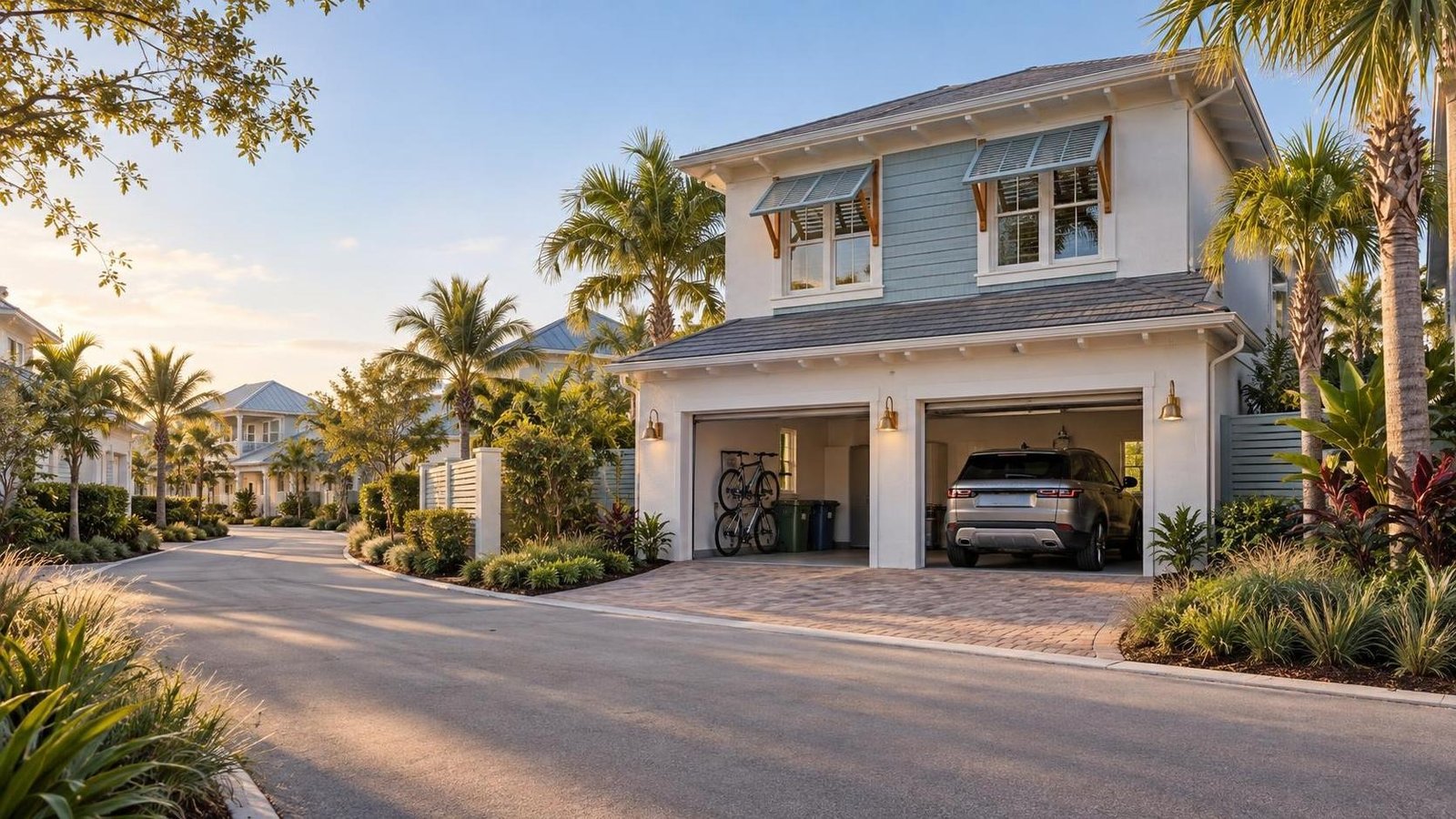
The tradeoff is that the driveway becomes part of the front-yard experience. Parked vehicles can sit between the porch and the street. Basketball, bicycles, deliveries, and children walking toward a vehicle may share the same space. A short driveway can look adequate when empty but leave little room once garage storage prevents a vehicle from going fully inside.
That is why I measure use, not just concrete. If garage depth and storage are part of your decision, my comparison of a larger Viera garage versus a lower payment with better storage planning offers a useful second lens.
Trash day deserves its own walkthrough
Cart logistics sound minor until they interfere with the exact path you use every week. At an alley-loaded home, ask where the carts are stored, where collection actually occurs, and whether they narrow the garage turn or block a neighbor’s maneuvering space. At a front-entry home, trace the route from the storage area to the pickup point and check whether the carts compete with parked vehicles, gates, landscaping, or a sidewalk.
The Brevard County Solid Waste residential collection page is an official starting point for county service questions, but it does not replace address-specific confirmation. The provider, pickup point, community arrangement, and association rules can differ. I would ask the seller and association manager to identify the current routine in writing and then verify it independently.
Also look beyond pickup morning. Can the carts return to a screened location without crossing a parked car’s path? Will a resident with limited mobility manage the grade and distance? Does the garage door have to remain open while carts are moved? A layout that saves five minutes twice a week may be worth more to one household than decorative front-yard space.
School-morning traffic is an address-level question
“Near a school” does not tell you how the morning will work. Your route may depend on the exact address, grade level, bell time, bus eligibility, before-care, after-care, and which adult continues to work after drop-off. Brevard Public Schools’ current Transportation page links an address-level zoned-school lookup and provides the district starting point for transportation questions. Use that official information rather than assuming the neighborhood name determines the routine.
Then test the home during the real school window. Watch how vehicles enter and leave the street or alley. Notice whether drivers queue near an intersection, whether parked cars reduce visibility, and whether you can turn toward your next destination without circling the block. Repeat the test after dismissal if afternoon pickup, activities, or childcare matter.
This is not about declaring one Viera street “good” and another “bad.” Traffic changes by time, calendar, construction, and school operations. The useful question is whether the property gives your household a calm, repeatable route. My guide to testing school-day Stadium Parkway traffic before accepting another home tradeoff explains the same decision principle in more detail.
Read the recorded documents before you trust the routine
A visible driveway or paved alley does not answer every ownership question. Review the survey, recorded plat, declaration, current rules, architectural standards, parking provisions, and any maintenance responsibility affecting the lane or apron. Look for easements, common-area boundaries, private-road language, guest-parking rules, overnight restrictions, and instructions for carts, trailers, work vehicles, or garage changes.
The Brevard County Clerk’s Official Records page explains that recorded real-estate instruments include deeds, subdivision plats, surveys, and declarations. The Clerk also cautions that its online search is a public service and that records at branch offices are the official public records. For a purchase, use the online system as a research starting point and direct title, survey, or legal questions to the appropriate professional.
Association documents matter just as much. Ask whether residents may park temporarily on the garage apron, whether the alley must remain clear, where guests are expected to park, and who handles repairs or drainage. If your plan depends on adding storage racks, a charging outlet, a camera, a fence, or a different garage door, confirm the approval path before assuming the change is allowed.
Compare the carrying cost of the routine, not only the price
Garage orientation rarely appears as a neat line item on a mortgage estimate, but it can create secondary costs. A tight alley may make a larger vehicle impractical. Limited apron space may push you toward off-site storage for a trailer or recreational equipment. A front-entry garage that is constantly used for household overflow may lead to cabinets, ceiling racks, a shed, or a paid storage unit.
There can also be convenience costs: moving one car to release another, replacing landscaping damaged by repeated cart movement, adding lighting or cameras, or paying for a feature you do not actually use. None of those automatically makes one layout inferior. They belong in the total monthly and daily-life comparison.
I suggest assigning each home a realistic first-year adjustment budget. Include storage, organization, lighting, charging, drainage review, and any approved exterior work. Then compare that figure with the price difference. A front-entry home that costs slightly more may still be the economical choice if it avoids a vehicle or storage problem. An alley home may be the better value if it gives you the porch, privacy, and front-room setting you would otherwise pay to create.
Use a four-part test before making the offer
First, complete a vehicle test. Bring the largest vehicle that will regularly use the property. Park, unload, turn, back out, and open the liftgate with the garage configured the way you expect to keep it.
Second, complete a Tuesday-morning test. Visit during the school and work window, identify the cart path, and map the first two turns toward school, I-95, medical offices, or your employer. If two adults travel in different directions, test both exits. Buyers balancing school pickup against neighborhood choice may also find my Viera and Rockledge school-pickup comparison helpful.
Third, complete a document test. Match the physical layout to the survey, plat, declaration, and association rules. Confirm guest parking, cart placement, alley maintenance, driveway use, and planned modifications.
Fourth, complete a resale test. Ask whether the layout serves only your current household or remains understandable to a future buyer. A specialized arrangement can still be a good purchase, but price it with a realistic view of who will appreciate it later.
The bottom line for Viera relocators
An alley-loaded garage is often the better fit when you value a quieter front elevation, a porch-centered streetscape, and separation between guests and household arrivals—and when the rear access works easily with your vehicles and carts. A front-entry driveway is often better when simple loading, obvious guest access, independent vehicle movement, and a straightforward school-morning routine matter most.
I help relocating buyers test these small-looking details because they become the texture of daily life after closing. We can compare the actual routes, documents, parking, storage, and first-year costs instead of guessing from listing photos. Reach out for a no-pressure conversation about Viera and Brevard County homes for sale with REAL Broker. Your next chapter starts here.
