

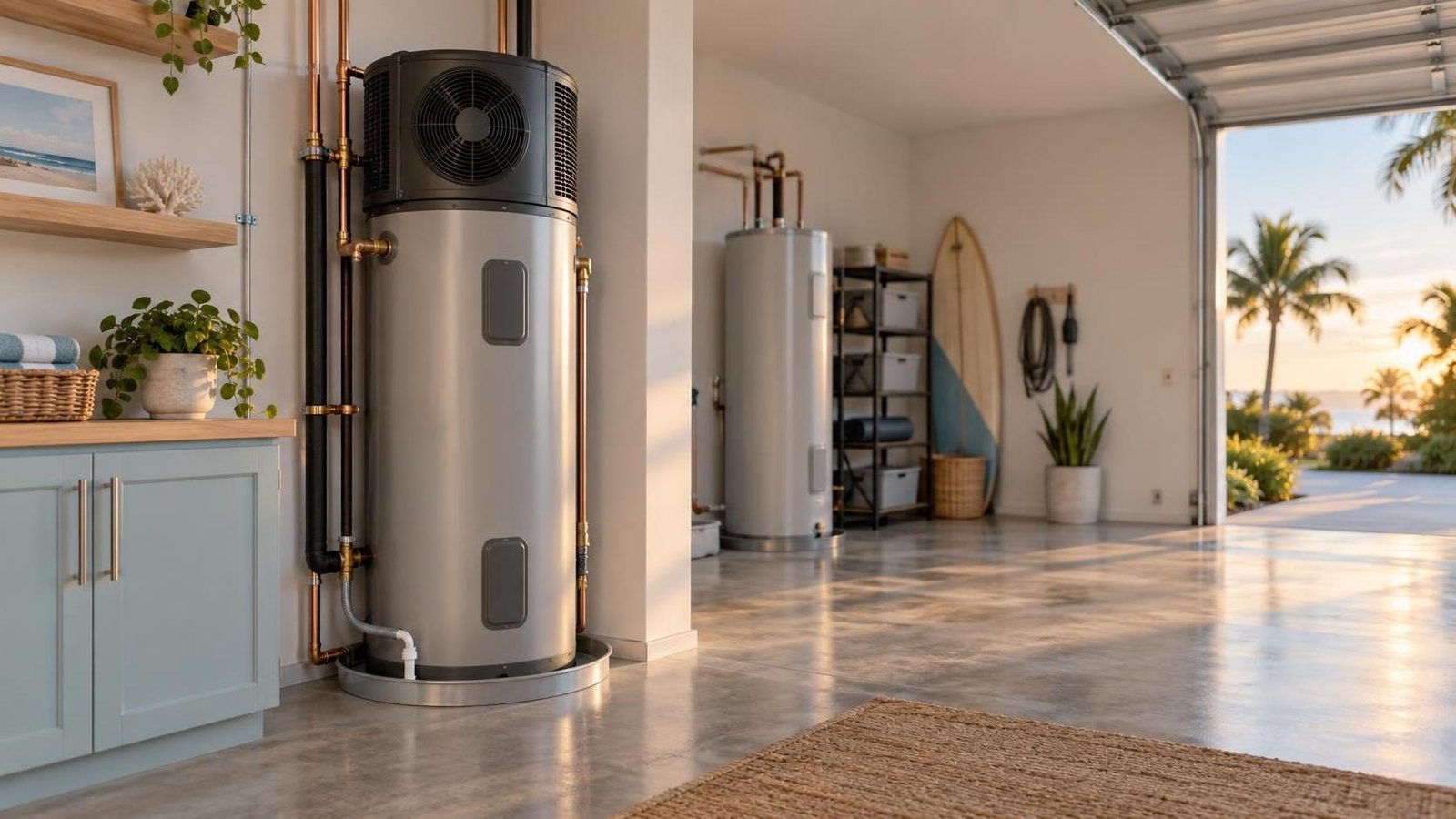
Heat-Pump Water Heater or Conventional Electric Tank: What Should Viera Relocators Choose?
By Carrie Liotta, Space Coast REALTOR® with REAL Broker | Published October 7, 2026
For many Viera households, a heat-pump water heater is the stronger long-term choice when the garage has enough air, a dependable condensate route, and room for service. A conventional electric tank is often the simpler choice when installation space, noise, recovery habits, or upfront cost matter more than maximum efficiency.
I would not choose between them from the technology name alone. The right decision comes from the actual garage, the household’s busiest hot-water hour, the model-specific EnergyGuide labels, and two complete installation proposals. A highly efficient unit in the wrong space can become an expensive compromise; a basic tank that fits cleanly can be the more practical ownership decision.
Start with the Viera garage, not the sales brochure
Many Viera buyers will find the water heater in a garage or utility area, but those spaces are not interchangeable. Before comparing equipment, measure the available footprint and height, photograph the plumbing and electrical connections, identify the drain-pan and relief-discharge routes, and note what else shares the space. A garage may also hold two vehicles, ceiling racks, a freezer, sports equipment, storm panels, and access to an attic or air handler.
A heat-pump water heater pulls heat from surrounding air and transfers it into the tank. That makes available air volume and temperature part of the installation, not background details. ENERGY STAR’s current heat-pump water-heater guidance tells shoppers to check where the unit will be installed, whether the space stays within the selected model’s temperature limits, and whether enough surrounding air is available. It also warns that the unit can cool the space around it.
That cooling may feel welcome in a hot garage during part of the year, but it is not free air conditioning for the house. The effect depends on run time, mode, garage volume, door use, ventilation, and the specific model. If a laundry alcove, pantry wall, or conditioned room shares the enclosure, ask the contractor how air moves and whether ducting or a louvered opening is allowed by the manufacturer.
A conventional electric tank wins on simplicity
A standard electric resistance tank is familiar equipment. It does not need to draw room air across a heat pump, it has no compressor fan, and it usually presents fewer location variables when replacing a similar existing unit. For a buyer moving on a tight schedule, that simplicity can make the proposal easier to understand and the installation easier to coordinate.
Simple does not mean maintenance-free or automatically inexpensive to own. The tank still needs the correct capacity, electrical supply, shutoff, temperature-and-pressure relief discharge, safe support, service access, and any required pan or leak protection. Its age, condition, permit history, and installation details can matter to an insurer or inspector. My guide to older water heaters and Brevard County insurance underwriting explains why buyers should verify the equipment rather than relying on a listing’s age estimate.
A standard tank uses electric resistance; a heat-pump model moves heat and can call on resistance backup. That affects expected operating cost, but it does not predict either unit’s cost in your home.
Compare labels model to model
Ask for the full model numbers and the yellow EnergyGuide labels for the exact capacities being proposed. The Federal Trade Commission explains that EnergyGuide labels use Department of Energy test procedures to disclose estimated annual energy cost or efficiency information and help shoppers compare similar products.
The estimate is a comparison tool, not a promise about a Viera electric bill. Household size, shower duration, incoming water temperature, thermostat setting, utility rate, recirculation, vacation habits, operating mode, and how often backup resistance heat runs all change real use. Compare labels for tanks that can meet the same household need, then ask the contractor to explain any difference in first-hour delivery and recovery.
Do not accept a generic payback claim without seeing the math. Put these items on one page:
- Equipment, delivery, labor, permit, and disposal price.
- Any electrical, plumbing, platform, louver, drain, duct, or condensate-pump work.
- Model-specific EnergyGuide estimate and warranty.
- Expected filter and maintenance tasks.
- Tank capacity, first-hour rating, and the mode assumed for peak demand.
- Any verified current rebate, with eligibility and expiration date in writing.
ENERGY STAR’s home-upgrade page still notes that the former federal tax credit for qualifying heat-pump water heaters ran through December 31, 2025. Because this is a 2026 decision, I would not build a purchase budget around that expired credit. Check current local and manufacturer programs at the time of purchase instead of carrying an old incentive into today’s comparison.
Size for the busiest hour, not the bedroom count alone
A relocating household may use hot water very differently from the current owner. Two adults with staggered schedules can have less peak demand than a household taking several showers while the dishwasher and washing machine run. Visiting family, a large soaking tub, or a high-flow shower can change the picture again.
ENERGY STAR advises using the existing tank capacity as a starting point and discussing a larger unit when occupants or frequently used fixtures are being added. Its current installation guidance notes that heat-pump models are often somewhat larger than conventional tanks and commonly come in several capacities. The selected unit still has to fit beneath shelves and around piping while preserving the manufacturer’s clearances and filter access.
Ask what happens when demand exceeds the efficient heat-pump mode. Some models can use electric resistance elements or different operating modes to recover faster, but that can change energy use. The practical goal is not to keep a unit in its most efficient mode at all costs. It is to choose a tank and control strategy that delivers enough hot water without forcing the household into constant backup operation.
Condensate and sound are ownership details
Unlike a conventional electric tank, a heat-pump unit creates condensate as it cools and dehumidifies surrounding air. ENERGY STAR says that condensate can be directed to a nearby drain or condensate pump. In a showing, I want buyers to trace that route rather than simply notice a small tube and assume it is complete.
Ask where the line terminates, whether it has proper slope, how it is protected from damage, how a pump failure would be noticed, and whether the route crosses vehicle or storage space. Look for staining, algae, loose fittings, an overflowing pan, or a line that disappears into a wall without documentation. If the home already has HVAC or dehumidifier drainage nearby, do not assume the water-heater connection was designed as part of that system. My article about Viera dehumidifier drainage and attic insulation shows why a drainage route deserves the same attention as the equipment it serves.
Listen to the unit too. A heat-pump model has a fan and compressor. Garage construction and a nearby bedroom can change how that sound is perceived, so run the unit when possible and listen from the nearest quiet room.
Verify the whole installation before assigning value
Whether the home already has a hybrid unit or you are pricing a future conversion, ask a qualified contractor to review more than the tank. Confirm the circuit and breaker, conductor size, shutoff, water connections, seismic or restraint details when applicable, relief discharge, drain pan, leak protection, support, clearance, condensate disposal, and service access. A taller replacement may conflict with overhead racks or force plumbing changes.
The 2023 Florida Building Code, Residential, Chapter 28 is the current state residential water-heater reference starting point. The applicable requirements still depend on the installation, work date, manufacturer instructions, and authority having jurisdiction. For a Viera address, verify the parcel’s jurisdiction and current permit path rather than assuming an online record search tells the whole story.
If a heat-pump unit is already installed, request the invoice, permit and final inspection when applicable, model number, warranty, EnergyGuide label, manual, condensate details, maintenance history, and settings. Check filter access and confirm that any connected app can transfer to the buyer.
How I would compare two otherwise similar Viera homes
I would give the heat-pump unit real value when it is correctly sized, documented, serviceable, and installed in a garage that can support its airflow and condensate needs. I would also want the household to be comfortable with its sound and controls. The benefit is weaker when the unit is squeezed into a small enclosure, the filter cannot be reached, drainage is improvised, or the family routinely overrides efficient operation to meet demand.
I would not discount a home simply because it has a conventional electric tank. If that tank is newer, well documented, properly installed, and adequate for the household, the buyer can compare its expected operating cost with the higher upfront cost and added work of a future heat-pump replacement. A basic system with a clear file is often preferable to premium equipment with unresolved installation questions.
Also protect the garage’s primary jobs. If the heat-pump model, condensate route, or required air opening eliminates the only practical freezer outlet, vehicle clearance, or storm-panel wall, that lost function belongs in the decision. My guide to choosing a Viera garage freezer circuit versus a better interior pantry makes the same point: one appealing feature should not be valued without mapping the space and electrical capacity around it.
Use the inspection period to price the real choice
If the installed water heater is older or the comparison affects your offer, I would try to complete these steps before the inspection deadline:
- Record the model, serial number, capacity, age, EnergyGuide information, operating mode, and visible condition.
- Test representative hot-water use and ask the inspector to document leaks, corrosion, pan, relief discharge, electrical supply, and installation concerns within the inspection scope.
- Measure the room or garage volume, height, clearances, filter access, and conflict with parking or storage.
- Obtain proposals for like-for-like replacement and a heat-pump alternative, including every required modification.
- Verify the condensate destination and price any pump, drain, louver, or duct work.
- Compare model-specific labels, warranties, expected maintenance, sound ratings, and hot-water delivery.
- Confirm current permits and incentives rather than relying on an old listing or contractor estimate.
Then decide whether the issue calls for seller correction, a credit that works within the transaction, condition-based pricing, or simply a future reserve. Do not reduce the choice to “efficient is good” or “simple is safe.” The better system is the one that fits the house, demand, and ownership plan with fewer hidden compromises.
Bottom line
For a suitable Viera garage and a household planning to stay, a properly sized heat-pump water heater can justify its higher installation complexity through lower expected energy use. A conventional electric tank remains a sensible choice when space is constrained, peak recovery is difficult to model, the garage is sensitive to sound or cool discharge, or the simpler proposal protects cash and storage.
If you are comparing Viera homes with different water-heating systems, reach out for a no-pressure conversation with Carrie Liotta, Space Coast REALTOR® with REAL Broker. I can help you organize model records, contractor questions, and the complete monthly-cost picture before your deadline. You can also join my private Facebook group, Moving to Brevard County Florida. Your next chapter starts here.
