

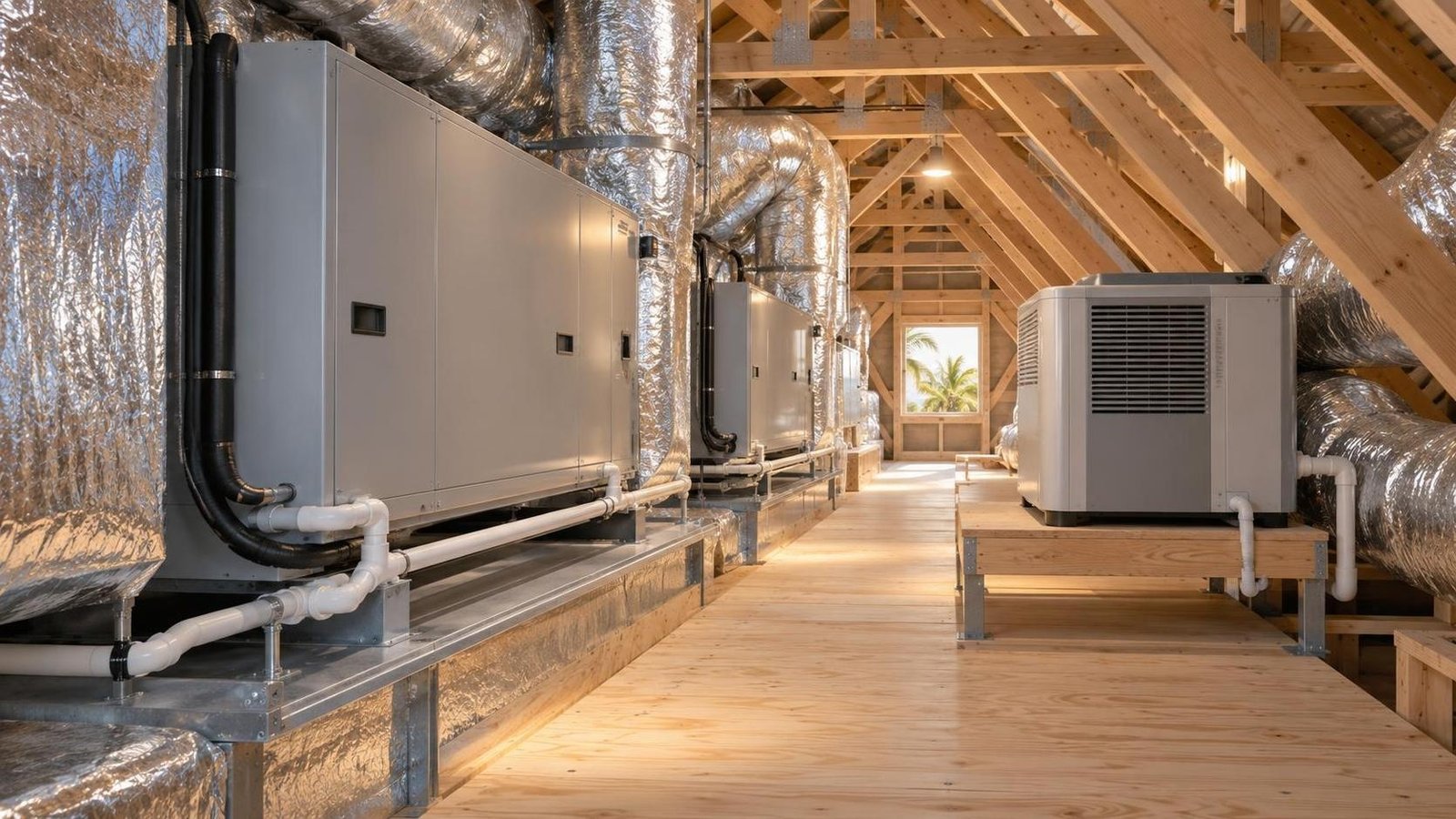
Attic Dehumidifier Blocking Access to a Second Air Handler: What Should Viera Buyers Verify?
By Carrie Liotta, Space Coast REALTOR® with REAL Broker | Published October 4, 2026
Do not accept “the technician can squeeze past it” as the answer. A Viera buyer should have an HVAC contractor verify that the dehumidifier platform preserves a practical route to inspect, maintain, repair, and eventually replace the second air handler. If it does not, define the correction before the inspection period ends.
This is not only a question of whether someone can crawl through the attic today. The farther air handler may need filters changed, panels removed, drains cleared, motors or coils serviced, and one day the entire cabinet replaced. A platform that leaves a narrow body-width gap can still make normal work difficult, damage insulation or ducts, and turn a routine service call into a larger project.
Start by mapping all three pieces of equipment
Ask the inspector and HVAC contractor to identify the first air handler, the second air handler, and the whole-home dehumidifier separately. Record each model number, installation date if known, area served, filter location, service-panel side, disconnect, drain route, overflow protection, and visible duct connection. Then draw the route from the attic opening to each unit.
The drawing should show more than the centerline of a walkway. Mark the dehumidifier platform footprint, roof framing, truss webs, ducts, electrical and control wiring, condensate piping, drain pans, insulation depth, lighting, and any places where a person must turn, kneel, or step over an obstacle. Photograph the route from both directions without moving or opening equipment yourself.
Ask what came first. If the dehumidifier was added later, the invoices and permit history may reveal whether anyone reevaluated access to the older equipment. If both were installed together, look for a plan, final inspection, or contractor sketch showing the intended service route.
Being able to enter the attic is not the same as being able to service the unit
A buyer may see a usable pull-down ladder and assume the access question is solved. It is not. The attic opening only gets a technician into the space. The important issue is whether that person can reach the second air handler with tools, open the required panels, remove serviceable components, work without leaning on ducts or drain lines, and exit safely.
Have the contractor demonstrate the route while the system remains closed and operating conditions are safe. Ask the contractor to point out:
- where a technician stands or kneels to remove each access panel;
- how the filter, blower assembly, control components, drain fittings, and other serviceable parts come out;
- whether the dehumidifier platform blocks a panel swing or the straight-line removal path for a component;
- whether tools and replacement parts can travel through the narrow point without resting on insulation, ducts, or piping;
- whether lighting and a stable work surface continue to the second unit; and
- what would need to be dismantled if the farther air handler were replaced.
The current 2023 Florida Building Code, Mechanical, Eighth Edition addresses appliance access and service space, including appliances in attics. That is the right code starting point, but a listing photo cannot establish compliance. The installed manufacturers’ instructions, the home’s permit history, the equipment arrangement, and the authority having jurisdiction all matter.
Measure the working route, not just the tightest gap
A single tape-measure photo can be misleading. The narrowest point matters, but so do headroom, turning room, changes in elevation, and the location of fragile systems along the route. A gap that looks adequate at floor level may be unusable when roof framing narrows shoulder space. A platform may preserve a straight passage but eliminate the room needed to rotate a service panel or pull a long component.
I would ask the HVAC contractor to document three different paths:
- Routine-maintenance path: the route for filters, drain cleaning, controls, electrical checks, and visual inspection;
- Repair path: the space needed to reach and remove components that the installed manual identifies as serviceable; and
- Replacement path: how the air-handler cabinet could leave the attic and how a replacement could arrive without cutting an unknown route through finished ceilings or dismantling unrelated equipment.
The replacement path does not need to make a future change effortless. It should be understood. If the realistic plan is to remove the dehumidifier and platform first, ask who would perform that work, what ducts, drains, wiring, or controls would be disturbed, and whether reinstallation would require new permits or inspections. That sequence belongs in the ownership-cost discussion now.
Check whether the platform created other conflicts
The platform itself deserves inspection. Determine what supports it, what it is attached to, whether it compresses insulation, and whether it was built as a service surface or simply as a shelf for the dehumidifier. Do not assume plywood laid across framing is designed for repeated foot traffic or equipment weight. A general inspector can document visible conditions; structural or construction questions may require the appropriate qualified professional.
Next, look underneath and around it. Later platforms sometimes hide drain fittings, junctions, ducts, dampers, wiring, or the edge of an auxiliary pan. They can also make it difficult to see staining or reach a float switch. The buyer needs a clear record of what remains accessible after the installation, not just a clean photograph of the equipment from the hatch.
The dehumidifier has its own maintenance needs. ENERGY STAR’s current whole-home dehumidifier guidance notes that these units need proper sizing and installation, a planned drain or condensate-pump route, and regular maintenance. If the filter or cabinet service side faces the second air handler, maintaining one appliance should not require putting the other at risk.
Verify drainage, controls, and shutdown protection while access is open
Restricted access is often the visible problem, but it can expose a larger coordination issue. Trace the condensate from both air handlers and the dehumidifier. Identify primary drains, auxiliary pans, pumps, float switches, cleanouts, and visible terminations. Ask which device shuts down which appliance when water does not drain normally.
Do not assume one nearby pipe serves only the closest cabinet. A recent 321 Coastal Living article on shared dehumidifier and air-handler drainage explains why each branch should be traced and tested instead of identified by appearance. In this Viera situation, the contractor should also confirm that the platform does not cover a cleanout, prevent pan removal, or force someone to disconnect a drain merely to reach the second unit.
Controls deserve the same clarity. Which thermostat serves each air handler? Is the dehumidifier integrated or independently controlled? Can each appliance be isolated for service? Florida law defines Class A and Class B air-conditioning contractor scopes to include installation, maintenance, repair, alteration, and evaluation of central air-conditioning equipment within the applicable classification. Verify the contractor through Florida DBPR and use the right licensed trade for any correction.
Pull the records before deciding whether this is a repair request
For a Viera property in county jurisdiction, start with the official Brevard County permit search. Confirm the jurisdiction for the actual address, because a postal description does not replace a parcel-specific check. Search for the original HVAC installations, later replacements, dehumidifier work, duct modifications, electrical work, and any attic alteration reflected in the record.
A blank or incomplete search does not prove work was exempt or improper. Ask the seller for invoices, proposals, final inspections, equipment registrations, warranties, service notes, and photographs taken before the platform covered the area. Match model and serial numbers to the records. If the dehumidifier invoice names an HVAC contractor but says nothing about a platform or second-unit access, request a written evaluation of the present arrangement.
The best contractor letter is specific. It should identify the equipment evaluated, describe the route and service side, state what panels and components were accessed, note any limitation, and define the recommended correction. “Both units work” answers an operating question. It does not answer whether they can be maintained without avoidable damage or whether the farther cabinet can be replaced.
How should a buyer handle the cost and negotiation?
Do not price this from a photograph. One correction may be as limited as rebuilding or narrowing a nonstructural equipment platform while preserving the approved installation. Another may require moving the dehumidifier, changing duct transitions, rerouting drains and controls, adding a stable service surface, or redesigning the equipment sequence. If framing or finished-space access must change, the scope can expand again.
Ask for at least one written scope before the inspection deadline, and make sure it answers four questions:
- What exactly prevents normal service or replacement access?
- What work restores a usable route while keeping the dehumidifier properly supported and serviceable?
- Which licensed trades, permits, and final inspections are required for that scope?
- What equipment must be disconnected, recommissioned, or retested after the work?
If the route can be corrected cleanly before closing, a seller-completed repair with invoices and final documentation may be easier to evaluate than a vague credit. If the design needs more investigation, the buyer may prefer a price adjustment or credit that fits the lender and contract, supported by a realistic proposal. The buyer should also preserve a reserve for the age and service history of both air handlers. My analysis of a Viera resale with two HVAC replacement horizons shows why dual-system planning can outweigh a small monthly savings.
What would make me comfortable proceeding?
I would be comfortable when the physical route, paperwork, and contractor’s findings agree. The inspector can reach and document the area. The licensed HVAC contractor can access the required panels and service points without climbing on ducts or disconnecting another appliance. The dehumidifier has its own usable filter and service access. Drains and safeguards can be traced and maintained. The second air handler has a credible repair and replacement plan.
I would slow down when the evaluation is limited because no one can pass the platform, when the platform hides stains or drain protection, when a contractor says major parts cannot be removed, or when the only replacement plan is “cut the ceiling later.” I would also pause if moving the dehumidifier could disturb unverified wiring, controls, ducts, or drainage and no one has defined who owns the complete scope.
That does not automatically make the home a bad purchase. It means the defect should become a known project before the buyer loses inspection leverage. The equipment should function as a coordinated system, not as three installations competing for the same attic space.
Bottom line for Viera buyers
When a dehumidifier platform narrows the route to a second air handler, verify more than whether a person can squeeze through. Confirm routine service space, component-removal room, stable footing, drainage and control access, permit history, and the eventual replacement sequence. If any of those are unclear, obtain a written correction plan and use it in the purchase decision.
I help Viera buyers look beyond the equipment labels and understand how a home will actually be maintained after closing. Reach out for a no-pressure conversation about Brevard County homes for sale with Carrie Liotta, Space Coast REALTOR® with REAL Broker, and join my private Facebook group, Moving to Brevard County Florida, for practical relocation guidance. Your next chapter starts here.
