

Selling a Merritt Island Home With Shared Dehumidifier and Air-Handler Drainage? Document the Route
By Carrie Liotta, Space Coast REALTOR® with REAL Broker | Published October 3, 2026
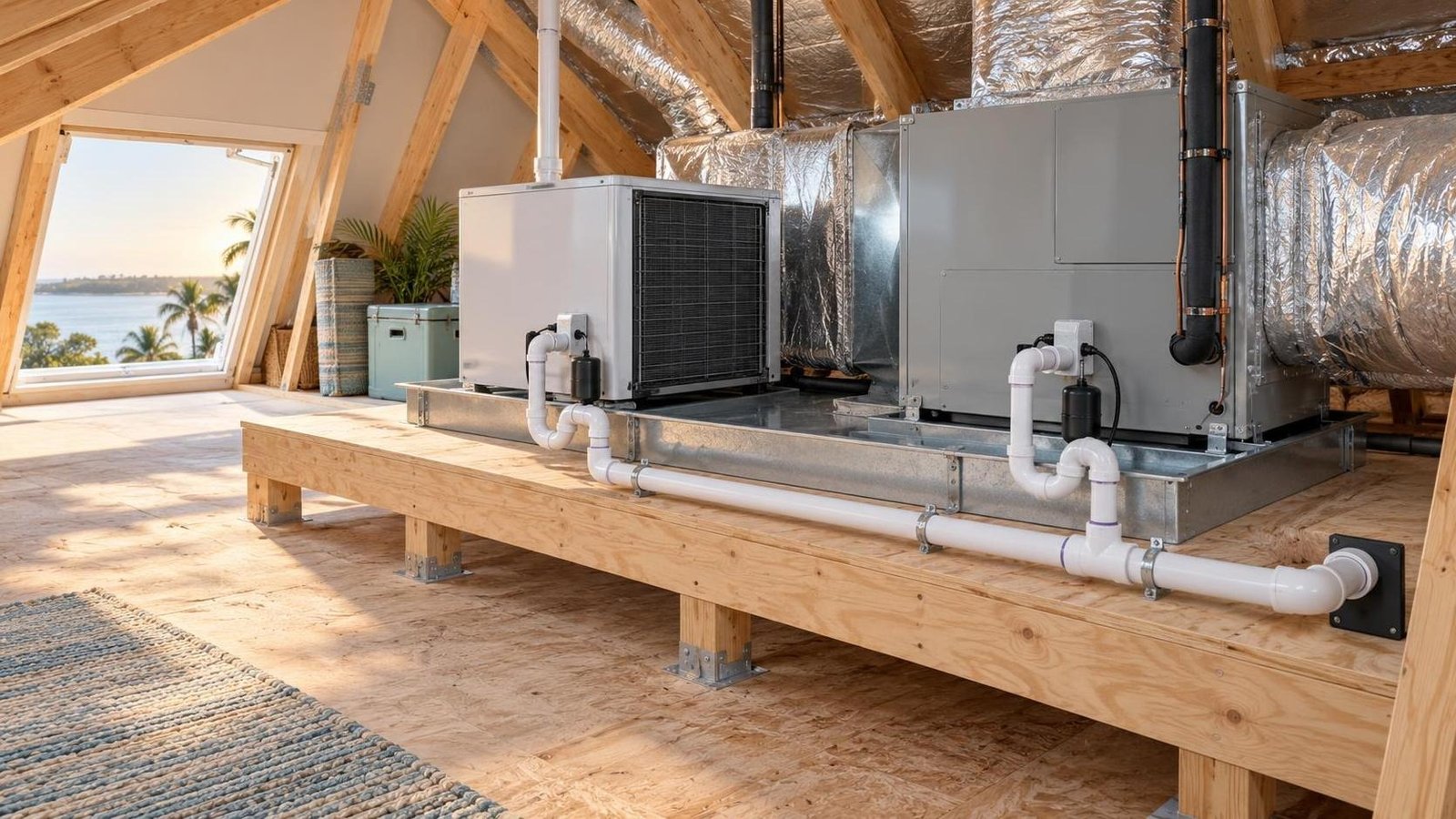
If an attic dehumidifier and air handler share one exterior condensate termination, do not label the arrangement defective or “good” from the pipe alone. Before listing, I would trace and label both branches, verify each appliance’s trap and overflow protection, test the combined route, and obtain a written HVAC evaluation that a buyer can follow.
This detail can create unnecessary suspicion in a Merritt Island sale. A buyer sees one PVC pipe dripping outdoors, then discovers two moisture-removal appliances in the attic. The seller may honestly remember installing the dehumidifier but not how its drain was tied in. An inspector may see a tee without being able to confirm the concealed route. What could have been a straightforward maintenance record becomes a question about blockage, backup, ceiling damage, and undocumented work.
The solution is not to promise that shared drainage is always acceptable. It is to remove the mystery before the home reaches the inspection period.
One exterior pipe can hide two separate systems
An air conditioner removes moisture while it cools. A whole-home dehumidifier can remove moisture when the cooling system is not running enough to control indoor humidity. Both may produce condensate, but they do not necessarily run at the same time, at the same rate, or under the same pressure conditions.
Start at the equipment, not at the exterior wall. Photograph the air handler, evaporator-coil cabinet, dehumidifier, drain pans, model plates, traps, cleanouts, float switches, pumps, and every visible fitting. Follow each branch until it joins another line or disappears behind construction. Then trace the common line to its final discharge point. A simple sketch showing “air handler,” “dehumidifier,” “tee,” “cleanout,” and “exterior termination” can be more useful than twenty unlabeled attic photos.
I would also mark the branches with removable service labels. The labels should identify the equipment served, not make claims such as “primary,” “emergency,” or “code compliant” unless a qualified professional has confirmed those functions. If a pipe cannot be traced, write “route not visually confirmed” instead of guessing.
Shared does not automatically mean improper
Two appliances joining one route may be workable when the installed equipment allows it, the line is properly sized and pitched, each appliance drains as designed, the connection does not defeat a trap, and adequate overflow protection remains in place. The same-looking arrangement can be a problem when one appliance pushes or pulls air through the other branch, the common line is undersized or poorly sloped, a tee creates a debris point, or a blockage can back water into both cabinets.
That is why a seller should avoid diagnosing the system from appearance. The current 2023 Florida Building Code, Mechanical, Eighth Edition places condensate disposal in Section 307. It is the appropriate code starting point, but the applicable building official and licensed professionals must interpret the actual installation, equipment instructions, permit history, and property jurisdiction.
For a Merritt Island seller, the practical question is more specific than “Can drains be shared?” Ask: does this exact dehumidifier permit the connection, does this exact air-handler configuration drain correctly, and what happens if the common section stops flowing?
Model-specific details matter more than a generic diagram
Find the manuals for both units by model number. Do not use a random internet diagram because it resembles the attic. Manufacturers can specify drain diameter, trap dimensions, vent placement, slope, pump requirements, service clearances, and safety-switch wiring differently.
For example, the March 2024 Santa Fe Ultra98/120 installation instructions require a trap for that product, call for a three-quarter-inch PVC drain assembly with stated pitch, and describe secondary-pan and float protection where leakage could cause damage. The manual also explains that negative pressure at a dehumidifier drain pan can pull air backward through the drain and cause water to pool inside the unit if the trap is wrong.
That manual is a useful example, not a universal rule for every brand. Your seller file should contain the manual for the equipment actually installed. Highlight the drainage page and ask the HVAC contractor to state whether the observed trap, vent, line size, pump, and tie-in follow those instructions. A buyer should not have to compare fittings in a dark attic to a fifty-page manual during a short inspection window.
Test each appliance alone, then test the combined route
A dry pipe during a ten-minute showing proves very little. Weather, thermostat settings, indoor humidity, and equipment staging all affect condensate production. Before listing, have the HVAC contractor perform an appropriate drainage test under controlled conditions. The contractor—not the seller or listing agent—should decide how to introduce water or operate equipment safely.
I want the written service note to answer these questions:
- Does the air-handler branch drain freely when the dehumidifier is off?
- Does the dehumidifier branch drain freely when the cooling system is off?
- What happens when both systems produce water?
- Can water or air move backward toward either appliance at the connection?
- Is the common route continuously supported and properly sloped?
- Where are the service cleanouts, and can a technician reach them without cutting pipe?
- Which float switch, auxiliary pan, or pump safety stops each appliance if drainage fails?
- Does the final termination discharge where it can be observed and maintained without damaging the house?
If the exterior termination is hard to see, buried in landscaping, discharging above a roof surface, or creating a recurring wet area, address that separately. My guide to a second-story condensate drain above a roof valley explains why the destination matters even when the equipment is draining.
Overflow protection should remain independent and understandable
The common pipe is not the entire protection strategy. Attic equipment sits above ceilings, insulation, wiring, and finished rooms. A seller should document the auxiliary pans, secondary outlets, float switches, pump safeties, and control connections that respond when normal drainage fails.
Ask the contractor to identify what shuts down the air handler and what shuts down the dehumidifier. If one switch controls both, have that written clearly. If the appliances have separate protection, document each device and test result. If an emergency or warning outlet exists, keep its function distinct from the normal combined discharge. A buyer should be able to tell the difference between routine dripping and a visible warning that something is blocked.
The U.S. Environmental Protection Agency’s moisture and mold guidance identifies poorly draining air-handler condensate pans as a hidden-moisture concern and recommends keeping pans sloped toward drains with the drains flowing freely. That does not mean a shared line proves mold is present. It explains why free drainage and prompt correction of leakage matter, especially when equipment is above finished space.
Build one clean seller file before photography
I would organize the records in the order a buyer is likely to ask for them. Include the dehumidifier installation invoice, HVAC replacement or coil records, permits and finals if applicable, model and serial numbers, both manuals, service history, drain-cleaning records, pump replacement receipts, and the latest written evaluation. Add dated photographs of the branches, traps, pans, switches, tee, cleanouts, common route, and exterior termination.
Check permit history in the correct jurisdiction. A Merritt Island address does not tell you everything needed about the applicable record source, and permit databases may not show every service repair. If the dehumidifier was installed later than the air handler, explain that sequence with invoices instead of implying the entire system was installed at once.
If the home has ever had staining, a drain overflow, a condensate-pump failure, wet insulation, ceiling repair, or microbial remediation, keep the event and repair records together. This is the same documentation principle I recommend when selling a home with prior water intrusion or drainage repairs: describe what happened, who diagnosed it, what was corrected, and how the repair was verified.
Do not market the dehumidifier beyond what the records prove
A whole-home dehumidifier can be valuable in a hot-humid coastal climate, but the listing should stay factual. State the make, model, installation date, area served, recent service, and documented control setting if those facts are known. Do not promise that the equipment “prevents mold,” guarantees a specific indoor humidity, or solves every moisture source.
Indoor humidity can be affected by equipment sizing, duct leakage, ventilation, air sealing, occupancy, thermostat strategy, and building-envelope conditions. Buyers comparing comfort upgrades may find my article on dehumidifier drainage versus attic insulation helpful because the two improvements solve different problems. For the seller, the strongest claim is the one supported by installation and service records.
When should the seller correct the drain before listing?
I would seek a defined correction before listing if the route cannot be traced, either unit fails a drainage test, the common line sags or leaks, a trap is missing or inconsistent with the installed manual, service access is blocked, an attic pan lacks functioning protection, or the termination is damaging the roof, wall, foundation area, or walking surface. I would also correct improvised tubing, loose connections, unsupported pipe, and abandoned branches that make the active route impossible to understand.
Do not guess at cost. One house may need labels, cleaning, and a new service fitting. Another may need separate drains, a condensate pump, control wiring, pan work, attic access improvements, drywall repair, or a new exterior route. Obtain a written scope that separates the defect, the recommended correction, the contractor responsible, permit needs, and the test used after completion.
If the system is functional but unusual, documentation may be the right answer. If it is failing or unverifiable, a buyer credit leaves the technical problem in place and may not satisfy the buyer, insurer, lender, or inspector. Repairing before listing can preserve leverage when the scope is clear and the work can be documented properly.
My bottom line for Merritt Island sellers
One exterior condensate pipe is not the story. The story is two appliances, two drainage requirements, one common route, and a clear plan if that route blocks. Trace it, label it, compare each branch with its model-specific instructions, test both systems, document overflow protection, and keep the evidence in the listing file.
I help Merritt Island sellers turn mechanical details into a clean, factual presentation instead of waiting for them to become inspection-period surprises. Reach out for a no-pressure conversation about selling a Brevard County home with Carrie Liotta, Space Coast REALTOR® with REAL Broker, and join my private Facebook group, Moving to Brevard County Florida, for practical local guidance. Your next chapter starts here.
