

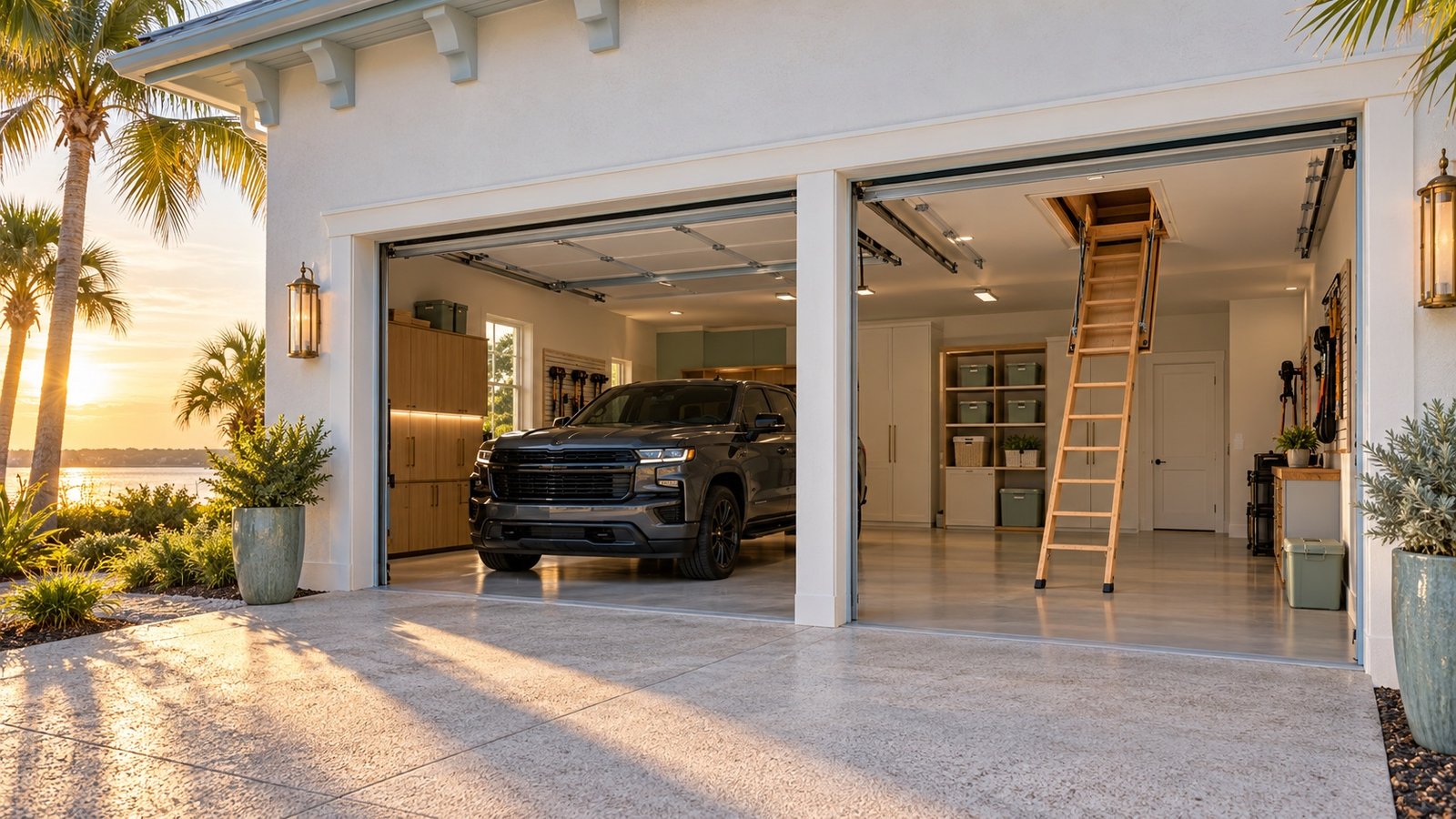
Deeper Work-Truck Bay or Clear Attic Access? A Titusville KSC Buyer’s Garage Test
By Carrie Liotta, Space Coast REALTOR® with REAL Broker | October 18, 2026
If you are relocating to Titusville for Kennedy Space Center, a deeper garage bay is usually the better choice only when it truly fits the vehicle or work setup you use every week. If both garages are narrow, I would not give up clear attic access just for a few extra feet of floor depth. A blocked attic opening can turn ordinary storage, insulation, HVAC, or electrical work into a recurring hassle and an avoidable due-diligence question.
This is not a rule that says every buyer needs the same garage. A work truck, long-wheelbase SUV, tool cart, fishing gear, launch-day chairs, and a household that moves often can make depth genuinely valuable. But I help Titusville buyers separate “I like more garage space” from “this house will work on an ordinary Tuesday.” The right choice is the one that gives you a usable parking routine and a service path you can explain to the next buyer.
Start with the daily-use test, not the listing photo
Garage listings can be misleading because an empty bay photographs bigger than a bay with a pickup, trash bins, bicycles, a rolling chest, and the boxes that have not made it upstairs yet. Before you fall for the deeper bay, ask the seller or listing agent for the interior depth and width at the narrowest points. Then bring a tape measure during the showing if the measurement will affect your decision.
I want a relocating buyer to test four things in the actual house: Can your vehicle enter without folding mirrors or moving a shelf? Can you open the driver door? Can you reach the water heater, panel, or other equipment without climbing over stored items? And can someone safely set up a ladder below the attic opening? A “two-car garage” is a description, not a promise that two particular vehicles and a work routine will fit.
For KSC and aerospace households, the deeper bay can earn its keep when a truck is not just transportation. It may carry job gear, a car seat, a cooler, tools, or equipment that cannot live outside in Florida weather. The useful question is not whether the truck fits on closing day. It is whether the vehicle, the door swing, and the walking aisle still work after the household settles in.
If quiet space matters as much as storage, read my related guide on choosing garage depth or a quieter bedroom wing in Titusville. The best tradeoff can change when one person works shifts or keeps a different schedule.
Why clear attic access is more than a storage detail
An attic opening is often the route to items you will need only occasionally, but that does not make it optional space. Insulation, ductwork, wiring, bath fans, and roof-related observations may all require access over the life of the home. A permanent shelf, built-in cabinet, parked vehicle, or stacked bins directly beneath the opening can make a simple visit more complicated than it needs to be.
During a showing, look up rather than assuming. Is the pull-down stair or hatch centered over a clear landing zone? Does the open ladder conflict with the garage door track, light fixture, shelves, vehicle roofline, or an overhead storage rack? If a prior owner installed storage, ask whether it can be moved and whether the attic has been accessed since the work was completed. A clean answer and a clear path are more useful than a vague assurance that “there is plenty of storage.”
That question has a future-cost angle. You may never need to climb into the attic yourself, but an HVAC technician, electrician, insulation contractor, or home inspector may need a practical route. A service visit that starts with moving a truck and dismantling a storage system is not automatically a deal-breaker. It is a cost of ownership to understand before you compare two otherwise similar homes.
Do not turn a garage compromise into unpermitted work
Buyers sometimes see the conflict and immediately imagine moving an attic opening, adding a receptacle, shifting lighting, or building a new storage wall. Pause before treating that as a weekend project. Florida’s permit law generally requires a permit before construction, alteration, modification, or repair work, and it specifically does not extend the small-work permit exemption to electrical, plumbing, structural, mechanical, or gas work at a single-family home. Read the current language in Florida Statutes section 553.79 before assuming a change is minor.
In Titusville, start with the city’s Building Department resources and confirm the current application, plan, and inspection path for the exact address and scope. The city provides an online permit-application link and building-department materials, but the property’s jurisdiction and the work itself determine what is required. A buyer should never rely on a seller’s old contractor story instead of checking the records and asking the appropriate local office.
If the solution touches wiring or an electrical panel, use an appropriately credentialed professional. The Florida Department of Business and Professional Regulation explains that electrical contractors are licensed and regulated through the Electrical Contractors’ Licensing Board, and describes the scope for installing, repairing, altering, or adding electrical wiring and related equipment. Its electrical-contractor information is a good starting point for understanding who should be doing the work.
What I would inspect before choosing the deeper bay
A deeper bay can be the better house. I just want the buyer to prove it, not assume it. I would make a short garage worksheet during the inspection period:
- Vehicle fit: Measure the vehicle with the tailgate, door, and mirrors considered. Include the room needed to walk around it.
- Attic path: Photograph the opening, ladder or hatch, and clear floor area below it before any seller belongings are moved.
- Service equipment: Identify the electrical panel, water heater, HVAC equipment, cleanouts, or other items that need reasonable access.
- Storage changes: Ask which shelves, racks, and cabinets convey, and which are attached to walls or ceiling framing.
- Records: If lights, outlets, a charger, a workshop circuit, or an attic stair were added, request permits, final inspections, invoices, and contractor information.
- Future layout: Sketch your truck, bins, ladder, and work surface before you promise yourself the garage can do everything.
A home inspection is not a design consultation, and a REALTOR® is not an electrician or building official. But this worksheet gives your inspector and any specialist a better question to answer. It also keeps a buyer from making a layout decision based only on a seller’s staging.
When the attic-access house is the smarter buy
I lean toward the clear-attic-access home when the deeper garage does not materially improve the way you live. Maybe both garages fit your vehicle, but the deeper one forces every seasonal box beneath the attic ladder. Maybe the deep bay gives you a handsome workbench, but it leaves no practical route to the panel. Or maybe the attic-access home has a slightly smaller bay yet a cleaner, more flexible floor plan with a driveway that handles the truck easily.
That flexibility has resale value even if no one can assign it a precise dollar amount. Future buyers may be military families, aerospace employees, retirees with storage needs, or people who simply do not want to solve a garage puzzle after closing. A clear garage that supports maintenance and ordinary storage tells an easier ownership story than a dramatic bay that works only when everything is arranged perfectly.
For buyers who expect heavier electrical use, my article on a work-truck air compressor and EV charger sharing a detached-garage subpanel is a useful companion. It is about capacity and verification, not about forcing every garage into a workshop.
When the deeper work-truck bay wins
The deeper bay wins when it solves a real, repeated problem: your truck cannot fit comfortably elsewhere, your gear must stay secure and dry, or your household needs a true staging area for an early shift, field work, or regular travel. In that case, look for a deep bay that still has a documented, physically clear service route. The best version is not “garage depth at any cost.” It is depth plus access plus records.
For an aerospace household moving from out of state, I would also compare the garage decision with the rest of the home’s daily function: commute route, driveway turn, HOA or parking rules, home office, and hurricane-prep storage. My guide to Brevard homes for engineers who need a workshop, quiet office, and practical commute can help you keep that wider picture in view.
My Titusville bottom line
Buy the deeper work-truck bay when it fits your actual vehicle and work life without sacrificing safe, usable access to the attic and service equipment. Choose the clearer attic-access layout when the added depth is mostly a nice-to-have and the deeper garage creates a permanent obstacle course.
Before you make an offer, I can help you compare the floor plan, garage measurements, records, inspection questions, and ownership tradeoffs—not just the listing photos. Reach out for a no-pressure conversation about Titusville and Brevard County homes for sale with Carrie Liotta, Space Coast REALTOR® with REAL Broker. Your next chapter starts here.
