

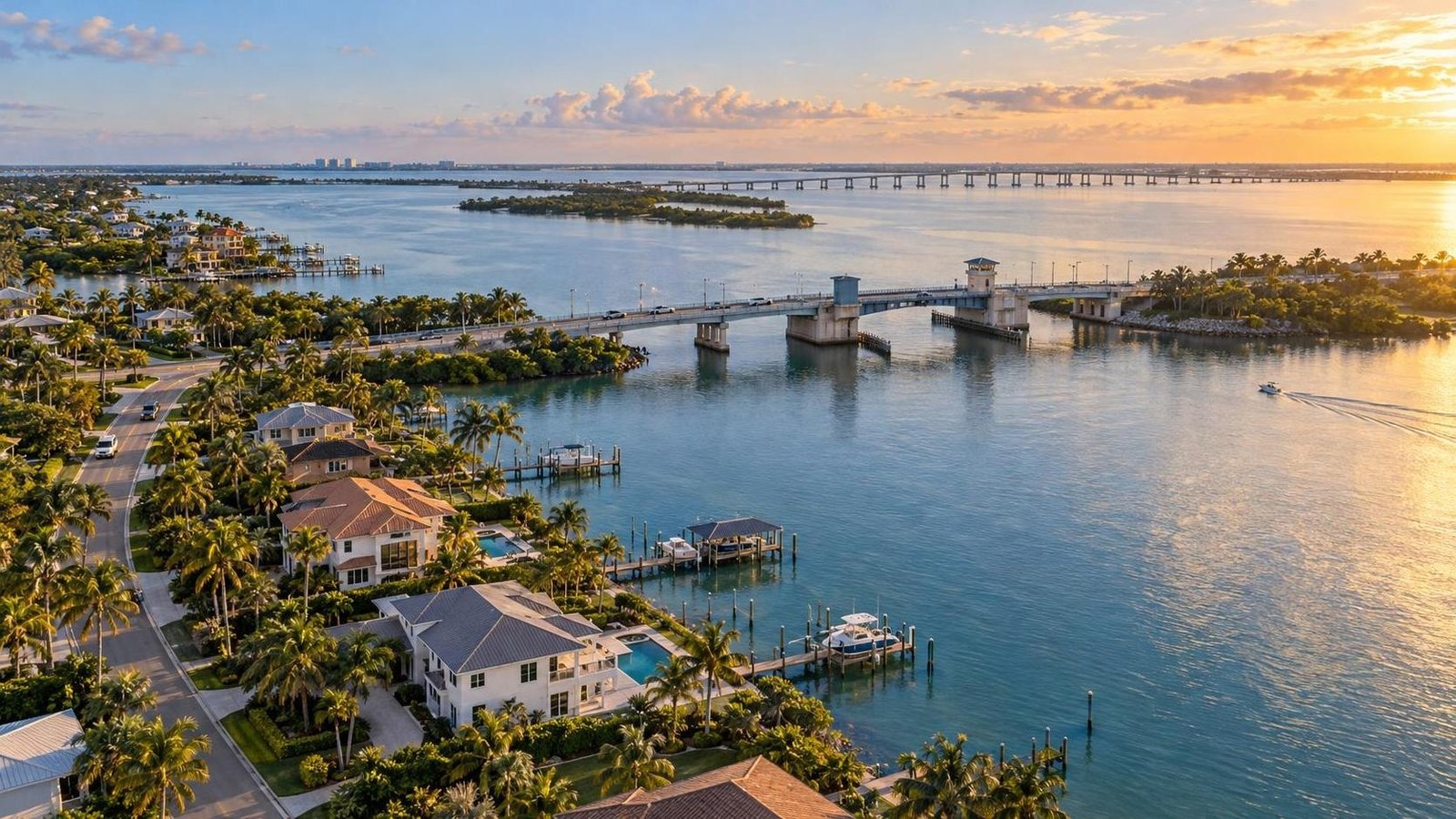
Living Near Mathers Bridge: What Should South Merritt Island Relocators Test?
By Carrie Liotta, Space Coast REALTOR® with REAL Broker | Published October 8, 2026
Before buying near Mathers Bridge, test the exact driveway-to-destination route at your real travel times, once through the bridge approach and once through your best Pineda Causeway alternative. South Merritt Island can be a wonderful fit, but only if an opening, school-line delay, or blocked turn does not break the household schedule.
I would not reject a home simply because a movable bridge is nearby, and I would not buy one because a map labels Pineda Causeway “close.” The location works when the household has a reliable normal route, a believable backup route, and enough time margin for the days when coastal infrastructure is doing exactly what it was designed to do.
Start by separating the bridge rule from your road delay
Mathers Bridge is not just scenery on a South Merritt Island map. It is a movable bridge serving both road users and vessels. The current federal rule in 33 CFR 117.263 says the Mathers (SR A-1-A) Bridge at Banana River mile 0.5 opens on signal. From 10 p.m. to 6 a.m. Monday through Friday, except federal holidays, the rule requires at least two hours’ notice for an opening.
That is useful evidence, but it is not a road-delay timetable. “Opens on signal” does not tell a homebuyer how often the bridge will open during one particular commute, how long traffic will take to clear, or whether a temporary maintenance or operational condition will affect a future day. The U.S. Coast Guard Bridge Program describes its role as balancing safe vessel passage with land-based transportation. That is the right mental model: two legitimate transportation needs meet at one crossing.
Observe the road as it functions instead of turning one quiet showing into a promise. If an opening occurs, record when you joined the queue and when traffic cleared. If none occurs, the trip still reveals turns, sight distance, school traffic, and the route’s normal rhythm; it does not prove openings will never affect you.
Trace the route from the driveway, not the neighborhood name
“Near Mathers Bridge” covers different daily lives. One home may naturally point east across the bridge for Indian Harbour Beach or beachside destinations. Another may make more sense north or west toward Pineda Causeway and mainland Melbourne. Two houses separated by a short distance can have different left turns, traffic exposure, and practical alternatives.
Put the actual address into a route worksheet and list every destination that controls the week:
- each adult’s work entrance, not merely the employer’s city;
- school, childcare, and after-school pickup locations;
- medical care and the pharmacy used after hours;
- grocery, sports, worship, and family-care trips;
- the beachside or mainland destination you expect to visit most often.
Then trace which trips truly require Mathers Bridge, which naturally use Pineda Causeway, and which have a third reasonable option. My broader guide to choosing north, central, or south Merritt Island for a Space Coast relocation explains why the island’s sections should not be compared by mileage alone. This home-level exercise takes that principle down to the driveway.
Run three different commute tests
A single navigation-app estimate is a starting point, not due diligence. I recommend three tests before the inspection period ends.
1. The ordinary workday
Leave at the time the household will normally leave, on the correct weekday. Use the real workplace gate, parking entrance, school drop-off lane, or childcare entrance. Note the time required to get from the driveway onto the main route, not just the time after the car is already moving. Repeat the return trip when the household would actually come home.
2. The bridge-exposure test
Drive the Mathers Bridge route even if a mapping app prefers another path that day. The goal is to understand the approach, the queue area, the turns on both sides, and what happens to the household schedule if traffic pauses. Do not stop in an unsafe place or try to manufacture an opening. Observe lawful conditions, and keep an unobserved opening in the uncertainty column.
3. The Pineda and backup-route test
Drive the best non-Mathers alternative under the same type of weekday conditions. A backup is only useful if the driver is genuinely willing to use it and the added turns, distance, school traffic, or congestion still fit the schedule. The route may perform differently in the opposite direction, so test both morning and evening obligations instead of assuming symmetry.
Use Florida 511 alongside those field tests. FDOT identifies FL511 as the state’s official traffic and travel information source, with covered-road information on congestion, crashes, construction, maintenance, travel times, cameras, closures, and detours. A current traffic tool can help explain why one test day was unusual. It still cannot guarantee the commute after closing, so save the date and conditions of each observation rather than treating one app screenshot as a permanent fact.
Pineda access is valuable only if the last mile works
Relocation listings often describe Pineda access as though the causeway begins at the front door. The more useful question is how the home reaches it. Does the route require a difficult left turn at the hour you travel? Is there a school zone or recurring pickup queue before the causeway? Does a narrow residential segment feel comfortable in darkness or heavy rain? Can both household drivers use the route without one person feeling that every trip is stressful?
This is where South Merritt Island can surprise buyers in either direction. A route that looks long on a screen may feel calm and predictable. A route that looks short may contain one turn or bottleneck that dominates the trip. I would compare total friction, not just the estimated minutes displayed before you leave.
Build a household route matrix before falling in love with the home
For a dual-career household, write the two work routes side by side. Add school pickup, a missed-bus scenario, one late shift, and one appointment on the opposite side of the county. Then label each route as normal, backup, or impractical.
A simple matrix often reveals the actual decision:
- Works well: both adults have a tested normal route, and at least one alternate keeps critical trips manageable.
- Works with schedule discipline: the home fits if departure windows remain flexible and one person can absorb occasional uncertainty.
- Fragile: one bridge pause, school delay, or incident causes a missed shift, pickup penalty, or impossible handoff.
The third category does not make the property bad. It means the property may be wrong for that household or needs to be priced against a real lifestyle cost. A remote worker with flexible hours may happily accept a route pattern that would be exhausting for a nurse changing shifts, a base employee with a fixed reporting time, or parents coordinating two schools.
Count the cost in more than minutes
Commute cost includes fuel and mileage, but those are rarely the only factors. Add the value of an earlier departure, extra childcare coverage, missed pickup risk, and the likelihood that one spouse becomes the default person for every time-sensitive errand. If the backup route adds distance, include that in the household budget without inventing a precise annual figure before you know the actual vehicle and schedule.
On the positive side, South Merritt Island may give a buyer the quieter established setting, water views, mature landscape, or coastal rhythm that makes the extra planning worthwhile. The purpose of the route test is not to talk you out of that lifestyle. It is to decide whether you are making a conscious trade rather than discovering it after closing.
Keep coastal-property due diligence separate from commute due diligence
A route that works does not answer the property questions. Review the exact parcel’s flood information through the FEMA Flood Map Service Center, obtain property-specific insurance quotes, and inspect the roof, openings, drainage, electrical, plumbing, and any waterfront components that apply. Verify permits and records rather than assuming every South Merritt Island house has the same exposure.
If boating is part of the purchase, road access and water access are two different investigations. My Brevard bridge-clearance and Canaveral Lock guide explains why boat route, vessel air draft, operating information, and temporary notices need their own verification. A bridge that affects a car trip can also matter to a vessel, but the buyer should not collapse those questions into one assumption.
Turn the route findings into an offer decision
Before writing, I would give each route one of three grades: dependable, conditionally workable, or untested. “Dependable” means the household drove it at the relevant times and has a reasonable alternate. “Conditionally workable” means the route depends on flexible hours, one untested variable, or a backup that adds meaningful friction. “Untested” means exactly that; it is not permission to fill the gap with optimism.
If the home is otherwise a strong fit, use the inspection period to finish the route work while you complete physical due diligence. Ask the seller factual questions about their normal travel pattern, but do not treat one person’s experience as a guarantee. Their employer, hours, tolerance, and destinations may be completely different from yours.
When two homes are close in price, compare the complete weekly package: route reliability, condition, insurance, flood review, maintenance, and the lifestyle each location buys. A renovated kitchen does not compensate for a route that repeatedly breaks the family schedule. Conversely, a slightly longer but calm, flexible route may be worth accepting for the right South Merritt Island setting.
My pre-offer Mathers Bridge route checklist
- Drive from the exact property at the household’s normal weekday departure time.
- Use the actual employee entrance, school queue, or childcare drop-off as the destination.
- Drive the return trip at the normal end of the day.
- Test the Mathers Bridge approach without assuming an opening will or will not occur.
- Test the best Pineda Causeway or other alternate under comparable conditions.
- Record construction, weather, school-day status, incidents, and unusual conditions.
- Check FL511 before leaving, then compare the digital report with what you observed.
- Run one schedule-stress scenario: late shift, school pickup, medical appointment, or simultaneous commutes.
- Keep route findings separate from flood, insurance, inspection, permit, and waterfront due diligence.
- Decide what uncertainty remains and whether the price and lifestyle justify it.
Bottom line
Living near Mathers Bridge can make sense for a relocating household that values South Merritt Island’s setting and can work with a movable-bridge corridor. The right evidence is not a best-case map estimate. It is a pair of real route tests, a workable household backup, and a clear understanding of which trips use Mathers Bridge and which depend on Pineda Causeway.
I help relocating buyers compare Brevard County homes at the level that matters after moving day: driveway, work entrance, school schedule, insurance file, and ownership responsibilities. Join my private Facebook group, Moving to Brevard County Florida, or reach out for a no-pressure conversation about Brevard County homes for sale. Your next chapter starts here.
