

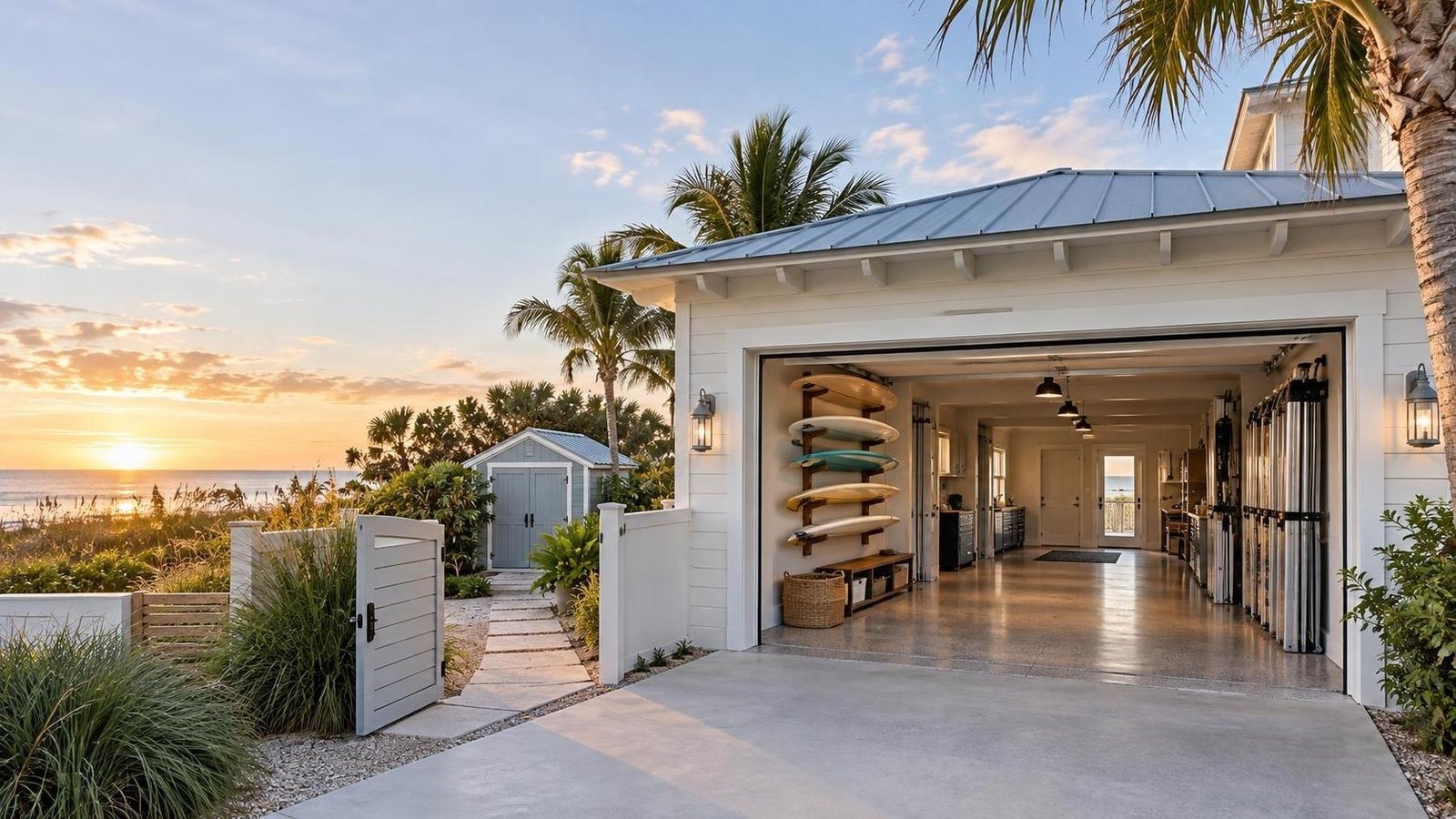
Tandem Garage or Detached Storm-Storage Shed Near the Beach: Which Satellite Beach Home Works Better?
By Carrie Liotta, Space Coast REALTOR® with REAL Broker | Published September 15, 2026
Choose the tandem garage if you need protected vehicle space, easier storm preparation, and storage that stays connected to the house. Choose the detached shed if your priority is separating sandy boards, bicycles, fishing gear, and yard equipment from the living space—and only after verifying that the structure is permitted, anchored, insurable, and sensible for the exact flood and drainage conditions.
Near a Satellite Beach public access, I would not decide from square footage alone. Test whether the garage actually works with two vehicles, whether the driveway is affected by legal beach parking or turnaround traffic, and whether the shed can safely hold the items you plan to store. A long garage and a detached building solve different problems.
A tandem garage is only useful if the circulation works
A tandem garage typically puts one parking or storage bay behind another. On paper, that can create the depth for two vehicles, a vehicle plus kayaks, or a workshop behind the primary parking area. In daily life, it can also mean moving one car whenever the rear space is needed.
Bring the measurements that matter: vehicle length and width with mirrors, garage-door opening, interior width around equipment, water-heater or laundry clearances, ceiling height, and the turning approach from the street. Open every vehicle door. Test whether bicycles, surfboards, hurricane panels, rolling bins, and a workbench still fit after the car is inside. If an electric vehicle is part of the plan, ask a qualified professional to evaluate the existing panel, receptacle, charger location, and permit history.
The tandem layout is strongest for a one-car household that wants deep enclosed storage or a two-car household with predictable departure schedules. It is weaker when two drivers leave at different hours, one works night shift, or moving the front vehicle every day will become a source of frustration.
A detached shed should be treated as a structure, not a bonus
A clean detached shed can be excellent beach-lifestyle storage. Wet chairs, sandy toys, paddle gear, fishing equipment, lawn tools, and bicycles do not have to travel through the garage or house. But buyers need to verify more than whether the door locks.
Start with the permit and site-plan history. Satellite Beach has its own municipal processes, so use the City of Satellite Beach’s official website and online permit resources to identify the correct department and current procedure. Ask whether the shed required permits when installed, whether final approval exists, and whether its location complies with setbacks, easements, utilities, lot coverage, and any association rules.
Then inspect anchoring, roof attachment, wall condition, door hardware, electrical work, ventilation, floor elevation, water entry, corrosion, termites, and surrounding drainage. A shed that sits in a low corner of the yard may be the first place water collects during heavy rain. A loose or poorly anchored structure is not the place to depend on for storm-season equipment.
Do not confuse dry today with low flood risk
A sunny showing tells you almost nothing about water behavior. Look for staining, swollen trim, rust at the base, settlement, patched wall panels, fresh paint in isolated areas, eroded soil, downspout discharge, and a yard slope that directs water toward the shed or garage.
Use the FEMA Flood Map Service Center for the official flood-hazard information supporting the National Flood Insurance Program, then review the exact parcel with the buyer’s insurance professional, surveyor, inspector, and lender. FEMA also notes that maps are updated over time, so save the effective product used in the transaction rather than relying on an old screenshot.
A flood-zone label does not tell you where runoff goes within one lot. Ask about prior water entry, drainage work, flood claims, elevation information, and whether stored belongings have ever been damaged. Keep irreplaceable papers, electronics, and hazardous materials out of a shed that is not designed for conditioned, elevated storage.
Storm preparation favors secure, documented space
Both layouts can help during storm season, but the garage usually gives faster access to panels, ladders, fasteners, tools, and bins. It may also protect vehicles and reduce the number of exterior objects that need to be moved. The tradeoff is that an overfilled garage can prevent the very vehicle protection the buyer expected.
A detached shed can keep panels and yard items organized if it is structurally sound and properly secured. Ask whether the panel set is labeled by opening, whether all fasteners and tracks are present, and whether the route from shed to house remains usable in rain. Heavy panels stored behind bicycles and lawn equipment do not represent an efficient plan.
The Florida Office of Insurance Regulation’s wind-mitigation resources are a useful reminder that insurance credits depend on documented building features and the applicable inspection—not a listing description. Ask the insurance agent how the garage door, opening protection, accessory structure, and detached contents are treated under the proposed policy.
Public beach access changes the driveway test
Living near a public beach access can be wonderful. It can also change weekend traffic, pedestrian flow, headlights, trash-day maneuvering, and the way guests approach the property. Visit the street early in the morning, after work, and during a busy beach period. Observe lawful conditions without assuming that every parked vehicle is violating a rule.
Confirm the actual property boundaries and driveway apron. A wide-looking shoulder may be public right-of-way rather than private parking. Ask whether vehicles can enter and leave the tandem garage without backing around beach traffic, and whether a truck or trailer can reach the shed without crossing landscaping, an easement, or an area too soft after rain.
Buyers choosing between storage and proximity should also read my comparison of a two-car garage versus walk-to-ocean access in Satellite Beach. The closer the home is to a popular access, the more important it is to test the street rather than imagine it from a map.
Which belongings belong where?
The tandem garage is generally better for vehicles, storm panels, power tools, e-bikes, charging equipment, and higher-value items that benefit from the home’s main security and electrical systems. Even then, buyers should evaluate heat, humidity, salt exposure, pest entry, and whether a garage floor has shown water intrusion.
The shed is well suited to rinsed beach gear, garden tools, empty coolers, utility carts, and durable outdoor equipment. Salt and moisture can still damage metal fasteners, bicycle chains, electrical contacts, fabrics, and fishing tackle. Verify ventilation and create shelving that keeps equipment off the floor. Never store gasoline, propane, batteries, or chemicals without following manufacturer, fire-safety, insurance, and local requirements.
Think about the return route from the beach. Can you reach an outdoor shower or hose, rinse the gear, and move it into the shed without dragging sand across the pool deck? Does the gate open wide enough for a paddleboard or beach cart? A detached shed may have more lifestyle value than extra garage depth when that route is excellent.
Insurance and resale need separate answers
Ask the insurance agent whether the detached structure is covered, what limits apply, how contents are treated, and whether unpermitted electrical work or water damage would create concern. Ask separately whether the tandem garage, garage door, or any enclosure affects the wind-mitigation and four-point review. Do not assume the larger-looking storage option automatically lowers a premium.
For resale, conventional enclosed garage space often appeals to a broad audience, but a legal, attractive shed can distinguish a beach home for buyers with surf, fishing, cycling, or gardening equipment. The value weakens if the shed occupies the only practical pool area, blocks drainage, sits on an easement, or would need to be removed.
The same whole-house thinking applies when buyers compare storm upgrades. My guide to impact doors versus unresolved drainage work explains why a documented feature cannot cancel a separate site problem.
Who should choose each layout?
Choose the tandem garage when vehicle protection, secure connected storage, storm-panel access, or workshop use leads the decision. It is particularly practical for one primary vehicle, a collector car, a household that coordinates departure times, or a buyer who does not want to cross the yard in bad weather.
Choose the detached shed when the home has a strong side-yard route, the structure is legal and well anchored, and the household owns a large volume of sandy or wet recreational gear. It can be the better lifestyle choice for a buyer who values a clean garage and wants beach equipment close to an outdoor rinse area.
Keep looking when the tandem bay cannot accommodate the vehicles, the shed occupies an easement or low drainage area, public-access traffic makes the driveway unworkable, or insurance and permit questions remain unresolved before the contract deadline.
My property-tour checklist
- Measure door opening, garage depth, pinch points, ceiling height, and vehicle clearances.
- Test two-driver circulation and access to stored gear with a vehicle parked inside.
- Review shed permits, final approvals, survey location, setbacks, easements, anchoring, and electrical records.
- Inspect both spaces for corrosion, pests, water entry, roof leaks, and drainage clues.
- Map the hose, rinse, gate, and storage route from the beach.
- Visit during a realistic public-access traffic period and verify lawful parking boundaries.
- Review flood information, prior water history, elevation details, and property-specific insurance quotes.
- Confirm storm panels, fasteners, labels, garage-door information, and a practical deployment plan.
- Decide whether the shed preserves or prevents future pool, patio, or side-yard plans.
Bottom line
A tandem garage is usually the safer all-purpose choice for protected vehicles, connected storm storage, and broad resale appeal. A permitted, anchored, well-drained detached shed can be the more useful Satellite Beach lifestyle feature when it creates a clean route for boards, bikes, fishing gear, and yard equipment.
If you are comparing beachside homes, I can help you test the storage layout, public-access pattern, permit file, flood information, insurance questions, and future-use tradeoffs before an attractive feature becomes an expensive assumption. Reach out for a no-pressure conversation about Satellite Beach homes with REAL Broker. Your next chapter starts here.