

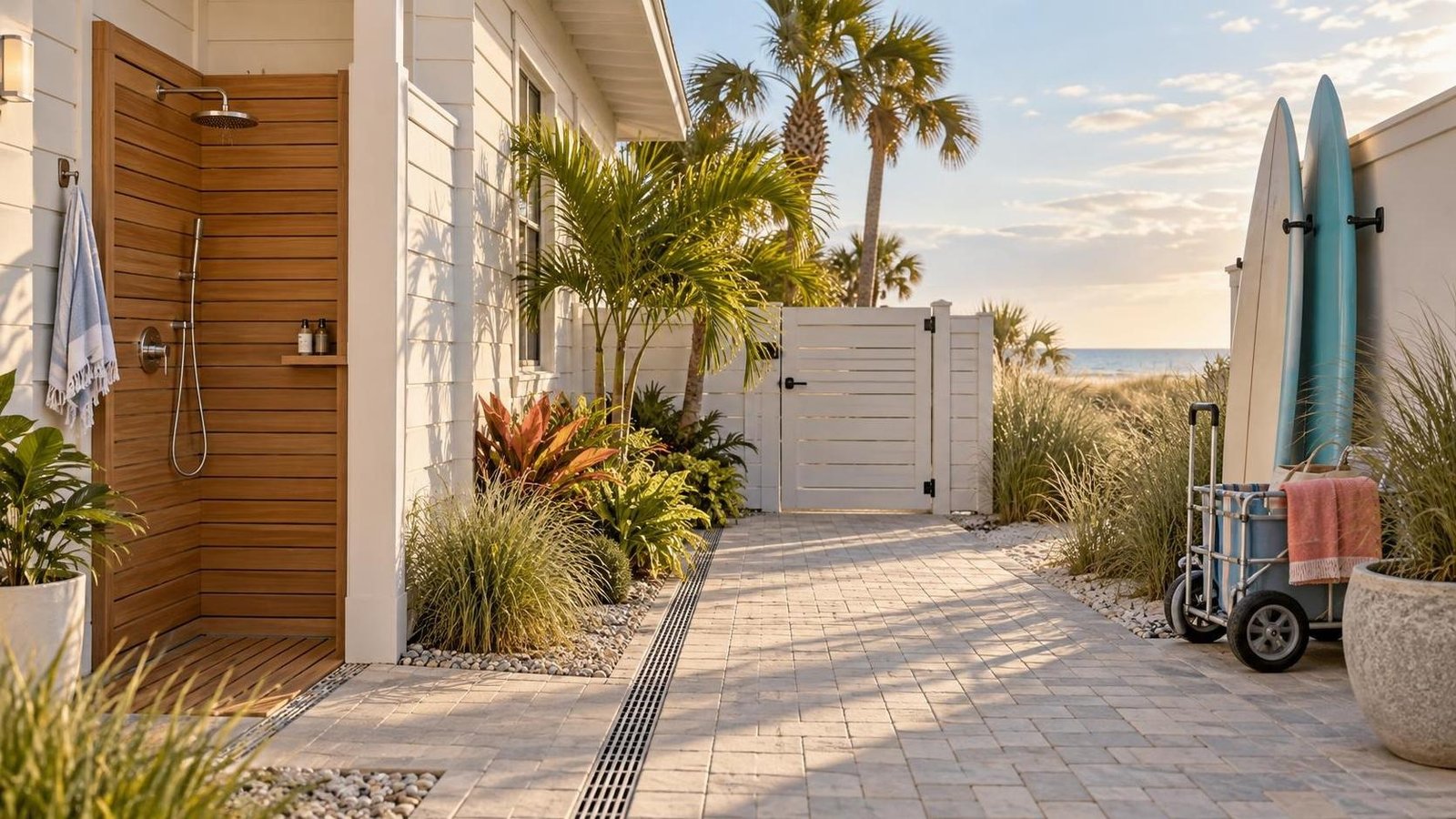
What Should Satellite Beach Sellers Document About Outdoor Showers, Drainage, and Beach-Access Foot Traffic?
By Carrie Liotta, Space Coast REALTOR® with REAL Broker | Published September 16, 2026
A Satellite Beach seller should prepare one clear file showing how the outdoor shower was installed, where its water drains, what side-yard drainage work has been completed, and how nearby public-beach-access activity actually affects the property. These details are lifestyle benefits when documented. When vague, they become inspection, privacy, permit, and insurance questions.
I would not wait for a buyer to ask whether the shower drains toward the neighbor, whether a fence blocks a drainage route, or whether beachgoers regularly use the street for parking. Walk the property before photography, gather records, correct active problems, and describe the location with facts rather than promises.
Treat the outdoor shower as a system, not décor
An outdoor shower can be one of the most useful beachside features. It keeps sand out of the house, helps rinse boards and pets, and makes a pool or beach routine easier. Buyers will still want to know how it works.
Gather the installation permit if one was required, final inspection, plumber invoice, fixture information, water-line details, drain or disposal plan, shutoff location, freeze or storm-preparation instructions if applicable, and any electrical records for lighting, pumps, heaters, or nearby outlets. If the shower was present before the seller’s ownership, document what is known and what is not rather than guessing.
The City of Satellite Beach Community Development Department provides the city’s building-permit and inspection services and links to its online portal for permitting, planning and zoning, code enforcement, and licensing. Use that official source to search available records and ask the city or a licensed professional what the specific installation required.
Show buyers where the water goes
“It drains into the yard” is not a complete answer. Identify whether the shower has a plumbing connection, approved drain, dry area, permeable surface, or another documented arrangement. Observe what happens during actual use. Does water pool against the foundation, run under a gate, erode mulch, create algae on pavers, reach the driveway, or cross a property line?
Soap and shampoo use can change the question, as can a hot-water connection or a shower enclosed for privacy. Sellers should not make code or environmental claims from memory. Ask the appropriate city staff and licensed plumber to evaluate the existing setup when records are unclear.
If correction is needed, obtain a written scope, permit where applicable, final approval, paid invoice, and photographs before landscaping conceals the work. A small documented fix tells a much better story than fresh gravel placed over recurring standing water.
Connect the shower to the whole side-yard drainage plan
Beachside lots can have tight side yards where several systems compete for space: HVAC equipment, pool equipment, fence gates, roof downspouts, irrigation, outdoor shower, utility service, trash storage, and the walking path from beach to backyard. Water must still move without damaging the home or neighbor’s property.
Walk the side yard during and after rain. Look for soil marks on stucco, algae, silt trails, washed-out beds, standing water, soft ground, rust stains, fence deterioration, settled pavers, clogged drains, and downspouts that discharge into a bottleneck. Ask whether recent gutters, landscaping, pool work, fencing, or exterior doors changed the flow.
The city’s Public Works page is the official current contact point for infrastructure questions and reporting issues. Private-lot drainage may require different professionals and city review, but sellers should know where public and private responsibilities meet before making representations.
My related guide on yard drainage after impact doors and new gutters explains why one improvement can unintentionally redirect water. The same systems thinking applies to an outdoor shower.
Verify fences, gates, pavers, and privacy screens
The shower may be permitted while the surrounding enclosure is not documented, or the reverse. Gather records for fences, gates, walls, pavers, decks, slabs, lighting, and plumbing work. Confirm survey boundaries, easements, setbacks, and utility access. If an HOA applies, obtain architectural approvals as well as city records.
Review the current Satellite Beach Code of Ordinances and verify current requirements with Community Development rather than relying on what a neighbor built. Rules and site conditions can differ, and an existing structure is not proof that the same improvement is currently approvable.
Privacy screens should not block drainage, equipment service, utility access, visibility needed for safe exits, or the gate path used to bring beach gear through the yard. Trim landscaping and repair hardware before photography so buyers can see a functional route, not a hidden problem.
Document repairs instead of staging around them
If there has been standing water, disclose and document it appropriately. Gather contractor reports, invoices, drain cleaning, grading work, gutter changes, paver resets, irrigation repairs, pump service, and before-and-after photographs. Note whether the work was tested in ordinary rainfall afterward.
A seller does not need to promise that a yard will never hold water during an extreme event. The goal is a factual history: what was observed, what was done, who did it, and how the system has performed since. Avoid claims such as “never floods” unless a qualified basis exists, and even then let the documents speak.
Buyers may compare the property with the current FEMA Flood Map Service Center, the official NFIP flood-hazard source. A map designation and ordinary lot drainage are related but not identical. A property can have nuisance drainage without a prior building flood, and a mapped zone does not describe every rain event in a side yard.
Describe public-beach-access foot traffic accurately
Proximity to a public beach access can be a major selling point. Buyers may value walking to the ocean without loading a car or paying for direct oceanfront ownership. They may also ask about pedestrians, bikes, surfboards, dogs, parking, headlights, trash, noise, and privacy at peak times.
Do not call the street “private” if it is not. Do not promise that public parking will always be available or that traffic is never noticeable. Instead, identify the actual public access, walk the route, and document observable patterns at weekday mornings, afternoons, weekends, and special conditions. If parking regulations or permits matter, point buyers to the current city resource rather than paraphrasing rules from memory.
Keep the description balanced: “The home is a short walk from a public beach access; buyers should visit at the times they expect to use the property and review current city parking rules.” That is more credible than both hype and defensiveness.
Separate public use from private encroachment
Public pedestrians may legally use public sidewalks, streets, or access routes. That does not give anyone the right to use private side yards, outdoor showers, hose bibs, trash cans, or driveways. If the seller has experienced trespass or recurring boundary confusion, document the pattern and discuss lawful, proportionate solutions with the appropriate professionals.
Clear house numbers, maintained boundaries, a working gate, thoughtful landscaping, and code-compliant lighting can define private space without making the property feel fortified. Cameras and signs may be useful, but sellers should check HOA and local rules and avoid overstating what they prove.
When a public-access route creates positive foot traffic, embrace it in photography by showing the home’s organized gear path and outdoor rinse station. When privacy is the concern, show the fence, gate, landscaping, and usable outdoor areas honestly.
Prepare for the buyer’s insurance and inspection questions
An outdoor shower touches plumbing, moisture, electrical safety, exterior construction, and liability. Buyers may ask the inspector to check shutoffs, leaks, backflow protection where applicable, grounding or outlet protection nearby, slippery surfaces, rot, corrosion, and water against the structure. Salt exposure can accelerate wear on fixtures and hardware.
Side-yard drainage can also lead buyers to inspect the foundation, stucco, pavers, fence posts, HVAC pad, pool equipment, and termite-prone materials. Address active leaks, exposed wiring, loose fixtures, broken drains, unstable pavers, and slippery algae before listing. Use licensed professionals for work within their scope.
If impact doors, shutters, or other storm work shares the same side yard, organize those records too. My guide to Satellite Beach seller lighting and exterior permit records shows how coastal documentation can make a buyer more confident without promising an insurance result.
Stage the feature for function
Clean and test the shower. Remove rusted accessories, empty containers, broken hooks, and tangled hoses. Confirm hot and cold labels only if accurate. Show the shutoff and drain path in the seller file, not necessarily in listing photos. Use non-slip surfaces and make the gate easy to operate.
Clear the side-yard route from the gate to the shower and backyard. Store beach carts, boards, and bicycles in the way the property actually supports. Buyers should see how the feature prevents sand from entering the house, where wet gear dries, and how the path avoids damaging landscaping.
Do not hide drainage grates under mats or place planters over low spots. A clean, visible system is more persuasive than decoration. If the route is narrow, measure it so buyers can determine whether their beach cart, paddleboard, or accessibility needs fit.
Choose repair, documentation, or pricing deliberately
Repair before listing when there is an active plumbing leak, unsafe electrical condition, recurring water against the home, failed drain, unstable walking surface, broken gate, or unpermitted work that professionals advise should be corrected.
Document and disclose when the system is functional, permitted or otherwise verified, and the history is the main question. Provide records early enough for buyers, inspectors, insurers, and lenders to review them.
Price for uncertainty when the seller cannot reasonably complete a larger drainage redesign or when specialist opinions differ. A licensed estimate is more useful than a vague credit. The contract, lender, and closing team must determine which credit structures are allowed.
Do not over-improve simply because a buyer might prefer a luxury shower. If the existing cold-water rinse is safe, documented, and useful, a costly enclosure or hot-water conversion may not return its cost. Solve risk first, then presentation.
My pre-listing property file
- Outdoor-shower permit, final inspection, plumbing invoice, fixture information, drain description, and shutoff location.
- Electrical records for nearby outlets, lighting, heaters, pumps, or equipment.
- Survey, fence and gate records, paver or slab documentation, and HOA approvals if applicable.
- Gutter, downspout, grading, drain, irrigation, and side-yard repair invoices.
- Photographs showing drainage work before it was covered and after ordinary rainfall.
- Accurate seller disclosures about known water intrusion, claims, drainage, and repairs.
- Current flood-map information and buyer-ready insurance documents the seller is comfortable sharing securely.
- A factual description of the nearest public beach access and current city resource for parking rules.
- A clean, measured route for beach gear from gate to shower and storage.
Bottom line
An outdoor shower, practical side yard, and walkable public beach access can make a Satellite Beach home memorable. The seller’s job is to turn those features into confidence: permitted work where required, a clear water path, documented repairs, defined private space, and honest expectations about public activity.
I can help you organize that file, decide what should be repaired before photography, and present the beach routine without glossing over the ownership questions. Reach out to Carrie Liotta, Space Coast REALTOR® with REAL Broker, through 321 Coastal Living for a no-pressure conversation about selling in Satellite Beach. Your next chapter starts here.