

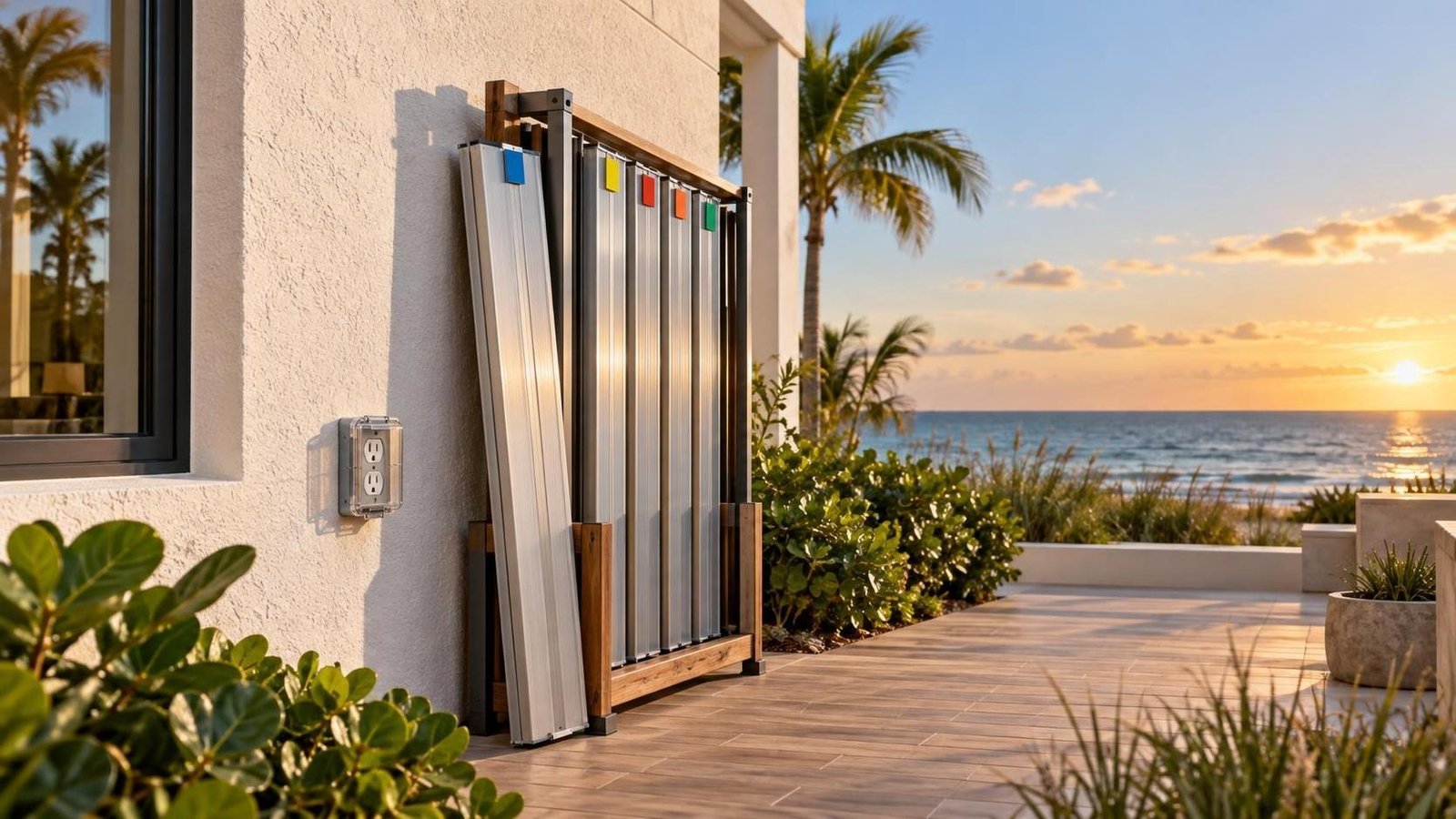
Exterior Receptacle Behind Storm-Panel Storage: What Should Satellite Beach Sellers Document?
By Carrie Liotta, Space Coast REALTOR® with REAL Broker | Published October 5, 2026
Before listing, clear permanent access to the receptacle and have a licensed electrical contractor evaluate its cover, box, fittings, wall penetration, circuit, grounding, and GFCI protection. Then document the repair and separately inventory the storm panels. A working outlet and a complete panel stack are not enough when one system hides the other.
This is the kind of small side-yard detail that can become a large inspection conversation. The seller sees a convenient place to keep removable panels. The buyer sees metal panels that must be moved before anyone can inspect an exterior electrical device exposed to beachside weather. I would resolve the layout and the electrical question before photography, not explain the conflict after an inspector finds it.
Separate the two systems before you evaluate either one
Start by removing the storm panels, fasteners, straps, and rack components from the receptacle area. Do not lean them against other equipment or a door. Use enough help and protection to move sharp-edged panels safely.
Once the area is open, photograph the receptacle from straight on and from both sides without removing the cover or device. Record where the branch circuit appears on the electrical-panel directory, what the receptacle has been used for, whether a GFCI test and reset are on the device or upstream, and whether the seller knows of prior repair, tripping, heat, sparking, water entry, or intermittent operation.
Then make a separate storm-panel inventory. Count every panel, match it to an opening, identify the fastener kit, save installation instructions and product information, and note damaged or missing pieces. The goal is to prevent one vague statement—“the panels and outlet work”—from substituting for two complete files.
My broader guide to storm-shutter and impact-window records for Space Coast sellers explains the opening-protection file. For this home, add a location map that shows where the panels are stored and how the electrical device remains reachable when the storage system is full.
Ask an electrical contractor to identify what is actually installed
I would not diagnose this receptacle from corrosion color, age, or a plug-in tester alone. Have a properly licensed electrical contractor identify the device, circuit, GFCI protection, box, cover, fittings, conductors, grounding path, and wall penetration. If it was added or relocated, ask what the permit record and applicable installation requirements were at that time.
The contractor should evaluate whether the receptacle and enclosure remain suitable for their exterior location; whether the cover closes and seals as intended; whether mounting, fasteners, entries, and wall sealant are intact; and whether there is evidence of moisture, heat, loose connections, incompatible parts, or physical impact. Ask for the findings and repair scope in writing, tied to the address and exact device.
The U.S. Consumer Product Safety Commission’s Home Electrical Safety Checklist recommends a weatherproof cover for each outdoor outlet, a weatherproof-while-in-use cover when an outlet is used in wet weather, and GFCI protection for outdoor outlets. It explains that moisture entering an outdoor outlet can create shock or fire hazards. The same guide says an outlet that does not operate normally, feels unusually warm, accepts plugs loosely, or lacks an intact faceplate needs correction or professional review.
That safety guidance is useful, but it is not a do-it-yourself inspection script or a code ruling for this property. A receptacle may energize a lamp and still have a damaged gasket, deteriorated box, questionable fitting, failed GFCI protection, or concealed connection problem. Let the contractor test and open electrical equipment within that professional’s scope.
Salt exposure is a reason to inspect, not a diagnosis
Satellite Beach sellers often describe exterior metal as “salt-air worn,” but that phrase should not replace a current evaluation. Distance from the ocean, wall orientation, wind, irrigation spray, roof runoff, shade, coating, maintenance, enclosure material, and installation details can all affect what develops at one location.
Document visible facts: chalking, discoloration, pitting, rust, cracked plastic, loose screws, a cover that will not close, staining below the box, deteriorated sealant, or a wall patch around the conduit. Do not state that salt caused a defect unless the responsible professional reaches that conclusion. Do not spray cleaner into the device, paint over corrosion, or replace only the cover to make the area photograph better.
The same discipline applies to larger exterior equipment. My article on documented exterior electrical equipment in Satellite Beach explains why permit history and present condition must be considered together. A closed permit can prove a project reached a past inspection; it does not certify the device’s condition today.
Permit records should match the work, not the seller’s memory
The City of Satellite Beach permit page says permits are required for most construction, installation, and replacement work and specifically lists electrical work and shutters. It also says permitted work must be inspected and directs owners to the BS&A portal to track applications and inspection results.
Search for permits associated with the receptacle’s installation or relocation, exterior renovation, service work, and the storm-protection system. Match the scope, contractor, dates, and final status to what is present. For the panels, save the product approval or manufacturer information, opening schedule, invoice, permit, final inspection, and wind-design details when available.
Do not assume one permit covers both systems or that a missing online record proves work was unpermitted. Ask the City what records exist and what process applies if the condition does not match the file.
Design storage around access, not around the last empty wall
After the electrical work is evaluated, decide whether the existing storm-panel rack can remain. Removable does not automatically mean practical. If a buyer must lift a heavy panel stack, release a strap, remove anchors, or balance sharp-edged metal just to reach the outlet cover, the arrangement has not solved the access problem.
I do not apply a universal clearance measurement to every receptacle. Instead, I ask the electrical contractor to define the access needed to inspect, test, plug in, unplug, service, and repair this installation. The storage plan must also let the owner remove panels in sequence without striking the device, pulling a cord across the stack, or blocking a side-yard gate.
A better solution may be to shift the rack, divide a large stack into smaller labeled groups, or move storage entirely. The answer depends on panel size and weight, wall construction, drainage, gate width, and the route to each opening. Review new anchoring or building work for permitting and hidden utilities before drilling.
Test the real storm-preparation sequence after the layout changes. Can one or two adults retrieve the panels safely? Can they keep the receptacle visible? Are the fasteners dry, organized, and matched to openings? Does the first panel needed sit behind the entire stack? A tidy listing photo is not the same as a usable system during preparation.
Build a property file that a buyer can follow
The electrical section should include the contractor’s license and business name, evaluation date, invoice, written findings, identified circuit and protective device, repair scope, permit number when applicable, inspection result, product information, and photographs after completion. Avoid saving passwords, gate codes, or unrelated panel details in a buyer packet.
The Florida Department of Business and Professional Regulation says its Electrical Contractors’ Licensing Board licenses and regulates electrical contractors. DBPR’s electrical-contractor information describes electrical-contractor work as including installation, repair, alteration, or additions to wiring, fixtures, apparatus, raceways, and conduit. Verify the contractor and current license through the official Florida license search rather than relying only on a logo or an old invoice.
The storm-panel section should include an opening map, panel count, labels, panel dimensions, installation sequence, hardware inventory, rack location, product information, permit and final inspection when applicable, wind-mitigation documents, and photographs. If anything is missing, disclose the gap accurately and obtain a qualified opinion about the next step instead of calling the system complete.
This is especially important when panels occupy valuable beachside storage. My guide to shutter permits and storage for Satellite Beach buyers explains why the panel set affects both storm preparation and everyday use. Here, the seller’s file should prove that storage convenience has not compromised electrical access.
Price the unresolved pieces separately
If the receptacle needs work, ask the contractor for a property-specific written scope. Separate device or cover replacement from box repair, conductor or circuit correction, wall and stucco restoration, permit work, and relocation. A small visible component can be attached to a larger concealed problem, but it can also be a contained repair. The evaluation—not a generic online estimate—should distinguish those outcomes.
Price panel storage separately: rack relocation, anchoring, suitable hardware, labeling, missing pieces, opening-schedule verification, and finish repair. Do not reduce the issue to an outlet cover or a few brackets.
I would usually correct active electrical defects and an obviously unsafe or unusable layout before listing. If a larger correction cannot be completed, provide the reports and estimates, disclose the condition, and set the price with that uncertainty in mind. A vague credit can be hard for a buyer to value when the City, electrician, insurer, or storm-panel installer has not yet defined the work.
What I would complete before listing photography
- Move the full panel stack and hardware away from the receptacle without creating a new obstruction.
- Have a licensed electrical contractor identify and evaluate the device, circuit, GFCI protection, cover, box, fittings, grounding, and wall penetration.
- Complete agreed repairs, permits, and inspections, then photograph the finished condition.
- Search City records for the electrical and shutter scopes and reconcile them with the property.
- Count, label, and map panels and fasteners to every claimed protected opening.
- Install or relocate storage so the outlet remains visible and usable without moving the complete rack.
- Test the panel-removal route and keep sharp edges, standing water, and electrical equipment separated.
- Prepare one concise index linking the electrical file and the opening-protection file without combining their conclusions.
During the final walk-through, I would confirm that the receptacle cover closes, the storage remains stable, the access path has not been filled with beach gear, and the labeled panels still match the inventory. I would also make sure the listing language is exact. “Exterior receptacle evaluated and repaired by a licensed contractor; records available” is stronger than “updated electric.” “Labeled removable panels and permit file available” is stronger than “full hurricane protection” when the seller cannot prove every opening and insurance classification.
My bottom line for Satellite Beach sellers
An exterior receptacle behind removable storm panels is not just a staging inconvenience. It is an electrical-condition question, an access question, and a storm-preparation question occupying the same patch of wall. Separate the systems, evaluate each with the right professional, correct the physical conflict, and give the buyer records that can be checked.
If you are preparing a Satellite Beach home for sale, I can help you identify which exterior details need documentation, professional review, repair, or a more practical layout before buyers arrive. Reach out for a no-pressure conversation about selling your Brevard County home with Carrie Liotta, Space Coast REALTOR® with REAL Broker, and join my private Facebook group, Moving to Brevard County Florida. Your next chapter starts here.
