

Buried Propane Tank, Pool Equipment, and a Future Generator: What Should Satellite Beach Relocators Verify?
By Carrie Liotta, Space Coast REALTOR® with REAL Broker | Published September 29, 2026
Before buying, verify the buried propane tank’s ownership, permit history, condition, capacity, connected loads, underground route, and service access. Then have qualified LP-gas, electrical, and generator professionals decide whether the proposed generator can fit safely beside the pool system. A tank already in the yard does not make the home “generator ready.”
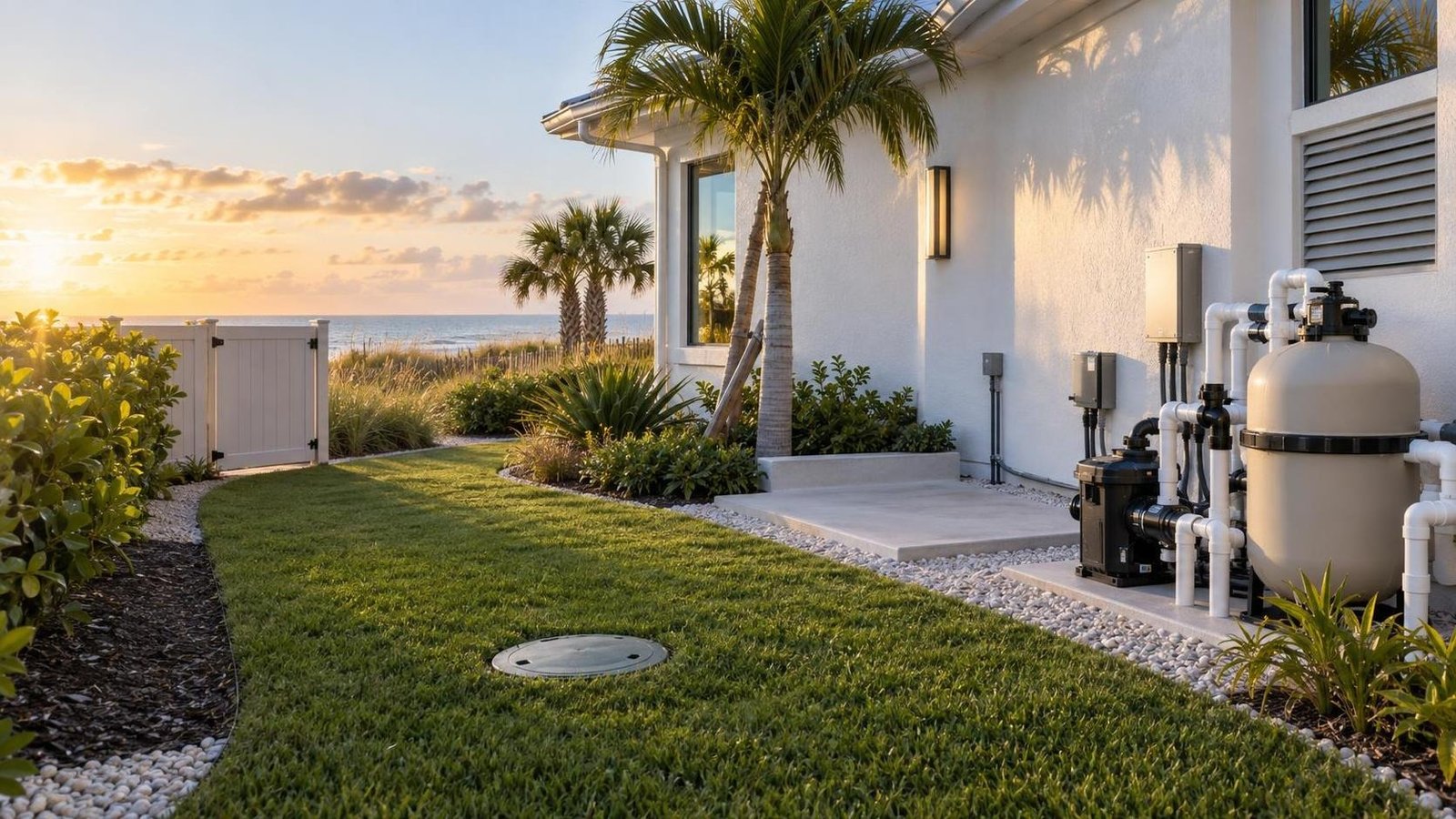
That distinction matters when you are relocating to Satellite Beach and trying to price storm preparation before closing. The backyard may look organized during a showing: pool pump against the wall, tank lid in the lawn, and an open pad that seems perfect for a standby generator. Below grade, however, the fuel line, electrical conduits, drainage, irrigation, and tank may occupy the same small piece of property.
I would treat this as a feasibility question, not an upgrade promise. Your offer decision should rest on what exists and is documented today. The future generator needs its own design, permits, contractors, equipment specifications, and budget.
Begin with the tank, not the generator brochure
Ask the seller for the original tank-set permit, final inspection, installation invoice, tank data, supplier records, and any site plan or survey showing the tank and fuel route. Add service reports, leak-call records if any, regulator work, appliance additions, and documents for cathodic or corrosion-protection testing when applicable to that installation. Do not assume the round lid shows the tank’s full footprint or orientation.
Next, establish ownership. A buried tank may be owned by the homeowner, leased from a propane company, or governed by a supplier agreement. The answer can affect who may fill, inspect, alter, move, or remove it and whether an account, lease, or minimum-use obligation transfers. Ask for the actual agreement rather than relying on “we have always used this company.”
The Florida Department of Agriculture and Consumer Services says it licenses businesses and individuals involved in LP-gas sale, storage, installation, service, and repair. Its Category V description specifically includes the design, installation, modification, service, and repair of LP-gas piping, equipment, and storage tanks. That is why I want an appropriately licensed LP-gas professional identifying the system, not a buyer or agent estimating from the lid and visible regulator.
Reconcile the paper drawing with the physical yard
Walk the property with the records. Locate the tank lid, fill connection, regulator, visible shutoffs, pool equipment, house openings, exterior electrical equipment, fence gates, drainage paths, irrigation, and the area being considered for the generator. Ask the LP-gas professional to identify the known fuel route and explain what must be located before excavation or new work.
The goal is not to turn an old permit sketch into a do-it-yourself utility map. It is to find contradictions early. If the tank appears in one place on the approved plan but landscaping, pavers, or a pool addition suggest the yard changed later, that deserves professional and jurisdictional review. If nobody can match a fuel line to the current appliances, the answer is not to guess.
Satellite Beach makes this especially important because many homes have compact side yards where pool service, storm-water movement, outdoor equipment, and access all compete. My guide to checking pool equipment, drainage, and service access in a Satellite Beach side yard explains why a pathway that looks wide enough for a person may still fail the replacement-equipment test.
Confirm what the propane system serves today
List every connected load supported by records and professional verification: water heater, range, dryer, pool heater, fireplace, outdoor kitchen, or other appliance. Record model information and rated input where available. Ask how the current usage pattern, regulator arrangement, pipe sizing, and tank service history relate to the existing system.
Do not subtract a few estimated gallons and declare that the remaining capacity belongs to a generator. A future installer needs to evaluate the specific generator, expected loads, fuel demand, piping, regulators, pressure, and operating plan. Pool-heater use may overlap with generator use during an outage. A tank that has been adequate for cooking and hot water may require a different strategy once backup power enters the system.
Also ask whether the tank is active, abandoned, or disconnected. Fresh landscaping around an old lid does not prove the tank is in service. Conversely, an older installation is not automatically defective. The useful facts are ownership, current condition, documented maintenance, actual connections, and a qualified evaluation.
Do not choose a generator location by empty-space alone
A future generator must work as part of the whole property. The installer needs to consider the equipment manufacturer’s instructions, adopted codes, the fuel system, electrical transfer equipment, house openings, ignition and exhaust concerns, pool-equipment access, property lines, easements, drainage, flood conditions where applicable, and a practical service route. The best-looking rectangle on a listing photo may not survive that review.
The City of Satellite Beach’s current permit information lists generators, electrical work, gas piping, tank sets, pools, and related work among projects requiring permits. The city also identifies site plans or surveys showing setbacks and easements, flood information when applicable, contractor credentials, and inspections as possible parts of the process. In other words, a salesperson’s rough placement idea is not the same as a permitted design.
I would ask for a written feasibility visit before treating a future generator as part of the home’s value. Ideally, the LP-gas contractor and generator installer can coordinate with the electrician, while the pool professional confirms that panels, pumps, filters, heaters, and plumbing remain accessible. If relocation of any existing component is assumed, get that scope and cost in writing.
Keep safety language precise
Generator discussions can become overly casual because buyers are focused on convenience during an outage. FEMA’s generator safety guidance identifies carbon-monoxide, fire, and electrocution hazards, tells owners to follow manufacturer instructions, and recommends qualified electrical installation for appropriate home transfer equipment under local codes. Those are good reasons not to advertise an unbuilt installation as simple or guaranteed.
A standby unit and its exhaust cannot be evaluated from an overhead photo. Nor should a buyer infer that the buried tank, house openings, and pool equipment have acceptable separation just because the existing yard has not produced a visible problem. The applicable design depends on the equipment and site. I would not publish a universal clearance number in a listing or offer summary; the licensed professionals and permitting authority need to apply the current requirements to the exact plan.
Florida’s LP-gas rule page for Rule 5J-20.002 identifies the state’s adopted NFPA-standard framework. As of September 29, 2026, that official page also shows proposed rulemaking activity. A proposal is not a final rule, and it is another reason to have the installation designed under the standards in force when the buyer actually applies.
Price the known system separately from the future project
When comparing homes, give value to what can be verified now: a sound, active tank with clear ownership; consistent permits and final inspections; a serviceable fuel route; current professional findings; and orderly records. Treat the future generator as a separate project until contractors confirm equipment, location, electrical work, fuel modifications, permitting, restoration, and total cost.
Ask for more than one written scope when possible. One proposal may assume the existing tank and piping can remain. Another may include tank work, a regulator change, trenching, a new pad, transfer equipment, panel work, pool-equipment relocation, fencing adjustments, or landscape restoration. Compare the assumptions before comparing the totals.
Build a reserve for the parts that cannot be confirmed during a short showing. The less complete the tank file, the more cautious I would be about paying a premium for “generator potential.” If backup power is essential to your relocation decision, use the inspection period to determine whether this property offers a realistic path or merely a hopeful patch of grass.
Use the inspection period to create one coordinated answer
I would organize the work in a deliberate order. First, review title, survey, easement, permit, tank-ownership, and supplier documents. Second, have the LP-gas system evaluated by an appropriately licensed professional. Third, ask the generator installer and electrician for a site-specific concept based on the actual equipment and loads. Fourth, let the pool contractor confirm access and conflicts. Finally, verify the permitting path with Satellite Beach before you depend on the project.
That process should produce a marked site sketch, photographs that avoid exposing sensitive controls, equipment and tank information, a list of current loads, known underground routes, professional findings, and written assumptions for future work. It should also identify what remains unknown. A clean “not yet verified” is more useful than an unsupported promise.
This is similar to the way I advise sellers to document a generator and pool-equipment corridor as one connected ownership system. The difference here is that you are buying the current layout while testing a future plan. You need enough information to judge feasibility without expecting the seller, agent, or inspector to engineer the project.
My buyer checklist before the inspection window closes
- Tank ownership or lease agreement, supplier history, and transfer requirements.
- Tank-set, gas-piping, pool, and related permit records with final status where available.
- Survey or site plan showing property constraints, plus a field check of the actual layout.
- Tank data, current condition findings, service records, regulators, shutoffs, fill point, and connected loads.
- Qualified identification of known underground fuel routing and any unresolved conflicts.
- A written generator feasibility concept covering fuel, electrical transfer, location, service access, and permitting assumptions.
- Pool-contractor confirmation that current and replacement equipment can still be reached.
- Separate budgets for known repairs, future generator work, and possible relocation or restoration.
If the seller has general generator records but not a coordinated property file, my earlier guide to generator age, permits, and service records can help you identify the basic documents to request.
The right answer is documented feasibility
A buried propane tank can be an asset, and an available standby-generator path can make a Satellite Beach home more practical for the right household. But the value comes from verified ownership, a sound system, a workable layout, and a professionally designed next step—not from the fact that a tank lid and an open corner appear in the same yard.
I am Carrie Liotta, a Space Coast REALTOR® with REAL Broker and the voice behind 321 Coastal Living. I help relocating buyers separate an existing feature from a future possibility, coordinate the right due-diligence questions, and compare the real ownership costs before the contract clock runs out. Reach out for a no-pressure conversation about Brevard County homes for sale. Your next chapter starts here.
