

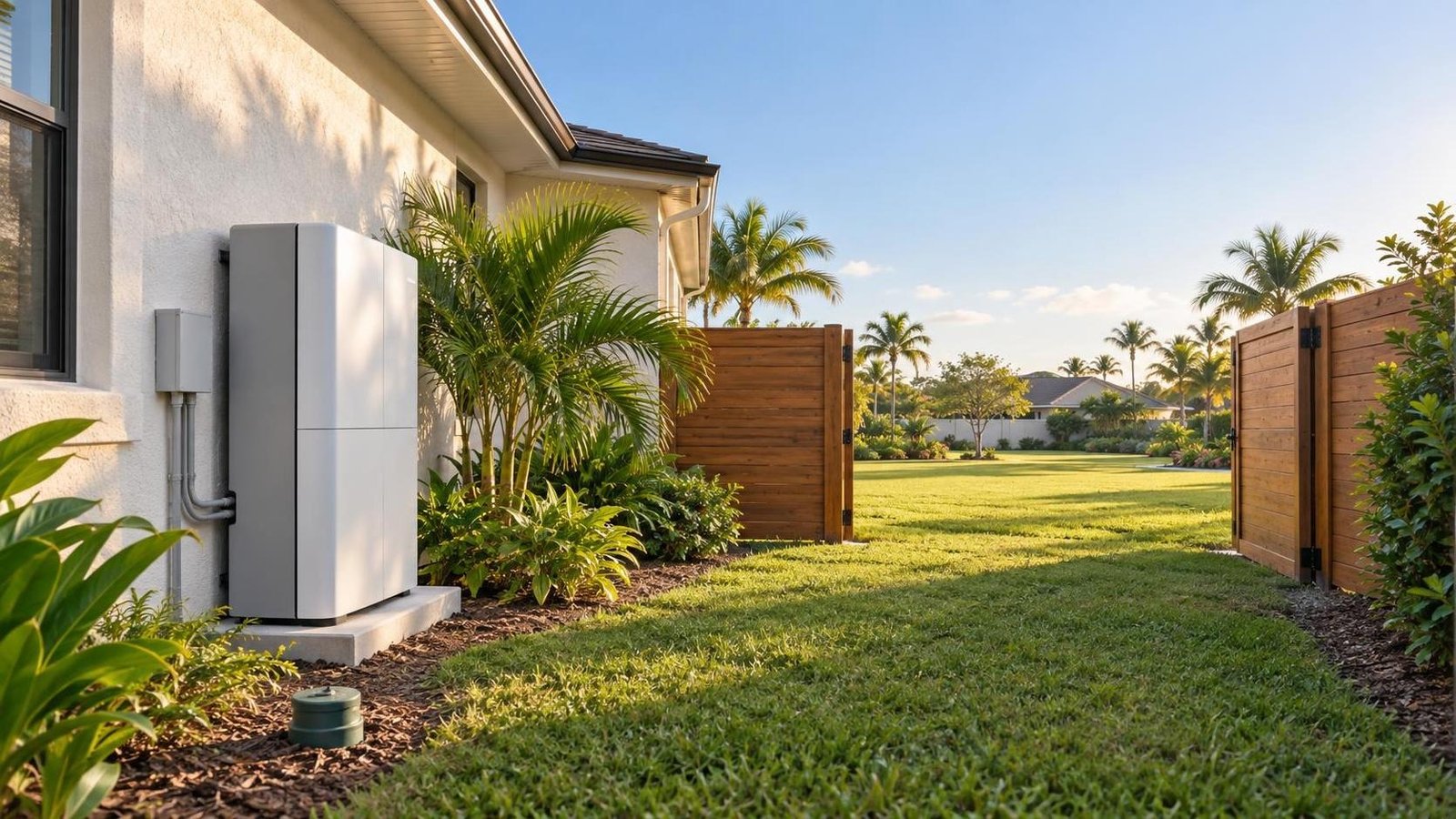
Sewer Cleanout, Solar-Battery Pad, and Future Pool Access in One Side Yard: What Should Palm Bay Buyers Verify?
By Carrie Liotta, Space Coast REALTOR® with REAL Broker | Published September 27, 2026
If a Palm Bay home’s sewer cleanout, solar-battery pad, and only practical pool-construction route share one side yard, do not assume the pool will fit because the backyard looks large. Verify the survey, sewer lateral, easements, equipment clearances, gate width, drainage, permits, and contractor access. Get a written feasibility opinion and concept plan before pricing the home as pool-ready.
The hidden issue is sequence. A finished pool needs a shell, deck, plumbing, electrical service, equipment, fencing or enclosure decisions, inspections, and a way to bring labor and machinery to the site. The side yard must also remain serviceable after construction. A cleanout cannot simply disappear under permanent work, and battery or electrical equipment should not be treated as an object that any pool crew can casually move.
I would rather disappoint a buyer during due diligence than let “room for a pool” become an expensive assumption after closing.
Start with documents before measuring grass
Collect the current boundary survey, title information, utility records, sewer or connection documents, solar and battery contracts, permits and finals, equipment manuals, warranties, HOA rules if any, and seller disclosure. Compare them with the yard as it exists today.
A survey should help identify boundaries and recorded easements, but it may not show every underground line or accurately reflect later improvements. A property appraiser sketch is not a pool plan. A listing photograph is not a utility locate. Use each document for its proper purpose and ask the relevant professional when records conflict.
The City of Palm Bay Building Permits and Inspections page is the official starting point for city permit and inspection information. Its current page also notes a separate access issue for work that uses Melbourne-Tillman canal rights-of-way: the applicable district permit must come first. That does not mean every pool touches canal property; it shows why access outside the visible lot can matter.
Trace the sewer path, not only the cleanout cap
The cleanout is one visible point in a larger system. Ask where the building sewer exits the home, how it travels to the public connection, whether records show repairs or lining, and which access points must remain available. Do not draw a straight line from the cap and call the route confirmed.
Contact City of Palm Bay Utilities for the appropriate parcel-specific questions, then coordinate a utility locate and professional review as needed. Public-marking services and private-locate work can have different scopes. Ask which portions are being identified and what remains unknown.
A pool concept should preserve access for cleaning, repair, and replacement. Consider where a plumber would work if the line failed after the pool and screen enclosure were finished. The cheapest construction route can create the most expensive maintenance route later.
My comparison of a larger Palm Bay pool layout and a clearer sewer record explains why documented underground infrastructure can be more valuable than apparent yard width.
Treat the solar-battery pad as a system
Identify what the pad holds: batteries, inverters, disconnects, gateways, service equipment, conduits, cooling or ventilation components, and protective barriers. Record the equipment make, model, ownership, installer, installation date, permit, final inspection, warranties, service history, monitoring account, and any financing or lease obligation.
Ask whether the system is owned, financed, leased, or subject to another agreement. Have the lender, title professionals, and contract documents address transfer requirements early. Do not assume the equipment conveys free and clear because it is attached to the house.
The Florida Electrical Contractors’ Licensing Board provides official licensing and scope information. Any proposal to move battery equipment, alter conduit, change disconnects, or reroute service deserves review by the utility, manufacturer, and appropriately licensed professionals—not a rough allowance from a pool salesperson.
Ready.gov’s power-outage guidance recommends identifying critical electrical needs and planning suitable battery or alternative power. For this purchase, ask what the system actually backs up, how it transitions during an outage, and whether the pool equipment would be included or intentionally excluded. The federal guidance does not certify the installation; your records and qualified inspection must do that work.
Measure the construction route in three dimensions
Gate width is only the beginning. Measure the narrowest point, overhead clearance, eaves, fence posts, AC units, meters, hose bibs, cleanout, electrical equipment, landscaping, retaining edges, swale, grade, and turning space at both ends. Ask the pool contractor what equipment must enter and whether smaller access equipment changes cost or schedule.
Look above and below. Roof overhangs, service drops, tree canopy, buried conduits, drains, irrigation, and the sewer route can all conflict with access. Check the street and driveway too: delivery, staging, spoil removal, concrete work, and temporary protection need space without blocking neighbors or damaging drainage.
Finally, preserve an emergency and maintenance path after the job. A beautiful deck should not trap the battery equipment behind a screen wall or leave the cleanout reachable only across the pool. Future technicians need a route that works when the yard is wet, equipment is heavy, and repairs are urgent.
Drainage can decide whether the plan works
Pool construction changes hardscape, grade, roof runoff paths, and the way people move through the yard. Examine swales, low points, neighboring grades, downspouts, existing drains, ponding evidence, and any easement that crosses the proposed work area. Visit after rain when possible.
Do not assume a deck drain solves a site-wide issue. Ask how water will move around the pool, screen enclosure, battery pad, house foundation, and adjacent lots. A drainage or civil professional may be appropriate when grading, easements, or repeated ponding is unclear.
If the home converted from septic to sewer, add the abandoned-system documentation and prior tank or drainfield location to the file. My guide to Palm Bay sewer conversion, abandoned septic records, and pool siting explains why a public-sewer bill alone does not answer every backyard question.
Get a concept plan before calling the property pool-ready
During the inspection period, ask a qualified pool professional to prepare a preliminary concept based on the survey and visible constraints. The goal is not final engineering. It is to test pool dimensions, deck, setbacks, equipment location, fence or enclosure, construction access, cleanout service, battery clearances, drainage, and likely permit questions.
Share the solar-battery documents and utility information. If the contractor excludes electrical relocation, utility locating, dewatering, drainage, engineering, screen work, landscaping, or restoration, put those exclusions into the cost estimate. A low preliminary pool number can omit the exact work that makes this side yard difficult.
Ask what remains contingent on engineering, utility verification, association approval, or city review. A concept is evidence of informed planning, not a permit guarantee.
Price three scenarios, not one
- Build without moving major infrastructure: pool, deck, enclosure or fence, equipment, permits, restoration, and a protected access route.
- Build with a qualified relocation: add battery, conduit, utility, cleanout, fence, or drainage work supported by written professional input.
- Do not build: value the home as it stands and decide whether the yard, systems, and resale still justify the purchase.
The third scenario protects you from overpaying. If the house works only when a future pool appears, the pool must be sufficiently feasible and affordable before you waive contingencies. If the house is still right without it, you can approach the project more patiently.
For a wider systems comparison, read my article on Palm Bay solar, battery, city-sewer, and backup-water records. Multiple upgrades become easier to own when each has a clear purpose and transfer file.
My side-yard due-diligence checklist
- Current boundary survey, title/easement review, and applicable HOA documents.
- City utility information, sewer connection records, cleanout and lateral investigation.
- Solar-battery ownership, permits, finals, warranties, monitoring, load plan, and transfer terms.
- Measured gate, side yard, overhead clearance, slope, and staging route.
- Utility locate scope plus any private locating needed.
- Drainage, swale, canal-right-of-way, and neighboring-grade review.
- Pool concept showing deck, equipment, enclosure or fence, setbacks, and service access.
- Written estimates for ordinary construction and any infrastructure relocation.
- A purchase decision that still works if the pool is delayed or not feasible.
When should the side yard change your offer?
Renegotiate or reconsider when the pool is central to your purchase and professional review identifies unresolved utility conflicts, no workable access, major equipment relocation, unverified easements, drainage risk, or costs beyond your reserve. A large backyard should not command a pool-ready premium when the construction path is speculative.
Proceed when the route, documents, concept, approvals path, and budget are sufficiently clear—and when service access remains workable afterward. The strongest plan solves both construction day and year-ten maintenance.
Bottom line
A sewer cleanout, solar-battery pad, and future pool can coexist on one Palm Bay property, but they cannot be planned independently when they share the same narrow corridor. Follow the underground lines, electrical system, water movement, equipment clearances, and construction route before you value the pool dream.
I help buyers connect the survey, inspections, utility questions, contractor input, insurance, and resale implications before the contingency period closes. Reach out for a no-pressure conversation about Brevard County homes for sale. Your next chapter starts here.
