

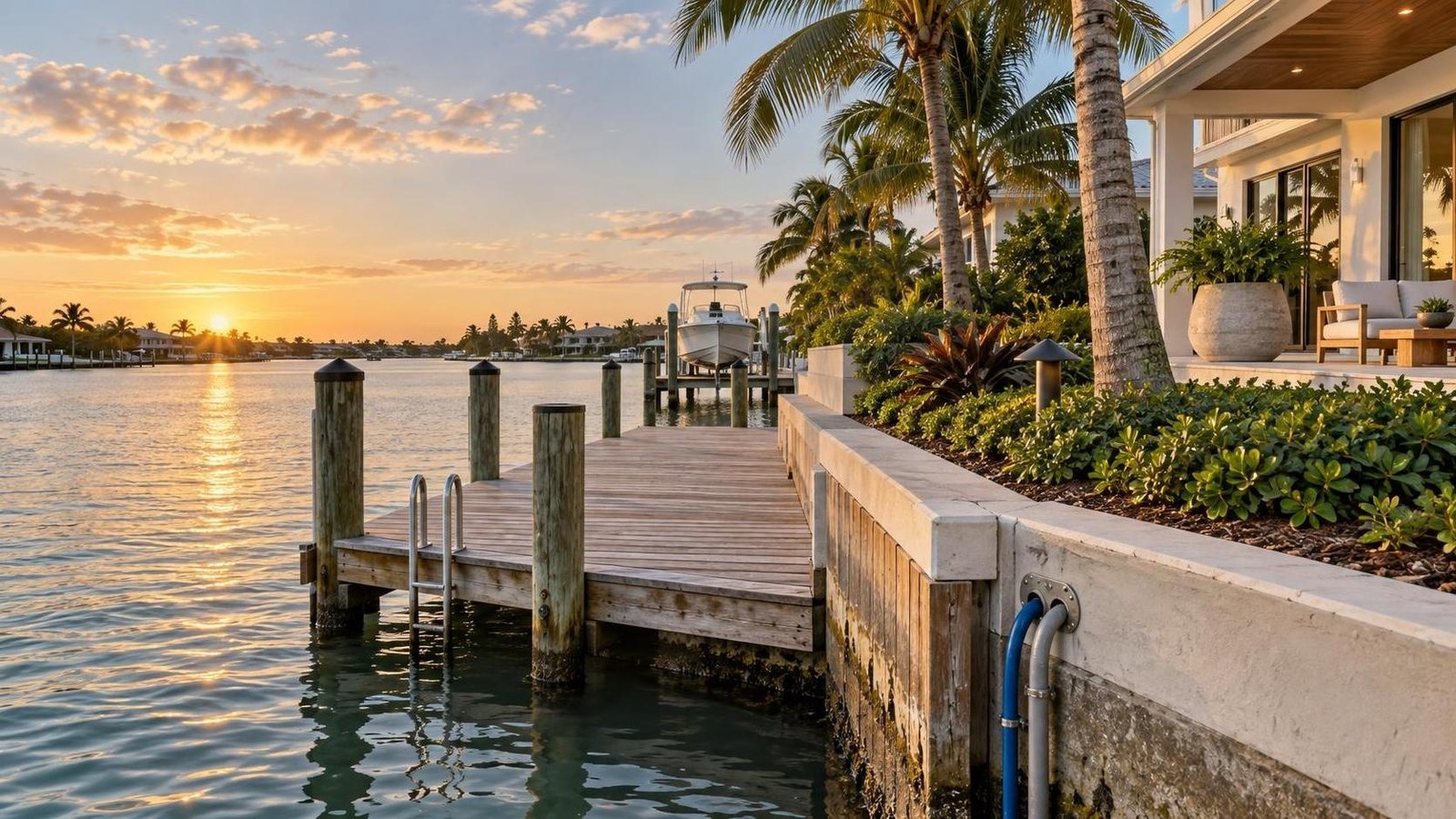
Dock Water and Low-Voltage Conduit in One Seawall Sleeve: What Should Merritt Island Buyers Verify?
By Carrie Liotta, Space Coast REALTOR® with REAL Broker | Published October 1, 2026
If dock water and low-voltage wiring appear to pass through one seawall sleeve, I want a Merritt Island buyer to identify both services, trace their complete routes, review permits and plans, and coordinate plumbing, electrical, and marine inspections. The shared opening is not automatically defective, but it should not remain an unexplained waterfront shortcut.
From the yard, you may see one patched penetration with a small water line and a conduit emerging near the dock. That view does not prove the lines share one continuous sleeve, touch behind the wall, or were installed together. It also does not reveal whether the “low-voltage” line serves landscape lights, cameras, a gate, boat-lift controls, internet equipment, or something abandoned.
I would not diagnose this from a listing photo. I would treat it as a coordination question: what is inside the wall, how is water kept out, can each service be replaced independently, and what happens when the seawall eventually needs work?
First, prove what enters and exits the seawall
Begin with a marked site plan, not labels written from memory. Photograph both sides of the penetration where safely visible. Trace the water line back to its shutoff and source. Trace the conduit to its controller, power supply, junction point, or equipment. Record changes in material, diameter, elevation, and direction.
The buyer’s inspector should note whether there is one outer sleeve containing two services, two smaller sleeves hidden by one patch, or simply two lines passing through the same broad repair area. No one should pull cable, disconnect plumbing, remove sealant, or excavate the wall during an ordinary inspection without permission and a defined professional scope.
Ask the seller for the seawall, dock, plumbing, irrigation, camera, lighting, and electrical files. Useful records include permits, approved drawings, final inspections, paid invoices, equipment specifications, photographs taken before the penetration was covered, and repairs after storms or settlement. For a county-jurisdiction property, the Brevard County building-permit search is an official starting point. Confirm the exact jurisdiction and request supporting plans when the permit description alone is vague.
Do not let the words “low voltage” end the electrical review
Low voltage describes part of the electrical system; it does not certify that the cable, conduit, fittings, power source, splices, or enclosures are suitable for a wet, exposed, corrosive waterfront location. A camera cable and a lift-control circuit may have different equipment and installation requirements. A disconnected-looking line may still be energized from a transformer or controller elsewhere on the property.
Florida’s electrical-contractor definitions include wiring, raceways, and conduit within electrical-contractor work and tie that work to applicable plans, specifications, codes, laws, and regulations. The Florida Electrical Contractors’ Licensing Board also distinguishes unlimited electrical contracting from limited specialty categories that can include low-voltage systems.
That is why I would have the buyer confirm the contractor’s actual license scope rather than accept “the camera company did it” or “it is only twelve volts.” The right electrical professional can identify what the line serves, whether the wiring method and components fit the observed environment, whether the raceway has been damaged or invaded by water, and whether the installation agrees with the permit and equipment instructions.
The inspection should extend beyond the seawall opening. Follow the route to every accessible junction, power supply, controller, disconnect, and piece of dock equipment. Note cracked fittings, missing covers, corrosion, improvised transitions, unsupported runs, buried splices, incompatible materials, and places where future service would require cutting the wall or dock.
Identify the water line before discussing backflow protection
The other line might supply a hose bib, fish-cleaning sink, boat washdown connection, irrigation, misting system, or another fixture. It may use potable water, reclaimed water, a well, or an abandoned source. Those distinctions matter more than the pipe color or what the seller calls it.
Ask a licensed plumbing professional to trace the source, locate the shutoff, identify the downstream fixtures, test for leakage, and evaluate freeze, impact, corrosion, and service access within the professional’s scope. If the line connects to a public potable-water system, ask the provider and plumber what cross-connection protection applies to the actual use.
Florida’s public-water-system cross-connection-control rule establishes a statewide framework, but that page does not tell a buyer which device belongs on an unidentified dock line. The correct answer depends on the connection, hazards, provider requirements, and installed plumbing. A hose-end attachment, chemical injector, submerged hose, or connection to nonpotable equipment can change the evaluation. Do not infer compliance from the presence of one small valve.
Also ask how the line is drained, isolated, and repaired. A shutoff hidden behind landscaping or inside a sealed wall cavity may turn a simple leak into a larger emergency. If the line breaks within a common sleeve, the buyer needs to know whether escaping water can follow that sleeve toward electrical components, erode material behind the wall, or appear somewhere that delays detection.
Have the marine professional evaluate the penetration as part of the wall
An electrician can evaluate electrical work, and a plumber can evaluate the water service, but neither opinion alone establishes what a seawall penetration does to the wall. Ask a qualified marine contractor or engineer to examine the visible panel, cap, joints, drainage conditions, soil loss, patch, movement, and relationship to anchors or tiebacks within that professional’s scope.
The important questions are physical. Was the opening part of the original design or drilled later? Is there evidence of repeated patching? Does the sleeve slope or drain in a way that directs water where it should not go? Is the seal flexible enough for the expected movement yet accessible for maintenance? Can a failed service be removed without enlarging the penetration or damaging the wall? Does the route interfere with future wall inspection, repair, or replacement?
This issue is narrower than the seller-documentation problem in my guide to pool drainage, seawall weeps, and dock conduit along one waterfront edge. Here, the buyer is trying to establish the construction and serviceability of one specific crossing. The same principle still applies: each trade should identify its own scope, then compare findings on one drawing.
A permit in one file does not approve every component
Waterfront improvements can involve separate building, electrical, plumbing, and environmental questions. An approved dock plan may not document a later camera conduit. An electrical final may not evaluate a potable-water connection. A seawall repair invoice may say nothing about the service sleeve. Match every record to its date and described scope.
The Florida Department of Environmental Protection’s Environmental Resource Permitting page explains that the ERP program regulates activities involving alteration of surface-water flows and identifies docking facilities and attendant structures among activities generally reviewed by the department under operating agreements. That does not mean this visible sleeve necessarily required a particular state authorization. It means a buyer should not assume that one local permit or a claimed exemption resolves every waterfront scope.
If a correction would alter the seawall, dock, or waterward work, have the designer or contractor identify the reviewing authorities before pricing the job. Current Florida law includes conditional exemptions for some activities, but an exemption from one environmental requirement is not a plumbing approval, electrical final, structural design, or permission to disturb another owner’s property.
Price access and restoration, not just two new lines
A verbal estimate to “separate the lines” can leave out most of the expensive work. Ask for written scopes that state where the new routes begin and end, how the old sleeve will be treated, whether the wall must be cored or opened, and who restores concrete, cap material, soil, pavers, landscaping, dock boards, and finishes.
I separate the cost into four parts:
- Identification and testing: tracing, controlled testing, record research, and limited non-destructive investigation by the relevant professionals.
- Service work: plumbing shutoff or backflow corrections, appropriate water piping, electrical or low-voltage raceway and wiring, fittings, enclosures, and commissioning.
- Marine and structural work: engineering when needed, wall penetration details, patching, drainage protection, and access from land or water.
- Restoration and documentation: pavers, landscaping, dock surfaces, permits, finals, photographs before concealment, and updated drawings.
If the inspection shows that the lines merely share a neat, documented service chase designed for independent replacement, the buyer may need no immediate project. If the route is unknown, the patch is deteriorating, water is entering the sleeve, or neither service can be removed without destructive wall work, the reserve should reflect the complete correction rather than a few feet of pipe and cable.
Questions I would put in writing during the inspection period
- What does each line serve, and where are its source, shutoff, controller, power supply, and endpoint?
- Are there one or multiple sleeves behind the visible patch?
- Which permits, approved plans, finals, invoices, and photographs show the installation?
- What contractor license scope covered the low-voltage work?
- Is every accessible electrical component identified and suitable for the observed waterfront environment?
- Is the water potable, reclaimed, well, irrigation, washdown, or abandoned?
- What cross-connection protection does the actual water source and use require?
- Is there leakage, corrosion, wall movement, soil loss, or evidence of repeated patching?
- Can either service be isolated and replaced without disturbing the other?
- How would future seawall work protect, move, or replace both services?
Ask each professional to state limitations. “Operational when tested” does not describe the concealed sleeve. “No visible wall movement” does not approve hidden wiring. “Low voltage” does not identify the circuit or its installation requirements. Precise limits help the buyer decide what remains uncertain instead of treating a brief inspection note as a warranty.
My decision rule for Merritt Island canal buyers
I would be comfortable moving forward when both services are positively identified, their records make sense, the water connection and protection are appropriate for the documented use, the electrical professional finds a suitable and serviceable installation, and the marine evaluation finds no meaningful penetration or access concern. A purpose-built shared chase can be manageable when each service remains protected, traceable, and replaceable.
I would slow down when no one can explain the route, water appears inside the conduit or patch, the line serves unknown equipment, repairs conflict with the permit timeline, or future service requires cutting an unassessed wall. I would also want written pricing when the electrician, plumber, and marine professional make incompatible assumptions about who opens and restores the penetration.
For the broader electrical decision, read my guide to documented dock electrical work versus a newer boat-lift motor. If access behind the wall is the larger concern, my article on a pool-screen footer crossing a seawall tieback corridor shows how to price the surrounding demolition and restoration rather than only the marine repair.
One tidy sleeve can connect plumbing, low-voltage equipment, seawall integrity, and future repair access. The buyer’s job is not to assume those systems conflict; it is to prove they can coexist and be serviced. If you are comparing Merritt Island canal homes, reach out for a no-pressure conversation with Carrie Liotta, Space Coast REALTOR® with REAL Broker, about records, inspections, and the full waterfront ownership budget. You can also join my private Facebook group, Moving to Brevard County Florida. Your next chapter starts here.
