

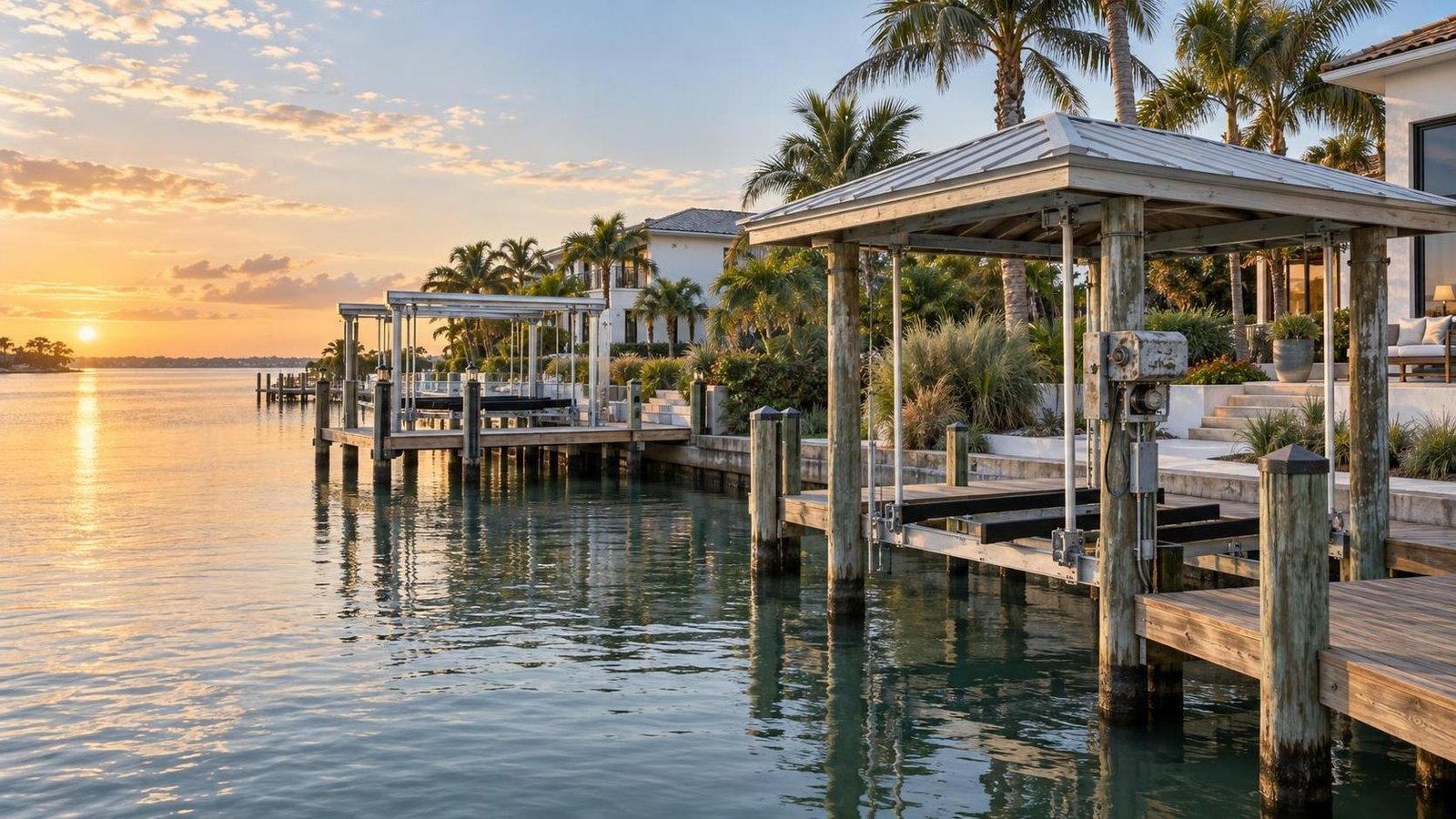
Private Boat Lift or Shared Lift With a Funded Reserve: Which Is Worth More on Merritt Island?
By Carrie Liotta, Space Coast REALTOR® with REAL Broker | Published September 17, 2026
A private lift with an older motor is not automatically worth more than a shared lift with a funded reserve. I would pay the premium only after comparing legal control, current condition, the buyer’s boat fit, replacement funding, and the complete dock and waterway. A well-governed shared lift can be the safer purchase; a sound private lift can offer more flexibility.
The useful question is not simply “private or shared?” It is: which arrangement gives this buyer a documented right, reliable daily use, a manageable next major expense, and a clean resale story? The answer can change even when both lifts operate perfectly during the showing.
What private ownership actually buys
A private lift usually gives one owner more control over scheduling, maintenance, contractor selection, boat setup, and future replacement. That control matters to buyers who boat frequently, leave early, return late, or want to adjust bunks and accessories for a specific hull. There is no neighbor calendar to coordinate and no vote before routine service.
Control also means responsibility. The owner carries the full cost of the motor, cables, controls, cradle, roof if present, electrical work, dock support, permitting, and eventual replacement. An older motor may be a manageable service item, or it may be one part of an aging system. I do not value the word “private” until a qualified specialist separates the motor’s condition from the lift’s larger condition.
Ask whether the lift sits entirely within the parcel or a documented riparian area, whether access crosses another property, and whether any dock or shoreline element is shared despite the private motor and cradle. A listing can describe a “private lift” even when the walkway, pilings, electric service, or canal access has shared obligations.
A funded shared reserve can reduce the next-owner shock
A shared lift with real money set aside may offer something the private lift does not: a defined plan for capital work. That can be especially valuable when the physical system is newer, the agreement is clear, and both owners contribute consistently. The reserve is not a guarantee, but it can reduce the chance that a sudden replacement request consumes the buyer’s post-closing cash.
Verify the account rather than accepting “funded” as a marketing phrase. Request the current balance, contribution history, bank statements or accounting records, recent invoices, reserve purpose, withdrawal authority, and the agreement’s formula for additional assessments. Determine whether the money is restricted to the lift or can also pay for dock, roof, pilings, electrical, or shoreline work.
A $10,000 balance sounds substantial until the documents reveal that it supports several components or that the buyer must fund half of a much larger project. Conversely, a modest reserve may be reasonable when a recent replacement is documented and the owners make scheduled contributions. The balance needs context.
My guide to negotiating a shared lift with no replacement reserve explains the opposite scenario. The same four-part test applies here: rights, rules, condition, and funding.
Confirm that the shared right transfers with the house
A funded account has little value if the buyer’s right to use the lift is personal, revocable, unclear, or dependent on an informal neighbor arrangement. Ask the title and closing professionals to identify the recorded easement, covenant, maintenance agreement, deed provision, association document, or other instrument that establishes the right.
Florida Statutes section 689.01 generally requires interests in real property to be created or transferred through a signed written instrument. It does not decide whether one particular lift agreement is sufficient. It explains why a buyer should have the property’s actual documents reviewed by an appropriate Florida attorney or title professional rather than rely on a handshake description.
The agreement should identify each owner’s use area, schedule if needed, access, guest rights, electrical charges, insurance, ordinary maintenance, capital replacement, damage caused by one user, contractor selection, emergency decisions, defaults, sale of either property, and dispute resolution. A funded reserve is strongest when the operating rules are equally strong.
Inspect the whole system, not only the older motor
During a showing, a lift motor can sound smooth and still tell us very little about cables, bearings, gearboxes, bunks, cradle alignment, fasteners, electrical protection, pilings, corrosion, or the supporting dock. For either arrangement, use an appropriate marine contractor, lift technician, electrician, engineer, or other qualified specialist based on what is observed.
Ask for the manufacturer, model, rated capacity, installation date, service history, parts invoices, warranties, and any prior failures. Then compare the rating and geometry with the buyer’s actual boat, including fuel, batteries, motors, equipment, and how the hull must sit. Similar published boat weights do not guarantee the same fit.
An older private motor may be acceptable when the structure, cables, electrical work, and maintenance file are strong and replacement is straightforward. A shared lift with a funded reserve may still be a poor choice when capacity is wrong, corrosion is advanced, the reserve cannot be used without unanimous consent, or the supporting dock needs unrelated work.
Match improvements to permits and future feasibility
Use the Brevard County permit search as a starting point for property in the county’s jurisdiction, then check the applicable municipality and agencies when necessary. Match visible lift, dock, roof, and electrical improvements to permits, inspections, invoices, and final approvals. Older records can be incomplete, so the goal is a reasoned file, not an assumption from an empty search.
Future marine work can involve multiple layers of review. The St. Johns River Water Management District permitting portal and Florida DEP’s waterfront-structure resources are agency starting points, but neither substitutes for parcel-specific confirmation. If the buyer expects to enlarge, relocate, roof, or replace a lift, verify the likely path before assigning value to that plan.
Compare the waterway before pricing the machinery
A private lift does not overcome a waterway that fails the buyer’s boating plan. Confirm canal width, turning room, route, bridge clearance, water depth at relevant conditions, wake exposure, and travel time to the intended destination. Do not promise a depth from one visit or infer navigability from the seller’s boat.
A shared lift on a better route may be more valuable than a private lift on a constrained canal. The reverse can also be true if the private setup fits the boat and gives the buyer direct access without scheduling friction. My discussion of Merritt Island bridge clearance and deeper-water questions provides the route-first checklist I use before comparing lift features.
Build a five-year ownership budget
For the private option, budget immediate service, the buyer’s likely share of dock or shoreline work if anything is shared, electrical corrections, insurance considerations, and a reasonable replacement reserve. Get property-specific estimates rather than using a generic online motor price. Access, capacity, supporting structure, wiring, permits, and contractor scope can change the total.
For the shared option, review current contributions and model at least one special assessment. Ask whether contributions can rise, whether a new owner owes a buy-in, and what happens if the other owner does not pay. Include legal or recording costs if the agreement needs clarification. A funded reserve should lower uncertainty, not hide it.
Then protect cash after closing. Buyers sometimes spend the entire waterfront premium on the purchase price and leave no room for roof, insurance deductible, seawall drainage, dock work, or boat equipment. The better home is often the one that preserves a workable total reserve, not the one with the most impressive lift label.
When I would favor the private lift
I would lean toward the private lift when the buyer boats often, needs flexible access, has a specific vessel, and values control; when the recorded property rights and permits are clear; when the specialist finds the supporting system sound; and when the buyer can comfortably fund the motor or next capital project. The premium should reflect usable control and documented condition, not merely exclusivity.
A private setup may also present a cleaner resale story because a future buyer does not have to understand a neighbor relationship. But that advantage disappears if the lift is undersized, poorly documented, difficult to permit, or attached to a dock with deferred maintenance.
When I would favor the shared lift
I would lean toward the shared lift when the recorded agreement transfers cleanly, use is practical, the boat fits, maintenance records are complete, the reserve is independently verified, and the contribution and default rules are clear. This can suit a buyer who boats less frequently, values predictable shared costs, and does not need unilateral control.
The shared arrangement can be especially compelling when the entire system is newer or better maintained than the private alternative. Still, review the human friction points. How are weekends scheduled? Can one owner leave a boat on the lift continuously? Who approves a service call? Is access blocked when the neighbor has guests? My article on recorded shared-lift maintenance agreements goes deeper into those operating questions.
Use the offer to solve the specific weakness
If the private lift’s motor is the only identified concern, the offer might address a specialist inspection, seller-performed service, a documented repair, a price adjustment, or an allowable closing credit. A buyer may prefer to choose the replacement after closing rather than rush a seller-selected installation. The lender and closing professionals should confirm how any credit works.
If the shared option has good equipment and money but weak documents, a properly prepared and recorded amendment may be more valuable than a cosmetic repair. If the reserve is underfunded relative to a documented project, negotiate a seller contribution or price that leaves the buyer ready for the assessment. If legal rights, capacity, or future feasibility cannot be confirmed, a larger credit may not solve the actual problem.
My side-by-side decision sheet
- Identify exactly who owns the lift, dock, pilings, roof, electrical service, and access.
- Confirm that every shared use right transfers with the property.
- Review maintenance, capital replacement, insurance, default, and dispute rules.
- Inspect motors, controls, cables, cradle, electrical work, pilings, and dock support.
- Confirm rated capacity and physical fit for the buyer’s loaded boat.
- Match visible work to permits, invoices, and final approvals.
- Test the route, bridge clearance, turning room, and water conditions.
- Verify the shared reserve balance, restrictions, and contribution history.
- Obtain property-specific estimates for the most likely near-term work.
- Compare five-year costs and preserve enough cash for the wider waterfront maintenance stack.
Bottom line
I would pay more for the private lift only when its control is useful to the buyer and the older motor sits within a sound, documented, financially manageable system. I would choose the shared lift when the right is secure, the rules work, the reserve is real, and the arrangement fits the buyer’s boating routine. Neither label wins without evidence.
If you are comparing Merritt Island waterfront homes, I can help you organize the property, waterway, document, and cost questions before the premium becomes emotional. Reach out to Carrie Liotta, Space Coast REALTOR® with REAL Broker, through 321 Coastal Living for a no-pressure conversation. Your next chapter starts here.
