

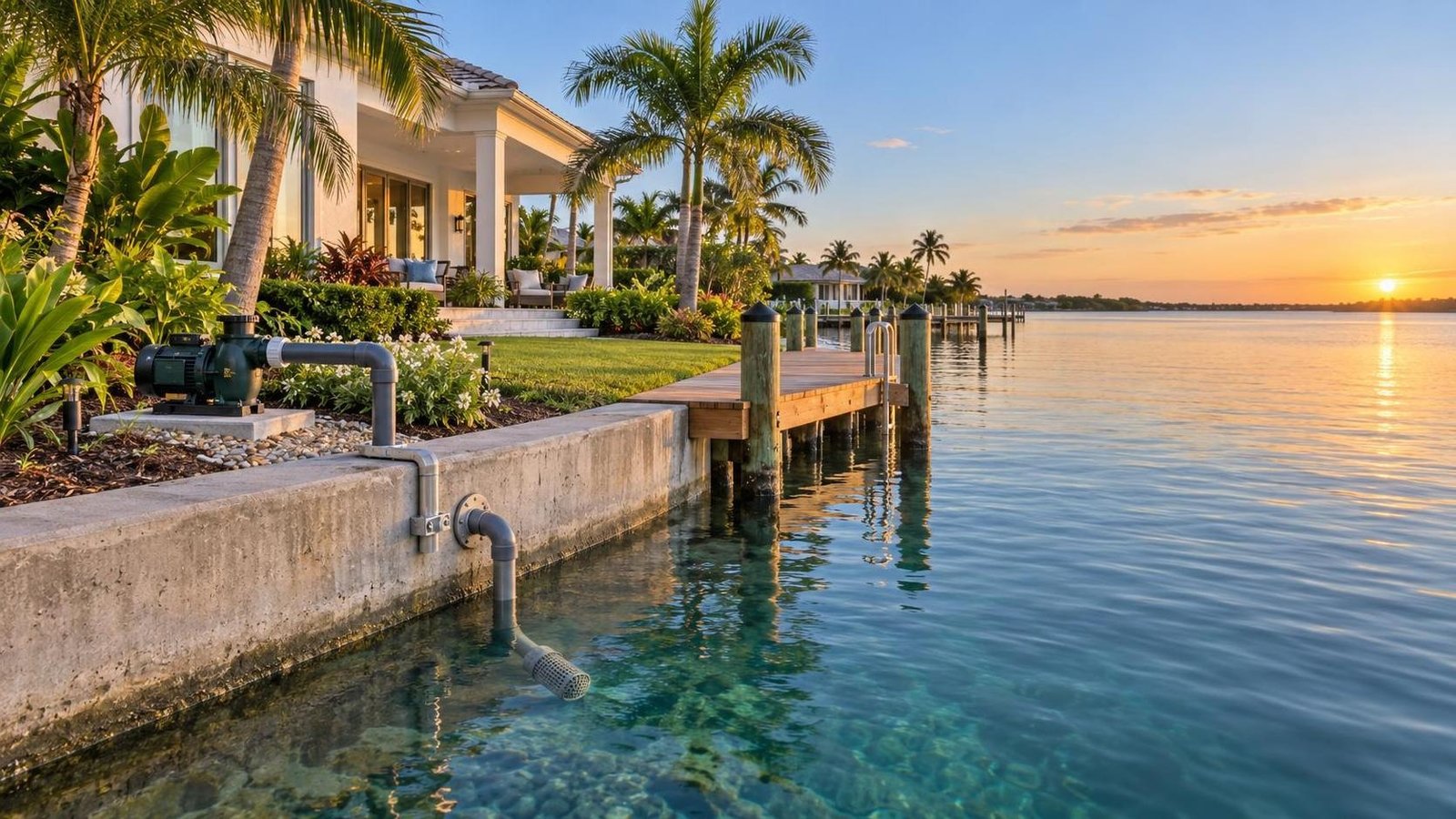
Irrigation-Pump Intake Through the Seawall: What Should Merritt Island Canal Buyers Verify?
By Carrie Liotta, Space Coast REALTOR® with REAL Broker | Published October 2, 2026
If an irrigation-pump intake passes through a Merritt Island seawall, verify what the line serves, its intake size, water-use status, seawall sleeve and seal, pump condition, electrical supply, cross-connection protection, low-water performance, and repair access. The pipe may be useful, but an unidentified penetration can turn a lawn feature into a waterfront liability.
I would not operate the pump from an unlabeled switch and call that due diligence. A marine contractor or engineer should evaluate the wall and penetration; the appropriate irrigation, plumbing, and electrical professionals should trace the system; and permit records should be compared with what is actually installed. The buyer needs one coherent answer from the canal intake to the last irrigation zone.
First prove that it is an irrigation intake
A pipe near the water does not identify itself. It may be a canal-water intake, an abandoned intake, a pool line, a dock washdown supply, a drainage outlet, a conduit sleeve, or a remnant from an older system. Fresh paint and a working sprinkler controller do not prove that the pipe through the wall feeds the lawn.
Start at both ends. At the canal, document the pipe location, outside diameter, end fitting, screen or strainer, supports, water depth, and distance from dock or lift activity. On land, trace the line to the pump, valves, filter, pressure tank if present, controller, and irrigation zones. Record the pump make, model, horsepower, voltage, and serial number. If the route disappears behind landscaping or decking, mark the unknown segment instead of guessing.
Ask the seller for installation invoices, service records, permits, seawall plans, irrigation diagrams, and repair photographs. A new-pump receipt does not establish that the intake or wall opening was approved, while a missing online record does not prove the opposite. Resolve the gap with the correct jurisdiction and professionals.
Treat the opening as part of the seawall
The visible pipe may be inexpensive. The hole through the wall is the more important ownership question. A seawall panel, joint, cap, tieback system, drainage path, and soil behind the wall work together. A drilled or enlarged opening can behave differently from a sleeve shown in the original design, especially if the pipe is rigidly attached, poorly sealed, repeatedly patched, or loaded by pump vibration.
I would ask the marine professional to identify whether the intake passes through a panel, joint, cap, return wall, or separate sleeve; whether there is cracking, rust staining, spalling, loose patch material, soil loss, wetness behind the wall, or movement around it; and whether the route conflicts with a tieback or drainage feature. The professional should also explain how the pipe can move, be serviced, or be removed without damaging the wall.
This is narrower than my guide to dock water and low-voltage conduit sharing one seawall sleeve. That article focuses on two outbound dock services. Here, the line is a withdrawal point exposed to canal debris, water-level changes, pump suction, and a different maintenance cycle.
A hedge, pool screen, deck, or paver field can block inspection and repair. Buyers facing a crowded wall zone should review how a pool-screen footer can overlap seawall tieback access. Waterfront systems cannot be evaluated one attractive feature at a time.
Inspect the intake where the canal is least forgiving
A pump that runs during a showing may still be unreliable. The screen can clog with vegetation or debris. A low intake can pull sediment. A high intake can lose prime when the water level drops. An unsupported pipe can move with boat wake or service activity. A line near a propeller, ladder, kayak launch, or lift cradle can become both a damage risk and an obstacle.
Ask the irrigation professional to evaluate low-water intake depth, the strainer, check valve, priming, suction leaks, filter, pump capacity, pressure, zone demand, and shutdown protection. Test every zone only after the intake route and electrical condition are understood; running a pump dry or energizing corroded equipment can create a new problem.
Note what reaches the lawn. Brackish canal water can affect plant selection, emitters, stains, filters, and maintenance differently from potable or reclaimed water. Do not promise water quality from appearance or a seller’s memory. If landscape performance matters, ask an irrigation professional what testing is useful and whether the existing plants and equipment are appropriate for the actual source.
Water-use authorization and wall authorization are separate questions
Florida water law makes an important distinction. Florida Statutes section 373.019 defines domestic use as individual household drinking, bathing, cooking, or sanitation; it says other uses are not domestic. That is why a buyer should not assume that the individual domestic-consumption exception automatically covers landscape irrigation from a canal.
As of October 2, 2026, St. Johns River Water Management District Rule 40C-2.041 requires an individual consumptive-use permit at listed thresholds, including a surface-water intake diameter or cumulative intake diameter of six inches or greater. The rule measures that diameter at the end of the pump intake. Intake size is therefore a legal and technical fact to document, not an estimate from the pipe visible above the seawall.
For uses below the individual-permit thresholds, Rule 40C-2.042 establishes a general permit by rule and includes residential landscape-irrigation conditions. During daylight saving time, the current rule generally assigns odd-numbered addresses Wednesday and Saturday and even-numbered addresses Thursday and Sunday, prohibits irrigation between 10 a.m. and 4 p.m., and limits application to three-quarters of an inch and one hour per zone per watering day, subject to the rule’s stated exceptions. Standard-time scheduling is generally one assigned day. Confirm the current rule, address, source, local restrictions, and exceptions rather than copying an old controller schedule.
The wall opening creates a second review. The Florida Department of Environmental Protection explains that Environmental Resource Permitting covers regulated alterations of surface-water flows and dredging or filling in wetlands and other surface waters, with DEP and water-management-district responsibilities divided by operating agreements and project type. That does not mean every small intake requires the same authorization. It means buyers should identify whether the installation was permitted, verified exempt, included in a larger waterfront approval, or never resolved.
Search more than one database. DEP’s guide to finding ERP and water-use permits says the shared portal generally reaches back to 2007 and excludes exempt projects. Start with the Brevard County permit search, then confirm jurisdiction and older-record custody. A blank result is not a professional opinion.
Keep canal water separate from drinking water and other systems
The irrigation route should be understandable without trial and error. Trace the pump discharge to the irrigation manifold and confirm whether there is any connection, bypass, hose bib, fill valve, or shared piping with the home’s potable supply, reclaimed-water piping, pool equipment, or dock plumbing. Labels and pipe color help, but the physical configuration and protective devices matter more than labels alone.
The official Florida Plumbing Code chapter on water supply and distribution is a starting point for water identification, backflow, and cross-connection concepts. A licensed plumber and the authority having jurisdiction should apply the correct code edition and provisions to the actual house. The buyer should not accept a closed valve or a note on the controller as permanent separation.
Have a licensed electrician evaluate the pump circuit, disconnect, controller, bonding or grounding questions within that professional’s scope, weather exposure, corrosion, splices, and any receptacle or extension-cord arrangement. Do not open a waterfront panel, reset a tripping breaker repeatedly, or stand in wet soil while testing equipment. An irrigation system is optional landscaping equipment until improvised wiring or cross-connected piping turns it into a safety or water-quality problem.
Build the cost estimate around access and failure, not pump price
A replacement pump may be the simplest line item. The larger cost can be tracing pipe, rebuilding the intake, correcting wiring, opening hardscape, obtaining authorization, repairing the wall penetration, or removing the system during seawall work. An online pump price excludes diagnosis and the waterfront interface.
Ask for a written scope that separates four possibilities:
- Service: cleaning the screen, correcting priming, replacing a valve or filter, and testing zones.
- Mechanical replacement: a pump or controller change with the existing intake and wall sleeve retained.
- Route correction: replacing or relocating the intake, supports, penetration, irrigation connection, or electrical supply.
- Removal: abandoning the canal-water system and professionally closing the wall opening while converting irrigation to another approved source.
Each scope should identify permits or agency confirmation, marine work, electrical and plumbing work, access, restoration, testing, disposal, and exclusions. If a seawall project is already likely, ask whether the intake should be integrated into that design or removed rather than repaired twice.
Put this cost beside the rest of the waterfront decision. My comparison of canal width, turning room, and seawall age for Merritt Island buyers explains why boating utility and major shoreline components usually matter more than a small equipment credit. A useful irrigation intake is a benefit only when the canal, wall, system, and records support it.
Use a controlled inspection sequence
I would begin with records and a dry visual review. Next, the marine professional evaluates the wall and access. The irrigation professional traces the equipment and determines whether operation is appropriate. The plumber and electrician address separation and power questions. Only then should the owner-authorized test run through each zone while someone watches the intake, wall penetration, pump pad, buried-route clues, valves, and sprinklers.
During the test, listen for cavitation, loss of prime, cycling, bearing noise, and pressure changes. Look for air, leaks, wet soil behind the wall, sleeve movement, clogged emitters, and weak zones. Recheck after shutdown because suction-side and pressurized leaks can present differently.
Finish with a simple diagram and photographs. Future owners and contractors should be able to identify the intake, pipe diameter, screen, wall sleeve, pump, disconnect, filter, valves, controller, zone lines, alternate-water connections, and shutoff procedure. Good documentation reduces the chance that a future repair crew cuts the wrong pipe or seals critical access behind a new deck.
My Merritt Island canal-buyer checklist
- Trace and label the system from the canal intake through every irrigation zone.
- Measure the intake at its end and verify the current water-use rule or permit status.
- Search county, DEP, water-management-district, and seller records as applicable.
- Have a qualified marine professional evaluate the penetration, wall condition, and repair access.
- Confirm screen position, low-water reliability, support, priming, filtration, pressure, and zone coverage.
- Verify physical separation from potable, reclaimed, pool, and dock-water systems.
- Have licensed professionals evaluate plumbing and electrical concerns within their scopes.
- Obtain a written service, correction, or removal scope before negotiating.
Bottom line
An irrigation intake through a Merritt Island seawall is not automatically a defect, and it should not be treated as a free utility without proof. The right answer combines water-use compliance, a sound and serviceable wall penetration, safe separation and power, reliable operation at real canal conditions, and a documented plan for repair or removal.
If you are comparing Merritt Island canal homes, reach out for a no-pressure conversation about Brevard County homes for sale. I can help you organize the marine, irrigation, plumbing, electrical, permit, and pricing questions before the inspection period closes. Join my private Facebook group, Moving to Brevard County Florida, for practical Space Coast guidance. Your next chapter starts here.
